Sea Moss for Skin and Collagen Support
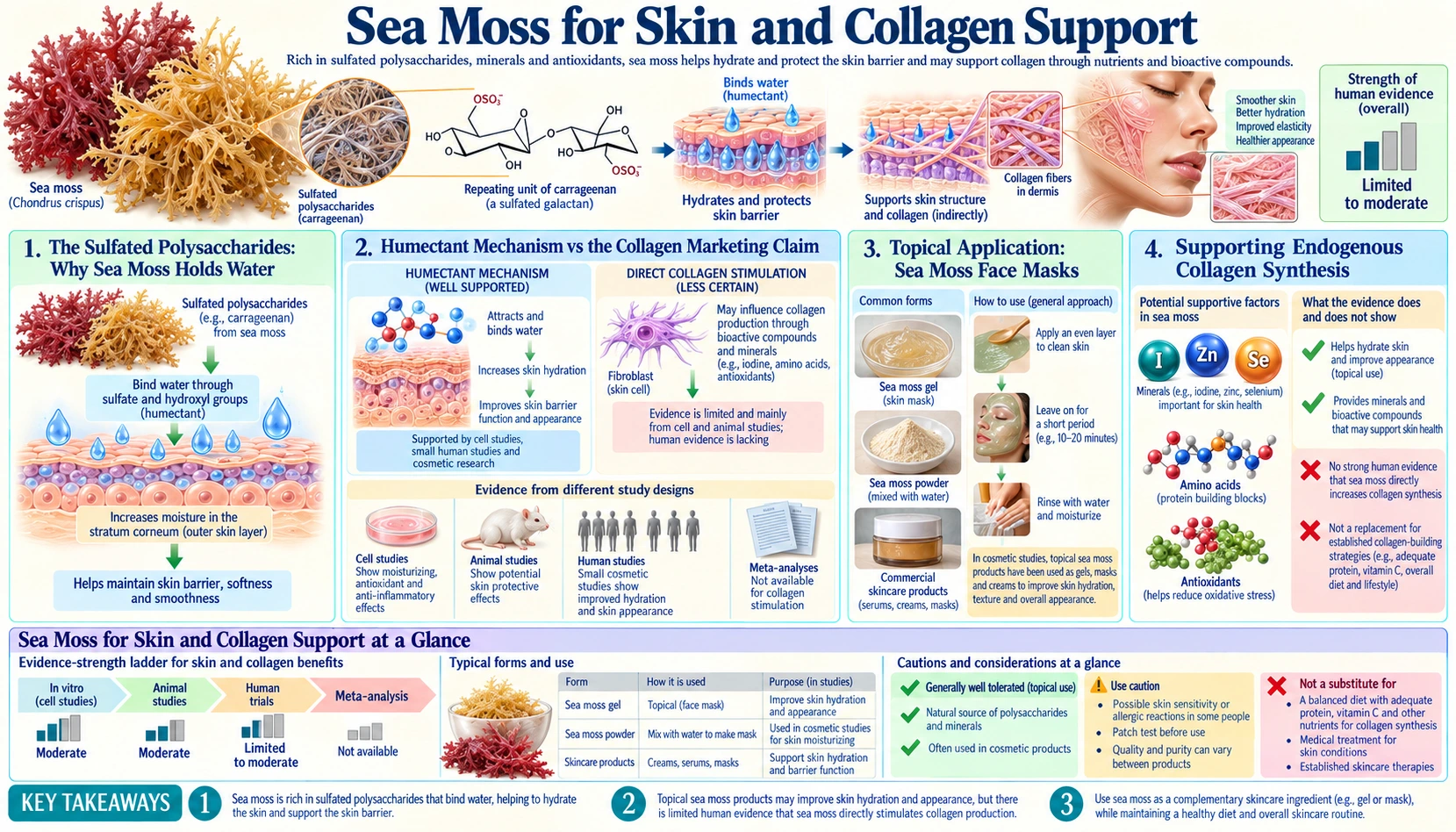
Sea moss is widely marketed as a collagen booster, an anti-aging skin food, and a natural alternative to hyaluronic acid serums. The underlying biochemistry is more nuanced than the marketing claims. Sea moss does not contain collagen — it is a seaweed, and seaweeds do not produce the glycine-proline-hydroxyproline triple helix that defines animal collagen. What sea moss does contain is a high concentration of sulfated polysaccharides (carrageenans) that bind water strongly, which is the basis for their use as gelling, thickening and skin-conditioning ingredients in cosmetics. It also contains minerals such as iron, zinc and copper, plus sulfur, that take part in the body's own collagen synthesis. No clinical trial has tested sea moss itself, eaten or applied to the skin, for skin or collagen outcomes. This page sets out the mechanism: what the chemistry suggests, what has and has not been studied, and how sea moss gel is used on the skin.
Table of Contents
- The Sulfated Polysaccharides: Why Sea Moss Holds Water
- Humectant Mechanism vs the Collagen Marketing Claim
- Topical Use: Sea Moss Gel Masks
- Supporting Endogenous Collagen Synthesis
- Silica, Zinc, and Sulfur Amino Acids
- Anti-Inflammatory Effects in Dermatology
- Eczema, Psoriasis, and Rosacea Applications
- UV Protection and Photoaging
- Sea Moss Alongside Vitamin C, Hyaluronic Acid and Collagen: What Is Known
- Cautions and Realistic Expectations
- Key Research Papers
- Connections
- Featured Videos
The Sulfated Polysaccharides: Why Sea Moss Holds Water
The dominant polysaccharides in Chondrus crispus are the carrageenans, a family of high-molecular-weight sulfated galactans built from alternating units of D-galactose and 3,6-anhydro-D-galactose. The galactose units carry sulfate ester groups, and the number and pattern of those sulfates define the three main carrageenan types:
- Kappa-carrageenan — one sulfate per galactose dimer; forms strong rigid gels in the presence of potassium ions. The classic "Irish moss pudding" gel.
- Iota-carrageenan — two sulfates per galactose dimer; forms softer, more elastic gels in the presence of calcium ions.
- Lambda-carrageenan — three sulfates per galactose dimer; does not form gels but produces viscous solutions, and is used as a thickener.
The sulfate groups give carrageenans a high negative charge density, which gives them a strong affinity for water and for positively charged ions including calcium, potassium, and magnesium. The combined effect is that a small amount of carrageenan polymer can hold a large volume of water as a gel. A review of carrageenan describes its commercial uses as gelling, thickening and stabilizing agents in food, pharmaceutical formulations and cosmetics.
Hyaluronic acid, the best-known cosmetic humectant, is also a water-binding polysaccharide, but a different one: it is a non-sulfated glycosaminoglycan made by the body. The comparison between the two is one of general chemistry; no study comparing sea moss gel with hyaluronic acid on human skin was found.
Humectant Mechanism vs the Collagen Marketing Claim
Popular sea moss marketing collapses two separate phenomena into one. The proposed skin mechanism is humectancy: water-binding polysaccharides on the skin surface hold water in the stratum corneum, the outermost layer of the epidermis, which in principle increases skin water content and gives a plumper appearance. This is the general mechanism of humectant ingredients; it has not been measured in a published trial of sea moss gel itself.
The language of "collagen support" describes something else. Collagen is a protein built from amino acids (primarily glycine, proline, hydroxyproline, and alanine) assembled into a triple-helix structure. It is produced by fibroblasts in the dermis, the layer below the epidermis, and it is the primary structural protein that gives skin its mechanical strength and resistance to wrinkling. A humectant layer on the skin surface holds water in the stratum corneum; it is not known to act on fibroblast collagen synthesis in the dermis.
The "sea moss collagen" claim likely persists because hydrated skin looks plumper and less wrinkled, an effect that can resemble collagen replenishment over short timescales. Any hydration effect from a humectant lasts only as long as the product stays on the skin; it is not a structural change.
Topical Use: Sea Moss Gel Masks
The most common topical use described in popular sources is a thin film of prepared gel applied to clean skin and left in place for 15 to 30 minutes before rinsing.
Home preparation, as popular guides commonly describe it:
- About 1 ounce (about 30 grams) of dried Chondrus crispus is rinsed in cool water to remove sand and surface salt
- It is soaked in water for 12 to 24 hours, during which it swells considerably
- It is drained and blended with about 1 cup of water to a smooth gel
- The gel is stored in the refrigerator; preparation guides commonly quote a keeping time of up to 3 weeks, a figure that has not been tested in published studies
- For a mask, a thin layer is applied, left 15 to 30 minutes, and rinsed off, often followed by a moisturizer
Some users also add the gel to moisturizers or hair conditioners. No published study has measured the skin effects of homemade sea moss gel, its microbial stability, or how often it is tolerated; the frequencies quoted in popular sources (often 2 to 3 masks per week) are user practice rather than research findings.
Supporting Endogenous Collagen Synthesis
If sea moss does not contain collagen and is not known to act directly on fibroblast collagen synthesis, the remaining question is whether it supplies nutrients the body uses to make its own collagen. It does contain several of those cofactors, but in amounts that USDA data put well below many other foods, and no study has tested sea moss as a source of them for skin.
For scale, USDA FoodData Central (FDC 168456, "Seaweed, irishmoss, raw", 81% water) lists per 100 g raw: 1.5 g protein, 8.9 mg iron, 1.95 mg zinc, 0.15 mg copper and 3 mg vitamin C. A typical serving of sea moss gel is a few grams of seaweed, so the amounts per serving are a small fraction of these.
Collagen synthesis in fibroblasts requires:
- Amino acid substrate — predominantly glycine and proline. Raw Irish moss is about 1.5% protein (about 8% of its dry weight, by the USDA figures). Bone broth, gelatin, and animal collagen sources provide much more concentrated glycine and proline.
- Vitamin C — required as a cofactor for prolyl-4-hydroxylase and lysyl hydroxylase, which add hydroxyl groups to proline and lysine residues during collagen post-translational modification. Without adequate vitamin C, the collagen triple helix is unstable. Sea moss has little vitamin C (3 mg per 100 g raw); foods like bell peppers, citrus, and acerola provide far more. See Vitamin C page.
- Iron — also required by the hydroxylases. Raw Irish moss lists 8.9 mg iron per 100 g; the iron is non-heme, and absorption of non-heme iron is generally improved by vitamin C eaten at the same time.
- Silicon — proposed to take part in collagen synthesis or stabilization; its exact biological role is still not clear (see the next section). No reliable figure for the silicon content of Chondrus crispus was found.
- Zinc — required for fibroblast function and for the matrix metalloproteinases that remodel collagen. Raw Irish moss lists 1.95 mg zinc per 100 g.
- Copper — required by lysyl oxidase for the cross-linking step that converts soluble tropocollagen into the insoluble mature collagen fiber. Sea moss contains trace copper (0.15 mg per 100 g raw).
- Sulfur amino acids (cysteine, methionine) — involved in disulfide bonds in the procollagen molecule and in the synthesis of glutathione. An analysis of 14 retail seaweeds found the highest sulfur content in Chondrus crispus.
The summary: sea moss supplies small amounts of several collagen-related nutrients, none of them uniquely. The nutrients themselves — protein, vitamin C, zinc, copper — are available from many foods, and oral hydrolyzed collagen has its own body of trials (see the section on combinations below).
Silica, Zinc, and Sulfur Amino Acids
Silicon is one of the lesser-known connective-tissue nutrients. A review by Jugdaohsingh describes accumulating evidence that dietary silicon is beneficial to bone and connective tissue, and lists collagen synthesis or stabilization among the proposed mechanisms, while noting that its exact biological role is still not clear. In the Framingham Offspring cohort, dietary silicon intake was positively associated with bone mineral density in men and premenopausal women. In the Aberdeen Prospective Osteoporosis Screening Study (3,198 women aged 50 to 62), silicon intake was associated with femoral neck bone mineral density only in women with adequate oestrogen (late premenopausal women and women on HRT).
Two small randomized, placebo-controlled trials of choline-stabilized orthosilicic acid (10 mg silicon per day) have reported effects on skin and hair. In 50 women with photodamaged facial skin, 20 weeks of supplementation reduced skin roughness, improved skin mechanical properties, and lowered self-rated hair and nail brittleness compared with placebo. In 48 women with fine hair, 9 months of supplementation reduced the loss of hair tensile strength and increased hair thickness compared with placebo. These trials used a concentrated silicon supplement, not sea moss.
In the Framingham cohorts, mean dietary silicon intake was 30 to 33 mg per day in men and 24 to 25 mg per day in women, and the major food sources were beer and bananas in men and bananas and string beans in women. No reliable measurement of how much silicon sea moss contributes was found.
Zinc is the other connective-tissue mineral often mentioned for sea moss. Zinc deficiency presents clinically with delayed wound healing, hair loss, taste disturbance, and immune compromise. The zinc content of sea moss is modest, and no study has used sea moss as a zinc source or measured how well zinc is absorbed from it. Zinc requirements are covered on the Zinc page.
Anti-Inflammatory Effects in Dermatology
A paradox surrounds carrageenan in inflammation research. In pharmacology, carrageenan-induced paw edema in rats is a classic standardized assay for testing anti-inflammatory drugs — researchers inject carrageenan under the skin to produce a reliable local inflammatory response, then test candidate compounds for their ability to reduce the swelling. In that animal model, isolated carrageenan injected into tissue is pro-inflammatory.
Gel applied to intact skin is a different exposure from an injection, and results from the injection model do not transfer directly to topical use. No controlled study of sea moss gel on inflamed human skin was found. Laboratory studies of extracts from Chondrus crispus and related red seaweeds report antioxidant activity in test-tube assays, which is one reason soothing effects are proposed; these are in-vitro findings, not clinical results.
Eczema, Psoriasis, and Rosacea Applications
Atopic dermatitis (eczema), psoriasis, and rosacea all involve impaired skin barrier function together with chronic inflammation. In eczema in particular, the skin's normal barrier — the stratum corneum lipid lamellae and the filaggrin-derived natural moisturizing factor — is functionally deficient, leading to increased transepidermal water loss and greater reactivity to external triggers.
Sea moss gel is promoted for all three conditions as a barrier-supporting humectant. The evidence is limited to user reports; no clinical trial or published case series of sea moss gel in eczema, psoriasis or rosacea was found. The proposed mechanism is that the gel forms a temporary film that reduces water loss while holding water in the stratum corneum.
For psoriasis, the rationale is weaker still. Psoriatic plaques are thick and hyperkeratotic, and a humectant alone is not expected to modify the underlying immune-driven hyperproliferation; at most it may soften scale.
For rosacea, the popular rationale is that a cool, simple product is less irritating than formulations containing alcohol, fragrance or exfoliating acids, which are common rosacea triggers. Whether sea moss gel itself affects flushing has not been studied.
Standard care for these conditions (topical steroids, calcineurin inhibitors, and biologics for severe disease) is based on clinical trials; sea moss has no such evidence and is described in popular sources as an add-on, not a replacement.
UV Protection and Photoaging
Red algae (Rhodophyta, which includes Chondrus crispus) produce small UV-absorbing molecules called mycosporine-like amino acids (MAAs) that act as natural sunscreens for the algae. Light-exposure experiments have shown that Chondrus crispus produces the MAA shinorine in response to UV-A and blue light, and an analysis of edible Canadian red seaweeds, including wild and cultivated C. crispus, identified several MAAs (palythine, asterina-330, shinorine and others) in their extracts. In the algae, MAAs help protect against the high UV exposure of intertidal life.
MAAs from algae are being researched as ingredients for sun-care products; a 2017 review describes their potential as sunscreens and anti-photoaging molecules. That research is largely at the laboratory stage. No sea moss product or homemade gel has a measured SPF, and the small amounts of MAAs in the whole seaweed are not a substitute for a tested sunscreen.
Antioxidant pigments in red algae (phycoerythrin, carotenoids) have been proposed to quench reactive oxygen species generated by UV exposure, the same secondary mechanism discussed for vitamin C, vitamin E, and polyphenols in photoaging skincare. For sea moss this remains a proposed mechanism; it has not been tested on human skin.
Sea Moss Alongside Vitamin C, Hyaluronic Acid and Collagen: What Is Known
Sea moss is often discussed together with other skincare ingredients. None of these combinations has been studied with sea moss; what is known about each partner on its own is summarized here.
- Topical vitamin C (L-ascorbic acid) — vitamin C is a collagen-synthesis cofactor, and a review of topical antioxidants covers its use against UV photodamage in skin. Whether a sea moss layer changes its stability or uptake has not been studied.
- Hyaluronic acid serum — hyaluronic acid and carrageenan are both water-binding polysaccharides, but hyaluronic acid is a non-sulfated glycosaminoglycan, while carrageenan is a sulfated galactan. No study has compared or combined them on skin.
- Niacinamide and zinc compounds — common barrier and anti-inflammatory ingredients in commercial skincare; their combination with sea moss gel is a home-formulation practice, not a studied one.
- Hydrolyzed collagen (oral) — the evidence here is mixed. Individual randomized trials reported improved skin elasticity with 2.5 or 5 g per day for 8 weeks (69 women) and improved skin hydration and dermal collagen density with daily collagen peptides over 8 to 12 weeks. Meta-analyses of 19 trials (2021) and 26 trials (2023) found improvements in hydration and elasticity versus placebo, with the 2023 analysis noting several biases in the included trials. A 2025 meta-analysis of 23 trials found that the benefit appeared in trials funded by pharmaceutical companies and in lower-quality trials; trials without such funding, and high-quality trials, showed no effect, and its authors concluded there is currently no clinical evidence to support collagen supplements for skin aging.
- Dietary vitamin C, vitamin E and carotenoids — antioxidants discussed for protecting skin from oxidative damage; sea moss is not a meaningful source of them compared with fruits and vegetables.
Cautions and Realistic Expectations
- Skin reactions — any new topical can cause irritation or allergic contact dermatitis in some people. No published reports specific to sea moss gel were found, and there is no published data on how often reactions occur.
- Bacterial growth in homemade gel — homemade sea moss gel is a water-rich, preservative-free gel, a type of product in which microbes can grow. Its shelf life has not been studied; the keeping times quoted in preparation guides are not tested figures.
- Realistic timeline — a humectant's hydrating effect lasts only while it remains on the skin. No study has measured longer-term effects of sea moss gel on skin elasticity, texture or dermal collagen.
- Eye area — the gel is not a product formulated or tested for use in the eye.
- Acne-prone skin — whether sea moss gel is comedogenic has not been studied; reports from users are mixed.
- Cosmetic safety review — a 2026 assessment by the Expert Panel for Cosmetic Ingredient Safety of 60 red-algae-derived cosmetic ingredients concluded that 16 are safe as currently used and that the data are insufficient for the other 44; it notes that arsenic, heavy metals and pesticides may be present as impurities.
- Eating sea moss: iodine and heavy metals — when sea moss is eaten rather than applied, its iodine and heavy-metal content matter. Iodine content of seaweeds varies by orders of magnitude between species; one study of retail Irish moss measured an average of 3.86 mg iodine per kg dry weight, and analyses of retail seaweeds have found arsenic, cadmium and lead. LactMed notes that maternal intake of excess iodine from seaweed has caused thyroid suppression in breastfed infants. The iodine question is covered on the Sea Moss for Thyroid page in this wing.
- Pregnancy and breastfeeding — there is no published safety data on topical sea moss gel in pregnancy or breastfeeding; for eating sea moss while breastfeeding, LactMed's entry advises against it unless iodine and heavy-metal levels have been shown to be low enough to be safe.
- Not a sunscreen — the MAA content of sea moss has not been shown to provide measurable sun protection, and no sea moss product has a tested SPF.
- Over-claiming products — products marketed as "sea moss collagen serum" that claim to deliver structural collagen describe a mechanism that sea moss chemistry does not support: seaweeds contain no collagen.
- Decisions — decisions about supplements and skin treatments belong with a clinician.
Key Research Papers
- Necas J, Bartosikova L (2013). Carrageenan: a review. Veterinarni Medicina 58(4):187-205. — doi:10.17221/6758-VETMED
- Wijesinghe WAJP, Jeon YJ (2012). Biological activities and potential industrial applications of fucose-rich sulfated polysaccharides and fucoidans isolated from brown seaweeds: a review. Carbohydrate Polymers 88(1):13-20. — doi:10.1016/j.carbpol.2011.12.029
- Pereira L (2018). Therapeutic and Nutritional Uses of Algae. CRC Press (book). — doi:10.1201/9781315152844
- Barel A, Calomme M, Timchenko A, et al. (2005). Effect of oral intake of choline-stabilized orthosilicic acid on skin, nails and hair in women with photodamaged skin. Archives of Dermatological Research 297(4):147-53. — PubMed PMID: 16205932
- Asserin J, Lati E, Shioya T, Prawitt J (2015). The effect of oral collagen peptide supplementation on skin moisture and the dermal collagen network: evidence from an ex vivo model and randomized, placebo-controlled clinical trials. Journal of Cosmetic Dermatology 14(4):291-301. — PubMed PMID: 26362110
- Lupo MP (2001). Antioxidants and vitamins in cosmetics. Clinics in Dermatology 19(4):467-73. — PubMed PMID: 11535390
- Chrapusta E, Kaminski A, Duchnik K, et al. (2017). Mycosporine-like amino acids: potential health and beauty ingredients. Marine Drugs 15(10):326. — PubMed PMID: 29065484
- Kim SK, Wijesekara I (2010). Development and biological activities of marine-derived bioactive peptides: a review. Journal of Functional Foods 2(1):1-9. — doi:10.1016/j.jff.2010.01.003
- Pillaiyar T, Manickam M, Namasivayam V (2017). Skin whitening agents: medicinal chemistry perspective of tyrosinase inhibitors. Journal of Enzyme Inhibition and Medicinal Chemistry 32(1):403-425. — PubMed PMID: 28097901
- Pinnell SR (2003). Cutaneous photodamage, oxidative stress, and topical antioxidant protection. Journal of the American Academy of Dermatology 48(1):1-19. — PubMed PMID: 12522365
- Jugdaohsingh R (2007). Silicon and bone health. Journal of Nutrition, Health & Aging 11(2):99-110. — PubMed PMID: 17435952
- Proksch E, Segger D, Degwert J, et al. (2014). Oral supplementation of specific collagen peptides has beneficial effects on human skin physiology: a double-blind, placebo-controlled study. Skin Pharmacology and Physiology 27(1):47-55. — PubMed PMID: 23949208
- Wickett RR, Kossmann E, Barel A, et al. (2007). Effect of oral intake of choline-stabilized orthosilicic acid on hair tensile strength and morphology in women with fine hair. Archives of Dermatological Research 299(10):499-505. — PubMed PMID: 17960402
- Jugdaohsingh R, Anderson SH, Tucker KL, et al. (2002). Dietary silicon intake and absorption. American Journal of Clinical Nutrition 75(5):887-93. — PubMed PMID: 11976163
- Jugdaohsingh R, Tucker KL, Qiao N, et al. (2004). Dietary silicon intake is positively associated with bone mineral density in men and premenopausal women of the Framingham Offspring cohort. Journal of Bone and Mineral Research 19(2):297-307. — PubMed PMID: 14969400
- Macdonald HM, Hardcastle AC, Jugdaohsingh R, et al. (2012). Dietary silicon interacts with oestrogen to influence bone health: evidence from the Aberdeen Prospective Osteoporosis Screening Study. Bone 50(3):681-7. — PubMed PMID: 22173054
- de Miranda RB, Weimer P, Rossi RC (2021). Effects of hydrolyzed collagen supplementation on skin aging: a systematic review and meta-analysis. International Journal of Dermatology 60(12):1449-1461. — PubMed PMID: 33742704
- Pu SY, Huang YL, Pu CM, et al. (2023). Effects of oral collagen for skin anti-aging: a systematic review and meta-analysis. Nutrients 15(9):2080. — PubMed PMID: 37432180
- Myung SK, Park Y (2025). Effects of collagen supplements on skin aging: a systematic review and meta-analysis of randomized controlled trials. American Journal of Medicine 138(9):1264-1277. — PubMed PMID: 40324552
- Kräbs G, Watanabe M, Wiencke C (2004). A monochromatic action spectrum for the photoinduction of the UV-absorbing mycosporine-like amino acid shinorine in the red alga Chondrus crispus. Photochemistry and Photobiology 79(6):515-9. — PubMed PMID: 15291302
- Athukorala Y, Trang S, Kwok C, Yuan YV (2016). Antiproliferative and antioxidant activities and mycosporine-like amino acid profiles of wild-harvested and cultivated edible Canadian marine red macroalgae. Molecules 21(1):E119. — PubMed PMID: 26805798
- Ferguson P, Bergfeld WF, Belsito DV, et al. (2026). Safety assessment of red algae-derived ingredients as used in cosmetics. International Journal of Toxicology (online ahead of print). — PubMed PMID: 42853009
- Darias-Rosales J, Rubio C, Gutiérrez AJ, et al. (2020). Risk assessment of iodine intake from the consumption of red seaweeds (Palmaria palmata and Chondrus crispus). Environmental Science and Pollution Research International 27(36):45737-45741. — PubMed PMID: 32803579
- Desideri D, Cantaluppi C, Ceccotto F, et al. (2016). Essential and toxic elements in seaweeds for human consumption. Journal of Toxicology and Environmental Health, Part A 79(3):112-22. — PubMed PMID: 26817952
- Drugs and Lactation Database (LactMed) (2006–, updated 2026). Sea Moss. National Institute of Child Health and Human Development. — PubMed PMID: 41730053