Sea Moss for Thyroid and Iodine Status
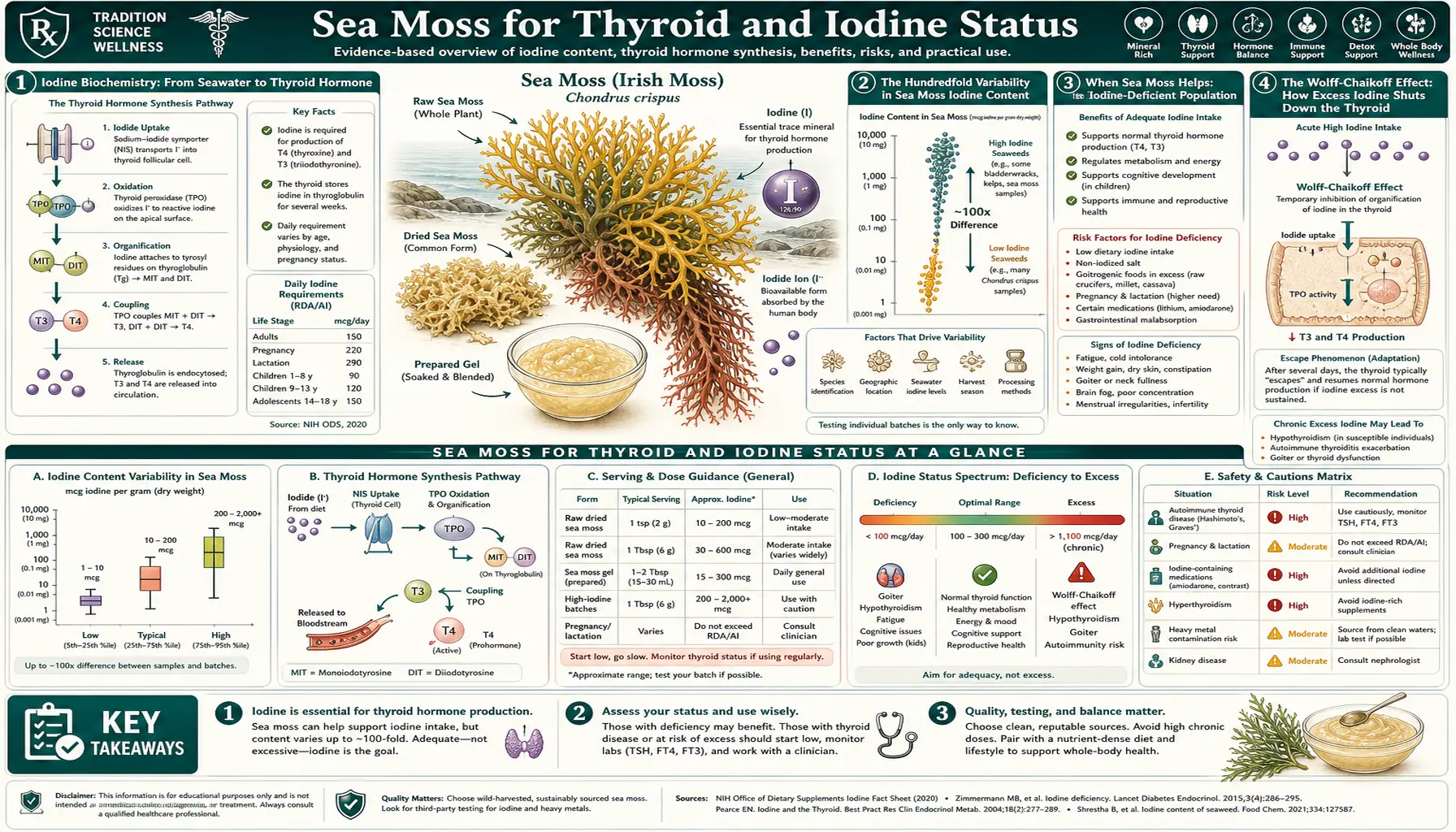
Seaweeds are among the richest natural food sources of iodine, and iodine is why sea moss matters to the thyroid in both directions. Iodine is the raw material for thyroid hormone, so people with low intake run short of it; yet excess iodine can cause hypothyroidism or hyperthyroidism in susceptible people — among them people with autoimmune thyroiditis (Hashimoto's), autonomous thyroid nodules, or Graves' disease. No clinical trial has tested sea moss itself for any thyroid outcome. This page walks through the iodine biochemistry, the wide variation in iodine content between seaweeds and between batches, the two autoregulation phenomena (Wolff-Chaikoff and Jod-Basedow) that make iodine both protective and harmful, what population studies show, and what is known about testing and serving size.
Table of Contents
- Iodine Biochemistry: From Seawater to Thyroid Hormone
- The Wide Variability in Seaweed Iodine Content
- Iodine Deficiency: Who Runs Short
- The Wolff-Chaikoff Effect: How Excess Iodine Shuts Down the Thyroid
- The Jod-Basedow Phenomenon: How Excess Iodine Causes Hyperthyroidism
- Hashimoto's Thyroiditis and Iodine Intake
- The Japanese Population Data: How Much Iodine Is Too Much?
- Thyroid and Iodine Tests
- Serving Size and Iodine Dose: What Is and Is Not Known
- Who the Research Raises Concerns For, and Interactions
- Key Research Papers
- Connections
- Featured Videos
Iodine Biochemistry: From Seawater to Thyroid Hormone
Iodine is the essential substrate for thyroid hormone synthesis. The thyroid gland concentrates iodide actively against a gradient — the sodium-iodide symporter (NIS, encoded by the SLC5A5 gene) on the basolateral membrane of thyroid follicular cells pumps iodide into the cell at concentrations many times higher than in the blood. Inside the follicle, thyroid peroxidase (TPO) oxidizes iodide and covalently attaches it to tyrosine residues on thyroglobulin to form mono- and di-iodotyrosine, which are then coupled to form T4 (thyroxine, four iodines) and T3 (triiodothyronine, three iodines).
The body contains roughly 15 to 20 milligrams of iodine in total, of which about 70% resides in the thyroid gland itself. The recommended dietary intake is 150 micrograms per day for adults, 220 micrograms per day in pregnancy, and 290 micrograms per day during lactation. The tolerable upper intake level (UL) set by the U.S. Institute of Medicine is 1,100 micrograms per day for adults. A 2014 review by Leung and Braverman describes intake above the 150-microgram recommendation as generally well tolerated, but notes that people with pre-existing thyroid disease, the elderly, fetuses and neonates, and patients with other risk factors face a higher risk of iodine-induced thyroid dysfunction.
Seaweeds enter this picture because they take up iodine from seawater, which holds roughly 60 micrograms per liter. Brown seaweeds, especially the kelps (Laminaria), are among the most iodine-rich foods measured; red seaweeds such as Chondrus crispus (Irish moss) have generally measured far lower. Iodine content varies with species, growing conditions, season and processing.
The Wide Variability in Seaweed Iodine Content
Teas and colleagues (2004, Thyroid) measured iodine in 12 species of commercially available edible seaweeds and found a range from 16 micrograms per gram in nori (Porphyra tenera) to more than 8,000 micrograms per gram in one sample of processed kelp granules made from Laminaria digitata. In two Namibian kelps, iodine was lowest in sun-bleached blades (about 514 micrograms per gram) and highest in freshly cut juvenile blades (about 6,571 micrograms per gram). Because iodine is water-soluble in cooking and may vaporize in humid storage, the authors noted that the iodine content of prepared seaweed foods is difficult to estimate, and that some seaweed dishes may exceed the 1,100-microgram upper level. Kelp is a brown seaweed and a different organism from the red seaweeds sold as sea moss, though the two are sometimes confused in commerce.
For true Irish moss (Chondrus crispus), a 2020 analysis of 30 retail samples of red seaweeds found an average of 3.86 ± 1.49 milligrams of iodine per kilogram dry weight (about 4 micrograms per gram) — the higher of the two species tested, but far below the kelp values above. On those figures, 4 grams a day of dried Irish moss supplied about a quarter of a child's recommended intake, and an adult would have to eat about 286 grams a day to exceed the 1,100-microgram upper level (Darias-Rosales 2020). Rehydration and boiling also release part of the iodine from C. crispus and other seaweeds (Correia 2021). Published iodine measurements for the warm-water Eucheuma, Kappaphycus and Gracilaria species sold as "sea moss" are sparse.
The iodine delivered by a given product is therefore unknown without batch-specific testing, and ingredient lists do not show iodine content — a point Pearce and colleagues (2004) made about common foods such as bread and milk.
Iodine Deficiency: Who Runs Short
Iodine deficiency is one of the most common preventable causes of intellectual disability worldwide, and WHO estimates have put the number of people with insufficient iodine intake at around two billion. In the United States, iodized salt (introduced in 1924) largely eliminated endemic goiter, but several trends are often cited as lowering iodine intake in some groups:
- In the U.S. national survey (NHANES) for 2005–2008, pregnant women had a median urinary iodine concentration of 125 micrograms per liter, below the WHO adequacy range for pregnancy of 150 to 249 micrograms per liter, and 56.9% of them were below 150 (Caldwell 2011)
- Decreased use of iodized table salt (sea salt, kosher salt, and Himalayan pink salt are typically not iodized)
- Decreased use of iodophor sanitizers in commercial dairy processing (formerly an unintentional dietary iodine source)
- Increased consumption of processed foods made with non-iodized salt
- Vegan and plant-based diets that omit the iodine-rich foods (dairy, eggs, fish, seaweed)
These are the groups for whom an additional dietary iodine source could, in principle, raise intake. No trial has measured the effect of sea moss on iodine status or thyroid function, and the iodine a product delivers depends on species and batch (see above). Signs associated with hypothyroidism include fatigue, cold intolerance, mild weight gain, and dry skin; subclinical hypothyroidism is commonly defined as a TSH of about 4.5 to 10 mIU/L with a normal free T4. Urinary iodine (a spot urine sample, interpreted against population medians) is the standard measure of iodine status.
The broader clinical picture is covered on the hypothyroidism page.
The Wolff-Chaikoff Effect: How Excess Iodine Shuts Down the Thyroid
The Wolff-Chaikoff effect, described by Jan Wolff and Israel Chaikoff in 1948, is the paradoxical observation that large doses of iodide suppress thyroid hormone synthesis. When large quantities of iodide reach the thyroid, organification — the attachment of iodine to thyroglobulin by thyroid peroxidase — is acutely inhibited, by a mechanism still not fully understood. Markou and colleagues (2001) describe it as an effective way for the gland to reject large quantities of iodide and avoid making excessive amounts of hormone.
In a normal thyroid the acute effect lasts a few days. The gland then "escapes": the sodium-iodide symporter is downregulated, intrathyroidal iodide falls, and normal T4 and T3 synthesis returns (Markou 2001). This escape is why most people tolerate iodine intakes well above the recommended amount.
In susceptible thyroids the escape fails and clinical or subclinical hypothyroidism follows. Markou and colleagues list a few apparently normal individuals, fetuses and newborns, some patients with chronic systemic diseases, euthyroid patients with autoimmune thyroiditis (Hashimoto's), Graves' disease patients previously treated with radioactive iodine, surgery or antithyroid drugs, people with a history of postpartum or subacute thyroiditis, and patients who developed thyroid dysfunction on interferon-alpha. This is the mechanism usually invoked for seaweed-associated hypothyroidism; a PubMed search in October 2026 found no published case report specific to sea moss.
The Jod-Basedow Phenomenon: How Excess Iodine Causes Hyperthyroidism
The Jod-Basedow phenomenon is the mirror image of Wolff-Chaikoff — iodine-induced hyperthyroidism. A 1998 review by Stanbury and colleagues found that iodine in almost any chemical form can induce an episode of thyrotoxicosis, and that the usual biological basis is autonomously functioning thyroid tissue arising from mutational events in thyroid cells, often within nodules. When enough autonomous tissue is present and iodine supply increases, hormone production rises without normal feedback control. The same review notes that iodine-induced hyperthyroidism can also occur in people whose Graves' disease had not been expressed because of iodine deficiency. The result is thyrotoxicosis — rapid heart rate, weight loss, tremor, anxiety, and heat intolerance.
Stanbury and colleagues found iodine-induced hyperthyroidism most commonly in older people with long-standing nodular goiter and in regions of chronic iodine deficiency, typically after a rise in iodine intake during iodine-prophylaxis programs or after iodine-containing drugs such as radiocontrast media or amiodarone. Supplements can do the same: Eliason (1998) reported transient hyperthyroidism in a patient taking dietary supplements containing kelp.
The research raises the strongest concern here for people with known autonomous nodules, multinodular goiter, Graves' disease, or a past history of hyperthyroidism. Stanbury and colleagues note that the risks of iodine-induced hyperthyroidism fall principally on the elderly, who may have heart disease.
Hashimoto's Thyroiditis and Iodine Intake
Hashimoto's thyroiditis is an autoimmune disease, more common in women, in which antibodies against thyroid peroxidase (TPO) and thyroglobulin accompany an immune attack on the thyroid gland. Several lines of research link higher iodine intake with thyroid autoimmunity:
- In China, a five-year follow-up of 3,018 people in regions with mildly deficient, more than adequate, and excessive iodine intake found that the cumulative incidence of subclinical hypothyroidism (0.2%, 2.6%, and 2.9%) and of autoimmune thyroiditis (0.2%, 1.0%, and 1.3%) rose with intake; among people with thyroid antibodies at baseline, a raised TSH developed more often at the higher intakes (Teng 2006)
- In Denmark, the share of the population with TPO antibodies above 30 U/ml rose from 14.3% to 23.8% four to five years after mandatory salt iodization, which had raised median urinary iodine only from 61 to 101 micrograms per liter; the increase was most pronounced in young women (Pedersen 2011)
- Euthyroid patients with autoimmune thyroiditis are among those whose thyroid fails to escape from the Wolff-Chaikoff effect, so that large iodide doses can produce clinical or subclinical hypothyroidism (Markou 2001)
- Laboratory work found that iodination changes the shape of thyroglobulin, so that some antibody-binding sites are lost and new ones appear (Saboori 1998); that T cells from people with chronic lymphocytic thyroiditis proliferated in response to iodinated but not non-iodinated thyroglobulin; and that adding iodine to drinking water increased the prevalence and severity of thyroiditis in a susceptible mouse strain (Rose 1999)
Leung and Braverman (2014) list people with pre-existing thyroid disease among those at increased risk of iodine-induced thyroid dysfunction. No trial has tested sea moss in people with Hashimoto's, and its variable iodine content is the reason the research raises a concern for this group. The Hashimoto's Thyroiditis page covers the condition in more depth.
The Japanese Population Data: How Much Iodine Is Too Much?
Japan is the most frequently discussed example of chronic high iodine intake, largely from kelp (kombu) used in dashi broth, wakame in soups and salads, and nori in sushi. What the research reports:
- Combining dietary records, food surveys, urine iodine measurements, and seaweed iodine content, Zava and Zava (2011) estimated that Japanese iodine intake averages 1,000 to 3,000 micrograms per day. They noted that researchers frequently overestimate or underestimate this figure, which has led to misleading diet and supplementation recommendations for people trying to copy the Japanese diet.
- In 1,061 adults in five coastal kelp-producing areas of Japan, the prevalence of hypothyroidism (TSH above 5.0 mU/L) varied from 0 to 9.7%, and among people without thyroid antibodies it was 12.1% in those with high urinary iodide versus 2.3% in those with normal levels. The authors concluded that excessive iodine intake should be considered a cause of hypothyroidism in these areas (Konno 1994).
- Fifteen Japanese newborns with raised TSH were traced to excess iodine eaten by their mothers during pregnancy — kombu, other seaweeds, and instant kombu soups, estimated at roughly 820 to 3,200 micrograms per day. Twelve of the 15 needed levothyroxine, and the authors proposed that the condition may not always be transient (Nishiyama 2004).
Taken together: iodine intake above the recommended level is generally well tolerated by healthy adults (Leung and Braverman 2014), but very high habitual intake is associated with hypothyroidism in some adults and in infants exposed before birth (Konno 1994; Nishiyama 2004), and a rise in intake in people with long-standing nodular goiter can trigger hyperthyroidism (Stanbury 1998).
Thyroid and Iodine Tests
These are the standard laboratory measures used to assess thyroid function and iodine status:
- TSH — the most sensitive single marker of thyroid function. A raised TSH points toward hypothyroidism and a suppressed TSH toward hyperthyroidism; many laboratories place the upper reference limit around 4.5 mIU/L.
- Free T4 and Free T3 — especially if TSH is abnormal, these characterize the hormone production rate independent of binding protein variation.
- TPO antibody and thyroglobulin antibody — these detect underlying thyroid autoimmunity. Because euthyroid people with autoimmune thyroiditis are among those who fail to escape the Wolff-Chaikoff effect (Markou 2001), antibody status bears directly on iodine-related risk. The thyroid panel page covers these tests.
- Urinary iodine concentration (UIC) — a spot urine test, interpreted against WHO population cut-offs (a median below 100 micrograms per liter indicates insufficient intake, 100 to 199 is adequate for non-pregnant adults, and 150 to 249 is adequate in pregnancy). It is the standard measure of iodine status.
- Selenium status (if available) — selenium is a component of the deiodinase enzymes that convert T4 to active T3, and has been proposed, largely on the basis of animal research, to protect against iodine-induced thyroid damage.
Markou and colleagues (2001) report that iodine-induced hypothyroidism usually resolves within 2 to 3 weeks of withdrawing the iodine source, though some patients need temporary T4 replacement, and that many of those affected go on to develop permanent primary hypothyroidism, so long-term follow-up is part of the published picture.
Serving Size and Iodine Dose: What Is and Is Not Known
No clinical trial has established a dose of sea moss for any thyroid outcome, and no official body sets a sea moss serving size. What the evidence does show:
- Iodine per serving — depends on species, origin, batch, and preparation. At the Irish moss average measured by Darias-Rosales (about 4 micrograms per gram dry weight), a few grams of dried Irish moss supply a modest share of daily iodine; at the highest kelp value measured by Teas (over 8,000 micrograms per gram), a single gram exceeds the 1,100-microgram upper level.
- Form — gels, capsules, and powders made from different species or origins cannot be assumed to deliver the same iodine, and the ingredient list does not show the iodine content.
- Timing relative to levothyroxine — levothyroxine absorption is reduced by mineral products such as calcium and iron supplements, and separating levothyroxine from them by about 4 hours is commonly cited guidance. Whether sea moss itself affects levothyroxine absorption has not been studied.
- Selenium — selenium is a cofactor for the deiodinase enzymes; its role in thyroid function is covered on its own page.
- Iron and zinc — like selenium, these trace minerals are involved in thyroid hormone synthesis and metabolism.
Decisions about supplements alongside thyroid conditions or medicines belong with a clinician.
Who the Research Raises Concerns For, and Interactions
- Hashimoto's thyroiditis — euthyroid people with autoimmune thyroiditis can fail to escape the Wolff-Chaikoff effect and develop hypothyroidism on large iodide doses (Markou 2001), and population iodization has been followed by more thyroid antibodies (Pedersen 2011)
- Graves' disease and toxic nodular goiter — iodine-induced hyperthyroidism occurs mainly in people with nodular goiter and autonomous thyroid tissue, and in those whose Graves' disease has not yet been expressed (Stanbury 1998)
- Pregnancy and lactation — iodine requirements rise to 220 mcg/day (pregnancy) and 290 mcg/day (lactation). Japanese newborns whose mothers ate large amounts of kombu and other seaweeds during pregnancy had raised TSH, and most needed levothyroxine (Nishiyama 2004). The LactMed drugs-and-lactation database (U.S. National Institute of Child Health and Human Development) states that no medicinal value of sea moss has been proven, that maternal consumption of excess iodine from seaweed has caused thyroid suppression in breastfed infants, and that sea moss should be avoided during breastfeeding unless its iodine and heavy-metal levels have been shown to be low enough to be safe.
- Levothyroxine, methimazole, propylthiouracil — the dosing of all thyroid medications depends on thyroid status, which iodine intake can shift; questions about combining sea moss with them are for the prescribing clinician
- Amiodarone, lithium, interferon — amiodarone is an iodine-containing drug and a recognized trigger of iodine-induced hyperthyroidism (Stanbury 1998); patients who developed thyroid dysfunction on interferon-alpha are among those prone to iodide-induced hypothyroidism (Markou 2001); lithium is known to disrupt thyroid function, so these medicines add to the iodine-related risk
- Radioactive iodine therapy — preparation for radioactive iodine ablation or a whole-body scan commonly includes stopping iodine-containing supplements, including seaweed products, beforehand, often with a low-iodine diet
- Children — there is no safety data on sea moss in children; their iodine requirements are lower, and Leung and Braverman (2014) list fetuses and neonates among the groups most susceptible to iodine-induced thyroid dysfunction
- Heavy metal contamination — LactMed notes that sea moss can contain arsenic, lead, cadmium, and mercury from the water where it grew; in 14 retail seaweeds, total arsenic reached 67.6, cadmium 7.2, and lead 6.7 mg/kg dry weight, levels the authors judged not to threaten consumers but recommended be controlled (Desideri 2016). Cumulative exposure rises with the amount eaten.
Key Research Papers
- Wolff J, Chaikoff IL (1948). Plasma inorganic iodide as a homeostatic regulator of thyroid function. Journal of Biological Chemistry 174(2):555-64. — PubMed PMID: 18865621
- Teas J et al. (2004). Variability of iodine content in common commercially available edible seaweeds. Thyroid 14(10):836-41. — PubMed PMID: 15588380
- Zava TT, Zava DT (2011). Assessment of Japanese iodine intake based on seaweed consumption in Japan: a literature-based analysis. Thyroid Research 4:14. — PubMed PMID: 21975053
- Markou K et al. (2001). Iodine-induced hypothyroidism. Thyroid 11(5):501-10. — PubMed PMID: 11396709
- Stanbury JB et al. (1998). Iodine-induced hyperthyroidism: occurrence and epidemiology. Thyroid 8(1):83-100. — PubMed PMID: 9492158
- Teng W et al. (2006). Effect of iodine intake on thyroid diseases in China. NEJM 354(26):2783-93. — PubMed PMID: 16807415
- Pedersen IB et al. (2011). A cautious iodization programme bringing iodine intake to a low recommended level is associated with an increase in the prevalence of thyroid autoantibodies in the population. Clinical Endocrinology 75(1):120-6. — PubMed PMID: 21521277
- Eliason BC (1998). Transient hyperthyroidism in a patient taking dietary supplements containing kelp. Journal of the American Board of Family Practice 11(6):478-80. — PubMed PMID: 9876004
- Konno N et al. (1994). Association between dietary iodine intake and prevalence of subclinical hypothyroidism in the coastal regions of Japan. Journal of Clinical Endocrinology and Metabolism 78(2):393-7. — PubMed PMID: 8106628
- Leung AM, Braverman LE (2014). Consequences of excess iodine. Nature Reviews Endocrinology 10(3):136-42. — PubMed PMID: 24342882
- Pearce EN et al. (2004). Sources of dietary iodine: bread, cows' milk, and infant formula in the Boston area. Journal of Clinical Endocrinology and Metabolism 89(7):3421-4. — PubMed PMID: 15240625
- Toft AD, Beckett GJ (2003). Thyroid function tests and hypothyroidism. BMJ 326(7384):295-6. — PubMed PMID: 12574021
- Darias-Rosales J, Rubio C, Gutiérrez ÁJ, Paz S, Hardisson A (2020). Risk assessment of iodine intake from the consumption of red seaweeds (Palmaria palmata and Chondrus crispus). Environmental Science and Pollution Research International 27(36):45737-45741. — PubMed PMID: 32803579
- Correia H et al. (2021). Seaweeds rehydration and boiling: impact on iodine, sodium, potassium, selenium, and total arsenic contents and health benefits for consumption. Food and Chemical Toxicology 155:112385. — PubMed PMID: 34237393
- Caldwell KL, Makhmudov A, Ely E, Jones RL, Wang RY (2011). Iodine status of the U.S. population, National Health and Nutrition Examination Survey, 2005–2006 and 2007–2008. Thyroid 21(4):419-27. — PubMed PMID: 21323596
- Nishiyama S et al. (2004). Transient hypothyroidism or persistent hyperthyrotropinemia in neonates born to mothers with excessive iodine intake. Thyroid 14(12):1077-83. — PubMed PMID: 15650362
- Saboori AM, Rose NR, Bresler HS, Vladut-Talor M, Burek CL (1998). Iodination of human thyroglobulin (Tg) alters its immunoreactivity. I. Iodination alters multiple epitopes of human Tg. Clinical and Experimental Immunology 113(2):297-302. — PubMed PMID: 9717981
- Rose NR, Rasooly L, Saboori AM, Burek CL (1999). Linking iodine with autoimmune thyroiditis. Environmental Health Perspectives 107 Suppl 5:749-52. — PubMed PMID: 10502541
- Desideri D et al. (2016). Essential and toxic elements in seaweeds for human consumption. Journal of Toxicology and Environmental Health, Part A 79(3):112-22. — PubMed PMID: 26817952
- Drugs and Lactation Database (LactMed). Sea Moss. Bethesda (MD): National Institute of Child Health and Human Development; updated 2026. — PubMed PMID: 41730053