Sea Moss: History and Discovery
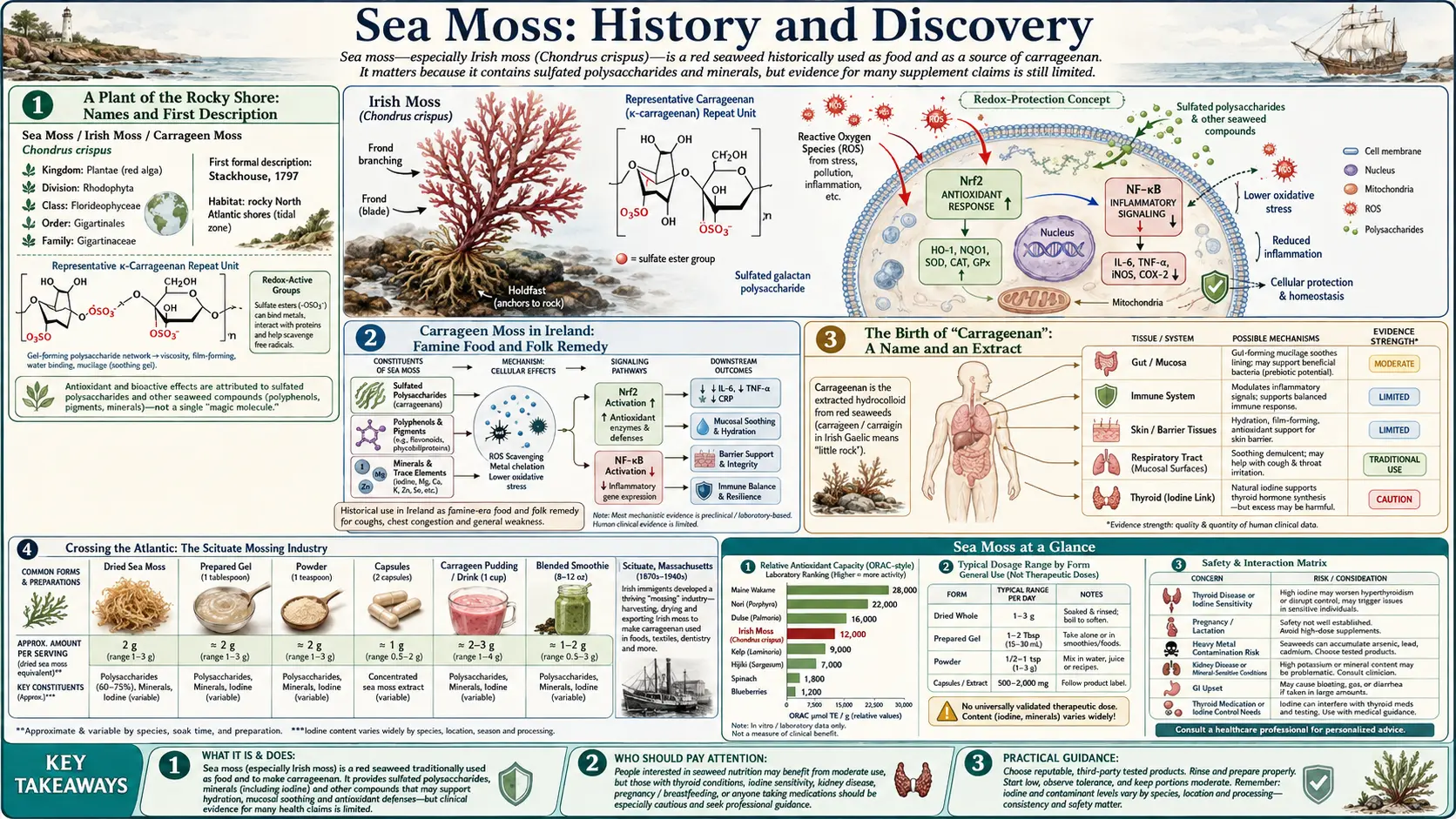
The seaweed now sold as sea moss has a reasonably well-documented history, although much of what circulates online about it is half-legend. The plant itself, Chondrus crispus, grew on the rocky Atlantic shores of Ireland and New England long before anyone wrote it down, but parts of the written record are firm: the year it received its scientific name, its use as a food in Ireland, the Irish immigrant credited with starting an American harvesting industry, the wartime shortage that made its gelling extract big business, and a recent wave of popularity driven by alkaline-diet promotion and social media. This article sets out what the historical record supports and marks the places where popular tellings go beyond the evidence.
Table of Contents
- A Plant of the Rocky Shore: Names and First Description
- Carrageen Moss in Ireland: Famine Food and Folk Remedy
- The Birth of “Carrageenan”: A Name and an Extract
- Crossing the Atlantic: The Scituate Mossing Industry
- War, Agar, and the Rise of an Industry
- From Sea Moss to Science: Carrageenan in the Laboratory
- The Modern Revival: Alkaline-Diet Promotion and Social Media
- What the History Does and Does Not Tell Us
- Key Research Papers
- Connections
- Featured Videos
A Plant of the Rocky Shore: Names and First Description
The first thing to understand about sea moss is that it is not a moss at all. The plant sold under that name — and under the older name Irish moss — is a red seaweed, a marine alga in the phylum Rhodophyta. Its scientific name is Chondrus crispus, and the most common species had been gathered from the shore for food and folk medicine for a very long time before any naturalist gave it a Latin name. People used the plant first; the science came later.
That naming happened in stages, and the record here is firm. The seaweed first appeared in botanical works under the broad, catch-all genus Fucus; Linnaeus called it Fucus crispus in 1767. The decisive step came in 1797, when the English botanist John Stackhouse, in Nereis Britannica (a survey of the seaweeds of the British Isles), separated certain species out of Fucus and proposed a new genus, Chondrus, with Chondrus crispus as its first species. That name is still the accepted one today. It also settled a naming problem: Linnaeus's 1767 Fucus crispus was an illegitimate later homonym, because William Hudson had already used the name Fucus crispus in 1762 for a different seaweed (now placed in the genus Phyllophora), so Chondrus crispus Stackhouse became the legitimate name for Irish moss. The nomenclature is recorded in the AlgaeBase taxonomic database and in the FAO fisheries synopsis on the species.
The names themselves carry the plant's story. The genus name Chondrus comes from the ancient Greek chondros, meaning “cartilage,” a nod to the tough, springy feel of the fresh fronds. The species name crispus is Latin for “curled,” describing the way the flat, fan-shaped fronds fork and ruffle. The everyday name carrageen (and the industrial word carrageenan built from it) is usually traced to the Irish carraigín, from carraig, “rock”; whether the name came into English from that word directly or by way of an Irish place name has been debated in the ethnobotanical literature (Mitchell and Guiry, 1983). The last of these names went on to label a widely used food additive.
Carrageen Moss in Ireland: Famine Food and Folk Remedy
The best-known early tradition of using Chondrus crispus grew up along the Atlantic coast of Ireland, which is how it earned the English name “Irish moss.” Coastal families gathered it at low tide, dried and bleached it in the sun, and used it both as food and as a household remedy. Its most prized property was easy to see: when the dried weed is simmered in milk or water and then cooled, it sets into a soft jelly. That made it a natural thickener long before anyone knew why it worked — the basis of the traditional carrageen moss pudding or blancmange still made in Ireland, and a traditional way of clarifying beer.
The plant's other traditional use was as a soothing remedy for coughs, sore throats, and chest complaints; the same gel that thickened a pudding was taken as a demulcent drink to coat an irritated throat. These are traditional uses, recorded in folk practice and older herbal literature, not findings from clinical trials.
Sea moss is bound up most famously with the Great Irish Famine, which began in 1845, when repeated failures of the potato crop brought mass starvation. Accounts of the period describe coastal families turning to what the sea would give, with Chondrus crispus boiled into soups, porridges, and jellies that stretched scarce food. Carrageen was eaten in Ireland before the famine, so the famine did not introduce it; rather, it fixed the seaweed in Irish memory as a food of hard times. That association is part of why the plant travelled, as the following sections describe.
The Birth of “Carrageenan”: A Name and an Extract
The story of sea moss as a substance — as opposed to a whole seaweed — is the story of carrageenan, the family of sulfated polysaccharides that give the plant its gelling power. Carrageenan is not a single chemical but a group of closely related long-chain carbohydrates (the main types are now labelled kappa, iota, and lambda). It is the reason a spoonful of dried sea moss can set a bowl of liquid into jelly.
The early dates in this part of the story are less firm than popular accounts suggest. Dates often repeated online — an extract “first described” in Ireland around 1810, the word “carrageen” appearing in 1829, and a derivation from a named headland in County Donegal — could not be confirmed against a verifiable source for this page, and the place-name derivation itself is disputed (Mitchell and Guiry, 1983). What is clear is that “carrageen” was the Irish-derived name for the seaweed, and that over time the suffix “-an” was attached to give carrageenan, the name now used for the purified extract rather than the whole weed.
The gelling property was recognised through long household use rather than in a single laboratory “discovery” of a pure molecule by a named chemist on a known day. Carrageenan was not invented; it was a property of a familiar seaweed that was gradually recognised, named, and eventually purified. The detailed chemistry — working out that carrageenan is a mixture of distinct sulfated galactans — came much later, in the twentieth century, and is taken up further down this page.
Crossing the Atlantic: The Scituate Mossing Industry
The same red seaweed grows on the other side of the North Atlantic, along the rocky coasts of Atlantic Canada and New England, and that is where Irish moss became an industry. The pivotal figure in the local history is Daniel Ward, an Irish immigrant fisherman in Massachusetts. Around 1847, according to the Scituate account published by Smithsonian magazine in 2019, Ward recognised the familiar carrageen growing in the waters off Scituate, a coastal town south of Boston — the seaweed harvested back in Ireland for pudding and for clarifying beer. He turned from fishing to gathering it, and with his friend and partner Miles O'Brien started what became the American Irish-moss, or “mossing,” trade.
The timing was no accident. The famine was driving Irish emigrants to New England, and Irish families moved to Scituate to work in the trade. The town's Irish character has lasted: in the 2010 census, nearly half of its residents reported Irish ancestry, earning it the nickname the “Irish Riviera.” Mossers worked the offshore rocks from small dories, prying the weed loose with long-handled rakes around low tide, then drying it on the beaches before selling it on. Because the work was seasonal, mossers could also serve in winter as “surfmen” in the U.S. Life-Saving Service along that wreck-prone coast. The Scituate mossing industry persisted, in declining form, through most of the twentieth century and ended in the late 1990s.
The broad outline — an Irish immigrant starting the Scituate mossing trade in the 1840s — is recorded in local Massachusetts history, including the Scituate Historical Society's own publications. The single year “1847” is given as an approximate date (“around 1847”), and details of the partnership vary a little from telling to telling.
War, Agar, and the Rise of an Industry
For decades the New England moss trade was a modest, regional business. What turned carrageenan into a global commodity was the Second World War. Before the war, food processing relied heavily on agar, another seaweed gelling agent, much of it from Japan. According to the FAO's guide to the seaweed industry (McHugh, 2003), Chondrus crispus came to prominence during the war, when access to Japanese agar stopped, and research during the war showed that carrageenan could substitute for agar. Production climbed steeply: Canadian Irish-moss output rose from about 261,000 pounds (dry weight) in 1941 to over 2 million pounds by 1942, according to the 2019 Smithsonian account.
Demand did not fade with the war. As processed food grew, carrageenan became a common food-industry ingredient — used to thicken, stabilise, and gel dairy products, processed meats, plant milks, toothpaste, and many other goods. Atlantic Canada was for a time the main source of the raw seaweed: the FAO fisheries synopsis on Chondrus crispus states that until 1975 Canada produced up to 75% of the western world's raw material for carrageenan, a share that later fell as farming of the warm-water seaweed Eucheuma grew in the Philippines.
Two strands of sea moss's modern story diverge at this point, and it helps to keep them apart. One strand is industrial carrageenan, the purified, regulated food additive extracted from Chondrus crispus and several related tropical seaweeds. The other is whole sea moss, the dried weed or home-made gel eaten as a food and supplement. They come from the same family of seaweeds and share the same gelling chemistry, but they are not the same product — a distinction worth remembering whenever “sea moss” and “carrageenan” are discussed together.
From Sea Moss to Science: Carrageenan in the Laboratory
Once carrageenan mattered commercially, scientists set about understanding it. Through the twentieth century, chemists established that “carrageenan” is not one compound but a family of sulfated galactans — long chains of the sugar galactose carrying sulfate groups — and sorted them into the principal types now labelled kappa, iota, and lambda, which differ in how much sulfate they carry and therefore in how firm or soft a gel they form. This is the molecular explanation for the property Irish coastal families had been exploiting for generations without knowing the chemistry: the sulfated polysaccharides are what set the pudding.
More recently the same molecules have drawn biomedical interest. A 2015 animal study in BMC Complementary and Alternative Medicine by Liu and colleagues fed weaning rats a diet supplemented with cultivated Chondrus crispus and reported prebiotic-type effects — a shift in the gut microbiome (including a rise in Bifidobacterium breve), higher short-chain fatty acids in faeces, and higher blood immunoglobulin levels in one dose group. Separately, carrageenans have been studied for antiviral activity, mainly through blocking the stage at which a virus attaches to a cell; a 2021 review in Marine Drugs by Álvarez-Viñas and colleagues surveys this evidence. These findings come from animal and laboratory research rather than human trials, and they mostly describe isolated carrageenan rather than whole sea moss gel.
Chondrus crispus is also a well-studied subject of basic marine biology, and in 2013 an international team reported the sequence of its 105-million-base-pair genome (Collén and colleagues, Proceedings of the National Academy of Sciences). The plant that began as a folk food has thus ended up in three different laboratories at once: the food chemist's, the gut-microbiome researcher's, and the marine biologist's.
The Modern Revival: Alkaline-Diet Promotion and Social Media
For most of the twentieth century, sea moss in the English-speaking world meant one of two things: an old-fashioned Irish pudding, or an anonymous ingredient on a food label. In the Caribbean, especially Jamaica and Trinidad and Tobago, “Irish moss” also names a traditional sweet drink made by boiling a red seaweed — usually a Gracilaria species rather than Chondrus crispus — with milk and spices. Its recent return as a popular “superfood” is commonly linked in popular accounts to Alfredo Darrington Bowman, a Honduran-born herbalist known as Dr. Sebi, who promoted an alkaline, plant-based diet based on his view that disease arises from mucus and acidity in the body, and who included sea moss in that diet as a mineral food. Interest later spread widely through social media.
The research context for these ideas is limited. A 2016 systematic review in BMJ Open (Fenton and Huang) looked for evidence on dietary acid load, alkaline diets, and alkaline water in cancer; out of 8,278 citations it found only one eligible study, which showed no association, and the authors concluded that there is almost no research to support or disprove these ideas. The popular claim that sea moss “contains 92 of the 102 minerals the body needs” is a marketing claim with no scientific basis: the human body is not known to need 92 minerals. None of this changes sea moss's real mineral content or its long history as a food; the measured evidence on its iodine, minerals, and safety is covered on the companion pages.
From a few dried fronds boiled by Irish coastal families, sea moss has become a widely sold supplement — as raw weed, gels, capsules, gummies, and powders — and much of what is now sold as “sea moss” comes from warm-water Gracilaria and Eucheuma species rather than the original Chondrus crispus.
What the History Does and Does Not Tell Us
The history of sea moss has some firm dates and names attached: the seaweed named Chondrus crispus by John Stackhouse in 1797; its long use as a food and gel in Ireland; Daniel Ward starting the Scituate mossing trade around 1847; the Second World War turning carrageenan into a global industry; and a recent revival linked to alkaline-diet promotion and social media. Other dates often repeated online could not be confirmed and are marked as such above.
A long and well-recorded history is not, by itself, evidence of any particular health benefit. It shows that people have eaten this seaweed, valued its gel, and depended on it in hard times; it does not show what it does in the body. The modern research on carrageenan's prebiotic and antiviral behaviour comes from animal and laboratory studies, mostly of the isolated extract rather than whole sea moss. And the most extravagant claims — the “92 minerals,” the promise of curing disease — belong to the marketing layer of the story, not its documented core.
The detailed evidence on sea moss and the body — its iodine and thyroid effects, its minerals, the claimed gut and skin effects, and the safety concerns around excess iodine — is covered in the companion Sea Moss Benefits articles and on the main Sea Moss page. This history concerns a narrower question: where this shore-weed came from, and how it travelled from the rocks of the Atlantic to the centre of a modern health trend.
Key Research Papers
The list below combines peer-reviewed sources on Chondrus crispus and carrageenan with non-PubMed reference sources used for the historical dates (AlgaeBase, the FAO guide to the seaweed industry, and the 2019 Smithsonian account of the Scituate mossing trade), plus curated PubMed topic-search links. Author names, titles, and journals are given as plain text; only the stable DOI, PMID, or archive link is hyperlinked, and each opens in a new tab.
- Liu J, Kandasamy S, Zhang J, et al. Prebiotic effects of diet supplemented with the cultivated red seaweed Chondrus crispus or with fructo-oligo-saccharide on host immunity, colonic microbiota and gut microbial metabolites. BMC Complementary and Alternative Medicine. 2015;15:279. — doi:10.1186/s12906-015-0802-5 · PubMed PMID: 26271359
- Álvarez-Viñas M, Souto S, Flórez-Fernández N, Torres MD, Bandín I, Domínguez H. Antiviral activity of carrageenans and processing implications. Marine Drugs. 2021;19(8):437. — doi:10.3390/md19080437 · PubMed PMID: 34436276
- Khalifa M, Aftab HB, Kantorovich V. “Fueling the fire” Irish sea-moss resulting in Jod-Basedow phenomenon in a patient with Graves' disease. Journal of the Endocrine Society. 2021;5(Suppl 1):A906. · PMC8090171 — doi:10.1210/jendso/bvab048.1849
- Collén J, Porcel B, Carré W, et al. Genome structure and metabolic features in the red seaweed Chondrus crispus shed light on evolution of the Archaeplastida. Proceedings of the National Academy of Sciences. 2013;110(13):5247-5252. — doi:10.1073/pnas.1221259110 · PubMed PMID: 23503846
- Chondrus crispus Stackhouse, 1797 — taxonomic record and nomenclature. AlgaeBase. — AlgaeBase: Chondrus crispus
- Chondrus crispus history, ethnobotany, and traditional use PubMed: Chondrus crispus history and ethnobotany
- Carrageenan chemistry, structure, and sulfated polysaccharides PubMed: carrageenan structure and chemistry
- Mitchell ME, Guiry MD. Carrageen: a local habitation or a name? Journal of Ethnopharmacology. 1983;9(2-3):347-351. — doi:10.1016/0378-8741(83)90043-0 · PubMed PMID: 6677826
- Fenton TR, Huang T. Systematic review of the association between dietary acid load, alkaline water and cancer. BMJ Open. 2016;6(6):e010438. — doi:10.1136/bmjopen-2015-010438 · PubMed PMID: 27297008
- McHugh DJ. A guide to the seaweed industry. FAO Fisheries Technical Paper 441. Rome: Food and Agriculture Organization of the United Nations; 2003. — FAO: A guide to the seaweed industry
- Pringle JD, Mathieson AC. Chondrus crispus Stackhouse. FAO Fisheries Synopsis. Food and Agriculture Organization of the United Nations. — FAO: Chondrus crispus synopsis
- Toomey E. The most Irish town in America was built on seaweed. Smithsonian Magazine. July 22, 2019. — Smithsonian Magazine