Glycine — Benefits Deep Dive
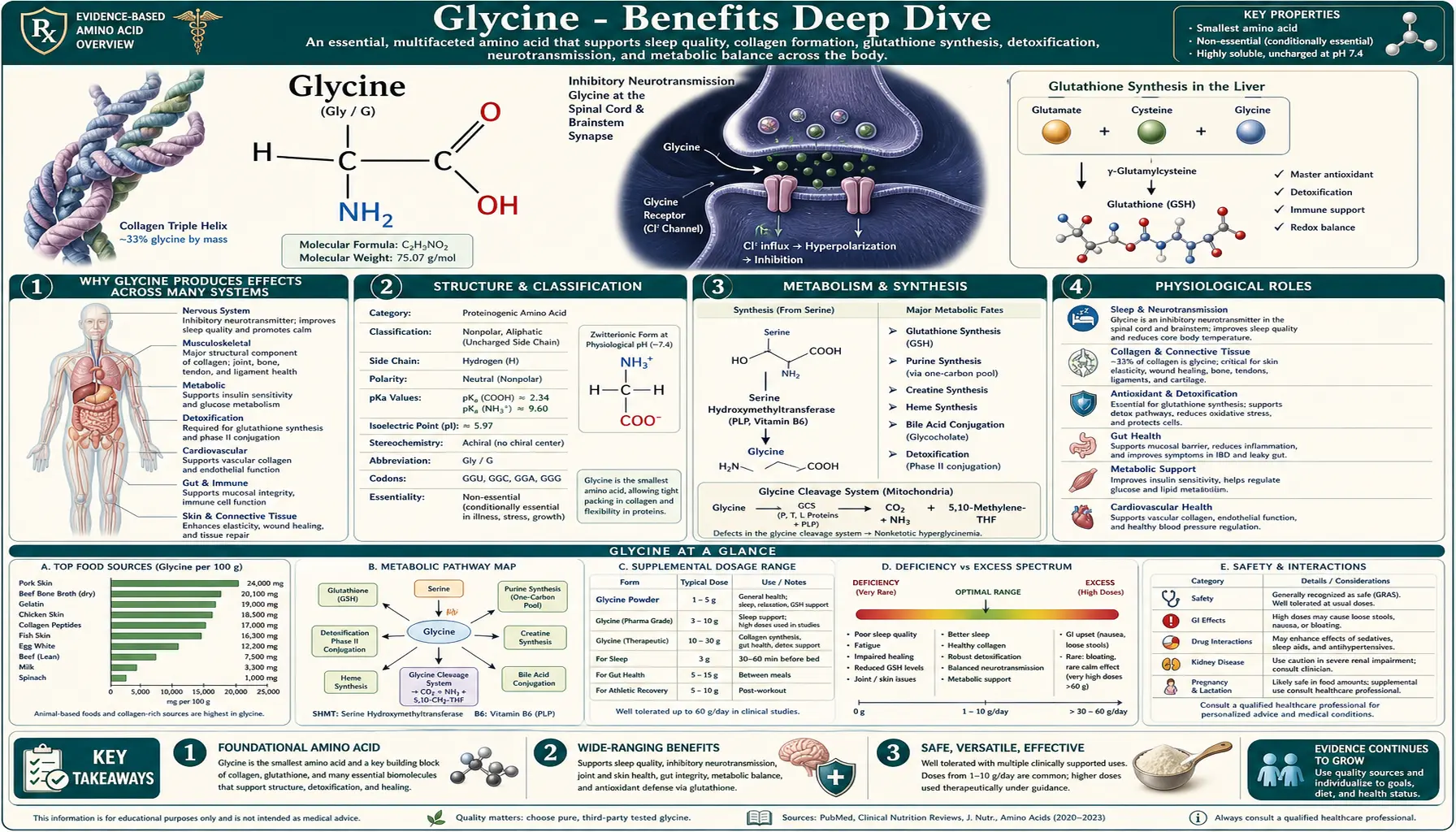
Glycine is the smallest of the twenty standard amino acids — a single hydrogen atom as its side chain — and the most structurally simple. Despite that simplicity, it sits at the convergence point of four largely independent physiological systems. It is approximately 33% of every collagen molecule by residue count, mandatory at every third position because no larger amino acid can fit inside the triple helix. It is the dominant inhibitory neurotransmitter in the brainstem and spinal cord, and a coagonist at NMDA glutamate receptors in cortex and hypothalamus. It is the often-overlooked third amino acid in glutathione (cysteine + glutamate + glycine), now recognized through the Sekhar GlyNAC trials as rate-limiting for antioxidant synthesis in aging and chronic-disease populations. And it is the rate-limiting cofactor for the glycine N-acyltransferase (GLYAT) enzyme that disposes of salicylate, benzoate, and other carboxylic-acid drugs via the salicyluric and hippuric acid pathways. Four benefit pages below explore each of these in depth.
Deep-Dive Articles
Sleep & Relaxation
Glycine as the dominant inhibitory neurotransmitter at brainstem and spinal-cord glycine receptors, the Bannai and Inagawa 3 g-before-bed randomized trials (improved sleep efficiency, reduced fatigue rating, increased slow-wave sleep), the thermoregulatory mechanism (cutaneous vasodilation drives core-temperature drop that the brain reads as a sleep cue), NMDA coagonism in the suprachiasmatic nucleus, daytime calm, and the high-dose schizophrenia research.
Collagen Synthesis
Why every third amino acid in the collagen triple helix is glycine and no other residue can substitute, bone broth and gelatin as ancestral glycine sources, the dietary glycine deficiency hypothesis of Meléndez-Hevia and McCarty (modern diets eat muscle meat not connective tissue), wound healing applications, the Shaw collagen-and-vitamin-C tendon-adaptation protocol, the collagen-peptide skin-aging trials, and Rajagopal Sekhar's GlyNAC work on aging.
Glutathione Synthesis
The often-overlooked third amino acid in glutathione — cysteine, glutamate, and glycine combine via a two-step ATP-dependent synthesis. Why cysteine alone (as N-acetylcysteine) was historically considered the sole rate-limiting precursor, and how the Sekhar 2011–2023 GlyNAC trials demonstrated that glycine + cysteine combined restores glutathione in aging more effectively than NAC alone. Mitochondrial dysfunction connection and the broad hallmarks-of-aging improvements documented in the 2021 and 2023 randomized trials.
Aspirin Metabolism
The two-step disposal pathway aspirin → salicylate → salicyluric acid, the GLYAT enzyme in hepatocyte mitochondria, why glycine becomes rate-limiting at higher aspirin doses (GLYAT Km sits at the upper end of physiologic mitochondrial glycine concentrations), the salicylate-overdose plasma-glycine-depletion data, the Reye's syndrome mitochondrial connection, GLYAT pharmacogenetics, and practical glycine support for chronic low-dose and high-dose aspirin users.
Table of Contents
- Deep-Dive Articles
- Why Glycine Produces Effects Across Many Systems
- Research Papers: Sleep & Neurotransmission
- Research Papers: Collagen & Connective Tissue
- Research Papers: Glutathione & Aging
- Research Papers: Aspirin & Drug Conjugation
- Research Papers: Cross-Cutting (Metabolism, Diet, Safety)
- External Authoritative Resources
- Connections
- Featured Videos
Why Glycine Produces Effects Across Many Systems
Most amino acids do one or two things in the body — they get incorporated into proteins and they serve as precursors to a small number of derived molecules. Glycine is unusual because it operates through at least four largely independent mechanisms, each driving a distinct cluster of clinical effects. The mechanisms are not in competition with each other — they all draw from the same hepatic, plasma, and intracellular glycine pool — but each represents a different reason that adequate glycine availability matters for adequate biological function.
- Structural protein assembly — glycine is the obligate residue at every third position in the collagen triple helix, the constraint imposed by the fact that no other amino acid has a side chain small enough (a single hydrogen) to fit inside the cramped axial space of the triple helix. Collagen is ~30% of total body protein and 33% of collagen is glycine, so glycine alone accounts for roughly 10% of total body protein-bound amino acids. This is the mechanism behind glycine's effects on skin, bone, cartilage, tendon, ligament, and gut-lining integrity.
- Inhibitory neurotransmission — glycine activates a pentameric ligand-gated chloride channel (the glycine receptor, structurally homologous to GABAA) on neurons in the brainstem and spinal cord, hyperpolarizing them and dampening neural excitability. This is the mechanism behind glycine's direct contribution to sleep onset, motor relaxation, and the subjective sense of calm. Strychnine is the classical glycine-receptor antagonist; strychnine poisoning produces exactly the explosive disinhibition predicted by loss of glycinergic tone.
- NMDA-receptor coagonism — glycine binds to the "glycine site" on the NMDA glutamate receptor, where it is required as a coagonist alongside glutamate for the channel to open. This mechanism overlaps with neurotransmission but operates in different brain regions and at different timescales. It is the mechanism behind glycine's effect on the suprachiasmatic-nucleus thermoregulatory cue for sleep onset and behind the high-dose schizophrenia research targeting cortical NMDA-receptor hypofunction.
- Substrate for synthesis — glycine is incorporated into a long list of physiologically essential molecules:
- Glutathione (the body's master intracellular antioxidant; covered on the Glutathione Synthesis page)
- Creatine (energy buffer for muscle, brain, and heart)
- Heme (the iron-binding ring of hemoglobin, myoglobin, cytochromes)
- Purines (DNA and RNA bases adenine and guanine)
- Bile salts (glycocholate and glycochenodeoxycholate, the dominant human bile acid conjugates)
- Salicyluric acid and hippuric acid (drug-conjugate elimination, see Aspirin Metabolism page)
The arithmetic consequence of those four mechanisms is that total daily glycine demand for a healthy adult is approximately 10–15 grams — well above what endogenous synthesis from serine and threonine can provide (~3 g/day) and above what typical modern Western diets supply (~3–5 g/day). This is the basis of the Meléndez-Hevia and McCarty argument that modern humans are chronically glycine-insufficient, and the basis of the practical recommendations to supplement with collagen peptides, bone broth, or free-form glycine powder.
Research Papers: Sleep & Neurotransmission
- Bannai M, Kawai N (2012). New therapeutic strategy for amino acid medicine: glycine improves the quality of sleep PubMed
- Yamadera W et al. (2007). Glycine ingestion improves subjective sleep quality in human volunteers, correlating with polysomnographic changes PubMed
- Inagawa K et al. (2006). Subjective effects of glycine ingestion before bedtime on sleep quality PubMed
- Kawai N et al. (2015). The sleep-promoting and hypothermic effects of glycine are mediated by NMDA receptors in the suprachiasmatic nucleus PubMed
- Lynch JW (2004). Molecular structure and function of the glycine receptor chloride channel PubMed
- Heresco-Levy U et al. (1999). Efficacy of high-dose glycine in the treatment of enduring negative symptoms of schizophrenia PubMed
- Buchanan RW et al. (2007). CONSIST: efficacy of glutamatergic agents for negative symptoms and cognitive impairments in schizophrenia PubMed
- Bannai M et al. (2012). The effects of glycine on subjective daytime performance in partially sleep-restricted healthy volunteers PubMed
- Lopez-Corcuera B et al. (2001). Glycine neurotransmitter transporters: an update PubMed
- Razak MA et al. (2017). Multifarious beneficial effect of nonessential amino acid, glycine: a review PubMed
Research Papers: Collagen & Connective Tissue
- Meléndez-Hevia E et al. (2009). A weak link in metabolism: the metabolic capacity for glycine biosynthesis does not satisfy the need for collagen synthesis PubMed
- McCarty MF, O'Keefe JH, DiNicolantonio JJ (2018). Dietary glycine is rate-limiting for glutathione synthesis and may have broad potential for health protection PubMed
- Shaw G et al. (2017). Vitamin C-enriched gelatin supplementation before intermittent activity augments collagen synthesis PubMed
- Proksch E et al. (2014). Oral supplementation of specific collagen peptides has beneficial effects on human skin physiology PubMed
- Asserin J et al. (2015). The effect of oral collagen peptide supplementation on skin moisture and the dermal collagen network PubMed
- Clark KL et al. (2008). Collagen hydrolysate as a dietary supplement in athletes with activity-related joint pain PubMed
- Marini JC et al. (2017). Osteogenesis imperfecta (collagen glycine substitution mutations) PubMed
- de Miranda RB et al. (2021). Effects of hydrolyzed collagen supplementation on skin aging: systematic review and meta-analysis PubMed
- Persikov AV, Ramshaw JA, Brodsky B (2005). Prediction of collagen stability from amino acid sequence PubMed
- Kumar S et al. (2015). Collagen peptide for osteoarthritis PubMed
Research Papers: Glutathione & Aging
- Sekhar RV et al. (2011). Glutathione synthesis is diminished in patients with uncontrolled diabetes and restored by dietary supplementation with cysteine and glycine PubMed
- Sekhar RV et al. (2011). Deficient synthesis of glutathione underlies oxidative stress in aging and can be corrected by dietary cysteine and glycine supplementation PubMed
- Nguyen D et al. (2013). Glutathione restoration with cysteine + glycine in older HIV-infected patients PubMed
- Kumar P et al. (2021). GlyNAC improves glutathione deficiency, mitochondrial dysfunction, inflammation, insulin resistance, muscle strength, and cognition in older adults: RCT PubMed
- Kumar P et al. (2023). Reversing aged hallmarks in older humans with GlyNAC supplementation PubMed
- Sekhar RV (2022). GlyNAC implications for healthy aging PubMed
- Kumar P et al. (2022). GlyNAC in old mice: brain glutathione, oxidative stress, mitochondrial dysfunction, cognitive impairment PubMed
- Lopez-Otin C et al. (2013, 2023). The hallmarks of aging (original + expansion) PubMed
- Lu SC (2013). Glutathione synthesis review PubMed
- Mosharov E, Cranford MR, Banerjee R (2000). Homocysteine metabolism and glutathione synthesis via the transsulfuration pathway PubMed
Research Papers: Aspirin & Drug Conjugation
- Levy G (1965). Pharmacokinetics of salicylate elimination in man — DOI
- Hutt AJ, Caldwell J, Smith RL (1986). The metabolism of aspirin in man: a population study — DOI
- Patel DK et al. (1990). Metabolism of aspirin after therapeutic and toxic doses — DOI
- Badenhorst CPS et al. (2013). Glycine conjugation, GLYAT, and interindividual variation — DOI
- van der Sluis R et al. (2015). Conservation of GLYAT coding regions: an essential detoxification pathway — DOI
- Knights KM, Sykes MJ, Miners JO (2007). Amino acid conjugation: metabolism and toxicity of xenobiotic carboxylic acids — DOI
- Glasgow JFT (2006). Reye's syndrome: the case for a causal link with aspirin — DOI
- Starko KM et al. (1980). Reye's syndrome and salicylate use — PubMed
- Quick AJ (1931). The conjugation of benzoic acid in man — DOI
- Bartels M et al. (1986). Glycine N-acyltransferase: characterization of the recombinant human enzyme Search PubMed
Research Papers: Cross-Cutting (Metabolism, Diet, Safety)
- Wang W et al. (2013). Glycine metabolism in animals and humans: implications for nutrition and health PubMed
- Yu HH, Yang TH, Plas DR, Thompson CB (2013). Glycine and its impact on cancer cell proliferation PubMed
- Alves A et al. (2019). Glycine metabolism and its relevance for ketogenic and low-protein diets PubMed
- Persaud C et al. (1989). The excretion of urinary hippurate: a marker of dietary protein intake PubMed
- Adeva-Andany M et al. (2018). Insulin resistance and glycine metabolism in humans PubMed
- Gannon MC, Nuttall JA, Nuttall FQ (2002). The metabolic response to ingested glycine PubMed
- Zhong Z et al. (2003). L-glycine: a novel anti-inflammatory, immunomodulatory, and cytoprotective agent PubMed
- Sun K et al. (2017). Glycine regulates protein turnover by activating Akt/mTOR signaling and inhibits proteolysis PubMed
- Howard A, Tahir I, Javed S, Waring SM, Ford D, Hirst BH (2010). Glycine transporter GLYT1 is essential for glycine-mediated protection of human intestinal epithelial cells PubMed
- Bartlett K, Eaton S (2004). Mitochondrial beta-oxidation PubMed
External Authoritative Resources
- Linus Pauling Institute — Micronutrient Information Center (general amino-acid context; LPI does not maintain a glycine-specific page but its amino-acid biochemistry coverage is the most authoritative summary available)
- PubMed — All research on glycine (~100,000+ papers covering metabolism, neuroscience, drug conjugation, collagen, aging)
- NIH Office of Dietary Supplements — Fact Sheets
- StatPearls / NCBI Bookshelf — Biochemistry of Glycine
- PubChem — Glycine (chemical structure, properties, safety data)
- UniProt — GLYAT (Glycine N-acyltransferase) gene/protein entry
- UniProt — GLRA1 (Glycine receptor alpha-1 subunit) entry
Connections
- All Amino Acids
- Glycine (Main Page)
- Glycine for Sleep & Relaxation
- Glycine for Collagen Synthesis
- Glycine for Glutathione Synthesis
- Glycine & Aspirin Metabolism
- Cysteine
- Methionine
- Serine
- Proline
- Glutamic Acid
- Taurine
- NAC (N-Acetylcysteine)
- Glutathione
- Bone Broth
- Collagen
- Vitamin C
- Vitamin B6 (P5P)
- Magnesium
- Magnesium Glycinate
- Aspirin
- Oxidative Stress
- Sleep Hygiene
- Anti-Aging