Glycine: Food Sources & Daily Intake
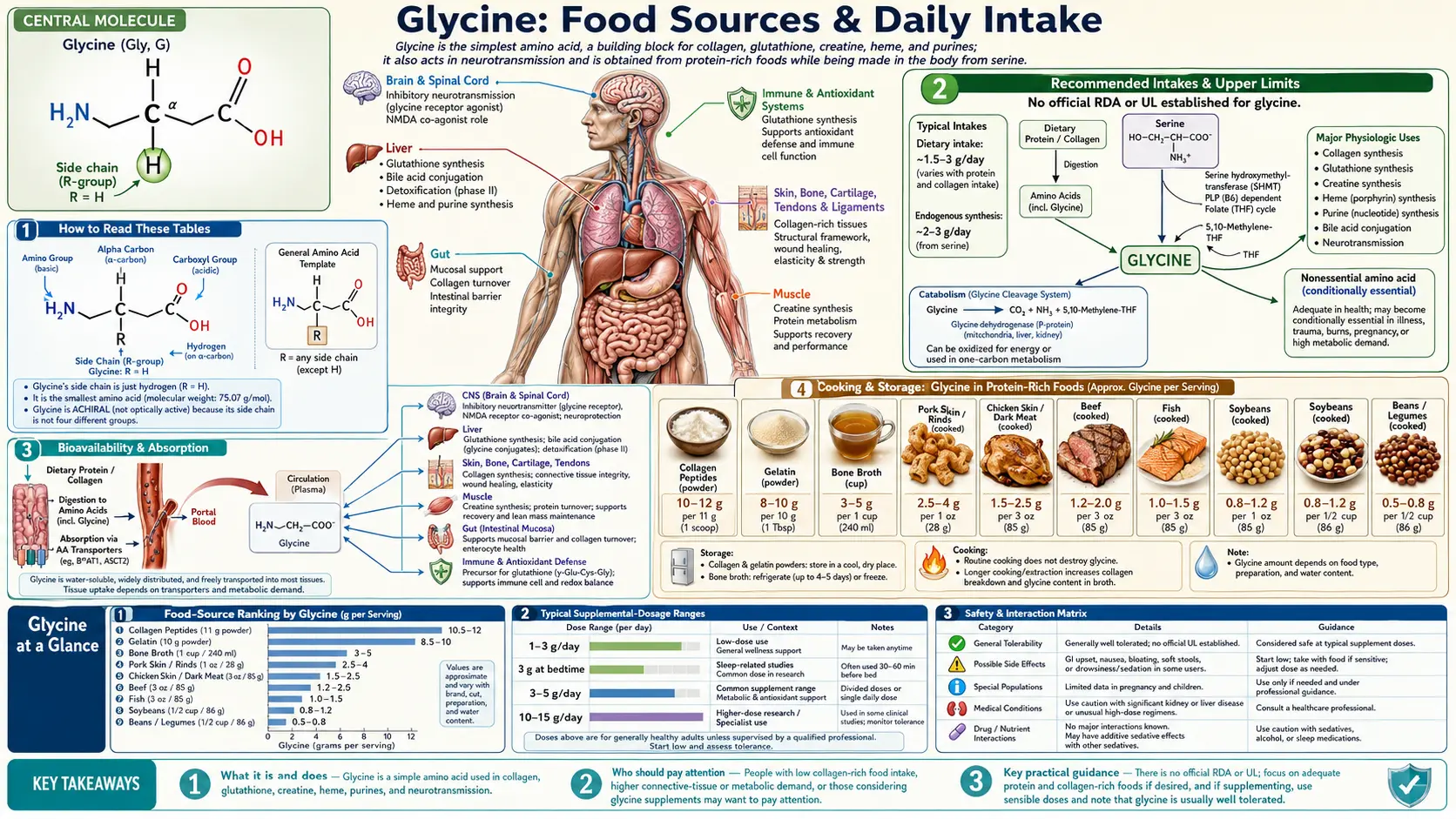
Glycine is the smallest amino acid, but it does outsized work. It is the single most common building block in collagen — the body’s most abundant protein and the scaffold of skin, tendons, cartilage and bone — where it fills every third position in the protein’s repeating chain. Beyond structure, glycine is a raw material for glutathione (the body’s master antioxidant), for creatine (which powers muscle), and for the bile salts that digest fat. In the brain it is a calming, inhibitory neurotransmitter, and taken before bed it can improve sleep quality. The body can make some glycine itself, so it is conditionally essential — but it often makes less than collagen turnover demands, which is why gelatin- and connective-tissue–rich foods are so valuable. The table below shows grams of glycine per 100 g of food; there is no FDA Daily Value for individual amino acids, so amounts are absolute.
| Glycine: Food Sources & Daily Intake | |||||
|---|---|---|---|---|---|
| Rank | Food (serving) | Per 100 g | Glucose | Fructose | Notes |
| 1 | Gelatin Powder 1 Tbsp / 7 g | 🟢 19 g | 0 | 0 | Pure collagen — by far the richest source. |
| 2 | Pork Skin 1 oz / 28 g | 🟢 12 g | 0 | 0 | Collagen-rich cracklings/rind. |
| 3 | Pumpkin Seeds 1 oz / 28 g | ⚪ 1.8 g | 0.1 | 0.1 | |
| 4 | Turkey With Skin 3 oz / 85 g | ⚪ 1.8 g | 0 | 0 | |
| 5 | Chicken Skin 1 oz / 28 g | ⚪ 1.8 g | 0 | 0 | Connective tissue concentrates glycine. |
| 6 | Chicken With Skin 3 oz / 85 g | ⚪ 1.8 g | 0 | 0 | |
| 7 | Pork Organ Meats 3 oz / 85 g | ⚪ 1.6 g | — | — | Nutrient-dense organ meat. |
| 8 | Peanuts 1 oz / 28 g | ⚪ 1.6 g | — | — | |
| 9 | Chicken Organ Meats 3 oz / 85 g | ⚪ 1.5 g | — | — | Nutrient-dense organ meat (giblets). |
| 10 | Beef Meat 3 oz / 85 g | ⚪ 1.5 g | 0 | 0 | Tougher, connective-tissue cuts are highest. |
| 11 | Sunflower Seeds 1 oz / 28 g | ⚪ 1.5 g | — | — | |
| 12 | Beef Organ Meats 3 oz / 85 g | ⚪ 1.4 g | — | — | Nutrient-dense organ meat. |
| 13 | Salmon 3 oz / 85 g | ⚪ 1.3 g | 0 | 0 | |
| 14 | Shrimp 3 oz / 85 g | ⚪ 1.2 g | — | — | |
| 15 | Pork 3 oz / 85 g | ⚪ 1.2 g | 0 | 0 | |
| 16 | Sesame Seeds 1 oz / 28 g | ⚪ 1.2 g | — | — | Top plant source. |
| 17 | Brown Rice 1 cup / 195 g | ⚪ 0.1 g | 0 | 0 | Common staple. |
Table of Contents
- How to Read These Tables
- Recommended Intakes & Upper Limits
- Bioavailability & Absorption
- Cooking & Storage
- Vegetarian & Vegan Sources
- Who Needs to Pay Attention
- Data Sources & References
- Connections
- Featured Videos
How to Read These Tables
- Conditionally essential. Your body makes glycine (mainly from the amino acid serine), so it is not strictly “essential.” But synthesis often falls short of what collagen, glutathione, creatine and bile production together require, so dietary glycine — especially from gelatin and bone broth — meaningfully tops up the supply.
- Grams per 100 g, not %DV. There is no FDA Daily Value for individual amino acids, so this table reports the absolute grams per 100 g of food and ranks foods by that. A typical serving is shown beside each food so you can scale the number.
- Collagen tells you where it hides. Because glycine is one-third of collagen, the richest foods are the collagen-rich parts of animals — gelatin, skin, tendon and bone — not lean muscle meat. A pork chop has some; the crackling, the skin-on thigh and the broth made from the bones have far more.
Recommended Intakes & Upper Limits
Your personal target depends on age, sex and pregnancy. The Daily Value used for the %DV column above is a single label figure; the table below is the age-specific guidance.
| Reference | Adult value | Notes |
|---|---|---|
| Essential? | Conditionally essential | The body makes some glycine (mainly from serine), but often less than is ideal, so collagen- and gelatin-rich foods usefully top it up. |
| Adult requirement | None set | No official requirement exists, yet collagen turnover alone needs roughly 10 g/day — more than the body typically synthesizes — so gelatin and bone-broth foods help close the gap. |
| Key roles | Collagen, glutathione, creatine, bile | Glycine is the backbone of collagen and a building block for the master antioxidant glutathione, for creatine, for bile salts, and it acts as a calming (inhibitory) neurotransmitter that supports sleep. |
| Richest in | Gelatin, bone broth, skin-on meats | Glycine concentrates in collagen-rich animal parts — gelatin, bone broth, pork and chicken skin, and connective-tissue cuts — far more than in lean muscle meat. |
Bioavailability & Absorption
Glycine from food is small, water-soluble and very well absorbed, whether it comes from intact protein or from the hydrolyzed collagen in gelatin and bone broth. What governs your intake is which parts of the animal you eat: muscle meat is relatively low in glycine, while skin, connective tissue, gelatin and slow-simmered bone broth are rich in it. Eating “nose-to-tail” — or simply adding a daily cup of broth or a scoop of unsweetened gelatin — is the practical way to raise glycine without supplements.
Cooking & Storage
Glycine is heat-stable, so ordinary cooking does not destroy it. In fact, cooking is how you liberate it: simmering bones, skin and connective tissue for hours breaks down collagen into gelatin, releasing glycine-rich protein into the liquid. This is exactly what makes a long-cooked bone broth set to a jelly when chilled — that gel is dissolved collagen, and it is one of the most glycine-dense foods you can make at home. Braises, stews and slow-cooked tough cuts work the same way.
Vegetarian & Vegan Sources
Glycine is one of the harder amino acids to get on a fully plant-based diet, because the richest sources — gelatin, skin, bone broth and connective tissue — are all animal-derived, and plants are generally lower in glycine. The best plant options are sesame seeds, pumpkin and sunflower seeds, chia seeds, peanuts, lentils and beans. Eating a generous variety of these every day, with enough total protein, supplies a reasonable amount; some plant-based eaters also use supplemental glycine powder to match what omnivores get from collagen foods.
Who Needs to Pay Attention
Frank glycine deficiency is uncommon in people eating enough total protein, because the body can synthesize it. The subtler concern is that modern muscle-meat–heavy diets may be low in glycine compared with traditional whole-animal eating. When we ate the whole animal — skin, organs, cartilage, bone broth — glycine intake balanced the methionine that is abundant in lean meat. Eating mostly boneless, skinless cuts can leave that balance off. The remedy is dietary, not pharmacological: include gelatin, bone broth and skin-on, connective-tissue cuts (a nose-to-tail approach), which naturally restores glycine alongside the rest of your protein.
Data Sources & References
- NIH MedlinePlus — Amino acids
- Linus Pauling Institute — protein and amino acids
- PubMed — glycine, collagen synthesis and metabolic demand
- PubMed — glycine, glutathione and oral supplementation
Connections
- All Amino Acids
- Glycine (Main Page)
- Glycine Benefits
- Glycine History
- Proline
- Creatine
- Bone Broth
- Glutathione & Antioxidant Support