Glutamine for Weight Loss Support
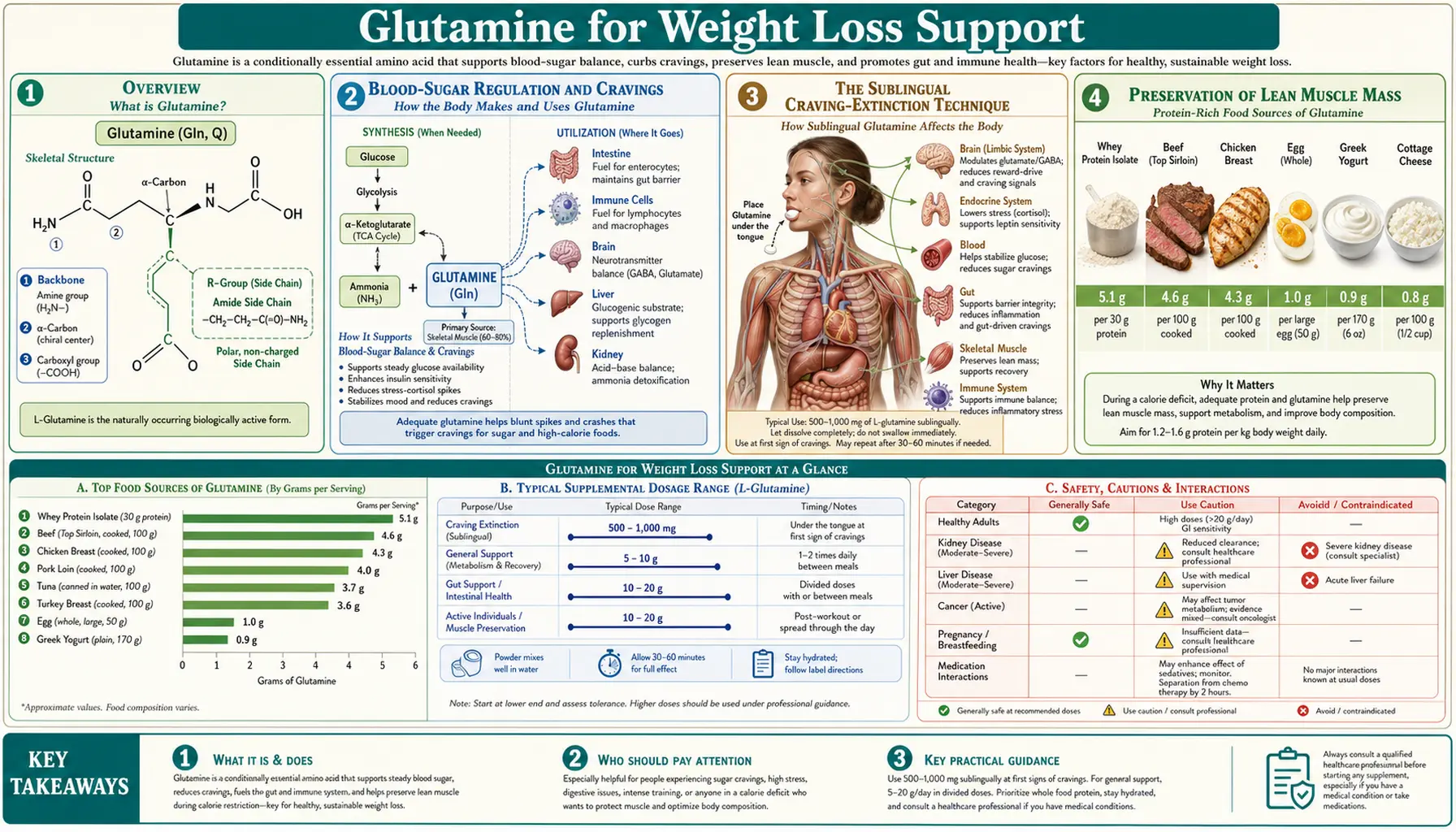
L-glutamine is not a weight-loss drug, a stimulant, or an appetite suppressant. It is a conditionally essential amino acid that supports several underlying physiological processes that, when optimized, make it meaningfully easier to lose fat and sustain a healthy body composition: blood-sugar stabilization, sugar and alcohol craving extinction, preservation of lean muscle during calorie restriction, GLP-1 augmentation, and favorable shifts in the gut microbiota that reduce metabolic endotoxemia. The most striking single intervention is the sublingual technique — 1-2 grams dissolved under the tongue at the onset of a craving, with relief arriving within minutes via direct gluconeogenic glucose supply to the brain — but the broader story includes the Laviano 2014 pilot trial in nondieting obese women, the de Souza 2015 gut-microbiota shift in overweight adults, and the Greenfield 2009 GLP-1 augmentation finding in lean, obese, and type 2 diabetic subjects.
Table of Contents
- Overview
- Blood-Sugar Regulation and Cravings
- The Sublingual Craving-Extinction Technique
- Preservation of Lean Muscle Mass
- Gut Microbiome and Metabolic Endotoxemia
- GLP-1 Augmentation and Insulin Sensitivity
- Reducing Chronic Inflammation
- Benefits for a Sedentary Lifestyle
- Clinical Protocol for Weight Management
- Combining Glutamine with Other Strategies
- Limitations and Realistic Expectations
- Cautions
- Key Research Papers
- Connections
- Featured Videos
Overview
L-glutamine is not a weight-loss drug, a stimulant, or an appetite suppressant in the pharmacological sense. It is a conditionally essential amino acid that supports several underlying physiological processes that, when optimized, make it meaningfully easier to lose fat and sustain a healthy body composition. Unlike typical "fat burners," the effects of glutamine on body weight are upstream and foundational, improving the biochemical environment in which fat loss can occur.
Naturopathic practitioners often include glutamine in weight loss protocols not because it forces fat to burn faster, but because it addresses four of the most common obstacles to successful weight management: blood-sugar instability, chronic cravings, loss of lean tissue during calorie restriction, and the low-grade inflammation driven by a compromised gut barrier.
Blood-Sugar Regulation and Cravings
Perhaps the most practical benefit of glutamine during a weight-loss effort is its ability to stabilize blood sugar and diminish cravings. The brain requires a constant supply of glucose, and when blood sugar drops even briefly, it generates urgent cravings for sugar, refined carbohydrates, or alcohol. These cravings are among the most common reasons that people abandon an otherwise successful eating plan.
L-glutamine is a preferred substrate for gluconeogenesis, the process by which the liver and kidneys produce glucose from non-carbohydrate precursors. By feeding this pathway, glutamine helps maintain steady blood glucose between meals and during fasting windows. The result is a noticeable reduction in the intensity and frequency of cravings, which in turn makes it easier to adhere to caloric reductions or intermittent-fasting protocols.
The Sublingual Craving-Extinction Technique
A well-known clinical technique is to dissolve 1 to 2 grams of L-glutamine powder directly under the tongue at the onset of a sugar or alcohol craving. Because sublingual absorption bypasses the digestive system, the amino acid reaches the bloodstream within minutes, often extinguishing the craving before it can drive a behavioral lapse.
The relationship between glutamine and alcohol cravings was first explored in the 1950s by researcher Roger Williams at the University of Texas, who observed that glutamine supplementation reduced voluntary alcohol consumption in animal studies. Subsequent clinical observations have supported this finding, with many practitioners reporting that patients in recovery from alcohol dependence experience reduced cravings and improved mood stability when taking glutamine.
The mechanism is straightforward: the brain is highly glucose-dependent, and acute drops in blood glucose are interpreted as urgent fuel-shortage signals that drive craving behavior. By supplying the brain with a rapid-onset gluconeogenic substrate, sublingual glutamine effectively communicates "fuel has arrived" within minutes, eliminating the physiological driver of the craving even when the underlying caloric pattern hasn't changed.
Preservation of Lean Muscle Mass
One of the most overlooked problems with traditional dieting is that roughly 20 to 30 percent of weight lost through calorie restriction alone comes from lean body mass rather than fat. Since muscle is several times more metabolically active than fat, losing muscle during weight loss progressively slows the resting metabolic rate. This explains why many dieters find it harder and harder to keep losing weight and why they regain it so easily when they return to normal eating.
Glutamine helps prevent this by supplying nitrogen and fuel to the immune system, gut, and kidneys — tissues that would otherwise draw on skeletal muscle glutamine stores during periods of stress or reduced intake. By sparing muscle protein from catabolism, glutamine helps preserve basal metabolic rate, maintain physical strength during weight loss, and improve the ratio of fat lost to lean mass lost.
For individuals combining calorie restriction with resistance training, the muscle-preserving effect is especially valuable. A dose of 5 to 10 grams daily, split between morning and post-workout, provides background support for nitrogen balance without noticeably adding calories to the diet.
Gut Microbiome and Metabolic Endotoxemia
Over the last fifteen years, research has revealed a tight bidirectional link between the composition of the gut microbiota and host metabolism. Obese individuals consistently show altered gut flora, elevated circulating bacterial endotoxins (lipopolysaccharides, or LPS), and increased intestinal permeability. This "metabolic endotoxemia" drives chronic low-grade inflammation, insulin resistance, and fat accumulation around the abdominal organs.
Glutamine intervenes in this process on two levels. First, by repairing tight junctions and nourishing enterocytes (covered in detail in the companion Gut Health & Leaky Gut page), it reduces the translocation of LPS from the gut into systemic circulation, directly lowering the endotoxin load. Second, small clinical studies have shown that oral glutamine supplementation can favorably shift the balance of gut bacteria, including a reduction in the Firmicutes-to-Bacteroidetes ratio — a pattern commonly associated with leaner body composition.
De Souza and colleagues (2015) reported that 30 days of oral glutamine at 30 g/day measurably changed the gut microbiota of overweight and obese adults in a direction similar to that produced by calorie restriction. While the research is still early, the mechanistic case for glutamine as a gut-mediated metabolic-support nutrient is becoming increasingly strong.
GLP-1 Augmentation and Insulin Sensitivity
One of the more intriguing recent findings is that oral glutamine directly augments the release of glucagon-like peptide 1 (GLP-1) from intestinal L-cells. Greenfield and colleagues (2009) demonstrated that a single oral dose of glutamine increased circulating GLP-1, glucagon, and insulin concentrations in lean, obese, and type 2 diabetic subjects alike. This is the same incretin pathway exploited by the now-popular semaglutide and tirzepatide drugs — not the same magnitude of effect, but a clear mechanistic overlap.
The Samocha-Bonet 2011 follow-up confirmed that oral glutamine reduces postprandial glycemia and augments the GLP-1 response specifically in type 2 diabetes patients, and the Mansour 2015 trial documented improved cardiovascular risk markers in diabetic subjects supplementing with glutamine. The Abboud 2019 rodent study added the observation that oral glutamine reduces obesity, pro-inflammatory markers, and improves insulin sensitivity in diet-induced obese Wistar rats.
Some studies have found that glutamine supplementation improves markers of insulin sensitivity in overweight and diabetic patients, though the mechanism remains under investigation. Proposed pathways include reduced inflammation, improved GLP-1 secretion from intestinal L-cells, and better maintenance of pancreatic beta-cell function. Improved insulin sensitivity means the body is able to store glucose as muscle glycogen rather than fat, and fat cells become more willing to release stored fuel for energy.
Reducing Chronic Inflammation
Chronic low-grade inflammation is now recognized as one of the central drivers of metabolic dysfunction. Elevated inflammatory cytokines interfere with insulin signaling, disrupt satiety hormones such as leptin, and promote fat storage particularly in visceral depots. Anything that reduces background inflammation without pharmaceutical intervention tends to improve the metabolic environment for fat loss.
Glutamine contributes several anti-inflammatory actions: it nourishes the gut barrier (reducing endotoxin-driven inflammation), induces protective heat-shock proteins, and serves as a precursor to glutathione, the body's most powerful endogenous antioxidant. Together these effects lower the inflammatory background load and support healthier insulin signaling.
Benefits for a Sedentary Lifestyle
Most weight-loss research is conducted on either athletes or clinical patients, leaving a gap when it comes to the needs of sedentary office workers, drivers, remote employees, and older adults who cannot easily exercise. This group often experiences slow, age-related muscle loss (sarcopenia), declining metabolism, and a chronic drain on glutamine reserves from psychological stress and sub-optimal diet.
For sedentary individuals attempting weight loss, a modest daily glutamine dose of 2 to 5 grams offers several advantages: it helps preserve the muscle that exists, supports gut and immune function, curbs cravings, and provides biochemical support for the kind of metabolic resilience that sedentary lifestyles steadily erode.
Clinical Protocol for Weight Management
Dosing
- General weight-management support: 5 grams of powdered L-glutamine once or twice daily, taken on an empty stomach
- Craving management: 1 to 2 grams dissolved under the tongue at onset of a craving (up to 3 times daily)
- Muscle preservation during calorie restriction: 5 grams in the morning and 5 grams after any physical activity
- Gut-microbiota shift (de Souza protocol): 30 g/day in divided doses for 30 days, then taper to a maintenance 5-10 g/day
Timing
Morning, between meals, before bed, and at the onset of a craving are the most effective times. Avoid combining with hot beverages, and take on an empty stomach whenever possible for best absorption.
Duration
For weight-management purposes, 8 to 16 weeks of consistent daily use is typical, often continued as a low-dose maintenance protocol beyond that point.
Combining Glutamine with Other Strategies
Glutamine is most effective when it is part of a comprehensive approach to weight management rather than a stand-alone tactic. Foundational elements include:
- A whole-foods diet built around lean protein, colorful vegetables, healthy fats, and minimal refined sugar
- Consistent resistance training at least two or three times per week to stimulate muscle maintenance
- Adequate sleep (7 to 9 hours), since sleep deprivation sabotages leptin, ghrelin, and insulin signaling
- Stress management through meditation, breathwork, or time outdoors, to reduce cortisol-driven abdominal fat deposition
- Hydration and electrolyte balance, particularly for those using intermittent fasting
- Complementary supplements such as berberine, magnesium, omega-3 fatty acids, and probiotics
Limitations and Realistic Expectations
L-glutamine is not a substitute for dietary change, physical activity, or stress management. Large randomized trials have not established it as an independent weight-loss drug, and the existing clinical studies that do show benefits generally involve relatively small populations. What glutamine does well is remove biochemical obstacles, reduce cravings, protect lean tissue, and support gut and immune health in ways that make it easier to sustain the lifestyle changes that actually produce lasting fat loss.
Think of glutamine as a supportive nutrient that optimizes the environment for weight loss rather than a direct fat-burning agent. For most people, the benefits are real but subtle, and they accumulate over weeks rather than days.
Cautions
- Liver disease / hepatic encephalopathy — avoid; impaired ammonia clearance.
- Severe kidney disease — consult a nephrologist.
- Active cancer — some tumor cells exhibit "glutamine addiction"; consult oncology team.
- Seizure disorders — glutamine converts to glutamate; start at low doses.
- GLP-1 receptor agonist users (semaglutide, tirzepatide, liraglutide) — given that oral glutamine augments endogenous GLP-1, theoretically additive effects on appetite and gastric emptying are possible; monitor for nausea and adjust accordingly.
Key Research Papers
- Laviano A, Molfino A, Lacaria MT, Canelli A, De Leo S, Preziosa I, Rossi Fanelli F (2014). Glutamine supplementation favors weight loss in nondieting obese female patients: A pilot study. European Journal of Clinical Nutrition. — PubMed
- de Souza AZ, Zambom AZ, Abboud KY et al. (2015). Oral supplementation with L-glutamine alters gut microbiota of obese and overweight adults. Nutrition. — PubMed
- Greenfield JR et al. (2009). Oral glutamine increases circulating glucagon-like peptide 1, glucagon, and insulin concentrations in lean, obese, and type 2 diabetic subjects. American Journal of Clinical Nutrition. — PubMed
- Mansour A, Mohajeri-Tehrani MR, Qorbani M, Heshmat R, Larijani B, Hosseini S (2015). Effect of glutamine supplementation on cardiovascular risk factors in patients with type 2 diabetes. Nutrition. — PubMed
- Samocha-Bonet D, Wong O, Synnott EL et al. (2011). Glutamine reduces postprandial glycemia and augments the glucagon-like peptide-1 response in type 2 diabetes patients. Journal of Nutrition. — PubMed
- Abboud KY et al. (2019). Oral Glutamine Supplementation Reduces Obesity, Pro-Inflammatory Markers, and Improves Insulin Sensitivity in DIO Wistar Rats. Nutrients. — PubMed
- Williams RJ (1959). Alcoholism: The Nutritional Approach. Foundational observation that glutamine reduces voluntary alcohol consumption. — PubMed
- Iwashita S et al. (2005). Glutamine supplementation increases postprandial energy expenditure. JPEN Journal of Parenteral and Enteral Nutrition. — PubMed
- Reimann F, Tolhurst G, Gribble FM (2012). G-protein-coupled receptors in intestinal chemosensation. Cell Metabolism. — PubMed
- Cruzat V et al. (2018). Glutamine: Metabolism and Immune Function, Supplementation and Clinical Translation. Nutrients. — PubMed
PubMed Topic Searches
- PubMed: Glutamine, weight loss, obesity
- PubMed: Glutamine and GLP-1
- PubMed: Glutamine and gut microbiota
- PubMed: Glutamine and alcohol cravings
- PubMed: Glutamine and insulin sensitivity
Connections
- All Amino Acids
- Glutamine Overview
- Glutamine Benefits Hub
- Glutamine for Gut Health & Leaky Gut
- Glutamine for Immune Function
- Glutamine for Exercise Recovery
- Leucine
- Arginine
- Glycine
- Blood Sugar
- Gut-Brain Axis
- Fasting
- Stress Management
- GLP-1 Receptor Agonists
- Insulin Resistance
- Diabetes
- Obesity
- Metabolic Syndrome
- Berberine
- Magnesium
- Gut Microbiome
- CGM