Choline Toxicity (High-Dose Choline): Fishy Body Odor
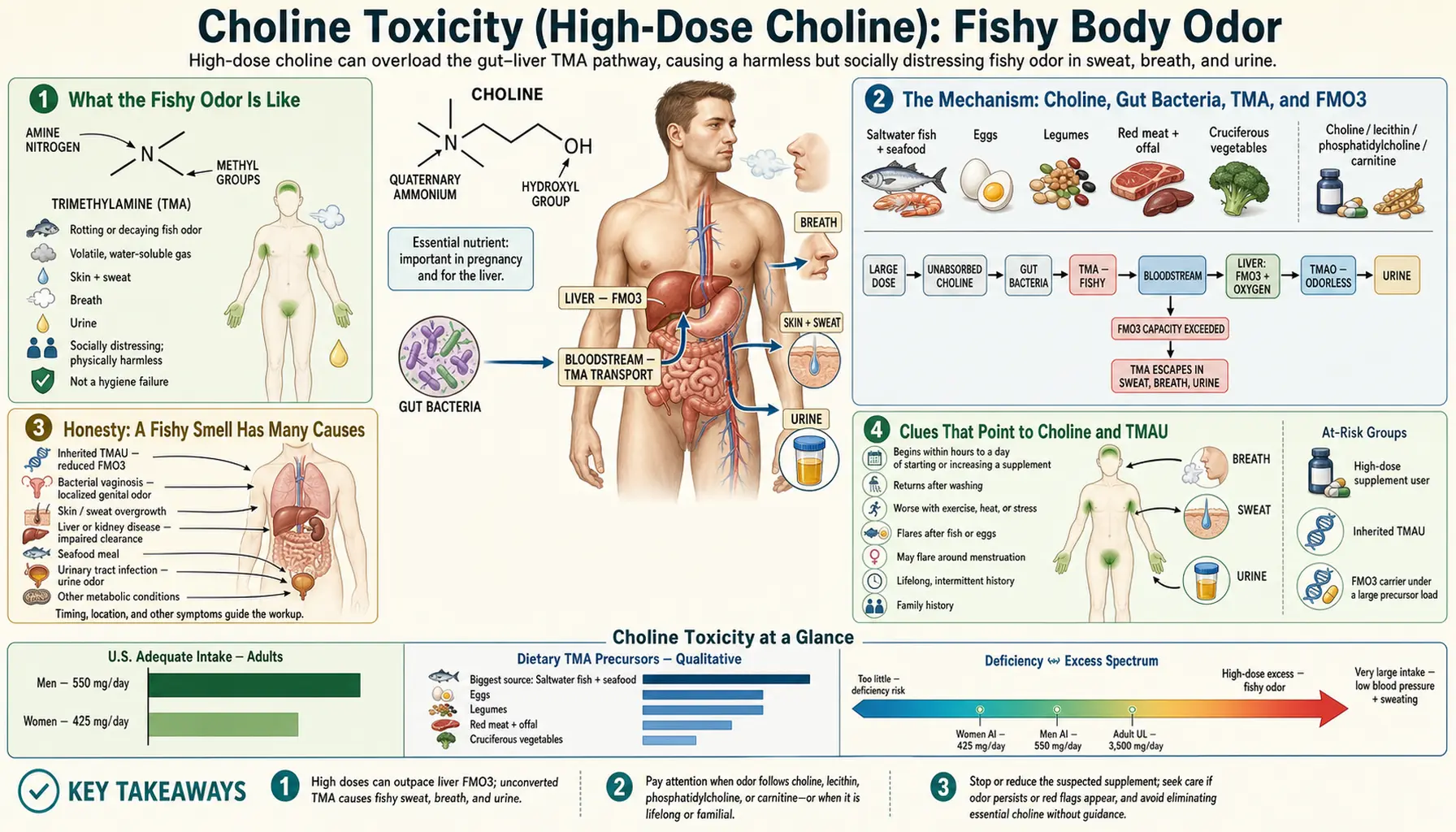
The best-known side effect of taking too much choline — usually from high-dose supplements such as choline bitartrate, lecithin, or phosphatidylcholine — is a fishy body odor. Choline that escapes absorption is broken down by gut bacteria into trimethylamine (TMA), a gas that smells exactly like rotting fish. Normally a liver enzyme called FMO3 converts that TMA into an odorless form before it can build up. But in people who carry common, harmless variations in the FMO3 gene — a condition called trimethylaminuria (TMAU), or “fish-odor syndrome” — the enzyme can't keep up, and a big dose of choline floods the system with TMA that leaves the body in sweat, breath, and urine. This is one of the most socially distressing symptoms in all of nutrition, yet it is, for your physical health, harmless. This page explains why the smell happens, why some people get it and most don't, and exactly what to do about it.
Table of Contents
- What the Fishy Odor Is Like
- The Mechanism: Choline, Gut Bacteria, TMA, and FMO3
- Honesty: A Fishy Smell Has Many Causes
- Clues That Point to Choline and TMAU
- What Triggers It: Doses, Foods, and Forms
- Getting Checked
- How It Is Managed
- When to Seek Care / Red Flags
- Key Research Papers
- Connections
- Featured Videos
What the Fishy Odor Is Like
People who experience this describe a smell that is unmistakable and hard to live with: a strong odor of rotting or decaying fish. It is not a faint sweaty smell — it is the same compound (trimethylamine) that gives old fish and certain seafood markets their characteristic reek. The odor can come from several places at once:
- The skin and sweat. The smell rises from the whole body, concentrating where sweat collects — the underarms, scalp, groin, and hands. It tends to flare after a meal, after exercise, with stress, and (in those who menstruate) around menstruation, all of which increase sweating or the production of the odor compound.
- The breath. Fishy breath can be mistaken for an oral or dental problem, but it persists no matter how carefully someone brushes, flosses, or uses mouthwash, because the source is in the bloodstream, not the mouth.
- The urine. A strong fishy smell to the urine is common and is often the first thing noticed after starting a choline supplement.
What makes this symptom so painful is almost entirely social, not medical. The odor is intermittent and the person carrying it frequently cannot smell it themselves (the nose adapts to a constant smell), so they may only learn of it through a hurtful comment, avoidance by others, or a partner's remark. Many people with the inherited form go years being told they have poor hygiene, and they describe real anxiety, social withdrawal, and depression as a result. It is important to say plainly: this is a real biochemical condition, not a failure of washing, and the distress it causes is entirely understandable.
The reassuring half of the truth is just as important. A fishy odor from too much choline does not mean the choline is poisoning your organs. Unlike fat-soluble vitamins, choline does not accumulate to toxic tissue levels; the odor is simply a byproduct that is escaping faster than the liver can deodorize it. Lower the dose and the smell goes away. This sets choline apart from genuinely dangerous overdoses — the symptom is loud, but the harm is small.
The Mechanism: Choline, Gut Bacteria, TMA, and FMO3
To understand the fishy smell you only need to follow choline through four steps: down into the gut, into a smelly gas, up to the liver, and (normally) into an odorless waste product. The odor appears when the last step fails to keep pace.
Step 1 — choline reaches the gut. Choline and choline-containing compounds (such as phosphatidylcholine and lecithin) are absorbed in the small intestine. But when the dose is large — far more than the body needs at once — a portion is not absorbed and passes deeper into the gut, where it meets the trillions of resident bacteria.
Step 2 — bacteria turn choline into trimethylamine. Certain gut bacteria possess enzymes that strip choline apart and release trimethylamine (TMA). TMA is a small, volatile, water-soluble gas, and it is the actual smell — the pure compound is what chemists and food scientists have long identified as the “rotting fish” odor. The same bacterial pathway acts on other dietary precursors, which is why this is a whole-diet phenomenon, not a choline-only one (more on the food list below).
Step 3 — TMA travels to the liver. The TMA made in the gut is absorbed into the bloodstream and carried to the liver, the body's chemical processing plant.
Step 4 — FMO3 deodorizes it (or doesn't). In the liver, an enzyme called flavin-containing monooxygenase 3 (FMO3) adds an oxygen atom to TMA, converting the smelly gas into trimethylamine N-oxide (TMAO), which is completely odorless and is harmlessly excreted in the urine. This host–microbiome “TMA–TMAO axis” runs quietly in everyone every day. When FMO3 has enough capacity, even a large choline load is deodorized before it can escape, and there is no smell.
Why the smell appears. The odor occurs when the supply of TMA outruns the FMO3 enzyme's ability to convert it. The unconverted TMA then leaves the body the only ways a small volatile compound can — in sweat, breath, and urine — carrying its fishy smell with it. There are two ways the enzyme gets outrun:
- The genetic form (primary TMAU). Some people inherit two reduced-function copies of the FMO3 gene. Their enzyme works poorly, so even ordinary amounts of TMA precursors can overwhelm it. This inherited trimethylaminuria is the classic cause, and for these individuals a single high-dose choline or lecithin supplement can trigger a dramatic flare. People who carry just one weak copy (carriers) usually smell normal day to day but can develop a transient odor when given a large precursor load — for example, a big choline supplement — a phenomenon documented in challenge studies.
- The overload form (secondary, in normal enzymes). Even a perfectly normal FMO3 enzyme has a finite throughput. Pour in a sufficiently enormous dose of choline, lecithin, or carnitine, and you can briefly exceed its capacity, producing a temporary odor that fades once the dose stops. This is the more relevant scenario for the average person who simply took too much of a supplement.
An analogy. Picture FMO3 as the single deodorizing fan over a kitchen stove. TMA is the fish smell coming off the pan. Cook one fillet (a normal choline intake) and the fan clears the air before the smell escapes the kitchen — no one in the next room notices. Now fry a dozen fillets at once (a megadose of choline or lecithin): the smell pours out faster than the fan can pull it away, and it drifts through the whole house. People with inherited TMAU are working with a fan that runs at a fraction of its rated speed, so even one fillet is enough to leave a smell. The fix in both cases is the same — cook less fish, or cook it more slowly — not to scrub the house harder.
Honesty: A Fishy Smell Has Many Causes
A fishy body odor is a real and specific clue, but it is honest to say that choline excess is only one of its causes, and not the most common. Before assuming a supplement is to blame, it is worth knowing the other possibilities, because the right fix depends entirely on the real cause:
- Inherited trimethylaminuria with an ordinary diet. Far more often than a supplement, the odor reflects the underlying FMO3 variation interacting with everyday fish, eggs, and legumes — the choline supplement may simply have unmasked a tendency that was already there.
- Bacterial vaginosis. In people with a vagina, a fishy genital odor — often worse after sex or around menstruation — is commonly due to bacterial vaginosis, a shift in vaginal bacteria, and is treated with antibiotics. This is unrelated to choline and is a frequent, easily treatable cause.
- Skin and sweat conditions. Ordinary body odor (bromhidrosis), bacterial or fungal skin overgrowth, and infected sweat can all smell strong, though usually not specifically fishy.
- Liver or kidney disease. Advanced liver disease or kidney failure can cause distinctive breath and body odors because waste products that are normally cleared build up; this is a “secondary” cause of impaired TMA handling and is accompanied by other signs of organ trouble.
- Other foods and infections. A heavy seafood meal can transiently make sweat or breath smell of fish in anyone; some urinary tract infections change urine odor; and rare metabolic conditions produce other characteristic smells (maple-syrup, sweaty-feet, mousy).
The practical message: a fishy smell that appeared right after starting a choline, lecithin, or carnitine supplement points strongly at this mechanism and usually resolves on stopping it. A fishy smell with no supplement, present for years, or localized to the genital area, points elsewhere and deserves a different workup. Don't self-diagnose TMAU from the smell alone — but don't dismiss it either.
Clues That Point to Choline and TMAU
Several features make it more likely that a fishy odor is coming from the choline–TMA–FMO3 pathway rather than from something else:
- Clear timing with a supplement. The single strongest clue is that the smell began (or sharply worsened) within hours to a day of starting or increasing choline, lecithin, phosphatidylcholine, or carnitine, and eased after stopping. A deliberate, careful stop-and-restart that reproduces the pattern is highly suggestive.
- It washes but doesn't wash off. The odor returns within hours of a thorough shower and is unaffected by deodorant, mouthwash, or careful dental care — because the source is internal, secreted through sweat and breath, not a film on the skin or in the mouth.
- It tracks with sweating and certain foods. Flares after exercise, heat, stress, a fish or egg-heavy meal, or (for those who menstruate) around their period fit the pattern, because all of these raise either sweating or TMA production.
- A lifelong, on-and-off history. If the person recalls intermittent “unexplained” body or breath odor going back to childhood — especially episodes tied to fish, eggs, or beans — an underlying FMO3 variation (TMAU) is likely, and the supplement merely amplified it.
- A family history of the same complaint. Because primary TMAU is inherited, relatives with similar unexplained odor raise the suspicion considerably.
If those clues fit, two sibling situations are worth a look on this site: high-dose choline can also cause a digestive upset (nausea, loose stools) and, at very large intakes, a drop in blood pressure with sweating. The odor often travels with these other signs of simply taking more choline than the body can comfortably process.
What Triggers It: Doses, Foods, and Forms
The amount of choline it takes to produce a fishy odor varies enormously from person to person, because it depends on how well an individual's FMO3 enzyme works. For someone with inherited TMAU, a quite ordinary amount can be enough; for someone with a normal enzyme, it usually takes a genuinely large supplemental dose.
The supplement forms most often implicated:
- Choline bitartrate and choline chloride — basic, inexpensive, high-dose choline salts, the classic offenders when taken by the gram.
- Lecithin and phosphatidylcholine — popular “brain” and liver supplements that deliver choline in bulk; see Lecithin and Phosphatidylcholine.
- L-carnitine — a separate supplement (and a natural component of red meat) that gut bacteria also convert toward TMA; it can trigger the same odor through the same FMO3 bottleneck. See Carnitine.
- CDP-choline (citicoline) and alpha-GPC — choline-donor nootropics; generally produce less odor than the cheap salts at typical doses, but the same mechanism applies if intake is high enough.
For reference, ordinary needs are modest. The U.S. Adequate Intake for choline is about 550 mg/day for men and 425 mg/day for women, and the Tolerable Upper Intake Level is 3,500 mg/day for adults — a ceiling that the National Academies set specifically because a fishy body odor (and, at the very top, a drop in blood pressure) is the symptom that appears with excess. Many supplements deliver one to several grams per serving, so it is easy to approach or pass that ceiling without realizing it.
The dietary precursors that feed the same pathway (relevant both for diagnosis and for management of TMAU):
- Saltwater fish and seafood — the biggest dietary source, because ocean fish store TMAO in their flesh and it is converted to TMA. This is why “fish-odor syndrome” got its name.
- Eggs — egg yolks are rich in choline; see Eggs.
- Legumes — soybeans, kidney beans, and peas contain choline and related precursors.
- Red meat and offal (liver) — sources of both choline and carnitine.
- Cruciferous vegetables (broccoli, cabbage, Brussels sprouts) — can both contribute precursors and, separately, inhibit the FMO3 enzyme.
In short, the odor is the sum of everything entering the TMA pathway — the supplement plus the diet — weighed against how fast FMO3 can clear it. That is why a person can be fine for years on a normal diet and then suddenly start to smell after adding a single large choline or lecithin capsule.
Getting Checked
If a fishy odor fits the choline pattern, the first and simplest step is also the most informative: stop the suspected supplement and see whether the smell resolves over the following days. For many people that, by itself, answers the question and fixes the problem — no testing required.
When the odor persists off supplements, recurs, or has been a lifelong problem, formal testing for trimethylaminuria can confirm the underlying cause:
- Urine TMA / TMAO testing. The standard test measures the ratio of trimethylamine to its oxidized form (TMAO) in the urine, typically after eating a defined amount of precursor (a “choline challenge”). A high proportion of unconverted TMA indicates that FMO3 is not keeping up — the biochemical signature of TMAU. This is the practical diagnostic test and is offered by specialized metabolic laboratories.
- FMO3 genetic testing. Sequencing the FMO3 gene can identify the specific reduced-function variants responsible for primary (inherited) trimethylaminuria. It is useful for confirming the diagnosis and for family counseling, and it is usually arranged through a metabolic or genetics clinic.
- Looking for secondary causes. If the picture suggests the smell comes from impaired clearance rather than genetics, a clinician may check liver and kidney function and review medications, and (for a genital fishy odor) evaluate for bacterial vaginosis, which is diagnosed and treated quite differently.
Because TMAU is uncommon and many clinicians have never seen it, it can help to bring up the choline/lecithin timeline and the specific request for urine TMA/TMAO testing. A metabolic specialist (often the same clinic that manages inherited metabolic disorders) is the right referral.
How It Is Managed
The good news is that the fishy odor is almost always controllable, and the cornerstone is straightforward: reduce the load of TMA precursors so the FMO3 enzyme can keep up. Because the odor is a byproduct and not a poison, the goal is comfort and confidence, not detoxification.
- Stop or cut the supplement. If a choline, lecithin, phosphatidylcholine, or carnitine supplement triggered the smell, stopping it is the most effective single step, and the odor typically fades within days. If choline is being taken for a genuine reason, a much lower dose, a different choline donor (some people tolerate citicoline or alpha-GPC better), or dividing the dose may avoid the problem — worth discussing with whoever recommended it.
- Adjust the diet (for confirmed TMAU). A managed reduction of high-TMA-precursor foods — especially saltwater fish and seafood, and to a lesser degree eggs, legumes, and offal — markedly reduces odor in people with trimethylaminuria. Because choline is also an essential nutrient (vital in pregnancy and for the liver), this should be done with a dietitian's guidance so the diet doesn't swing into a harmful choline deficiency; the aim is moderation tailored to the individual, not elimination.
- Short courses of gut antibiotics. Because gut bacteria are what make the TMA, occasional short courses of antibiotics (such as metronidazole or neomycin) can lower TMA production during especially important times — a wedding, an interview, a first date. This is an intermittent rescue strategy, not a daily treatment, used under medical supervision.
- Lower stool and skin pH. Some patients benefit from supplements that bind or reduce TMA in the gut and from slightly acidic soaps and lotions (around pH 5.5–6.5) that trap TMA in the skin so less evaporates. These are adjuncts that help at the margins.
- Riboflavin (vitamin B2) support. FMO3 uses a riboflavin-derived cofactor (FAD) to do its work, so ensuring adequate vitamin B2 — sometimes with a modest supplement — can help the residual enzyme function as well as it can, particularly in people with partial activity.
- Address the emotional toll. Because the condition is socially isolating and is so often mistaken for poor hygiene, support — from a knowledgeable clinician, patient organizations, or counseling — is a legitimate and important part of care. The distress is real; naming the true cause and having a plan is itself a relief for many people.
For the ordinary person who simply overshot on a supplement, the entire “treatment” is usually just step one: stop the megadose, and the smell stops too.
When to Seek Care / Red Flags
A fishy odor from choline is, in itself, harmless — the urgency is low and the main reason to seek care is to confirm the cause and get help with the social burden. But certain situations deserve prompt medical attention because they suggest something other than (or in addition to) simple choline excess:
- A fishy odor with signs of liver or kidney trouble — yellowing of the skin or eyes, swelling, confusion, very dark urine, or markedly reduced urination — should be evaluated promptly, because impaired organ clearance is a different and more serious cause of the smell.
- A persistent fishy genital odor in someone with a vagina, especially with discharge or itching, points toward bacterial vaginosis or another genital infection and should be seen; it is easily treated and is unrelated to choline.
- An odor that does not resolve after stopping all suspected supplements for a couple of weeks warrants formal evaluation for trimethylaminuria (urine TMA/TMAO testing) rather than continued guesswork.
- Faintness, lightheadedness, a very fast or pounding heartbeat, or near-collapse after a large choline dose — these are not part of the odor itself and suggest a different effect of excess choline (a drop in blood pressure); see Choline and Low Blood Pressure & Sweating, and seek care if symptoms are significant.
- Severe emotional distress — if the odor (real or feared) is driving anxiety, social withdrawal, or low mood, that is a valid reason on its own to reach out for support. People with TMAU experience meaningful psychological impact, and help is available.
Absent those features, a fishy smell that clearly followed a choline or lecithin supplement and eases when the supplement stops is a benign, self-limited problem — uncomfortable socially, but not a threat to your health.
Key Research Papers
- Treacy EP, Akerman BR, Chow LML, et al. (1998). Mutations of the flavin-containing monooxygenase gene (FMO3) cause trimethylaminuria, a defect in detoxication. Human Molecular Genetics;7(5):839-845. — DOI: 10.1093/hmg/7.5.839
- Akerman BR, Lemass H, Chow LML, et al. (1999). Trimethylaminuria Is Caused by Mutations of the FMO3 Gene in a North American Cohort. Molecular Genetics and Metabolism;68(1):24-31. — DOI: 10.1006/mgme.1999.2885
- Fennema D, Phillips IR, Shephard EA (2016). Trimethylamine and Trimethylamine N-Oxide, a Flavin-Containing Monooxygenase 3 (FMO3)-Mediated Host-Microbiome Metabolic Axis Implicated in Health and Disease. Drug Metabolism and Disposition;44(11):1839-1850. — DOI: 10.1124/dmd.116.070615
- Cashman JR, Camp K, Fakharzadeh SS, et al. (2003). Biochemical and Clinical Aspects of the Human Flavin-Containing Monooxygenase Form 3 (FMO3) Related to Trimethylaminuria. Current Drug Metabolism;4(2):151-170. — DOI: 10.2174/1389200033489505
- Cashman JR (2000). Human Flavin-Containing Monooxygenase: Substrate Specificity and Role in Drug Metabolism. Current Drug Metabolism;1(2):181-191. — DOI: 10.2174/1389200003339135
- Al-Waiz M, Ayesh R, Mitchell SC, Idle JR, Smith RL (1988). Trimethylaminuria ('fish-odour syndrome'): A study of an affected family. Clinical Science;74(3):231-236. — DOI: 10.1042/cs0740231
- Mitchell SC, Smith RL (2005). Trimethylaminuria (fish-odour syndrome) and oral malodour. Oral Diseases;11(Suppl 1):10-13. — DOI: 10.1111/j.1601-0825.2005.01081.x
- Fraser-Andrews EA, Manning NJ, Ashton GHS, et al. (2003). Fish odour syndrome with features of both primary and secondary trimethylaminuria. Clinical and Experimental Dermatology;28(2):203-205. — DOI: 10.1046/j.1365-2230.2003.01230.x
- Shimizu M, Cashman JR, Yamazaki H (2007). Genetic Polymorphism of the Flavin-Containing Monooxygenase 3 (FMO3) Associated with Trimethylaminuria (Fish Odor Syndrome): Observations from Japanese Patients. Current Drug Metabolism;8(5):487-491. — DOI: 10.2174/138920007780866825
- Humbert JR, Hammond KB, Hathaway WE, et al. (1970). Trimethylaminuria: The Fish-Odour Syndrome. The Lancet;296(7676):770-771. — DOI: 10.1016/S0140-6736(70)90241-2
- Wang Z, Klipfell E, Bennett BJ, et al. (2011). Gut flora metabolism of phosphatidylcholine promotes cardiovascular disease. Nature;472(7341):57-63. — DOI: 10.1038/nature09922
PubMed Topic Searches
- PubMed — Trimethylaminuria and the FMO3 gene
- PubMed — Choline supplementation and trimethylamine odor
- PubMed — Dietary management and treatment of trimethylaminuria
- PubMed — FMO3 and trimethylamine N-oxide metabolism
- PubMed — Psychosocial impact of trimethylaminuria
Connections
- All Vitamins
- Choline Toxicity Hub
- Choline and Low Blood Pressure & Sweating
- Choline and Digestive Upset
- Choline Deficiency Hub
- Choline Overview
- Choline, TMAO & Cardiovascular Health
- Lecithin
- Phosphatidylcholine
- Food Sources of Choline
- Carnitine
- Vitamin B2 (Riboflavin)
- Eggs
- Salmon
- Liver Disease