Leukemia
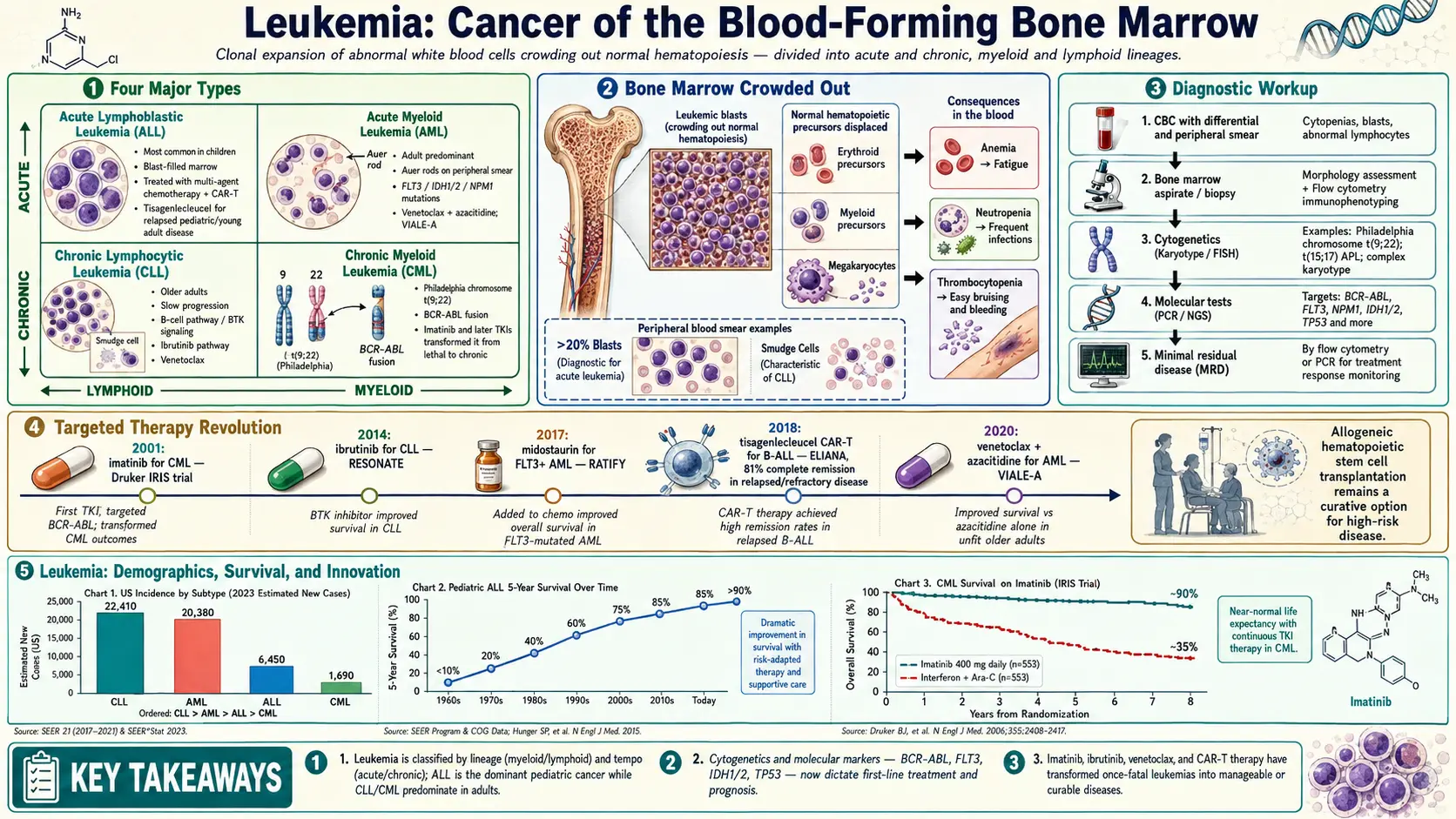
Table of Contents
How Leukemia Starts
Leukemia is a type of cancer that originates in the blood-forming tissues, such as the bone marrow and lymphatic system. It results in the excessive production of abnormal white blood cells, which impairs the body’s ability to fight infections.
Types of Leukemia
The names carry two facts. "Acute" means the disease moves fast and "chronic" means it usually moves slowly. "Lymphocytic" and "myeloid" name the family of blood cell that has gone wrong.
1. Acute Leukemia
- Acute Lymphocytic Leukemia (ALL): Most common in children but can occur in adults.
- Acute Myeloid Leukemia (AML): Affects adults more frequently but can occur in children as well.
2. Chronic Leukemia
- Chronic Lymphocytic Leukemia (CLL): Common in older adults and may progress slowly over years.
- Chronic Myeloid Leukemia (CML): Typically affects adults and may have a slow progression before accelerating.
- Hairy Cell Leukemia (HCL): A rare, slow-growing leukemia of B cells, covered on its own page.
Causes and Risk Factors
The exact cause of leukemia is not known, but several risk factors have been identified:
- Genetic mutations: Certain genetic disorders like Down syndrome can increase risk.
- Exposure to radiation: High levels of radiation, such as from radiation therapy or nuclear exposure, can contribute.
- Family history: A history of leukemia in the family can increase risk.
- Previous cancer treatment: Chemotherapy and radiation therapy for other cancers can be a risk factor.
- Exposure to chemicals: Prolonged exposure to chemicals like benzene is linked to a higher risk of leukemia.
Symptoms of Leukemia
Common symptoms include:
- Fatigue and weakness
- Frequent or severe infections
- Unexplained weight loss
- Easy bruising or bleeding
- Swollen lymph nodes
- Pain or tenderness in the bones
- Fever or night sweats
Diagnosis and Treatment
Diagnosis
Diagnosis of leukemia involves several tests and procedures, including:
- Blood tests: To check for abnormal levels of white blood cells, red blood cells, or platelets.
- Bone marrow biopsy: A sample of bone marrow is taken to identify leukemia cells.
- Genetic tests: To detect specific mutations related to leukemia.
Treatment Options
Common treatment methods include:
- Chemotherapy: Uses drugs to destroy leukemia cells. It remains central in acute leukemia. It is no longer the main approach for every type: chronic myeloid leukemia is treated with targeted drugs such as imatinib, and chronic lymphocytic leukemia now has two main approaches, continuous Bruton's tyrosine kinase inhibitors and fixed-duration regimens built on venetoclax.
- Radiation therapy: Uses high-energy radiation to target and kill cancer cells.
- Stem cell transplant: Replaces diseased bone marrow with healthy stem cells.
- Targeted therapy: Drugs that specifically target the abnormalities in cancer cells.
- Immunotherapy: Uses the immune system against cancer cells. The kinds include a patient's own T cells engineered to find leukemia (tisagenlecleucel) and an antibody joined to a cell-killing drug (inotuzumab ozogamicin).
Recent Trial Results by Type
- Chronic lymphocytic leukemia: A UK trial found 5-year progression-free survival of 93.9% with ibrutinib-venetoclax, 79.0% with ibrutinib alone and 58.1% with older chemotherapy-based treatment (fludarabine, cyclophosphamide and rituximab). The CLL17 trial (2026) found time-limited venetoclax treatment was not inferior to continuous ibrutinib at 3 years, with about 80% free of progression in all groups.
- Acute lymphoblastic leukemia: In the E1910 trial (2024), adults aged 30 to 70 in remission with no measurable disease had 3-year survival of 85% when the antibody-based drug blinatumomab was added to chemotherapy, against 68% with chemotherapy alone. More nerve and mental-health side effects were reported with blinatumomab.
- Acute myeloid leukemia: For older or frailer people who cannot have intensive chemotherapy, azacitidine plus venetoclax gave a median survival of 14.7 months against 9.6 months with azacitidine alone, with fever and low white cells in 42% against 19% (VIALE-A, 2020). The 2022 European LeukemiaNet recommendations updated the risk classes for this disease.
- Chronic myeloid leukemia: Asciminib, a newer targeted drug, reached a major molecular response in 74.1% at 96 weeks, against 52.0% with other first-line targeted drugs chosen by doctors, with fewer stops for side effects than second-generation drugs (ASC4FIRST, 2026).
Prognosis
The prognosis for leukemia varies based on factors such as the type of leukemia, patient’s age, and overall health. Early detection and advances in treatment have significantly improved outcomes for many patients.
The outlook differs widely by type and age. Long-term survival in childhood acute lymphoblastic leukemia is approaching 90%. In chronic myeloid leukemia treated with imatinib, overall survival at 5 years was 89% and an estimated 7% progressed to a more advanced phase. In older or frailer people with acute myeloid leukemia who cannot have intensive chemotherapy, median survival was 14.7 months on azacitidine plus venetoclax.
Historical Background
The early history of leukemia reaches back 200 years, with descriptions by Peter Cullen (1811), Alfred Velpeau (1825) and Alfred Donné (1844). In 1845 John Hughes Bennett in Scotland named the disease leucocythemia, and that same year Rudolf Virchow in Germany reported the reversed balance of white and red blood cells. Virchow introduced the name leukämie in 1847 (from the Greek "leukos" meaning white and "haima" meaning blood). Sidney Farber’s pioneering use of aminopterin in 1947 to achieve the first remission in childhood leukemia marked the dawn of modern chemotherapy.
Key Research Papers
- Kantarjian HM, DeAngelo DJ, Stelljes M, et al. Inotuzumab ozogamicin versus standard therapy for acute lymphoblastic leukemia (INO-VATE ALL). N Engl J Med. 2016;375(8):740-753. — doi:10.1056/NEJMoa1509277
- Maude SL, Laetsch TW, Buechner J, et al. Tisagenlecleucel in children and young adults with B-cell lymphoblastic leukemia (ELIANA). N Engl J Med. 2018;378(5):439-448. — doi:10.1056/NEJMoa1709866
- Druker BJ, Guilhot F, O’Brien SG, et al. Five-year follow-up of patients receiving imatinib for chronic myeloid leukemia (IRIS trial). N Engl J Med. 2006;355(23):2408-2417. — doi:10.1056/NEJMoa062867
- Byrd JC, Brown JR, O’Brien S, et al. Ibrutinib versus ofatumumab in previously treated chronic lymphocytic leukemia (RESONATE). N Engl J Med. 2014;371(3):213-223. — doi:10.1056/NEJMoa1400376
- DiNardo CD, Stein EM, de Botton S, et al. Durable remissions with ivosidenib in IDH1-mutated relapsed or refractory AML. N Engl J Med. 2018;378(25):2386-2398. — doi:10.1056/NEJMoa1716984
- Döhner H, Estey E, Grimwade D, et al. Diagnosis and management of AML in adults: 2017 ELN recommendations. Blood. 2017;129(4):424-447. — doi:10.1182/blood-2016-08-733196
- Hunger SP, Mullighan CG. Acute lymphoblastic leukemia in children. N Engl J Med. 2015;373(16):1541-1552. — doi:10.1056/NEJMra1400972
- Hallek M, Cheson BD, Catovsky D, et al. iwCLL guidelines for diagnosis, indications for treatment, response assessment, and supportive management of CLL. Blood. 2018;131(25):2745-2760. — doi:10.1182/blood-2017-09-806398
- Hochhaus A, Baccarani M, Silver RT, et al. European LeukemiaNet 2020 recommendations for treating chronic myeloid leukemia. Leukemia. 2020;34(4):966-984. — doi:10.1038/s41375-020-0776-2
- Stone RM, Mandrekar SJ, Sanford BL, et al. Midostaurin plus chemotherapy for acute myeloid leukemia with a FLT3 mutation (RATIFY). N Engl J Med. 2017;377(5):454-464. — doi:10.1056/NEJMoa1614359
- Pui CH, Yang JJ, Hunger SP, et al. Childhood acute lymphoblastic leukemia: progress through collaboration. J Clin Oncol. 2015;33(27):2938-2948. — doi:10.1200/JCO.2014.59.1636
- Wei AH, Montesinos P, Ivanov V, et al. Venetoclax plus LDAC for newly diagnosed AML ineligible for intensive chemotherapy (VIALE-C). Blood. 2020;135(24):2137-2145. — doi:10.1182/blood.2020004856
- Döhner H, Wei AH, Appelbaum FR, et al. Diagnosis and management of AML in adults: 2022 recommendations from an international expert panel on behalf of the ELN. Blood. 2022;140(12):1345-1377. — PubMed PMID: 35797463
- Munir T, Girvan S, Cairns DA, et al. Measurable residual disease-guided therapy for chronic lymphocytic leukemia. N Engl J Med. 2025;393(12):1177-1190. — PubMed PMID: 40521799
- Al-Sawaf O, Stumpf J, Zhang C, et al. Fixed-duration versus continuous treatment for chronic lymphocytic leukemia. N Engl J Med. 2026;394(11):1084-1096. — PubMed PMID: 41358601
- Litzow MR, Sun Z, Mattison RJ, et al. Blinatumomab for MRD-negative acute lymphoblastic leukemia in adults. N Engl J Med. 2024;391(4):320-333. — PubMed PMID: 39047240
- DiNardo CD, Jonas BA, Pullarkat V, et al. Azacitidine and venetoclax in previously untreated acute myeloid leukemia. N Engl J Med. 2020;383(7):617-629. — PubMed PMID: 32786187
- Cortes JE, Hughes TP, Wang J, et al. Asciminib demonstrates superior efficacy and safety in newly diagnosed chronic myeloid leukemia in the ASC4FIRST trial. Blood. 2026;147(13):1433-1446. — PubMed PMID: 41397287
- Kampen KR. The discovery and early understanding of leukemia. Leuk Res. 2012;36(1):6-13. — PubMed PMID: 22033191
PubMed Topic Searches
The following PubMed topic searches surface the current peer-reviewed literature on Leukemia. Each link opens a live PubMed query; results update as new papers are indexed.
- PubMed: Search: leukemia
- PubMed: Search: acute myeloid leukemia
- PubMed: Search: acute lymphoblastic leukemia
- PubMed: Search: chronic lymphocytic leukemia
- PubMed: Search: chronic myeloid leukemia
- PubMed: Search: leukemia imatinib tyrosine kinase inhibitor
- PubMed: Search: leukemia allogeneic stem cell transplantation
- PubMed: Search: leukemia CAR T cell therapy
- PubMed: Search: leukemia FLT3 inhibitor
- PubMed: Search: leukemia venetoclax
- PubMed: Search: leukemia minimal residual disease
- PubMed: Search: pediatric leukemia
Connections
- Oncology
- Cancer Overview
- Lymphoma
- Multiple Myeloma
- Metastatic Cancers
- Chronic Myeloid Leukemia (CML)
- Anemia
- Vitamin B9 (Folate)
- Vitamin D3
- Turmeric
- Reishi Mushroom
- Turkey Tail Mushroom
- Gerson Therapy Cancer Treatment
- Complete Blood Count
- Sarcoma
- Fatigue
- Pesticides
- Thrombocytopenia
- Disseminated Intravascular Coagulation
- Sodium Benzoate
- Acute Myeloid Leukemia (AML) — most common acute leukemia in adults.
- Acute Lymphoblastic Leukemia (ALL) — the most common leukemia of childhood.
- Hairy Cell Leukemia (HCL) — rare indolent B-cell leukemia with decade-long remissions after one week of cladribine.
- Bishop & Varmus: the oncogene discovery behind imatinib — how understanding BCR-ABL turned chronic myeloid leukaemia from a fatal disease into a managed one
- Fischer & Krebs — reversible phosphorylation — why a kinase inhibitor works at all