Nattokinase: Fibrinolytic Enzyme, Dosing, and Cardiovascular Evidence
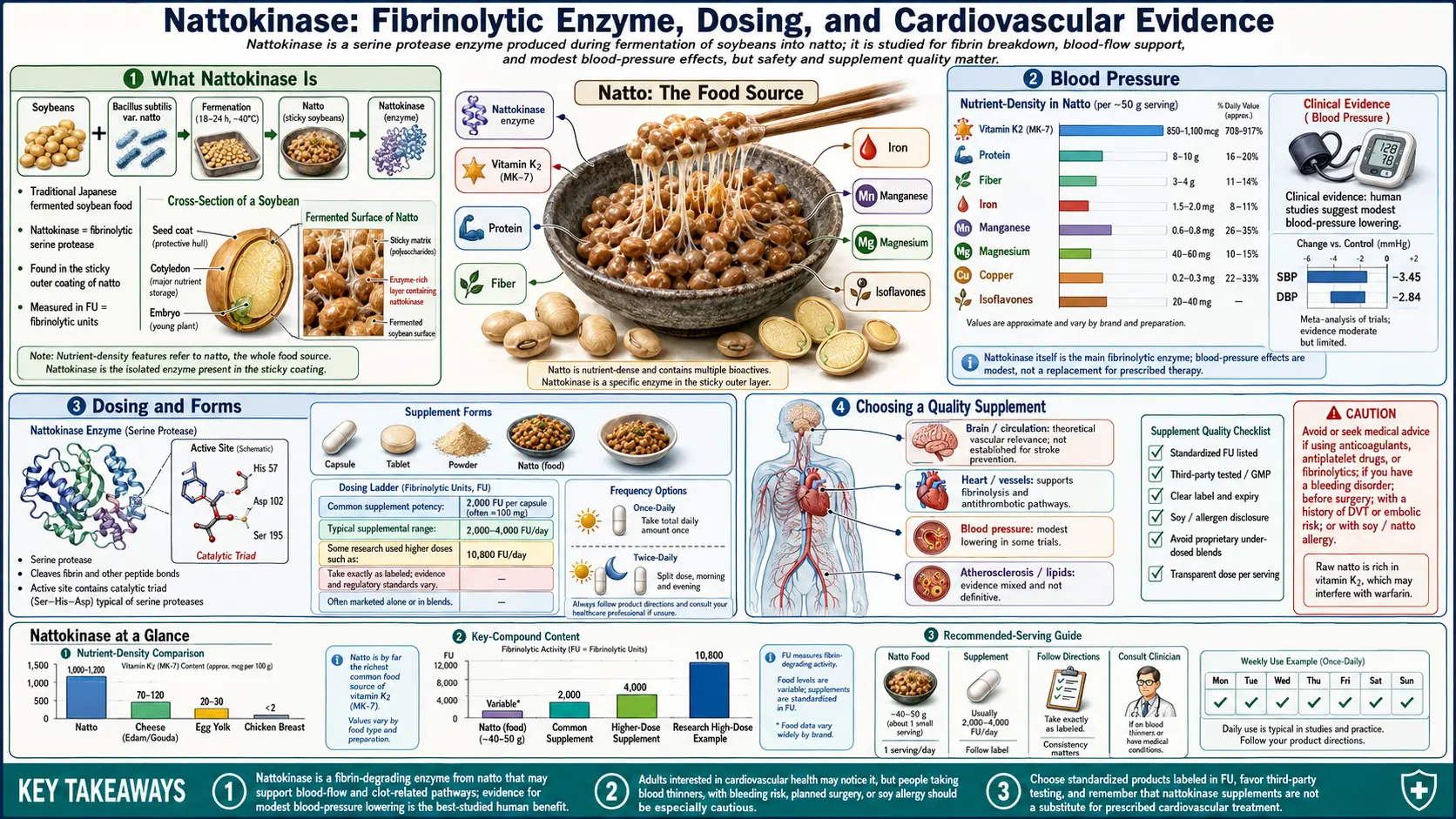
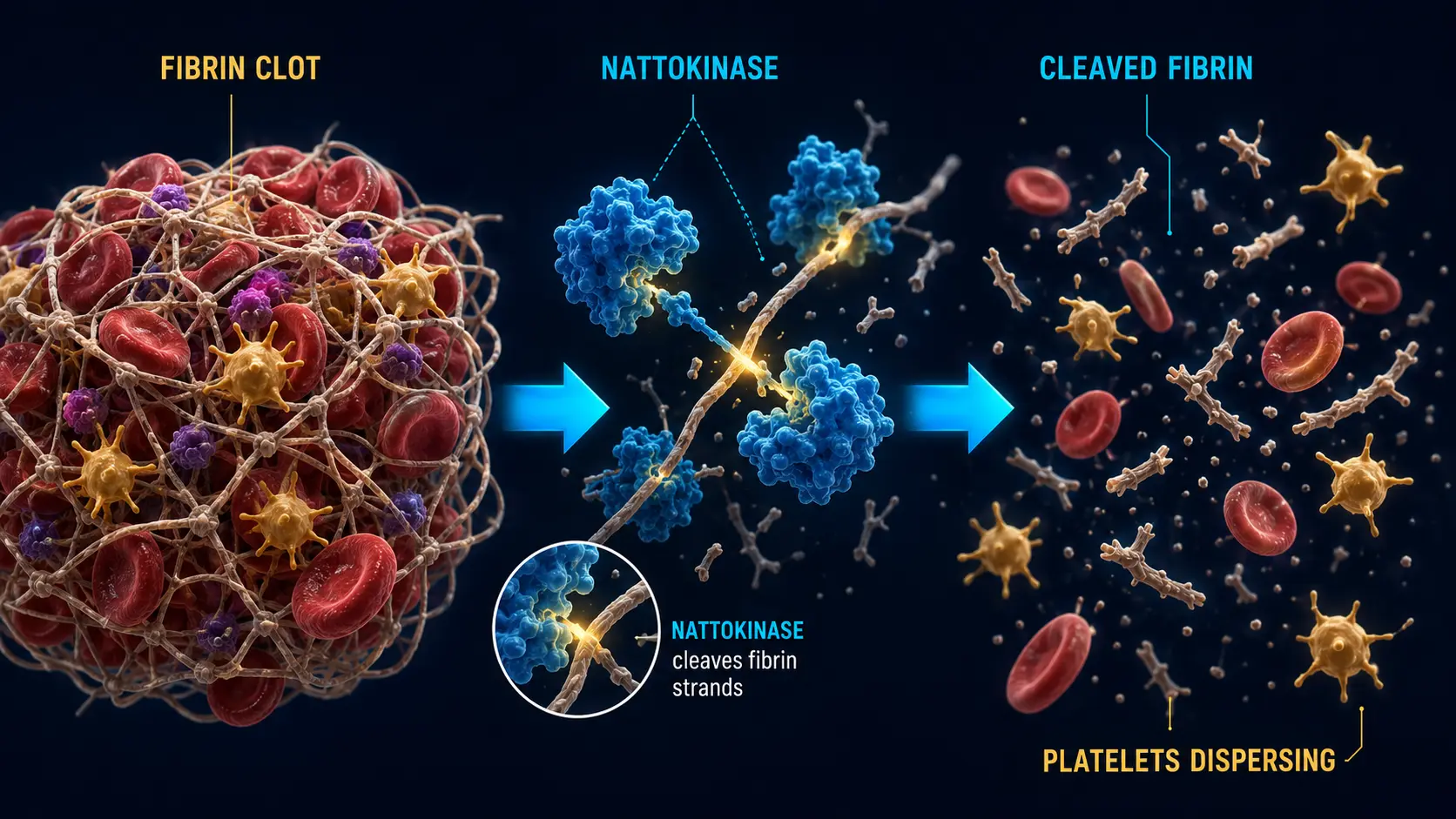
Nattokinase is a serine protease enzyme purified from natto, the traditional Japanese fermented soybean food. Discovered by Dr. Hiroyuki Sumi in 1980 while studying thrombolysis, nattokinase has since become one of the most widely studied natural fibrinolytic agents. It dissolves fibrin — the protein scaffold of blood clots — through a combination of direct enzymatic cleavage and indirect activation of the body's plasminogen system. As a supplement, nattokinase is most often used for cardiovascular support: thinning blood, reducing arterial stiffness, modestly lowering blood pressure, and supporting healthy circulation.
This page covers nattokinase as a standardized supplement measured in fibrinolytic units (FU), distinct from the whole food natto. For the food itself — preparation, taste, vitamin K2 content, and cultural notes — see the Natto page.
Table of Contents
- What Nattokinase Is
- Mechanism of Action
- Cardiovascular Evidence
- Blood Pressure
- Cholesterol and Lipids
- Arterial Stiffness and Atherosclerosis
- Dosing and Forms
- Safety, Bleeding Risk, and Drug Interactions
- Vitamin K2 in Natto vs Nattokinase Capsules
- Choosing a Quality Supplement
- Research Papers and References
- Connections
- Featured Videos
What Nattokinase Is
Nattokinase (NK) is a 275-amino-acid serine protease (EC 3.4.21.62) produced by the bacterium Bacillus subtilis var. natto during fermentation of cooked soybeans. The enzyme is concentrated in the sticky, stringy coating of natto and accounts for much of its proteolytic activity. Commercial nattokinase is extracted from natto fermentation broth, purified, and standardized by activity rather than by mass.
The standard activity unit is the fibrinolytic unit (FU), defined by the rate at which a sample dissolves a fibrin plate under controlled conditions. Reputable supplements list FU per capsule explicitly — usually 2,000 FU, 4,000 FU, 6,000 FU, or 10,000 FU per capsule. Studies have used doses ranging from 2,000 to 10,000 FU per day; typical supplement protocols deliver 2,000–4,000 FU once or twice daily.
Mechanism of Action
Nattokinase has at least four documented mechanisms relevant to cardiovascular health:
- Direct fibrinolysis — nattokinase directly cleaves fibrin, the structural protein of blood clots, in a manner similar to (but distinct from) the body's own plasmin. Unlike most dietary enzymes, oral nattokinase appears to retain measurable activity in serum after absorption, particularly in enteric-coated formulations.
- Plasminogen activation — nattokinase increases tissue plasminogen activator (tPA) activity and decreases plasminogen activator inhibitor-1 (PAI-1), pushing the system toward endogenous clot dissolution.
- Reduced fibrinogen — multiple human trials have shown reductions in plasma fibrinogen, factor VII, and factor VIII activity. Lower fibrinogen translates to lower whole-blood viscosity and reduced thrombotic tendency.
- Endothelial effects — nattokinase appears to improve flow-mediated dilation and reduce markers of endothelial dysfunction, possibly through reductions in oxidized LDL and inflammatory mediators.
The bioavailability question has been controversial: some critics argue large protein molecules cannot survive gastric digestion. Pharmacokinetic studies, however, document detectable changes in plasma fibrinolytic markers within 2–6 hours of an oral dose, and rat studies show absorption of intact enzyme through the intestinal wall. Enteric-coated capsules outperform uncoated forms.
Cardiovascular Evidence
The strongest evidence base supports nattokinase for cardiovascular markers rather than hard outcomes (no large mortality trials yet exist). Notable findings:
- Improved fibrinolytic activity — multiple randomized trials show acute and sustained increases in tPA activity and decreases in PAI-1 with daily dosing
- Reduced fibrinogen — meta-analyses show ~7–10% reductions in plasma fibrinogen with 4–8 weeks of daily 2,000 FU
- Reduced D-dimer in selected populations — especially in patients with elevated baseline (e.g., post-COVID hypercoagulability research is active in this area)
- Improved blood viscosity — small but consistent reductions in whole-blood viscosity
Blood Pressure
A 2008 randomized trial in 86 mildly hypertensive adults given 2,000 FU/day for 8 weeks showed average reductions of 5.6 mmHg systolic and 2.8 mmHg diastolic vs placebo. A 2016 follow-up study in 70 patients confirmed similar magnitude reductions. The mechanism is partly fibrinolytic (improved circulation) and partly an angiotensin-converting enzyme (ACE) inhibitory action that nattokinase shares with several food-derived peptides.
Magnitude is modest — not a substitute for lifestyle change or prescribed antihypertensives in moderate-to-severe hypertension — but meaningful as adjunctive support for pre-hypertension or stage 1 hypertension. Combined with magnesium, potassium-rich foods, and anti-inflammatory diet, the cumulative effect can be clinically significant.
Cholesterol and Lipids
Nattokinase has shown modest effects on lipid profiles: total cholesterol reductions of 7–15% and LDL reductions of 10–20% in some trials, often paired with HDL increases. The mechanism likely involves reduced LDL oxidation and improved hepatic lipid handling rather than direct enzymatic cholesterol clearance. The largest single trial (2009, Korea) showed nattokinase combined with red yeast rice produced LDL reductions comparable to low-dose statins, though without the muscle pain, hepatic enzyme elevations, or coenzyme Q10 depletion that statins can cause.
Arterial Stiffness and Atherosclerosis
Two small trials measured carotid intima-media thickness (CIMT) and brachial-ankle pulse wave velocity (baPWV) before and after several months of nattokinase. Both showed slowed progression or modest regression of CIMT and improved arterial compliance. The mechanism is hypothesized to be a combination of plaque stabilization (via fibrinolysis), reduced inflammation, and direct effects on smooth muscle cells. These are early findings and need larger replication.
Dosing and Forms
Standard cardiovascular dosing protocols:
- Maintenance / cardiovascular support: 2,000 FU once or twice daily
- Active fibrinolytic support: 4,000–6,000 FU twice daily, often with meals
- Time of day: some practitioners suggest evening dosing because fibrinolytic activity is naturally lowest in the early morning hours, when most cardiovascular events occur. Evidence is suggestive rather than definitive.
- Form: enteric-coated capsules outperform uncoated forms by retaining more activity through gastric pH
- Combination products: often paired with serrapeptase (another proteolytic enzyme), bromelain, or rutin for additive vascular effects
Onset of effect for fibrinolytic markers: hours to days. Onset for blood pressure changes: 4–8 weeks. Stop and reassess if no measurable effect after 12 weeks at a therapeutic dose.
Safety, Bleeding Risk, and Drug Interactions
Nattokinase is generally well-tolerated in healthy adults, but its mechanism creates real bleeding-risk considerations.
Contraindications and cautions
- Concurrent anticoagulant therapy — warfarin, apixaban, rivaroxaban, edoxaban, dabigatran. Combining nattokinase with these drugs may significantly raise bleeding risk and should only be done under medical supervision.
- Concurrent antiplatelet therapy — aspirin, clopidogrel, ticagrelor. Same caution.
- Active bleeding disorders — hemophilia, von Willebrand disease, thrombocytopenia
- Recent or planned surgery — stop at least 7 days before any planned procedure
- Recent stroke, especially hemorrhagic stroke
- Pregnancy and lactation — insufficient data; avoid
- Severe hypertension > 180/110 — address the underlying hypertension first
Side effects
Most are mild and dose-related: nausea, mild gastrointestinal discomfort, occasional bruising, infrequent menstrual increase. Allergic reactions are rare; soy allergy is technically separate from nattokinase allergy (the enzyme is purified) but a soy-allergic patient should choose a soy-free preparation.
Vitamin K2 in Natto vs Nattokinase Capsules
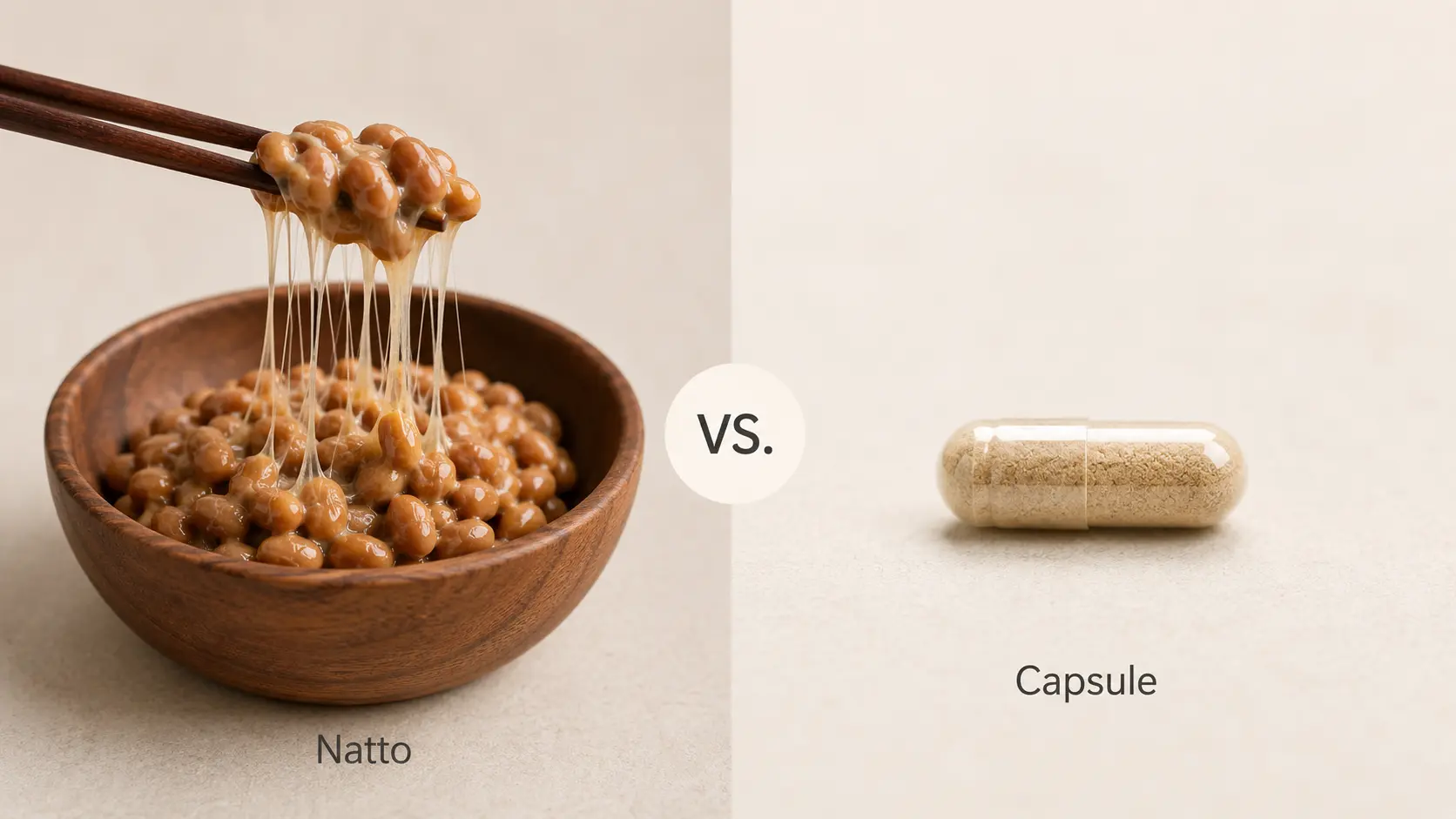
One source of frequent confusion: natto the food is the richest known dietary source of vitamin K2 (specifically MK-7), whereas nattokinase the supplement typically contains little to no vitamin K. The two effects you may be after — fibrinolysis and bone/cardiovascular calcium handling — come from different molecules.
- Want fibrinolytic activity? Take a standardized nattokinase capsule.
- Want vitamin K2 for bone, vascular calcification, and dental health? Eat natto, or take a vitamin K2 (MK-7) supplement, or both.
- Want both? A combined natto-derived product, regular natto consumption, or separate K2 + nattokinase supplements all work.
For more on vitamin K2, see Vitamin K.
Choosing a Quality Supplement
The supplement industry's quality control around nattokinase is uneven. Practical signals of quality:
- Activity stated explicitly in fibrinolytic units (FU), not just milligrams
- Enteric coating to protect activity through gastric pH
- Third-party verification (USP, NSF, Informed Sport, ConsumerLab)
- Vitamin K removed (or quantified) for patients on warfarin
- Manufacturer transparency on the source Bacillus subtilis var. natto strain (NSK-SD™ from Japan Bio Science Laboratory is the most-studied)
- Avoidance of unrealistic claims (e.g., dissolving existing arterial plaque, treating cancer, "miracle clot buster")
Research Papers and References
- Nattokinase fibrinolytic activity — PubMed search
- Nattokinase and blood pressure — PubMed search
- Nattokinase and lipid profile — PubMed search
- Nattokinase and arterial stiffness — PubMed search
- Nattokinase pharmacokinetics — PubMed search
- Nattokinase and PAI-1 — PubMed search
- Nattokinase safety profile — PubMed search
- Bacillus subtilis natto enzyme production — PubMed search
External Authoritative Resources
Connections
- Nattokinase Benefits Deep Dive
- Natto
- Vitamin K
- Anti-Inflammatory Diet
- Magnesium
- Aspirin
- Omega 3 Fatty Acids
- Coronary Calcium Score
- ApoB
- Coagulation Panel
- Lipid Panel
- Resistant Starches
- Hypertension
- Atherosclerosis
- Bacillus Subtilis
- Potassium Rich Foods
- Deep Vein Thrombosis
- Detox and Recovery
- Can You Reverse Coronary Calcium? Plaque Stabili
Featured Videos

Understanding ME-CFS and Courtney Craig — Can you treat MICROCLOTS naturally? Dr Courtney Craig Explains Nattokinase Treatment for ME/CFS

Natural Informant w/ Danny Curtin — Nattokinase: We Tested Them All... Which Products Can You Trust?
Dr. Sascha Gail — Nattokinase: Natürliches Blutverdünner-Supplement – oder gefährlicher Hype
Nick Norwitz MD PhD — Can Nattokinase Reverse Atherosclerosis?
Michigan Foot Doctors — Serrapeptase vs Nattokinase [Benefits, Side Effects, Does it Work?]
Natural Informant w/ Danny Curtin — Nattokinase | Serrapeptase | Lumbrokinase: From Novice To Expert, All Your Questions Answered & More
Michigan Foot Doctors — Lumbrokinase vs Nattokinase vs Serrapeptase [Benefits, Side Effects]
Natural Informant w/ Danny Curtin — Nattokinase: Can You Take Too Much? Everything You Need To Know...
Iron Mike Biohacking — Was ist Nattokinase? Herkunft, Wirkung, Dosierung usw. (mit Evidenz)

tvberlin — Nattokinase: Das müssen Sie wissen! | Naturmedizin | QS24 Gesundheitsfernsehen
Lily Johnston, MD MPH — Aspirin vs Nattokinase: Can a Supplement Replace This Drug? (and other questions!)

Natural Informant w/ Danny Curtin — Nattokinase Supplements Reviewed: Insights On Potency, Purity & Best Value
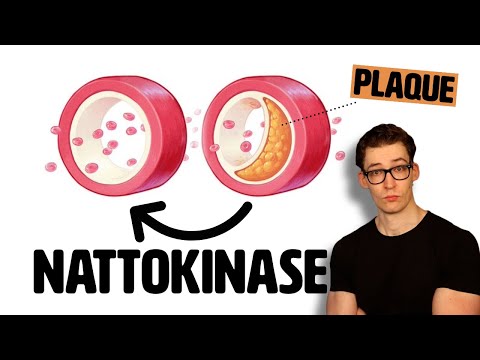
Physionic — Nattokinase: Plaque Reversing Supplement, or Biased Science?

Robert Franz — Achtung! Nattokinase und NKCP bei Spike Proteinen
Natural Informant w/ Danny Curtin — High Dose Nattokinase Benefits “They” Want Hidden…

York Cardiology — Nattokinase and the heart