BPA, Plastics, and Food Contact Chemicals
Table of Contents
- BPA (Bisphenol A)
- BPA Substitutes: BPS, BPF and Other Bisphenols
- Phthalates
- PFAS: "Forever Chemicals"
- Plastic Migration Into Food
- Estrogenic Activity and Reproductive Findings
- Developmental Effects
- Cancer Links
- Microplastics in Food and Water
- The Scale of the Problem
- What Studies Report About Lowering Exposure
- Key Research Papers
- Connections
- Featured Videos
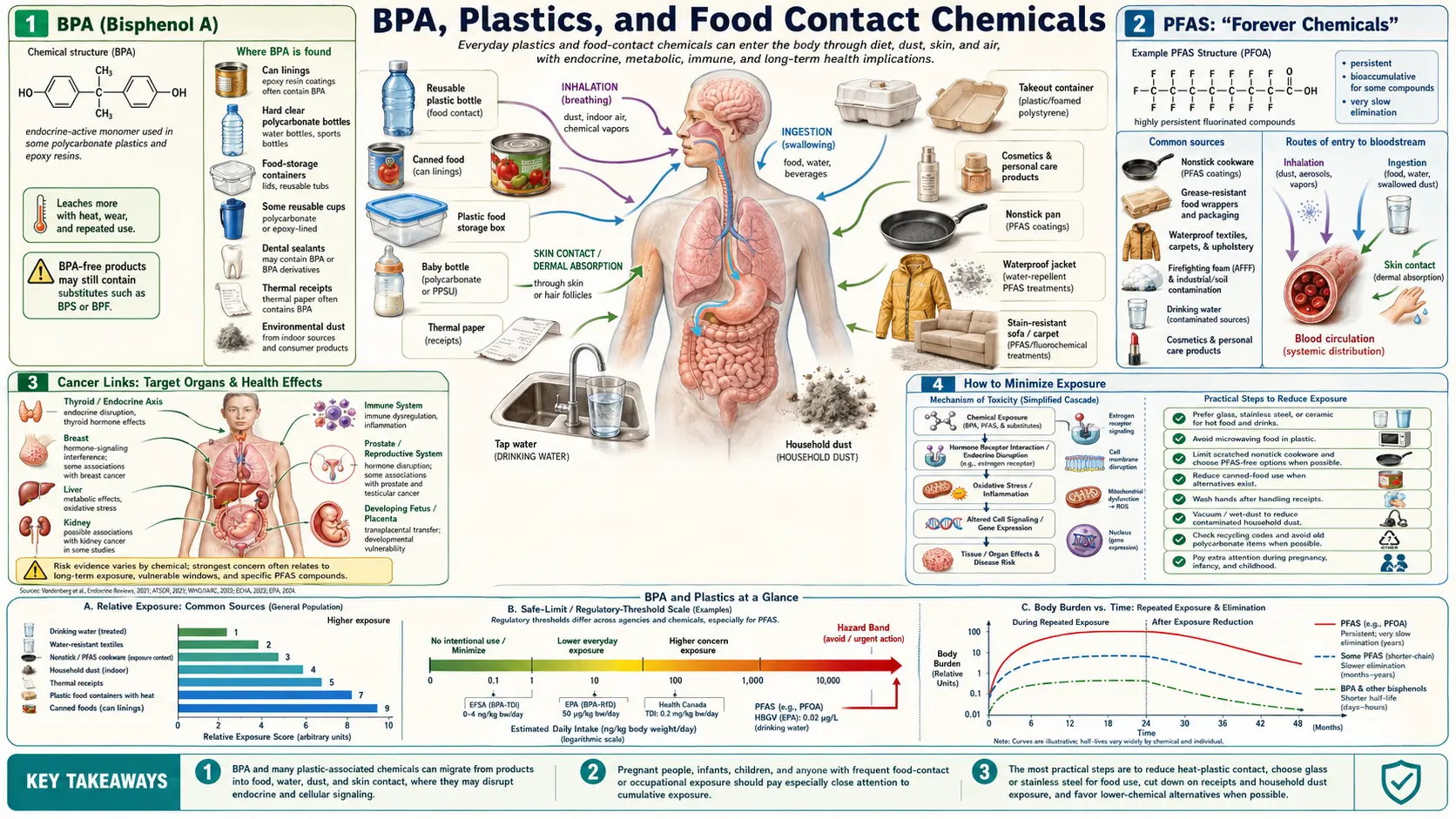
Food contact materials — packaging, can linings, containers and processing equipment — are one route by which chemicals reach food. A 2024 systematic review counted more than 14,000 known food contact chemicals, of which over 1,800 are known to migrate from food contact articles; the authors found evidence that 3,601 of them have been detected in people, and noted that many have hazard properties of concern while others have never been tested for toxicity (Geueke 2024). Bisphenol A (BPA), its substitutes, phthalates and PFAS are among the most studied. Studies link some of them to endocrine, reproductive, developmental, and immune effects, mostly in animal and observational human research; regulators have reached different conclusions about BPA, with the European Union banning it in food contact materials and the US FDA describing it as safe at current levels (Regulation (EU) 2024/3190; FDA).
Replacing one restricted chemical with a closely related one that turns out to have similar hazards is called a “regrettable substitution”; EU researchers describe insufficient safety data on BPA alternatives as a reason for that concern (Aiello-Holden 2026).
BPA (Bisphenol A)
- What it is: BPA is an industrial chemical used to make polycarbonate, a hard, clear plastic, and epoxy resins that line some metal food and beverage cans; it has been used in food packaging since the 1960s (FDA). In the EU it was used mainly to make epoxy resins for varnishes and coatings, including those on the inner and outer surfaces of cans, tins and jar lids and on large food-production tanks (Regulation (EU) 2024/3190)
- Can linings: In a randomized crossover trial of 75 volunteers, one 12-ounce serving of canned soup a day for 5 days raised urinary BPA from a geometric mean of 1.1 µg/L (after fresh soup) to 20.8 µg/L, which the authors describe as more than a 1,000% increase and likely a transient peak of uncertain duration; the trial tested a single soup brand (Carwile 2011)
- Thermal receipts: Free BPA is applied to the outer layer of thermal receipt paper at about 20 mg per gram of paper. When volunteers held receipts right after using a hand sanitizer containing skin-penetration enhancers and then ate French fries with their hands, serum unconjugated BPA rose to an average maximum of about 7 ng/mL within 90 minutes (Hormann 2014)
- Widespread exposure: BPA was detected in the urine of 92.6% of 2,517 people aged 6 and older in the 2003–2004 US National Health and Nutrition Examination Survey; children had higher concentrations than adolescents, who had higher concentrations than adults (Calafat 2008). In NHANES 2013–2014 it was detected in 95.7% of samples (Lehmler 2018)
- Low doses and dose–response: A 2012 review argues that endocrine-disrupting chemicals, BPA among them, can have effects at low doses that are not predicted by effects at higher doses (non-monotonic dose–response curves), and that this challenges the “dose makes the poison” assumption in chemical testing (Vandenberg 2012)
- EFSA 2023 re-evaluation: EFSA’s 2015 temporary tolerable daily intake (TDI) was 4 µg/kg body weight per day. Its 2023 re-evaluation identified the immune system as most sensitive to BPA, took an effect on Th17 cells in mice as the critical effect, and set a TDI of 0.2 ng/kg body weight per day. Both mean and 95th-percentile dietary exposures in all age groups exceeded the new TDI by two to three orders of magnitude, and the panel concluded there is a health concern from dietary BPA exposure (EFSA 2023). The EU regulation that followed describes the new TDI as 20,000 times lower than the 2015 temporary value (Regulation (EU) 2024/3190)
- EU ban: Commission Regulation (EU) 2024/3190 of 19 December 2024 prohibits the use of BPA and its salts in the manufacture of food contact adhesives, rubbers, ion-exchange resins, plastics, printing inks, silicones, and varnishes and coatings, and the placing of such articles on the EU market. It also prohibits other hazardous bisphenols and bisphenol derivatives unless authorised, and bans residual BPA in materials made with another bisphenol. Transitional rules let most single-use articles made with BPA be placed on the market until 20 July 2026, and some (packaging for fruit, vegetables and fishery products, and exterior-only can coatings) until 20 January 2028; a derogation covers polysulfone filtration membranes, subject to a requirement that BPA does not migrate into food (Regulation (EU) 2024/3190)
- FDA position: The FDA states that its current perspective, based on its most recent safety assessment, is that BPA is safe at the current levels occurring in foods; a four-year review of more than 300 studies completed in 2014 found nothing to prompt a revision. The FDA amended its regulations to no longer provide for BPA-based materials in baby bottles, sippy cups and infant formula packaging because those uses had been abandoned, and states it is reviewing a filed petition on BPA (FDA)
BPA Substitutes: BPS, BPF and Other Bisphenols
- Substitution: Bisphenol F (BPF) and bisphenol S (BPS) are replacing BPA in products made with polycarbonates and epoxy resins (Lehmler 2018)
- Hormonal activity: A 2015 systematic review of 32 studies (25 in vitro only, 7 in vivo) found that BPS and BPF had hormonal potency in the same order of magnitude as BPA, with similar estrogenic, antiestrogenic, androgenic and antiandrogenic actions, and concluded that they are as hormonally active as BPA (Rochester 2015)
- Wider comparison: A 2025 study tested BPA and 26 alternatives in six cell-based assays. Several close structural relatives activated the estrogen receptor as strongly as or more strongly than BPA; some alternatives without estrogenic activity activated a different receptor (PPARγ), and some inhibited mitochondrial function or were neurotoxic. The authors suggest many alternatives are regrettable substitutes, while identifying one (TMCD) as potentially more benign (Srebny 2025)
- “BPA-free” plastics: In a 2011 cell-assay study, almost all commercially available plastic products sampled leached chemicals with detectable estrogenic activity, including products advertised as BPA-free, some of which released more estrogenic activity than BPA-containing products. Several authors disclosed financial interests in companies working in this area (Yang 2011)
- Human exposure: In NHANES 2013–2014, BPS and BPF were detected in 89.4% and 66.5% of urine samples; median levels in adults (0.37 and 0.35 µg/L) were lower than BPA (1.24 µg/L). The authors describe exposure to the substitutes as almost ubiquitous (Lehmler 2018)
- Regulation: The EU regulation notes that BPS is authorised for use in plastic food contact materials and that EFSA’s 2020 technical report on BPS did not consider its full toxicological dataset; the regulation prohibits hazardous bisphenols other than BPA unless a specific use is authorised (Regulation (EU) 2024/3190)
- Testing gaps: An EU research partnership has prioritised eight BPA alternatives for tiered testing of endocrine disruption, developmental neurotoxicity, immunotoxicity, genotoxicity and carcinogenicity, citing insufficient safety data (Aiello-Holden 2026)
Phthalates
- Use in packaging: Di(2-ethylhexyl) phthalate (DEHP) is a high-production-volume chemical used in plastics and resins for food packaging (Rudel 2011)
- Anti-androgenic effects in animals: Prenatal phthalate exposure impairs testicular function and shortens anogenital distance in male rodents, part of a phthalate-related syndrome of incomplete virilization (Swan 2005)
- Anogenital distance in infants: In 85 boys with prenatal urine samples, higher maternal concentrations of four phthalate metabolites were associated with a shorter-than-expected anogenital index; the authors describe the associations as consistent with the rodent syndrome (Swan 2005)
- Male reproductive outcomes: A 2018 systematic review found robust evidence of an association between DEHP and DBP exposure and male reproductive outcomes (anogenital distance, semen parameters and testosterone for DEHP; semen parameters and time to pregnancy for DBP), moderate evidence for DINP and BBP, and slight evidence for DIBP and DEP (Radke 2018)
- Fast food: Among 8,877 NHANES participants, people with high fast-food intake (34.9% or more of energy) had 23.8% higher DEHP metabolite and 39.0% higher DiNP metabolite levels than non-consumers; no such relationship was seen for BPA (Zota 2016)
- Diet change: When 20 people in five families ate “fresh foods” not canned or packaged in plastic for 3 days, geometric mean DEHP metabolite levels fell by 53–56% and BPA by 66% (Rudel 2011)
PFAS: "Forever Chemicals"
- In food packaging: A 2024 evidence map identified 68 PFAS in food contact materials including paper, plastic and coated metal; long-chain perfluoroalkyl acids are still found, and hazard data exist for only 57% of the PFAS detected in food packaging (Phelps 2024)
- Diet and blood levels: In NHANES 2003–2014, more calories eaten from food prepared at home were associated with lower serum levels of five PFAS, and popcorn consumption with higher levels of four, up to 63% higher PFDA in daily popcorn eaters; the authors suggest migration from microwave popcorn bags as a possible explanation (Susmann 2019)
- Persistence in the body: After contaminated drinking water in Ronneby, Sweden, was replaced, mean estimated serum half-lives were 5.3 years for PFHxS, 3.4 years for PFOS and 2.7 years for PFOA, with about threefold variation between individuals (Li 2018)
- Persistence in the environment: A 2022 analysis concluded that PFOA and PFOS in rainwater often greatly exceed US EPA lifetime drinking-water health advisory levels and that global soils are ubiquitously contaminated through atmospheric deposition (Cousins 2022)
- Immune findings: In a Faroe Islands birth cohort, a doubling of major PFAS in children’s serum at age 5 was associated with 49% lower overall antibody concentrations to tetanus and diphtheria vaccines (Grandjean 2012)
- Cancer classification: In 2023 IARC classified PFOA as carcinogenic to humans (Group 1), on sufficient evidence in animals and strong mechanistic evidence in humans, with limited human evidence for renal cell carcinoma and testicular cancer; PFOS was classified as possibly carcinogenic (Group 2B) (Zahm 2024; IARC)
- US drinking water: EPA’s final drinking-water rule sets enforceable limits of 4.0 parts per trillion for PFOA and PFOS and 10 ppt for PFHxS, PFNA and HFPO-DA, plus a hazard index for mixtures. In May 2026 EPA proposed allowing systems two more years, to 2031, for PFOA and PFOS, and proposed rescinding the limits for PFHxS, PFNA, HFPO-DA and the hazard index (EPA)
Plastic Migration Into Food
- Heat: BPA migrated from new and used polycarbonate drinking bottles at 0.20–0.79 ng per hour; exposure to boiling water (100 °C) increased the migration rate by up to 55-fold (Le 2008)
- Wear and prior use: In the same study, at room temperature BPA migration did not depend on whether the bottle had been used before (Le 2008)
- Fat, contact time, surface and temperature: For styrene from polystyrene containers, the US National Toxicology Program reports that the migration rate is determined mainly by the lipophilicity (fat content) of the food, the container surface area per volume of food, the duration of contact, and food temperature (NTP styrene profile)
- Microwaving and storage: Microwave heating caused the highest release of micro- and nanoplastics from plastic containers and food pouches, compared with refrigeration or room-temperature storage; some containers released 4.22 million microplastic and 2.11 billion nanoplastic particles per square centimetre within 3 minutes. Storage for over six months also released millions to billions of particles (Hussain 2023)
- Heat and sunlight: In a simulation of PET bottled water stored in a vehicle, prolonged sunlight and heat accelerated PET degradation, producing up to 10.03 ppm microplastics within 28 days (Hu J 2025)
- How many chemicals reach people: Over 1,800 food contact chemicals are known to migrate from food contact articles, and 3,601 have been detected in human biomonitoring or exposome data (Geueke 2024)
Estrogenic Activity and Reproductive Findings
- Estrogenic chemicals: BPS and BPF act on hormone receptors with potency similar to BPA (Rochester 2015), and most plastic products tested in one study leached chemicals with estrogenic activity (Yang 2011)
- Male reproduction: Phthalate exposure at levels seen in human populations may have male reproductive effects, particularly DEHP and DBP, according to a 2018 systematic review (Radke 2018)
- Sperm counts: A 2017 meta-regression of 185 studies of 42,935 men found that sperm concentration among men unselected by fertility in North America, Europe, Australia and New Zealand declined by 52.4% between 1973 and 2011; no significant trend was seen in studies from South America, Asia and Africa. The authors state that research on the causes is urgently needed (Levine 2017)
- Transgenerational effects in rats: When pregnant rats were exposed to a mixture of BPA, DEHP and DBP during fetal gonadal sex determination, later generations (F1 and F3) had more disease, including pubertal abnormalities, testis disease, obesity and ovarian disease in F3, along with altered DNA methylation in sperm (Manikkam 2013). This is an animal study
Developmental Effects
- Behavior: In a Cincinnati birth cohort of 244 mothers and children, each 10-fold increase in gestational BPA was associated with more anxious and depressed behavior and poorer emotional control and inhibition at age 3, mainly in girls (scores 9 to 12 points higher), with null or negative changes in boys; childhood BPA exposure was largely not associated with behavior (Braun 2011)
- Immune response: Higher PFAS levels in children were associated with lower vaccine antibody concentrations at ages 5 and 7 (Grandjean 2012)
- Obesogen hypothesis: The “environmental obesogen” hypothesis proposes that some chemicals disrupt the controls over fat-cell development and energy balance; its originators note that environmental estrogens have been reported to perturb fat-cell development in laboratory cell systems (Grün 2006)
- Epigenetic findings in animals: The rat study of a BPA and phthalate mixture reported disease and sperm DNA methylation changes in the great-grandchildren of exposed females (Manikkam 2013)
- Children’s exposure: In US national data, children had higher urinary BPA concentrations than adolescents and adults (Calafat 2008)
Cancer Links
- BPA, breast and prostate: A 2016 review of in vivo studies concluded that there is substantial evidence from rodent studies that early-life BPA exposure below the US EPA’s 1982 oral reference dose increases susceptibility to mammary and prostate cancer, and its authors propose that BPA may be reasonably anticipated to be a human carcinogen in the breast and prostate (Seachrist 2016). These are animal findings
- PFAS: IARC classifies PFOA as carcinogenic to humans (Group 1) and PFOS as possibly carcinogenic (Group 2B); the limited human evidence for PFOA concerns renal cell carcinoma and testicular cancer (Zahm 2024; IARC)
- Styrene: The US National Toxicology Program lists styrene as reasonably anticipated to be a human carcinogen, based on limited evidence in humans (mainly workers), sufficient evidence in experimental animals and supporting mechanistic data; it reports that styrene in packaged foods comes primarily from leaching of monomer from polystyrene containers (NTP styrene profile)
- Vinyl chloride: The monomer of PVC is listed by the NTP as known to be a human carcinogen, based on occupational studies showing it causes hepatic angiosarcoma; the main route of occupational exposure is inhalation (NTP vinyl halides profile)
Microplastics in Food and Water
- Detection in food and people: Studies report micro- and nanoplastics in bottled water (Qian 2024) and released from food containers (Hussain 2023), and in human placenta, breast milk, testis, artery plaque and autopsy tissue (below); more detail is on the Microplastics page linked below
- Weekly intake estimates: A 2021 analysis of 59 publications estimated that people may ingest 0.1–5 g of microplastics a week on global average, describing it as the first attempt to convert microplastic counts into a mass (Senathirajah 2021). Published estimates differ widely; the Microplastics page compares them
- Bottled water: A 2024 study using stimulated Raman scattering microscopy estimated about 2.4 ± 1.3 × 10⁵ micro- and nanoplastic particles per litre of bottled water, about 90% of them nanoplastics — orders of magnitude more than earlier microplastic counts (Qian 2024)
- Nanoplastics and the brain in mice: In mice given polystyrene particles by mouth, nanometre-sized particles — but not larger ones — reached the brain within 2 hours (Kopatz 2023). This is an animal study
- Human brain tissue: A 2025 autopsy study using pyrolysis gas chromatography–mass spectrometry, infrared spectroscopy and electron microscopy reported micro- and nanoplastics, mainly polyethylene, in human kidney, liver and brain; concentrations were higher in 2024 than in 2016 samples, and higher still in brains of people with a documented dementia diagnosis (Nihart 2025). An author correction followed in 2025, and in November 2025 the journal published a letter from other researchers titled “Challenges in studying microplastics in human brain”, together with a reply from the study authors (A Monikh 2025; Campen 2025)
- Method caveats: Methods papers report that lipids in biological samples produce some of the same pyrolysis products as polyethylene, so polyethylene can be falsely identified unless the lipids are removed or the result is verified (Tan 2026); a 2026 systematic review lists lipid interference as a limitation of this method in biological samples (Zhang 2026). A 2026 review states that tissue detection confirms systemic distribution but that no study has yet established true bioaccumulation as distinct from transient presence (Aderinmola 2026)
- Artery plaque — an observational study: In a 2024 prospective observational study of 257 patients having carotid endarterectomy, those whose plaque contained micro- and nanoplastics (polyethylene in 58.4%) had a higher risk of the composite of heart attack, stroke or death from any cause over about 34 months than those without (hazard ratio 4.53; 95% CI 2.00–10.27). The study was observational: it reports an association between plastics in plaque and later events (Marfella 2024)
- Placenta, breast milk, testis: Microplastic fragments were found in 4 of 6 placentas (Ragusa 2021), in 26 of 34 breast milk samples (Ragusa 2022), and in all 23 human testes analysed in one study (Hu CJ 2024)
- Learn more: Microplastics in Food and Water: The Emerging Crisis
The Scale of the Problem
- Number of chemicals: More than 14,000 food contact chemicals are known; of 175 prioritized chemicals frequently detected in food contact materials, 59 lack hazard data (Geueke 2024)
- Exposure in people: 194 food contact chemicals appear in human biomonitoring programs, 80 of them with hazard properties of high concern (Geueke 2024)
- US premarket review: The FDA states that its food contact regulations and food contact notification program assess the likely migration from packaging materials to assure that any migration to food occurs at safe levels (FDA)
- Divergent regulatory conclusions: For BPA, the EU has moved to a ban based on EFSA’s 2023 TDI, while the FDA’s current perspective is that BPA is safe at current levels in food (EFSA 2023; Regulation (EU) 2024/3190; FDA)
- Substitutes: Exposure to BPA substitutes is almost ubiquitous in the US population (Lehmler 2018), and many alternatives lack adequate hazard data (Srebny 2025; Aiello-Holden 2026)
What Studies Report About Lowering Exposure
The studies below measured exposure changes under specific conditions; most are small or laboratory studies. Decisions about personal exposure belong with the reader and a clinician.
- Fresh-food diet: Three days of food not canned or packaged in plastic lowered urinary BPA by 66% and DEHP metabolites by 53–56% in 20 participants (Rudel 2011)
- Canned food: One serving of canned soup a day for 5 days was associated with a more than 1,000% increase in urinary BPA compared with fresh soup (Carwile 2011)
- Heating plastic: Boiling water raised BPA migration from polycarbonate bottles by up to 55-fold (Le 2008), and microwaving released the most micro- and nanoplastics from containers (Hussain 2023)
- Receipts and hand products: Handling thermal receipt paper after using a hand sanitizer with penetration enhancers, then eating with the hands, produced a rapid rise in serum BPA (Hormann 2014)
- Eating out and packaging: Higher fast-food intake was associated with higher phthalate metabolite levels (Zota 2016), and more food prepared at home with lower serum PFAS (Susmann 2019)
- Learn more: Microplastics in Food and Water: The Emerging Crisis
Key Research Papers
Key peer-reviewed research and authoritative sources underpinning the claims on this page. Links resolve to DOI, PubMed, or the issuing agency.
- Geueke B, Parkinson LV, Groh KJ, et al. Evidence for widespread human exposure to food contact chemicals. J Expo Sci Environ Epidemiol. 2025;35(3):330-341. — PubMed PMID: 39285208
- Aiello-Holden K, Bartmann K, Buratti FM, et al. Preventing regrettable substitutions: a proposal for a tiered testing approach for BPA alternatives under the PARC initiative. Front Toxicol. 2026;8:1815869. — PubMed PMID: 42488797
- European Commission. Commission Regulation (EU) 2024/3190 of 19 December 2024 on the use of bisphenol A (BPA) and other bisphenols and bisphenol derivatives with harmonised classification for specific hazardous properties in certain materials and articles intended to come into contact with food, amending Regulation (EU) No 10/2011 and repealing Regulation (EU) 2018/213. Official Journal of the European Union. L series, 31 December 2024. — EUR-Lex: Regulation (EU) 2024/3190
- US Food and Drug Administration. Bisphenol A (BPA): Use in Food Contact Application. Content current as of 20 April 2023. — FDA: BPA in food contact applications; see also FDA: Bisphenol A (BPA) overview and petitions
- Carwile JL, Ye X, Zhou X, et al. Canned soup consumption and urinary bisphenol A: a randomized crossover trial. JAMA. 2011;306(20):2218-20. — PubMed PMID: 22110104
- Hormann AM, Vom Saal FS, Nagel SC, et al. Holding thermal receipt paper and eating food after using hand sanitizer results in high serum bioactive and urine total levels of bisphenol A (BPA). PLoS One. 2014;9(10):e110509. — PubMed PMID: 25337790
- Calafat AM, Ye X, Wong LY, et al. Exposure of the U.S. population to bisphenol A and 4-tertiary-octylphenol: 2003-2004. Environ Health Perspect. 2008;116(1):39-44. — PubMed PMID: 18197297
- Lehmler HJ, Liu B, Gadogbe M, et al. Exposure to Bisphenol A, Bisphenol F, and Bisphenol S in U.S. Adults and Children: The National Health and Nutrition Examination Survey 2013-2014. ACS Omega. 2018;3(6):6523-6532. — PubMed PMID: 29978145
- Vandenberg LN, Colborn T, Hayes TB, et al. Hormones and endocrine-disrupting chemicals: low-dose effects and nonmonotonic dose responses. Endocr Rev. 2012;33(3):378-455. — PubMed PMID: 22419778
- EFSA Panel on Food Contact Materials, Enzymes and Processing Aids (CEP); Lambré C, Barat Baviera JM, Bolognesi C, et al. Re-evaluation of the risks to public health related to the presence of bisphenol A (BPA) in foodstuffs. EFSA J. 2023;21(4):e06857. — PubMed PMID: 37089179
- Rochester JR, Bolden AL. Bisphenol S and F: A Systematic Review and Comparison of the Hormonal Activity of Bisphenol A Substitutes. Environ Health Perspect. 2015;123(7):643-50. — PubMed PMID: 25775505
- Srebny V, Henneberger L, König M, et al. Beyond Estrogenicity: A Comparative Assessment of Bisphenol A and Its Alternatives in In Vitro Assays Questions Safety of Replacements. Environ Sci Technol. 2025;59(33):17457-17470. — PubMed PMID: 40817891
- Yang CZ, Yaniger SI, Jordan VC, et al. Most plastic products release estrogenic chemicals: a potential health problem that can be solved. Environ Health Perspect. 2011;119(7):989-96. — PubMed PMID: 21367689 — Note: the study drew a published comment titled “In vitro detection of estrogen activity in plastic products using a sensitive bioassay: failure to acknowledge limitations” (doi:10.1289/ehp.1103894).
- Rudel RA, Gray JM, Engel CL, et al. Food packaging and bisphenol A and bis(2-ethyhexyl) phthalate exposure: findings from a dietary intervention. Environ Health Perspect. 2011;119(7):914-20. — PubMed PMID: 21450549
- Swan SH, Main KM, Liu F, et al. Decrease in anogenital distance among male infants with prenatal phthalate exposure. Environ Health Perspect. 2005;113(8):1056-61. — PubMed PMID: 16079079
- Radke EG, Braun JM, Meeker JD, et al. Phthalate exposure and male reproductive outcomes: A systematic review of the human epidemiological evidence. Environ Int. 2018;121(Pt 1):764-793. — PubMed PMID: 30336412 — Note: a corrigendum was published in 2019 (PubMed PMID: 30784527).
- Zota AR, Phillips CA, Mitro SD. Recent Fast Food Consumption and Bisphenol A and Phthalates Exposures among the U.S. Population in NHANES, 2003-2010. Environ Health Perspect. 2016;124(10):1521-1528. — PubMed PMID: 27072648
- Phelps DW, Parkinson LV, Boucher JM, et al. Per- and Polyfluoroalkyl Substances in Food Packaging: Migration, Toxicity, and Management Strategies. Environ Sci Technol. 2024;58(13):5670-5684. — PubMed PMID: 38501683
- Susmann HP, Schaider LA, Rodgers KM, et al. Dietary Habits Related to Food Packaging and Population Exposure to PFASs. Environ Health Perspect. 2019;127(10):107003. — PubMed PMID: 31596611
- Li Y, Fletcher T, Mucs D, et al. Half-lives of PFOS, PFHxS and PFOA after end of exposure to contaminated drinking water. Occup Environ Med. 2018;75(1):46-51. — PubMed PMID: 29133598
- Cousins IT, Johansson JH, Salter ME, et al. Outside the Safe Operating Space of a New Planetary Boundary for Per- and Polyfluoroalkyl Substances (PFAS). Environ Sci Technol. 2022;56(16):11172-11179. — PubMed PMID: 35916421
- Grandjean P, Andersen EW, Budtz-Jørgensen E, et al. Serum vaccine antibody concentrations in children exposed to perfluorinated compounds. JAMA. 2012;307(4):391-7. — PubMed PMID: 22274686
- Zahm S, Bonde JP, Chiu WA, et al. Carcinogenicity of perfluorooctanoic acid and perfluorooctanesulfonic acid. Lancet Oncol. 2024;25(1):16-17. — PubMed PMID: 38043561
- International Agency for Research on Cancer. IARC Monographs evaluate the carcinogenicity of perfluorooctanoic acid (PFOA) and perfluorooctanesulfonic acid (PFOS). News release, 1 December 2023. — IARC news release
- US Environmental Protection Agency. Per- and Polyfluoroalkyl Substances (PFAS): Final PFAS National Primary Drinking Water Regulation. Last updated 18 May 2026. — EPA: PFAS drinking water regulation
- Le HH, Carlson EM, Chua JP, et al. Bisphenol A is released from polycarbonate drinking bottles and mimics the neurotoxic actions of estrogen in developing cerebellar neurons. Toxicol Lett. 2008;176(2):149-56. — PubMed PMID: 18155859
- National Toxicology Program. Report on Carcinogens, Fifteenth Edition: Styrene. US Department of Health and Human Services. — NTP RoC: Styrene profile (PDF)
- Hussain KA, Romanova S, Okur I, et al. Assessing the Release of Microplastics and Nanoplastics from Plastic Containers and Reusable Food Pouches: Implications for Human Health. Environ Sci Technol. 2023;57(26):9782-9792. — PubMed PMID: 37343248
- Hu J, Wu Y, Wang J, et al. Unraveling microplastics release in bottled water under in-vehicle conditions using carbon quantum dots. J Hazard Mater. 2025;496:139200. — PubMed PMID: 40652854
- Levine H, Jørgensen N, Martino-Andrade A, et al. Temporal trends in sperm count: a systematic review and meta-regression analysis. Hum Reprod Update. 2017;23(6):646-659. — PubMed PMID: 28981654
- Manikkam M, Tracey R, Guerrero-Bosagna C, et al. Plastics derived endocrine disruptors (BPA, DEHP and DBP) induce epigenetic transgenerational inheritance of obesity, reproductive disease and sperm epimutations. PLoS One. 2013;8(1):e55387. — PubMed PMID: 23359474
- Braun JM, Kalkbrenner AE, Calafat AM, et al. Impact of early-life bisphenol A exposure on behavior and executive function in children. Pediatrics. 2011;128(5):873-82. — PubMed PMID: 22025598
- Grün F, Blumberg B. Environmental obesogens: organotins and endocrine disruption via nuclear receptor signaling. Endocrinology. 2006;147(6 Suppl):S50-5. — PubMed PMID: 16690801
- Seachrist DD, Bonk KW, Ho SM, et al. A review of the carcinogenic potential of bisphenol A. Reprod Toxicol. 2016;59:167-82. — PubMed PMID: 26493093
- National Toxicology Program. Report on Carcinogens, Fifteenth Edition: Vinyl Halides (Selected). US Department of Health and Human Services. — NTP RoC: Vinyl halides profile (PDF)
- Senathirajah K, Attwood S, Bhagwat G, et al. Estimation of the mass of microplastics ingested - A pivotal first step towards human health risk assessment. J Hazard Mater. 2021;404(Pt B):124004. — PubMed PMID: 33130380
- Qian N, Gao X, Lang X, et al. Rapid single-particle chemical imaging of nanoplastics by SRS microscopy. Proc Natl Acad Sci U S A. 2024;121(3):e2300582121. — PubMed PMID: 38190543
- Kopatz V, Wen K, Kovács T, et al. Micro- and Nanoplastics Breach the Blood-Brain Barrier (BBB): Biomolecular Corona's Role Revealed. Nanomaterials (Basel). 2023;13(8):1404. — PubMed PMID: 37110989
- Nihart AJ, Garcia MA, El Hayek E, et al. Bioaccumulation of microplastics in decedent human brains. Nat Med. 2025;31(4):1114-1119. — PubMed PMID: 39901044
- Nihart AJ, Garcia MA, El Hayek E, et al. Author Correction: Bioaccumulation of microplastics in decedent human brains. Nat Med. 2025;31(4):1367. — PubMed PMID: 40164728
- A Monikh F, Materić D, Valsami-Jones E, et al. Challenges in studying microplastics in human brain. Nat Med. 2025;31(12):4034-4035. — PubMed PMID: 41233597
- Campen MJ, West AB, Garcia M, et al. Reply to: Challenges in studying microplastics in human brain. Nat Med. 2025;31(12):4036-4037. — PubMed PMID: 41233598
- Tan Y, Woodward WHH, Becker D, et al. Opportunities to improve polyethylene microparticle analysis by pyrolysis-gas chromatography/mass spectrometry. Microplastics and Nanoplastics. 2026;6:29. — doi:10.1186/s43591-026-00185-6
- Zhang Y, Liu Y, Li G, et al. Thermal analysis techniques for microplastic mass quantification: Methodological challenges and standardization needs. Talanta. 2026;310:130095. — PubMed PMID: 42275720
- Aderinmola JO. Microplastics and nanoplastics in humans: a critical ADME appraisal and the case for quantitative risk assessment. Toxicol Mech Methods. 2026:1-24. — PubMed PMID: 42786943
- Marfella R, Prattichizzo F, Sardu C, et al. Microplastics and Nanoplastics in Atheromas and Cardiovascular Events. N Engl J Med. 2024;390(10):900-910. — PubMed PMID: 38446676
- Ragusa A, Svelato A, Santacroce C, et al. Plasticenta: First evidence of microplastics in human placenta. Environ Int. 2021;146:106274. — PubMed PMID: 33395930
- Ragusa A, Notarstefano V, Svelato A, et al. Raman Microspectroscopy Detection and Characterisation of Microplastics in Human Breastmilk. Polymers (Basel). 2022;14(13):2700. — PubMed PMID: 35808745
- Hu CJ, Garcia MA, Nihart A, et al. Microplastic presence in dog and human testis and its potential association with sperm count and weights of testis and epididymis. Toxicol Sci. 2024;200(2):235-240. — PubMed PMID: 38745431
Connections
Featured Videos