Gut-Brain Axis Restoration Protocols
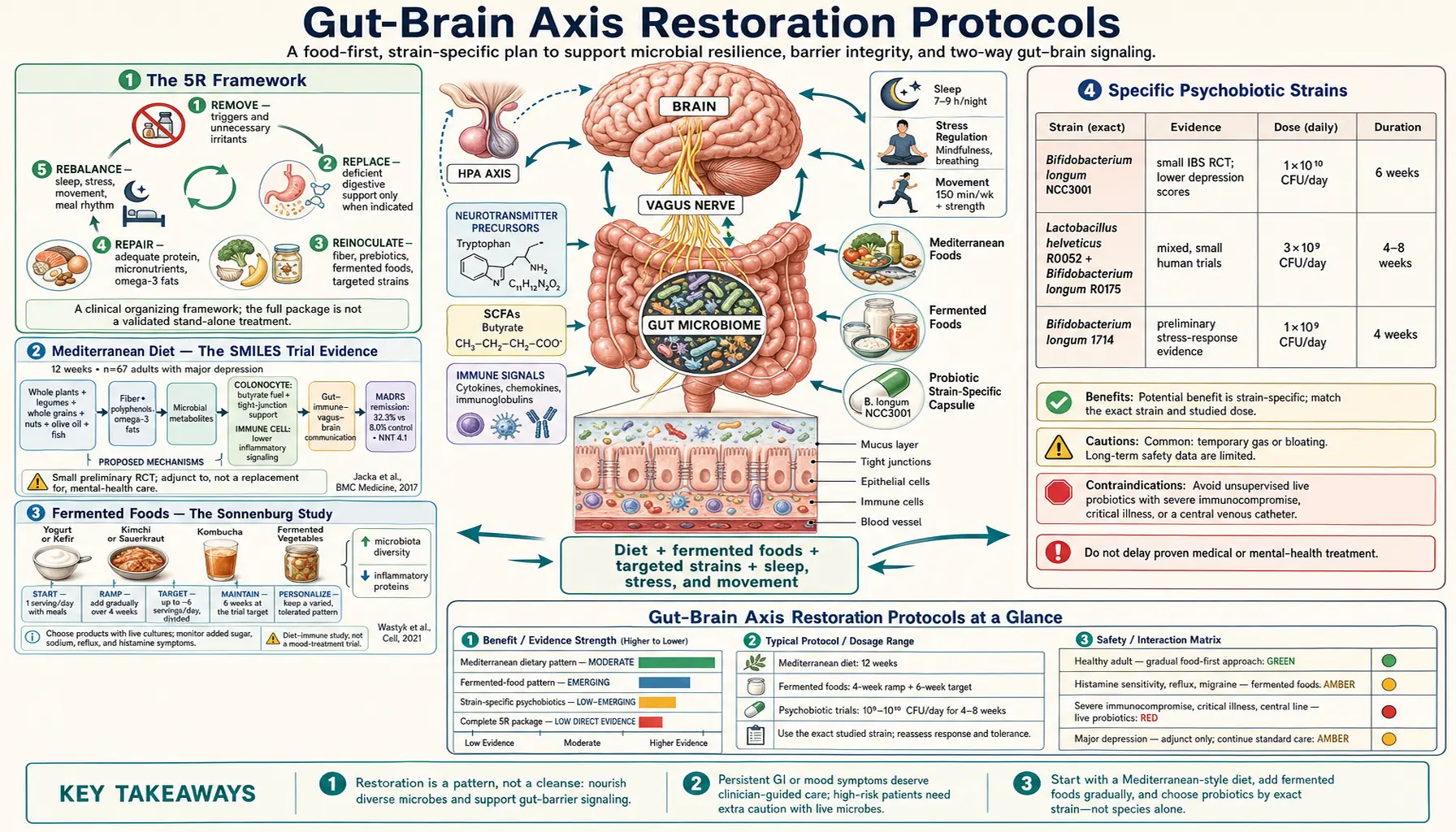
Restoring a dysregulated gut-brain axis requires multi-modal intervention that addresses all four communication pathways simultaneously — vagal tone, microbial composition, intestinal barrier integrity, and stress reactivity. No single intervention reliably reverses the stress-permeability-inflammation feedback loop once it has become entrenched. The Functional Medicine 5R framework (Remove, Replace, Reinoculate, Repair, Rebalance) provides a useful structure, but the highest-impact specific interventions are now well-characterized: the Mediterranean diet, fermented foods (specifically 6 servings/day per the Sonnenburg 2021 Cell study), strain-specific psychobiotic supplementation (Bifidobacterium longum 1714 and L. helveticus R0052 + B. longum R0175), daily slow-paced breathing for vagal tone, L-glutamine and zinc carnosine for barrier repair, and root-cause stress reduction. This page provides an evidence-graded synthesis of what works, what doesn't, and how to sequence interventions for the patient presenting with established gut-brain dysregulation.
Table of Contents
- The 5R Framework
- Mediterranean Diet — The SMILES Trial Evidence
- Fermented Foods — The Sonnenburg Study
- Specific Psychobiotic Strains
- Prebiotic Fiber and Butyrate Production
- Low-FODMAP Diet — When and How
- Barrier Repair Nutrients (L-Glutamine, Zinc Carnosine, DGL)
- Vagal Tone Training Protocol
- Root-Cause Stress Reduction
- Sequencing Interventions — A Practical 12-Week Protocol
- Key Research Papers
- Connections
- Featured Videos
The 5R Framework
The 5R framework, developed in the Functional Medicine community in the 1990s and 2000s, provides a useful organizing structure for gut-brain restoration:
- Remove — identify and eliminate the inputs driving dysregulation: food intolerances and sensitivities (gluten, dairy, lectins, FODMAPs in susceptible patients), unnecessary medications (PPIs, NSAIDs, antibiotics), environmental toxins, occult infections (parasites, SIBO, candida, H. pylori).
- Replace — restore inputs that may be deficient or insufficient: digestive enzymes (bromelain, pancreatic enzymes), hydrochloric acid (betaine HCl when gastric acid is low), bile salts (ox bile when gallbladder is removed or sluggish).
- Reinoculate — restore beneficial microbiome composition: psychobiotic probiotic strains (see below), fermented foods, prebiotic fiber to feed butyrate-producers.
- Repair — provide nutrients and conditions for mucosal regeneration: L-glutamine, zinc carnosine, deglycyrrhizinated licorice (DGL), N-acetyl-glucosamine, slippery elm, marshmallow root, sufficient protein, omega-3 fatty acids.
- Rebalance — address the broader life context that drives recurrence: stress reduction, sleep optimization, vagal tone training, regular movement, social connection, sense of meaning and purpose.
The 5Rs are sequential in concept but often parallel in practice. Most patients benefit from beginning Repair and Rebalance steps in parallel with Remove and Reinoculate, particularly stress reduction and L-glutamine supplementation. The mental shorthand is: stop the offending inputs, add back the missing inputs, fix the substrate, support the long-term context.
It is worth noting that the 5R framework is a Functional Medicine clinical heuristic, not an FDA-recognized treatment protocol. The individual components have varying degrees of evidence support — some excellent (Mediterranean diet for depression, fermented foods for microbiome diversity), some emerging (specific probiotic strains), some thin (extensive food-sensitivity panels with elimination of large food groups). Clinical judgment is essential.
Mediterranean Diet — The SMILES Trial Evidence
The single highest-quality randomized controlled trial of dietary intervention for major depression is the SMILES (Supporting the Modification of lifestyle In Lowered Emotional States) trial conducted by Felice Jacka and colleagues at Deakin University, published in BMC Medicine in 2017. The design:
- Population: 67 adults with moderate-to-severe major depressive disorder, mostly already on antidepressants and/or in psychotherapy
- Intervention arm (33 patients): 7 sessions of dietary counseling over 12 weeks toward a Mediterranean-style diet (whole grains, vegetables, fruits, legumes, low-fat unsweetened dairy, raw unsalted nuts, fish, lean red meats, chicken, eggs, olive oil)
- Control arm (34 patients): 7 sessions of social support (befriending), matched for time and attention
- Primary endpoint: Montgomery-Asberg Depression Rating Scale (MADRS) at 12 weeks
Results:
- MADRS reduction: -11.0 in dietary arm vs. -4.0 in control arm (large effect size, Cohen's d ~1.16)
- Remission (MADRS <10): 32% in dietary arm vs. 8% in control arm
- Effect was independent of weight loss, exercise change, or social support
- Greater dietary adherence correlated with greater clinical improvement
The effect size in SMILES is larger than most pharmaceutical antidepressant trials. Replication by the same group and others has been generally supportive, though effect sizes have been more modest in some trials (the AMMEND trial and the FoodMood trial showed smaller but still positive effects). The combined evidence supports Mediterranean dietary counseling as an evidence-based intervention for major depression.
For practical implementation, the Mediterranean pattern emphasizes:
- Vegetables: 5+ servings/day, especially leafy greens and cruciferous
- Fruits: 2-3 servings/day, especially berries
- Whole grains: 3-5 servings/day (oats, quinoa, brown rice, whole wheat)
- Legumes: 3-5 servings/week
- Nuts: 1 handful/day, especially walnuts
- Fish: 2-3 servings/week, especially oily fish (salmon, sardines, mackerel)
- Extra virgin olive oil: 3+ tablespoons/day
- Limited red meat: <1 serving/week
- Limited processed foods, sugar, and refined grains
The DASH and MIND diets (variations with overlapping principles) have similar evidence support. For more on the Mediterranean diet, see our Mediterranean Diet page.
Fermented Foods — The Sonnenburg Study
The landmark Sonnenburg and Wastyk 2021 Cell study (Stanford) provided the first rigorous comparison of high-fiber vs. high-fermented-foods diets on the human microbiome and immune system. The design:
- Two arms over 10 weeks: high-fiber arm gradually increased fiber from baseline to 45 grams/day; fermented foods arm gradually increased fermented food intake from baseline to 6 servings/day (yogurt, kefir, fermented cottage cheese, kimchi, sauerkraut, fermented vegetables, vegetable brine drinks, kombucha)
- Primary outcomes: 16S rRNA microbiome sequencing, 19 inflammatory cytokine measurements, multidimensional immune cell phenotyping
Key findings:
- Fermented foods arm: Significant increase in microbiome diversity (alpha diversity), decrease in 19 inflammatory markers including IL-6 and IL-12, increase in regulatory T cells. Effects were largest in subjects who started with lower baseline diversity.
- High-fiber arm: Variable response. Subjects with higher baseline fiber-degrading capacity showed expected SCFA increases; subjects with lower baseline capacity showed minimal change and in some cases increased inflammation. This suggests that high-fiber interventions may need to be preceded or accompanied by microbiome restoration in patients with significantly depleted microbiomes.
The clinical implication: for patients with depleted microbiome diversity (typical after antibiotics, in chronic GI disease, or in association with chronic stress), fermented foods may be more reliably beneficial than fiber as a first-line intervention. Fermented foods provide both live microorganisms (transient passengers that influence the resident community) and bacterial metabolites (lactic acid, acetic acid, conjugated linoleic acid, exopolysaccharides) that have direct biological effects.
Practical recommendation: 4-6 servings of fermented foods per day. A serving is roughly 1/2 cup yogurt or kefir, 1/4 cup sauerkraut or kimchi, or 4-8 ounces of kombucha. Important: many commercial yogurts are pasteurized after fermentation and contain no live cultures; check labels for "live and active cultures." For more on fermented foods, see Fermented Foods.
Specific Psychobiotic Strains
Probiotic effects are strain-specific. Buying a generic "Lactobacillus" capsule does not provide the benefits documented for specific researched strains. The strains with the best human evidence for mood, anxiety, and gut-brain effects:
| Strain | Indication | Commercial Product |
|---|---|---|
| Bifidobacterium longum 1714 | Stress and anxiety in healthy adults; emerging depression evidence | Zenflore (Precision Biotics) |
| L. helveticus R0052 + B. longum R0175 | Anxiety, depression, stress | Cerebiome, Probio'Stick |
| Bifidobacterium infantis 35624 | IBS with mood comorbidity | Align |
| L. plantarum 299v | IBS bloating, depression cognitive symptoms | Tuzen, Sense, IBS Support |
| VSL#3 / Visbiome (8-strain blend) | Ulcerative colitis, pouchitis, mood in IBD | Visbiome (medical food) |
| L. rhamnosus GG (LGG) | Antibiotic-associated diarrhea, pediatric anxiety | Culturelle |
| Saccharomyces boulardii | Antibiotic and traveler's diarrhea, C. diff prevention | Florastor |
Important practical points:
- Duration: At least 4-8 weeks of daily use to see meaningful clinical effect. Some effects (e.g., HPA axis dampening) take longer (12 weeks).
- Dose: Manufacturer-specified dose; more is not necessarily better, and the dose used in the underlying studies should be matched.
- Quality: Probiotics are subject to viability degradation. Refrigerated products generally have better viability than shelf-stable, but some shelf-stable strains (especially spore-forming Bacillus species) are intentionally robust.
- Contraindications: Probiotics are generally contraindicated in patients with central venous catheters, severely immunocompromised states, severe acute pancreatitis (one trial showed harm), and short bowel syndrome (SIBO concerns).
- Tracking: The Clinical Guide to Probiotic Products in Canada and US (clinicalguide.usprobioticguide.com) is the most current evidence-based reference mapping strains to indications.
For more general probiotic information, see Probiotics.
Prebiotic Fiber and Butyrate Production
Prebiotics are non-digestible food components that selectively feed beneficial gut bacteria. The most well-studied prebiotics:
- Inulin and fructo-oligosaccharides (FOS) — found in chicory root, Jerusalem artichoke, garlic, onions, leeks, asparagus, bananas. Selectively feeds Bifidobacterium. Can cause bloating and gas at high doses, especially in SIBO patients.
- Galacto-oligosaccharides (GOS) — found in human milk and certain dairy products; also available as supplements. Tend to be better tolerated than inulin/FOS. B. longum 1714 has been shown to ferment GOS effectively.
- Resistant starch — found in cooked-and-cooled potatoes, cooked-and-cooled rice, green bananas, raw oats. Selectively fermented by butyrate-producing bacteria like Faecalibacterium prausnitzii and Roseburia.
- Beta-glucan — found in oats, barley, mushrooms. Modulates immune function and supports butyrate production.
- Psyllium husk — not strictly a prebiotic, but a soluble fiber that supports microbial diversity and is well-tolerated.
- Pectin — found in apples, citrus, berries. Modified citrus pectin is a supplemental form.
The clinical rationale for prebiotic supplementation is to support butyrate-producing bacteria. Butyrate is the primary energy source for colonocytes, a histone deacetylase (HDAC) inhibitor with epigenetic effects, an activator of vagal afferent signaling, and a modulator of microglial function. Diets producing inadequate butyrate (the typical Western diet) produce a measurable colonocyte energy deficit that contributes to barrier dysfunction.
Practical: aim for 25-35 grams of total fiber per day from food sources, with deliberate inclusion of prebiotic-rich foods. If starting from a low baseline, increase fiber gradually over 2-4 weeks to allow microbiome adaptation and reduce bloating. Direct butyrate supplementation (calcium-magnesium butyrate or tributyrin) is available but generally not necessary if fiber intake is adequate.
Low-FODMAP Diet — When and How
FODMAPs (fermentable oligosaccharides, disaccharides, monosaccharides, and polyols) are short-chain carbohydrates that are poorly absorbed in the small intestine and rapidly fermented in the colon. In susceptible patients (typically those with IBS, SIBO, or visceral hypersensitivity), FODMAP-rich foods produce excessive gas production, distension, and pain.
The low-FODMAP diet developed at Monash University is a well-validated intervention for IBS, with approximately 70% of IBS patients reporting symptom improvement in randomized trials. The protocol has three phases:
- Elimination phase (2-6 weeks) — strict avoidance of high-FODMAP foods to establish symptom baseline. This includes wheat (high in fructans), onions and garlic (high in fructans), beans and legumes (high in galacto-oligosaccharides), apples and pears (high in fructose and sorbitol), milk and yogurt with lactose, stone fruits (high in polyols), and many others.
- Reintroduction phase (8-12 weeks) — systematic reintroduction of each FODMAP subgroup one at a time to identify specific triggers. This is the critical phase that many patients skip, leading to unnecessarily restrictive long-term diets.
- Personalization phase (long-term) — ongoing diet that avoids only the specifically identified triggers, allowing maximal dietary variety and microbiome diversity.
Important cautions:
- Low-FODMAP is a diagnostic tool more than a long-term lifestyle. Sustained strict low-FODMAP eating reduces microbiome diversity over time (because it eliminates the very fibers that feed beneficial bacteria) and can paradoxically worsen long-term gut health.
- Work with a registered dietitian or use the Monash FODMAP app to do the reintroduction phase correctly.
- Low-FODMAP is appropriate for IBS, SIBO, and visceral hypersensitivity patterns. It is not appropriate as a general "gut health" diet for asymptomatic patients.
- If a patient with IBS does not respond to low-FODMAP within 6 weeks, alternative diagnoses (SIBO, IBD, food intolerance, bile acid malabsorption) should be reconsidered.
For more on FODMAPs and IBS, see IBS and SIBO.
Barrier Repair Nutrients (L-Glutamine, Zinc Carnosine, DGL)
Several specific nutrients have evidence support for intestinal barrier repair:
- L-Glutamine — the primary fuel for enterocytes (intestinal cells preferentially use glutamine even over glucose). Supplementation at 5-15 grams per day has been shown to reduce intestinal permeability in burn patients, athletes with exercise-induced leaky gut, and patients with inflammatory bowel disease. Mechanism: provides energy substrate for enterocyte regeneration, supports tight junction protein synthesis, reduces oxidative stress. Best taken on an empty stomach in divided doses. Generally well-tolerated. Contraindicated in advanced cirrhosis (ammonia metabolism concerns). See L-Glutamine page.
- Zinc Carnosine — the combination compound (polaprezinc) used clinically in Japan for peptic ulcer disease for decades. Multiple human studies show acceleration of gastric and intestinal mucosal healing, reduction of NSAID-induced leaky gut, and reduction of permeability in athletes. Standard dose: 75 mg twice daily (containing 16 mg zinc and 59 mg L-carnosine). Generally well-tolerated.
- Deglycyrrhizinated Licorice (DGL) — licorice root with glycyrrhizin removed (glycyrrhizin can raise blood pressure). DGL has been used for decades for peptic ulcer disease and chronic gastritis. Acts through stimulation of mucin production and prostaglandin synthesis, supporting the mucus barrier layer. Standard dose: 380-760 mg chewed before meals.
- N-Acetyl-Glucosamine (NAG) — substrate for the mucin glycoprotein synthesis. Used in IBD and chronic gastritis. Standard dose: 500-1500 mg/day.
- Slippery Elm and Marshmallow Root — demulcent herbs that coat the gut lining. Traditional use; mechanism involves mucilage providing a protective film. Helpful for acute symptomatic relief in esophageal and gastric inflammation. Standard dose: 400-500 mg powder mixed with water, 3 times daily.
- Quercetin — flavonoid with mast cell stabilizing effects, reducing histamine release and tight junction disruption. Standard dose: 500-1000 mg twice daily, often combined with bromelain for absorption.
- Omega-3 fatty acids (EPA/DHA) — anti-inflammatory effects, reduce intestinal inflammation. Standard dose: 2-4 grams EPA+DHA per day from fish oil or algae oil. See Omega-3 page.
- Vitamin D3 — supports tight junction integrity and mucosal immunity. Deficiency (serum 25-OH-D below 30 ng/mL) is associated with increased intestinal permeability and IBD risk. Repletion typically requires 2000-5000 IU/day, with monitoring.
- Zinc (separate from carnosine form) — zinc deficiency directly impairs barrier function. Standard supplemental dose: 15-30 mg/day; balance with copper (zinc supplementation depletes copper at higher chronic doses).
A reasonable barrier-repair stack for a patient with documented leaky gut symptoms: L-glutamine 5 g twice daily, zinc carnosine 75 mg twice daily, omega-3 fish oil 2 g EPA+DHA daily, vitamin D3 to maintain serum 25-OH-D at 40-60 ng/mL, plus the dietary interventions above. Run for 8-12 weeks and reassess.
Vagal Tone Training Protocol
Daily vagal tone training is one of the highest-leverage interventions available because it directly targets the dominant gut-to-brain communication channel. The minimum effective protocol:
- Daily slow-paced breathing — 10 minutes at 5-6 breaths per minute (5 seconds in, 5 seconds out). Best done first thing in the morning before checking phone or email. Apps that provide pacing: Breathwrk, Calm, Othership, Inner Balance from HeartMath.
- HRV monitoring — wear a chest strap (Polar H10) or compatible wrist device (Oura, WHOOP) for objective feedback. Track morning RMSSD and 7-day rolling average. Aim for stable or rising trend.
- Cold exposure — cold water face immersion for 30-60 seconds 1-2 times per day, or cold shower for 30-90 seconds at the end of regular shower, or weekly cold plunge if available.
- Aerobic exercise — 150+ minutes per week of moderate-intensity aerobic activity. Zone 2 cardio (heart rate that allows nasal breathing) is particularly effective for vagal tone.
- Sleep optimization — 7-9 hours per night, consistent bedtime and wake time, dark cool room, no screens 1 hour before bed.
- Mindfulness or meditation — 10-20 minutes per day. Loving-kindness meditation has particularly strong HRV evidence.
- Optional: gargling, humming, singing — 2-3 minutes per day. Activates pharyngeal and laryngeal vagal branches.
- Optional: tVNS device — if available, FDA-cleared devices (Cefaly for migraine, gammaCore for cluster headache) are reasonable. Consumer-grade devices have weaker evidence.
See the Vagal Nerve Signaling page for the underlying mechanisms.
Root-Cause Stress Reduction
None of the gut-targeted interventions will produce lasting effect if the underlying chronic stress driver remains in place. Identifying and addressing the root cause of chronic stress is often the most important and most difficult component of restoration. Common categories:
- Work-life conflict — unsustainable workload, toxic workplace, misalignment between values and work. May require boundary-setting, role change, or career change.
- Relationship strain — marital conflict, family conflict, social isolation. May benefit from couples therapy, family therapy, or social network rebuilding.
- Financial stress — chronic financial precarity activates the HPA axis as effectively as acute trauma. Addressing through financial planning, lifestyle restructuring, or income increase.
- Unresolved trauma — childhood trauma, sexual trauma, combat trauma, medical trauma. Evidence-based therapies: EMDR, somatic experiencing, internal family systems, prolonged exposure, cognitive processing therapy.
- Health anxiety — chronic worry about health itself can perpetuate the loop. CBT for health anxiety is effective.
- Grief and loss — unresolved or complicated grief can produce persistent HPA dysregulation.
- Caregiving burden — chronic caregiver stress is a documented driver of inflammatory disease.
Evidence-based therapies that reduce chronic stress and inflammation:
- Cognitive-behavioral therapy (CBT)
- Mindfulness-based stress reduction (MBSR; the Kabat-Zinn 8-week program)
- Mindfulness-based cognitive therapy (MBCT)
- Acceptance and commitment therapy (ACT)
- EMDR for trauma
- Somatic experiencing
- Internal family systems (IFS)
For some patients, pharmaceutical management of the mood/anxiety component is appropriate alongside lifestyle interventions — SSRIs, SNRIs, low-dose tricyclic antidepressants, buspirone, or atypical agents like bupropion or mirtazapine, prescribed by a primary care physician or psychiatrist. The interventions on this page are not replacements for evidence-based pharmacologic treatment of moderate-to-severe depression or anxiety.
Sequencing Interventions — A Practical 12-Week Protocol
A reasonable starting protocol for the typical patient presenting with gut-brain dysregulation (chronic GI symptoms plus mood/anxiety symptoms, no red-flag findings):
Weeks 1-2: Foundation
- Begin Mediterranean-style eating, gradually displacing ultraprocessed foods
- Begin daily 10-minute slow breathing practice (5-6 breaths per minute)
- Establish consistent sleep schedule (target 8 hours)
- Start L-glutamine 5 g morning, 5 g evening (empty stomach)
- Start fish oil 2 g EPA+DHA daily
- Check vitamin D level; supplement if <40 ng/mL
- Identify and begin removing primary stressors
Weeks 3-6: Microbiome restoration
- Continue all above
- Begin fermented foods: 1 serving/day week 3, 2 servings/day week 4, working up to 4-6 servings/day by week 6
- Start psychobiotic supplement: B. longum 1714 (Zenflore) OR L. helveticus R0052 + B. longum R0175 (Cerebiome), per manufacturer dosing
- Begin gradually increasing dietary fiber (especially prebiotic-rich foods)
- Begin or increase aerobic exercise (150 min/week target)
Weeks 7-12: Repair, refine, and rebalance
- Continue all above
- Add zinc carnosine 75 mg twice daily if GI symptoms persist
- Consider DGL 380 mg before meals if upper-GI symptoms (heartburn, gastritis)
- Begin a mindfulness practice (MBSR, app-based meditation, or therapist-guided)
- If specific food triggers suspected, begin elimination-and-reintroduction trial
- Reassess at week 12: symptom diary, stress level, sleep quality, exercise consistency, dietary adherence
Reassessment markers at week 12:
- Substantial improvement (>50% symptom reduction): Continue maintenance, may reduce specific supplements while maintaining diet and lifestyle.
- Modest improvement (20-50%): Continue and add additional targeted interventions (specific elimination diet trial, additional psychobiotic strain, formal psychotherapy).
- Minimal improvement (<20%): Reconsider diagnosis. Possibilities: undiagnosed SIBO, food intolerance, parasite infection, untreated mental health condition requiring pharmacotherapy, autoimmune condition requiring specialist evaluation, mast cell disorder.
Most patients with mild-to-moderate gut-brain dysregulation experience meaningful improvement on this protocol within 8-12 weeks. Patients with severe or complex presentations (chronic IBD, established autoimmune disease, treatment-resistant depression, severe MCAS) typically need specialist care alongside these foundational interventions.
Key Research Papers
- Jacka FN, O'Neil A, Opie R, Itsiopoulos C, Cotton S, Mohebbi M, Castle D, Dash S, Mihalopoulos C, Chatterton ML, Brazionis L, Dean OM, Hodge AM, Berk M (2017). A randomised controlled trial of dietary improvement for adults with major depression (the 'SMILES' trial). BMC Medicine 15(1):23. — Search PubMed
- Wastyk HC, Fragiadakis GK, Perelman D, Dahan D, Merrill BD, Yu FB, Topf M, Gonzalez CG, Van Treuren W, Han S, Robinson JL, Elias JE, Sonnenburg ED, Gardner CD, Sonnenburg JL (2021). Gut-microbiota-targeted diets modulate human immune status. Cell 184(16):4137-4153. — Search PubMed
- Allen AP, Hutch W, Borre YE, et al. (2016). Bifidobacterium longum 1714 as a translational psychobiotic: modulation of stress, electrophysiology and neurocognition in healthy volunteers. Translational Psychiatry 6(11):e939. — PubMed: B. longum 1714
- Messaoudi M, Lalonde R, Violle N, et al. (2011). Assessment of psychotropic-like properties of a probiotic formulation in rats and human subjects. British Journal of Nutrition 105(5):755-764. — PubMed: Messaoudi psychotropic
- Rao R, Samak G (2012). Role of glutamine in protection of intestinal epithelial tight junctions. Journal of Epithelial Biology and Pharmacology 5(Suppl 1-M7):47-54. — PubMed: Glutamine tight junctions
- Mahmood A, FitzGerald AJ, Marchbank T, et al. (2007). Zinc carnosine, a health food supplement that stabilises small bowel integrity and stimulates gut repair processes. Gut 56(2):168-175. — PubMed: Zinc carnosine gut
- Whelan K, Martin LD, Staudacher HM, Lomer MCE (2018). The low FODMAP diet in the management of irritable bowel syndrome: an evidence-based review. Journal of Human Nutrition and Dietetics 31(2):239-255. — PubMed: Low FODMAP IBS
- Lehrer PM, Gevirtz R (2014). Heart rate variability biofeedback: how and why does it work? Frontiers in Psychology 5:756. — PubMed: HRV biofeedback
- Goyal M, Singh S, Sibinga EM, et al. (2014). Meditation programs for psychological stress and well-being: a systematic review and meta-analysis. JAMA Internal Medicine 174(3):357-368. — PubMed: Meditation meta-analysis
- Liu RT, Walsh RFL, Sheehan AE (2019). Prebiotics and probiotics for depression and anxiety: a systematic review and meta-analysis of controlled clinical trials. Neuroscience & Biobehavioral Reviews 102:13-23. — PubMed: Probiotics depression meta
- Mosaffa-Jahromi M, Lankarani KB, Pasalar M, et al. (2016). Efficacy and safety of enteric coated capsules of anise oil to treat irritable bowel syndrome. Journal of Ethnopharmacology. PubMed: Anise oil IBS
- Berk M, Williams LJ, Jacka FN, et al. (2013). So depression is an inflammatory disease, but where does the inflammation come from? BMC Medicine 11:200. — PubMed: Berk depression inflammation
PubMed Topic Searches
- PubMed: Mediterranean diet depression
- PubMed: Fermented foods microbiome
- PubMed: Strain-specific psychobiotic
- PubMed: L-glutamine barrier repair
- PubMed: MBSR inflammation
Connections
- All Remedies
- Gut-Brain Axis Hub
- Gut-Brain Benefits Deep-Dive
- Vagal Nerve Signaling
- Serotonin and Mood
- Stress and Permeability
- Gut Healing
- Stress Management
- Mediterranean Diet
- Elimination Diet
- Natural Anxiety Relief
- Fermented Foods
- Probiotics
- L-Glutamine
- Omega-3 Fatty Acids
- Irritable Bowel Syndrome
- Covered in depth on its own page: Fermented Foods