Vitamin K2 (Menaquinone): Forms, Food Sources, and the Research on Bones and Arteries
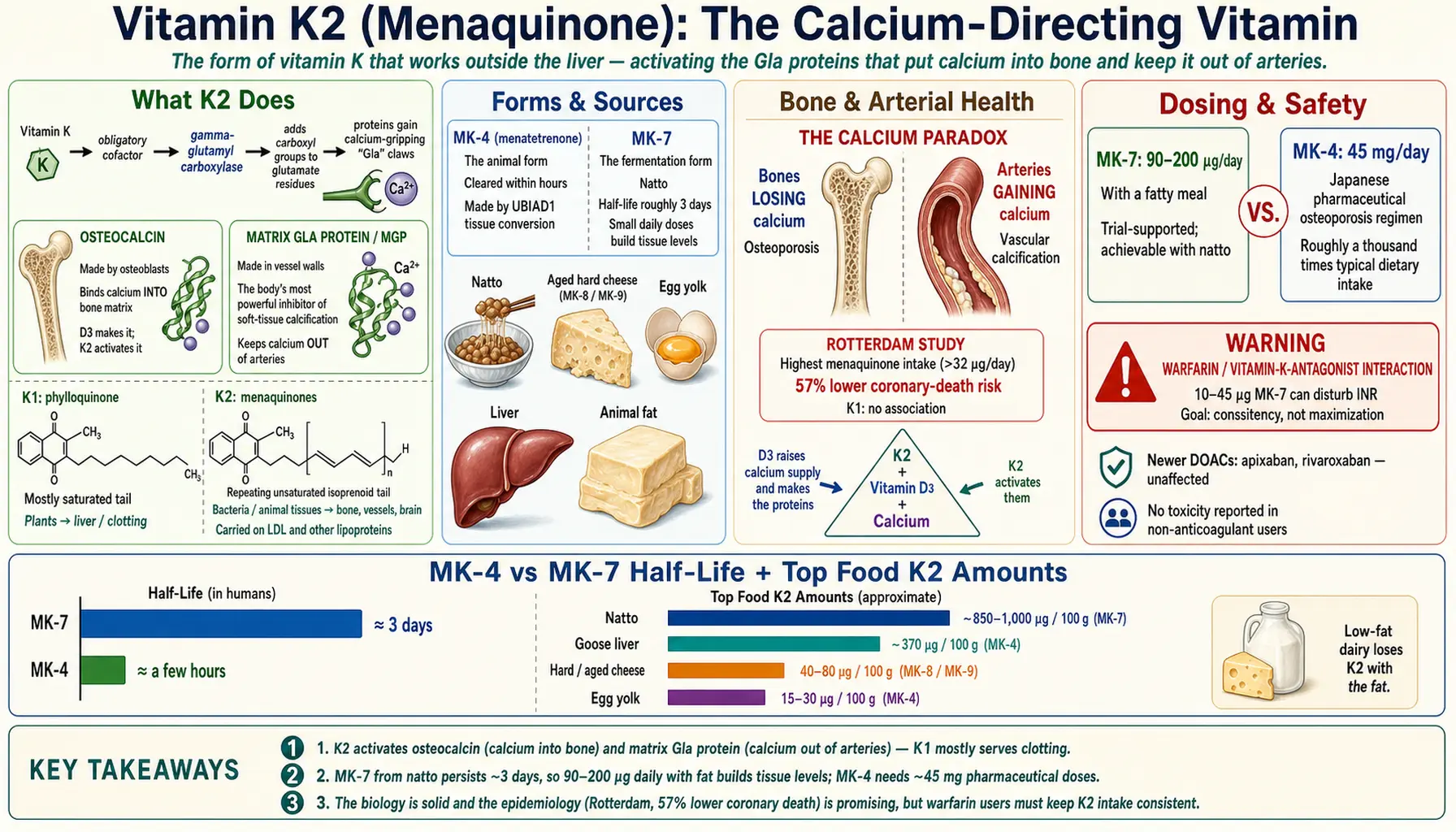
Vitamin K2 is the family of menaquinones — the form of vitamin K studied mainly for its work outside the liver. Vitamin K1 from leafy greens is preferentially retained in the liver, where it supports the carboxylation of blood-clotting factors, while long-chain menaquinones are redistributed through the circulation to tissues such as bone and blood vessels (Halder 2019), where vitamin K activates calcium-binding proteins such as osteocalcin and matrix Gla protein. Menaquinones are primarily of microbial origin and are found in fermented foods such as natto and cheese and in animal foods (Linus Pauling Institute, below). K2 makes up a small part of vitamin K intake in Western diets — in one Dutch cohort of 16,057 women, mean intake was about 29 micrograms a day of K2 against about 212 of K1 (Gast 2009).
Interactive Visualization Bone Remodeling & Calcium Balance Watch osteoclasts tunnel and osteoblasts rebuild — then drop vitamin D and see PTH quietly strip calcium out of your skeleton. Launch → Interactive Visualization How Blood Clots — and how thinners stop it Build a platelet plug, weave a fibrin mesh, then watch aspirin, warfarin and a DOAC each break a different step — with a live INR. Launch →
Table of Contents
- What Is Vitamin K2 — and How It Differs from K1
- The Menaquinone Family — MK-4 Through MK-13
- How the Body Gets K2 — Diet, Bacteria, and the UBIAD1 Conversion
- Gamma-Carboxylation — Switching On the K-Dependent Proteins
- The Calcium Paradox — Strong Bones, Clean Arteries
- Cardiovascular Evidence — The Rotterdam Study and Beyond
- Bone Evidence — From Japanese MK-4 Therapy to MK-7 Trials
- MK-4 vs MK-7 — Absorption, Half-Life, and Doses Studied
- Vitamin K2 and Vitamin D3 — Why They Are Paired
- Teeth and Weston Price's Fat-Soluble Activators
- Food Sources — Natto, Cheese, and Animal Foods
- Intake Reference Values, Forms, and Doses Used in Trials
- Cautions — Warfarin and Other Interactions
- Key Research Papers
- Connections
- Featured Videos
1. What Is Vitamin K2 — and How It Differs from K1
Vitamin K comes in two natural forms that share a chemical core but differ in their side chains, and the two forms are absorbed, distributed and retained differently (Halder 2019). Both carry the 2-methyl-1,4-naphthoquinone ring. Vitamin K1 (phylloquinone) has a phytyl side chain, while vitamin K2 (the menaquinones) carries an unsaturated side chain with a variable number of prenyl units (Halder 2019). K1 is found mainly in green leafy vegetables and some plant oils; menaquinones are mostly of bacterial origin, the exception being MK-4, which tissues make from other forms of vitamin K (Linus Pauling Institute, below).
The practical difference is where each form ends up. After absorption, vitamin K is packaged into chylomicrons that are taken up by the liver, and K1 is preferentially retained there for the carboxylation of clotting factors; long-chain menaquinones are redistributed to the circulation and are available to extrahepatic tissues such as bone and the vasculature (Halder 2019). A trial report notes that in human volunteers only the K2 vitamins (MK-4 and MK-7) were incorporated into the LDL fraction for transport to tissues outside the liver (Knapen 2007), and MK-7 has a much longer half-life than K1 (Schurgers 2007). This difference in distribution is one reason K2 is studied mainly for bone and arteries, and K1 mainly for clotting. For the full overview of both forms and the classical coagulation story, see the parent page: Vitamin K.
One more distinction matters: in the Dutch cohort studies, K1 and K2 intakes did not behave alike. In the Rotterdam Study, lower coronary risk was associated with menaquinone intake specifically — phylloquinone intake was not related to any of the outcomes (Geleijnse 2004) — and in the Prospect-EPIC cohort, vitamin K1 intake was not significantly related to coronary heart disease (Gast 2009). Whether that reflects K2's delivery to tissues, its longer residence time in blood, or the foods it travels in, is still being studied; it is one reason K2 is studied as its own topic rather than as a footnote to K1.
2. The Menaquinone Family — MK-4 Through MK-13
"Vitamin K2" is not a single molecule but a family. Each member is named MK-n, where n counts the isoprenoid units in its side chain — from MK-4 (four units) up to MK-13. The chain length determines how the molecule is absorbed, how long it stays in circulation, and which foods contain it:
- MK-4 (menatetrenone) — the only menaquinone not produced by bacteria. Tissues make it from other dietary forms of vitamin K, including phylloquinone, and it is found in dairy products, including milk, and in some meats (Linus Pauling Institute, below). Its circulating half-life is about 1–2 hours (Knapen 2007). As menatetrenone, at 45 mg/day by mouth, it is listed in the 2011 Japanese osteoporosis guidelines among the prescription drugs covered by Japan's public health insurance (Orimo 2012).
- MK-7 — the menaquinone of natto, soybeans fermented with Bacillus natto; natto contains a large amount of MK-7 (Kaneki 2001; Halder 2019). Its half-life in the circulation is described as about 3 days (Knapen 2007), and in a comparison with vitamin K1 it showed "accumulation of MK-7 to higher levels (7- to 8-fold) during prolonged intake" (Schurgers 2007).
- MK-8 to MK-11 — in an analysis of U.S. dairy foods, full-fat products contained menaquinones mainly as MK-9, MK-10 and MK-11, with modest MK-8 (Fu 2017).
- MK-12 and MK-13 — the same analysis found modest amounts of MK-12 and little MK-13 in most dairy products (Fu 2017); animal livers are a source of long-chain menaquinones from MK-7 to MK-13 (Linus Pauling Institute, below).
Because "vitamin K2" covers several molecules, a finding for one menaquinone does not necessarily apply to another. This page treats the family together and flags the differences where they matter; for a focused comparison of the two supplement forms, see MK-7 vs MK-4.
3. How the Body Gets K2 — Diet, Bacteria, and the UBIAD1 Conversion
The body has three supply lines for menaquinones, and understanding them explains several puzzles in the K2 literature.
First, direct dietary intake. Fermented foods and animal foods deliver preformed menaquinones — MK-7 from natto, MK-8 and MK-9 from some cheeses, and MK-4 from dairy products and some meats (Linus Pauling Institute, below). In Western diets menaquinones are the smaller share: in the Dutch Prospect-EPIC cohort, mean intake was 29.1 micrograms a day of K2 and 211.7 of K1 (Gast 2009).
Second, tissue conversion. Earlier studies had consistently shown that vitamin K1 is converted to MK-4 in the body, and MK-4 is present throughout extrahepatic tissues, with particularly high concentrations in the brain, kidney and pancreas. In 2010, Japanese researchers identified the human enzyme responsible, UBIAD1; its MK-4 synthesis was not affected by warfarin, and in mice it was expressed in several tissues (Nakagawa 2010, Nature). In a separate study, MK-4 taken at nutritional doses did not raise serum MK-4 (Sato 2012).
Third, gut bacteria. Bacteria in the large intestine (colon) can synthesize menaquinones, and it was once thought that up to half of the human vitamin K requirement might be met this way. All forms of vitamin K are absorbed in the small intestine by a mechanism requiring bile salts, whereas most menaquinone production takes place in the colon, where bile salts are lacking; current research suggests the contribution of bacterial synthesis to vitamin K status is much less than previously thought, although the exact contribution remains unclear (Linus Pauling Institute, below).
4. Gamma-Carboxylation — Switching On the K-Dependent Proteins
All forms of vitamin K share one biochemical job: both K1 and K2 act as cofactor for the enzyme gamma-glutamyl carboxylase, and only the carboxylated proteins are active (Halder 2019). This gamma-carboxylation converts specific glutamic acid residues into "Gla" residues, which give the proteins a high affinity for calcium and for the mineral components of the skeletal matrix (Munroe 1999).
At least 17 vitamin K–dependent proteins are known (Cirilli 2022). They include the clotting factors II, VII, IX and X, made in the liver (Linus Pauling Institute, below). The proteins at the centre of the K2 research are made elsewhere:
- Osteocalcin — made by osteoblasts (bone-forming cells); its synthesis is regulated by the active form of vitamin D, and its calcium-binding capacity requires vitamin K–dependent carboxylation of three glutamic acid residues (Linus Pauling Institute, below).
- Matrix Gla protein (MGP) — made by vascular smooth-muscle cells and chondrocytes (cartilage cells) (Luo 1997); MGP is described as one of the most powerful inhibitors of vascular calcification (Caluwé 2014); mice lacking it die within two months from arterial calcification (Luo 1997).
- Gas6, protein S, Gla-rich protein and others — Gas6 appears to be a cell-growth regulation factor, involved in cell adhesion, proliferation and protection against apoptosis; protein S is an anticoagulant protein (Linus Pauling Institute, below).
The fraction of these proteins left uncarboxylated can be measured in blood — undercarboxylated osteocalcin (ucOC) for bone, and dephospho-uncarboxylated MGP (dp-ucMGP) for vessels. Trials use them as markers of vitamin K status in bone and vessels (Knapen 2013; Caluwé 2014). In healthy people the clotting factors are essentially fully carboxylated, while 10–40% of osteocalcin and MGP remains undercarboxylated (Theuwissen 2012).
5. The Calcium Paradox — Strong Bones, Clean Arteries
The "calcium paradox" is the name reviewers give to a lack of calcium in bone alongside its storage in the vessel wall; one review proposes that vitamin K2 deficiency could be responsible (Flore 2013). The proposal rests on the two proteins described above: osteocalcin in bone and MGP, an inhibitor of calcification in the vessel wall.
The strongest single piece of evidence for MGP's importance comes from genetics: Keutel syndrome, a rare inherited disorder characterized by abnormal cartilage calcification, is caused by mutations that predict a non-functional MGP (Munroe 1999). Animal experiments point the same way — mice engineered to lack MGP die within two months as a result of arterial calcification (Luo 1997), and high doses of warfarin (which blocks vitamin K recycling; the authors suggest it acts here by inhibiting the carboxylation of MGP) caused calcification of rat arteries and heart valves within weeks (Price 1998).
It is important to state what is and is not established here. The mechanism — K2 activates MGP, active MGP inhibits vascular calcification — is solid biochemistry. The clinical claim — that taking K2 will measurably slow artery calcification or prevent heart attacks in the general population — rests on observational studies and trials with surrogate endpoints (described next), not yet on large outcome trials. In short: the biology is well documented; the human outcome evidence is incomplete.
6. Cardiovascular Evidence — The Rotterdam Study and Beyond
The most-cited cohort is the Rotterdam Study (2004), an observational, population-based study of 4,807 Dutch adults with dietary data and no history of heart attack at baseline (1990–1993), followed until January 2000. Compared with the lowest third of energy-adjusted menaquinone intake, the highest third had a relative risk of coronary heart disease mortality of 0.43 (95% CI 0.24–0.77), a relative risk of all-cause mortality of 0.74 (0.59–0.92) and an odds ratio for severe aortic calcification of 0.48 (0.32–0.71), after adjustment for age, sex, BMI, smoking, diabetes, education and dietary factors. Phylloquinone (K1) intake was not related to any of the outcomes (Geleijnse 2004). As an observational study it shows an association, not that menaquinone caused the difference.
Two further Dutch cohorts strengthened the pattern. The Prospect-EPIC analysis of 16,057 women (2009) found a hazard ratio for coronary heart disease of 0.91 (95% CI 0.85–1.00) per 10 micrograms a day of menaquinone intake over a mean follow-up of 8.1 years, an association mainly due to MK-7, MK-8 and MK-9; K1 intake was not significantly related (Gast 2009). A cross-sectional study in 564 postmenopausal women found higher menaquinone intake associated with less coronary artery calcification on imaging (Beulens 2009).
Interventional data exist but are smaller. A three-year randomized trial of MK-7 at 180 micrograms daily in 244 healthy postmenopausal women reported that carotid-femoral pulse-wave velocity and the stiffness index decreased in the whole group, with further measures of arterial stiffness improving in women whose stiffness was above the median at baseline; dp-ucMGP fell by 50% compared with placebo (Knapen 2015). In 200 hemodialysis patients — a group with accelerated vascular calcification — 360, 720 or 1,080 micrograms of MK-7 three times a week for 8 weeks lowered dp-ucMGP by 17, 33 and 46% (Caluwé 2014).
The caveats: the cohort studies are observational (people with high and low menaquinone intakes may differ in other ways), the trials used surrogate endpoints rather than heart attacks, and a two-year randomized trial in 365 older men with aortic valve calcification found that 720 micrograms of MK-7 plus 25 micrograms of vitamin D daily did not influence the progression of valve calcification, nor of aortic or coronary calcification, although dp-ucMGP fell (Diederichsen 2022). The evidence so far consists of observational associations and surrogate-endpoint trials; no trial has shown that K2 prevents heart attacks or treats established arterial disease. See also the deeper dive: Vitamin K2 and Arterial Calcification.
7. Bone Evidence — From Japanese MK-4 Therapy to MK-7 Trials
Most of the fracture data for vitamin K2 come from Japan, where menatetrenone — pharmaceutical MK-4 at 45 milligrams per day, a pharmacological dose far above nutritional supplement doses, which are measured in micrograms — is listed in the 2011 Japanese osteoporosis guidelines among the prescription drugs covered by public health insurance; the guidelines' summary of its fracture effect rests on the Cockayne 2006 meta-analysis described below (Orimo 2012). In an open-label randomized trial, Shiraki and colleagues (2000) assigned 241 patients with osteoporosis to 45 mg/day MK-4 or no treatment for two years: at 24 months lumbar bone mineral density had changed by −0.5% in the treated group and −3.3% in the control group, and clinical fractures were less frequent with treatment. The largest Japanese trial came out differently: the OF study, open-label with blinded evaluation, randomized 4,378 osteoporotic postmenopausal women to calcium alone or calcium plus menatetrenone; new vertebral fractures over 36 months, its primary endpoint, did not differ significantly between the groups, new clinical fractures over 48 months were lower with menatetrenone but not significantly, and adverse events were more frequent with menatetrenone. The authors concluded it was not effective for preventing vertebral fractures in the full analysis set, while suggesting it may prevent them in more advanced osteoporosis (Inoue 2009). Cockayne and colleagues (2006) pooled the 7 randomized trials that reported fracture data — all of them Japanese and all using menaquinone — and reported substantially lower odds of vertebral, hip and nonvertebral fractures. In 2018 the journal published a notice titled "Caution of Conclusions of a Meta-analysis Including Problematic Trials", alongside a caution to readers from the review's senior author (Torgerson 2018); Crossref, drawing on Retraction Watch, records the notice as an expression of concern, so the original pooled fracture figures are not repeated here. Several vitamin K2 bone papers from one Japanese research group have since been retracted: a 2005 fracture trial in elderly women with Alzheimer's disease, retracted in 2018 at the corresponding author's request because it contains fabricated clinical trial data (Sato 2005); a 2011 hip-fracture trial in Alzheimer's disease, retracted for scientific misconduct (Sato 2011); a 2004 review of vitamin K2 and osteoporosis, retracted in 2021 because its text, data and some figures came from sources retracted or under investigation for data fabrication and falsification (Iwamoto 2004); and a 2013 review of menatetrenone, retracted in 2019 (Iwamoto 2013). A 2006 review by the same authors carries a 2020 expression of concern (Iwamoto 2006). None of these papers is relied on here.
The same group's 2019 update (36 studies of oral vitamin K), written after the integrity of some of the earlier evidence had been questioned, concluded that for postmenopausal or osteoporotic patients there is no evidence that vitamin K affects bone mineral density or vertebral fractures, and that it may reduce clinical fractures but the evidence is insufficient to confirm this (Mott 2019). A 2020 correction removed the Yamaguchi Osteoporosis Prevention Study (YOPS), after concerns were raised about its integrity (Avenell 2020), and gave recalculated estimates for the four meta-analyses that had included it: the odds ratio for any clinical fracture changed from 0.72 (95% CI 0.55–0.95) to 0.74 (0.56–0.97), the low-risk-of-bias estimate of 0.76 (0.58–1.01) was unchanged, and vertebral fractures still showed no difference (0.98, 0.85–1.14); the authors stated that removing YOPS did not change their conclusions (Mott 2020 correction). The YOPS report itself was retracted in 2025; the journal's notice states that the evidence "strongly argues for scientific misconduct" (Ishida 2004, retracted).
Epidemiology inside Japan is consistent with an effect at dietary intakes, though it cannot show cause: serum MK-7 in postmenopausal women was higher in Tokyo, where natto is eaten frequently, than in Hiroshima, where it is seldom eaten (5.26 vs 1.22 ng/mL; 0.37 in British women), and hip-fracture incidence in women was inversely correlated with natto consumption across Japan's prefectures (Kaneki 2001).
For microgram doses, the main Western trial is Knapen's three-year study: 244 healthy postmenopausal women took 180 micrograms of MK-7 daily or placebo. MK-7 improved vitamin K status and decreased the age-related decline in bone mineral content and density at the lumbar spine and femoral neck, but not at the total hip; bone strength indices were favourably affected and loss of vertebral height in the lower thoracic spine was smaller (Knapen 2013). It measured bone density in healthy women, not fractures, and a one-year trial of 360 micrograms of MK-7 in 334 early-menopausal Norwegian women found no effect on bone loss rates (Emaus 2010); the trials are compared on the deeper dive at Vitamin K2 and Bone Health, and the disease context is at Osteoporosis.
8. MK-4 vs MK-7 — Absorption, Half-Life, and Doses Studied
The two supplement forms behave so differently that dose numbers cannot be compared across them.
- Half-life. MK-7 has a very long half-life, giving much more stable serum levels than vitamin K1 and 7- to 8-fold accumulation during prolonged intake (Schurgers 2007); its half-life in the circulation is described as about 3 days, and that of MK-4 as about 1–2 hours (Knapen 2007). After a single dose, MK-7 was detectable for up to 48 hours (Sato 2012).
- Absorption at nutritional doses. In a comparison in healthy Japanese women, a single 420-microgram dose of MK-4 taken with breakfast was not detectable in serum at any time point, while the same dose of MK-7 was well absorbed, peaked at 6 hours and was detectable up to 48 hours; 60 micrograms a day for 7 days raised serum MK-7 but not MK-4 (Sato 2012). The Japanese bone results used 45 milligrams of MK-4, not micrograms.
- Carboxylation at microgram doses. In a dose-finding trial in 42 healthy adults given 10 to 360 micrograms of MK-7 a day, doses around the EU reference intake increased the carboxylation of circulating osteocalcin and MGP, with no adverse effect on thrombin generation (Theuwissen 2012). The Western bone and vessel trials used 180 micrograms a day (Knapen 2013, 2015).
In short, the microgram-dose trials used MK-7, while the MK-4 evidence comes from the 45 mg/day prescription regimen used in Japan for osteoporosis (Orimo 2012) and a Dutch trial of the same dose (Knapen 2007). The full comparison: MK-7 vs MK-4.
9. Vitamin K2 and Vitamin D3 — Why They Are Paired
The rationale for studying the two together is a division of labor. The expression of MGP is vitamin D dependent (Braam 2004), and the synthesis of osteocalcin is regulated by the active form of vitamin D; the calcium-binding capacity of osteocalcin, however, requires vitamin K–dependent carboxylation (Linus Pauling Institute, below). A Dutch trial report notes that a number of Japanese studies reported variable effects of vitamin K2 alone but substantial beneficial effects when it was combined with vitamin D (Knapen 2007).
Human trial evidence for the combination is limited. In a three-year randomized trial in 181 postmenopausal women, the elastic properties of the carotid artery stayed unchanged with a supplement of minerals, vitamin D and vitamin K1, but declined with minerals plus vitamin D alone and with placebo (Braam 2004). In a two-year trial in 172 Japanese postmenopausal women with osteopenia or osteoporosis, vertebral bone density rose 4.92% with combined K2 and D3, compared with 0.135% with K2 alone (Ushiroyama 2002). In the AVADEC trial, by contrast, MK-7 plus vitamin D did not slow aortic valve calcification (Diederichsen 2022). None of these combination trials had fractures or cardiovascular events as its primary outcome.
The other two corners of this triangle are covered at Vitamin D3 and Calcium.
10. Teeth and Weston Price's Fat-Soluble Activators
In Nutrition and Physical Degeneration, written in the late 1930s, the dentist Weston Price described what he called "fat-soluble activators", a group that in his words included the known fat-soluble vitamins, and grouped the traditional diets he studied by their source: dairy products, the organs of animals and the eggs of birds, and sea foods. He reported that, since 1927, he had analyzed butter samples from many parts of the world and found a seasonal rise and fall in their vitamin content, the high level always associated with cows eating rapidly growing young plants, and he wrote that in his clinical work small additions of this high-vitamin butter regularly checked active tooth decay (Price, below). Later writers have linked these activators to vitamin K2; Price's own text does not identify any of them as vitamin K.
No randomized trial of vitamin K2 and tooth decay is cited on this page; the dental claim rests on Price's observations, a chapter in nutrition history rather than an established finding.
11. Food Sources — Natto, Cheese, and Animal Foods
Vitamin K2 is found in fermented and animal foods, and the form varies with the source. A food database from Maastricht listed vitamin K2 in meat, liver, butter, egg yolk, natto, cheese and curd cheese, while K1 was found mainly in green vegetables and plant margarines (Schurgers 2000):
- Natto (fermented soybeans) — contains a large amount of MK-7 (Kaneki 2001); in a feeding comparison, circulating K2 after a natto meal was about 10 times higher than circulating K1 after a meal of 400 g of spinach (Schurgers 2000). See Natto.
- Cheeses — in U.S. analyses, total vitamin K (mostly long-chain menaquinones MK-9 to MK-11) averaged about 506 micrograms per 100 g in soft cheese, 440 in blue cheese, 289 in semi-soft and 282 in hard cheese, and 98 in non-fermented processed cheese (Fu 2017). See Fermented Foods.
- Egg yolks — contain vitamin K2 (Schurgers 2000). See Eggs.
- Liver — contains vitamin K2 (Schurgers 2000); animal livers are a source of long-chain menaquinones, MK-7 to MK-13 (Linus Pauling Institute, below).
- Meat, butter, and full-fat dairy — meat and butter contain vitamin K2 (Schurgers 2000), and MK-4 is found in dairy products, including milk, and in some meats (Linus Pauling Institute, below); full-fat milk contained 38.1 micrograms of total vitamin K per 100 g in the U.S. analysis (Fu 2017).
Two patterns are worth noticing: menaquinones are primarily of microbial origin and are found in fermented foods (Linus Pauling Institute, below) and in animal foods, while K1 comes mainly from green vegetables and plant margarines (Schurgers 2000); and reduced-fat or fat-free dairy products contained only about 5–22% of the vitamin K of their full-fat equivalents, the vitamin K content being proportional to the fat content of the product (Fu 2017).
12. Intake Reference Values, Forms, and Doses Used in Trials
There is no official separate requirement for K2. The U.S. Adequate Intake for total vitamin K — 120 micrograms per day for men and 90 for women — was set by the U.S. Food and Nutrition Board in 2001 on the basis of phylloquinone (K1) intake levels in healthy individuals; the Board did not consider menaquinone intakes, for which data are limited. No tolerable upper intake level has been established for vitamin K (Linus Pauling Institute, below).
Doses used in the trials described on this page:
- MK-7: 180 micrograms daily — the dose in the three-year bone-density and arterial-stiffness trials in healthy postmenopausal women (Knapen 2013, 2015). In the bioavailability studies, doses were given with a standardized breakfast (Sato 2012); vitamin K is fat-soluble.
- MK-4: 45 milligrams daily — the Japanese prescription regimen for osteoporosis (Orimo 2012) and the dose in the Shiraki trial (Shiraki 2000); in a Dutch trial it was given as three 15 mg capsules spread over the day, which the authors attribute to MK-4's short half-life, noting that at this dose "the vitamin is used as a drug rather than as a food supplement" (Knapen 2007). The OF study used 15 mg capsules (Inoue 2009).
- Higher MK-7 doses — 360 to 1,080 µg three times a week for 8 weeks in hemodialysis patients, where drop-outs were mainly due to gastrointestinal side-effects related to the tablets' unpleasant smell (Caluwé 2014), and 720 µg daily with vitamin D for two years in men with aortic valve calcification (Diederichsen 2022). Both trials enrolled patient groups, not healthy people.
On forms: MK-7 exists as trans and cis isomers; in a laboratory study, trans MK-7 showed greater carboxylating activity, and cis MK-7 only slight activity (Cirilli 2022). In a crossover study in healthy adults, a synthetic MK-7 was bioequivalent to fermentation-derived MK-7 (Møller 2017).
13. Cautions — Warfarin and Other Interactions
The main documented interaction is with vitamin K antagonist anticoagulants such as warfarin and acenocoumarol. Warfarin acts by inhibiting vitamin K epoxide reductase and so preventing vitamin K recycling, and large or highly variable vitamin K intakes can interfere with the adjustment of the anticoagulant dose (Linus Pauling Institute, below), which is monitored with the INR. The authors of a K1 and MK-7 comparison noted that preparations supplying 50 micrograms a day or more of MK-7 may interfere with oral anticoagulant treatment in a clinically relevant way (Schurgers 2007). In 15 healthy volunteers stabilized on acenocoumarol, 45 micrograms of MK-7 a day lowered the mean INR by about 40%, and 10 and 20 micrograms a day were judged to cause a clinically relevant lowering of the INR in at least 40% and 60% of subjects; the authors concluded that MK-7 supplements need to be avoided in patients receiving vitamin K antagonist therapy (Theuwissen 2013). The Linus Pauling Institute notes that the newer direct inhibitors of coagulation factors do not interfere with the activity of vitamin K–dependent proteins. Decisions about anticoagulants and supplements belong with the prescribing clinician.
Other findings: in the two-year AVADEC trial, deaths and cardiovascular events did not differ between MK-7 plus vitamin D and placebo (Diederichsen 2022); in the dialysis dose-finding study, drop-outs were mainly gastrointestinal, related to the tablets' smell (Caluwé 2014). The trials on this page enrolled adults, mostly postmenopausal women, so they give no information on K2 supplements in pregnancy or breastfeeding. All forms of vitamin K are absorbed in the small intestine by a mechanism requiring bile salts, and people with fat-malabsorption disorders, including inflammatory bowel disease and cystic fibrosis, may be at increased risk of vitamin K deficiency (Linus Pauling Institute, below); a systematic review found people who have had major malabsorptive bariatric surgery at higher risk of vitamin K deficiency (Sherf-Dagan 2019). Natto is a soy food. The evidence does not establish K2 as a replacement for prescribed treatment of osteoporosis or cardiovascular disease.
Key Research Papers
Key peer-reviewed papers behind this article. Author, title, journal and year are given as text; the identifier at the end of each entry links to the paper's DOI or PubMed record.
- Geleijnse JM, Vermeer C, Grobbee DE, et al. Dietary intake of menaquinone is associated with a reduced risk of coronary heart disease: the Rotterdam Study. The Journal of Nutrition, 2004;134(11):3100–3105. — doi:10.1093/jn/134.11.3100
- Gast GCM, de Roos NM, Sluijs I, et al. A high menaquinone intake reduces the incidence of coronary heart disease. Nutrition, Metabolism and Cardiovascular Diseases, 2009;19(7):504–510. — doi:10.1016/j.numecd.2008.10.004
- Beulens JWJ, Bots ML, Atsma F, et al. High dietary menaquinone intake is associated with reduced coronary calcification. Atherosclerosis, 2009;203(2):489–493. — doi:10.1016/j.atherosclerosis.2008.07.010
- Knapen MHJ, Drummen NE, Smit E, Vermeer C, Theuwissen E. Three-year low-dose menaquinone-7 supplementation helps decrease bone loss in healthy postmenopausal women. Osteoporosis International, 2013;24(9):2499–2507. — doi:10.1007/s00198-013-2325-6
- Knapen MHJ, Braam LAJLM, Drummen NE, et al. Menaquinone-7 supplementation improves arterial stiffness in healthy postmenopausal women. Thrombosis and Haemostasis, 2015;113(5):1135–1144. — doi:10.1160/TH14-08-0675
- Shiraki M, Shiraki Y, Aoki C, Miura M. Vitamin K2 (menatetrenone) effectively prevents fractures and sustains lumbar bone mineral density in osteoporosis. Journal of Bone and Mineral Research, 2000;15(3):515–521. — doi:10.1359/jbmr.2000.15.3.515
- Cockayne S, Adamson J, Lanham-New S, et al. Vitamin K and the prevention of fractures: systematic review and meta-analysis of randomized controlled trials. Archives of Internal Medicine, 2006;166(12):1256–1261. — doi:10.1001/archinte.166.12.1256 — Expression of concern (JAMA Intern Med 2018: PubMed PMID: 29582046)
- Torgerson DJ (2018). Caution to readers about systematic review on vitamin K and prevention of fractures that included problematic trials. JAMA Internal Medicine 178(6): 863–864. — PubMed PMID: 29582044
- Mott A, Bradley T, Wright K, Cockayne ES, Shearer MJ, Adamson J, Lanham-New SA, Torgerson DJ (2019). Effect of vitamin K on bone mineral density and fractures in adults: an updated systematic review and meta-analysis of randomised controlled trials. Osteoporosis International 30(8): 1543–1559. — PubMed PMID: 31076817
- Mott A, Bradley T, Wright K, Cockayne ES, Shearer MJ, Adamson J, Lanham-New SA, Torgerson DJ (2020). Correction to: Effect of vitamin K on bone mineral density and fractures in adults: an updated systematic review and meta-analysis of randomised controlled trials. Osteoporosis International 31(11): 2269–2270. — PubMed PMID: 32965511
- Schurgers LJ, Teunissen KJF, Hamulyák K, et al. Vitamin K–containing dietary supplements: comparison of synthetic vitamin K1 and natto-derived menaquinone-7. Blood, 2007;109(8):3279–3283. — doi:10.1182/blood-2006-08-040709
- Sato T, Schurgers LJ, Uenishi K. Comparison of menaquinone-4 and menaquinone-7 bioavailability in healthy women. Nutrition Journal, 2012;11:93. — doi:10.1186/1475-2891-11-93
- Nakagawa K, Hirota Y, Sawada N, et al. Identification of UBIAD1 as a novel human menaquinone-4 biosynthetic enzyme. Nature, 2010;468(7320):117–121. — doi:10.1038/nature09464
- Caluwé R, Vandecasteele S, Van Vlem B, Vermeer C, De Vriese AS. Vitamin K2 supplementation in haemodialysis patients: a randomized dose-finding study. Nephrology Dialysis Transplantation, 2014;29(7):1385–1390. — doi:10.1093/ndt/gft464
- Halder M, Petsophonsakul P, Akbulut AC, et al. Vitamin K: Double bonds beyond coagulation — insights into differences between vitamin K1 and K2 in health and disease. International Journal of Molecular Sciences, 2019;20(4):896. — doi:10.3390/ijms20040896
- Kaneki M, Hodges SJ, Hosoi T, et al. Japanese fermented soybean food as the major determinant of the large geographic difference in circulating levels of vitamin K2: possible implications for hip-fracture risk. Nutrition, 2001;17(4):315–321. — PubMed PMID: 11369171
- Theuwissen E, Teunissen KJ, Spronk HM, et al. Effect of low-dose supplements of menaquinone-7 (vitamin K2) on the stability of oral anticoagulant treatment: dose-response relationship in healthy volunteers. Journal of Thrombosis and Haemostasis, 2013;11(6):1085–1092. — PubMed PMID: 23530987
- Theuwissen E, Cranenburg EC, Knapen MH, et al. Low-dose menaquinone-7 supplementation improved extra-hepatic vitamin K status, but had no effect on thrombin generation in healthy subjects. British Journal of Nutrition, 2012;108(9):1652–1657. — PubMed PMID: 22289649
- Diederichsen ACP, Lindholt JS, Möller S, et al. Vitamin K2 and D in patients with aortic valve calcification: a randomized double-blinded clinical trial. Circulation, 2022;145(18):1387–1397. — PubMed PMID: 35465686
- Braam LA, Hoeks AP, Brouns F, Hamulýak K, Gerichhausen MJ, Vermeer C. Beneficial effects of vitamins D and K on the elastic properties of the vessel wall in postmenopausal women: a follow-up study. Thrombosis and Haemostasis, 2004;91(2):373–380. — PubMed PMID: 14961167
- Ushiroyama T, Ikeda A, Ueki M. Effect of continuous combined therapy with vitamin K2 and vitamin D3 on bone mineral density and coagulofibrinolysis function in postmenopausal women. Maturitas, 2002;41(3):211–221. — PubMed PMID: 11886767
- Emaus N, Gjesdal CG, Almås B, et al. Vitamin K2 supplementation does not influence bone loss in early menopausal women: a randomised double-blind placebo-controlled trial. Osteoporosis International, 2010;21(10):1731–1740. — PubMed PMID: 19937427
- Luo G, Ducy P, McKee MD, et al. Spontaneous calcification of arteries and cartilage in mice lacking matrix GLA protein. Nature, 1997;386(6620):78–81. — PubMed PMID: 9052783
- Price PA, Faus SA, Williamson MK. Warfarin causes rapid calcification of the elastic lamellae in rat arteries and heart valves. Arteriosclerosis, Thrombosis, and Vascular Biology, 1998;18(9):1400–1407. — PubMed PMID: 9743228
- Munroe PB, Olgunturk RO, Fryns JP, et al. Mutations in the gene encoding the human matrix Gla protein cause Keutel syndrome. Nature Genetics, 1999;21(1):142–144. — PubMed PMID: 9916809
- Schurgers LJ, Vermeer C. Determination of phylloquinone and menaquinones in food. Effect of food matrix on circulating vitamin K concentrations. Haemostasis, 2000;30(6):298–307. — PubMed PMID: 11356998
- Fu X, Harshman SG, Shen X, et al. Multiple vitamin K forms exist in dairy foods. Current Developments in Nutrition, 2017;1(6):e000638. — PubMed PMID: 29955705
- Cirilli I, Orlando P, Silvestri S, et al. Carboxylative efficacy of trans and cis MK7 and comparison with other vitamin K isomers. BioFactors, 2022;48(5):1129–1136. — PubMed PMID: 35583412
- Møller M, Gjelstad IMF, Baksaas I, et al. Bioavailability and chemical/functional aspects of synthetic MK-7 vs fermentation-derived MK-7 in randomised controlled trials. International Journal for Vitamin and Nutrition Research, 2017;87(5–6):1–15. — PubMed PMID: 27374276
- Knapen MH, Schurgers LJ, Vermeer C (2007). Vitamin K2 supplementation improves hip bone geometry and bone strength indices in postmenopausal women. Osteoporosis International 18(7): 963–972. — PubMed PMID: 17287908
- Orimo H, Nakamura T, Hosoi T, Iki M, Uenishi K, Endo N, Ohta H, Shiraki M, Sugimoto T, Suzuki T, Soen S, Nishizawa Y, Hagino H, Fukunaga M, Fujiwara S (2012). Japanese 2011 guidelines for prevention and treatment of osteoporosis — executive summary. Archives of Osteoporosis 7: 3–20. — PubMed PMID: 23203733
- Inoue T, Fujita T, Kishimoto H, Makino T, Nakamura T, Nakamura T, Sato T, Yamazaki K (2009). Randomized controlled study on the prevention of osteoporotic fractures (OF study): a phase IV clinical study of 15-mg menatetrenone capsules. Journal of Bone and Mineral Metabolism 27(1): 66–75. — PubMed PMID: 19082528
- Ishida Y, Kawai S (2004). Comparative efficacy of hormone replacement therapy, etidronate, calcitonin, alfacalcidol, and vitamin K in postmenopausal women with osteoporosis: the Yamaguchi Osteoporosis Prevention Study. American Journal of Medicine 117(8): 549–555. — PubMed PMID: 15465502 — Retracted (retraction notice: PubMed PMID: 40222753)
- Avenell A, Grey A, Gamble GD, Bolland MJ (2020). Concerns about the integrity of the Yamaguchi Osteoporosis Prevention Study (YOPS) report, Am J Med. 2004;117:549-555. American Journal of Medicine 133(6): e311–e314. — PubMed PMID: 32532372
- Sato Y, Kanoko T, Satoh K, Iwamoto J (2005). Menatetrenone and vitamin D2 with calcium supplements prevent nonvertebral fracture in elderly women with Alzheimer's disease. Bone 36(1): 61–68. — PubMed PMID: 15664003 — Retracted (retraction notice: PubMed PMID: 29150013)
- Sato Y, Honda Y, Umeno K, Hayashida N, Iwamoto J, Takeda T, Matsumoto H (2011). The prevention of hip fracture with menatetrenone and risedronate plus calcium supplementation in elderly patients with Alzheimer disease: a randomized controlled trial. Kurume Medical Journal 57(4): 117–124. — PubMed PMID: 21778673 — Retracted (retraction notice: PubMed PMID: 28408729)
- Iwamoto J, Takeda T, Sato Y (2004). Effects of vitamin K2 on osteoporosis. Current Pharmaceutical Design 10(21): 2557–2576. — PubMed PMID: 15320745 — Retracted (retraction notice: PubMed PMID: 34264184)
- Iwamoto J, Sato Y (2013). Menatetrenone for the treatment of osteoporosis. Expert Opinion on Pharmacotherapy 14(4): 449–458. — PubMed PMID: 23346882 — Retracted (retraction notice: PubMed PMID: 31437064)
- Iwamoto J, Takeda T, Sato Y (2006). Menatetrenone (vitamin K2) and bone quality in the treatment of postmenopausal osteoporosis. Nutrition Reviews 64(12): 509–517. — PubMed PMID: 17274493 — Expression of concern (Nutr Rev 2020: PubMed PMID: 32412060)
- Flore R, Ponziani FR, Di Rienzo TA, et al. (2013). Something more to say about calcium homeostasis: the role of vitamin K2 in vascular calcification and osteoporosis. European Review for Medical and Pharmacological Sciences 17(18): 2433–2440. — PubMed PMID: 24089220
- Sherf-Dagan S, Goldenshluger A, Azran C, Sakran N, Sinai T, Ben-Porat T (2019). Vitamin K — what is known regarding bariatric surgery patients: a systematic review. Surgery for Obesity and Related Diseases 15(8): 1402–1413. — PubMed PMID: 31353233
PubMed Topic Searches
- PubMed: MK-7 supplementation randomized trials
- PubMed: Vitamin K2 and arterial calcification
- PubMed: Menatetrenone (MK-4) and osteoporosis
- PubMed: Matrix Gla protein and dp-ucMGP status
- PubMed: Natto, menaquinone, and bone health
- PubMed: Vitamin K2 + D3 combination studies
External Authoritative Resources
- NIH Office of Dietary Supplements — Vitamin K Fact Sheet for Health Professionals
- MedlinePlus — Vitamin K
- Linus Pauling Institute Micronutrient Information Center — Vitamin K
- Price WA. Nutrition and Physical Degeneration — full text (Project Gutenberg Australia)
- PubMed — All research on menaquinones
Connections
- All Vitamins
- How Blood Clots — interactive animation
- Bone Remodeling & Calcium Balance — interactive animation
- Vitamin K (Overview — K1 & K2)
- Vitamin K Benefits Hub
- MK-7 vs MK-4
- K2 and Arterial Calcification
- K2 and Bone Health
- K2 and Insulin Sensitivity
- Vitamin D3
- Calcium
- Magnesium
- Natto
- Nattokinase
- Fermented Foods
- Eggs
- Osteoporosis
- Atherosclerosis
- Cardiovascular Disease
- Fat-Soluble Activators: Vitamins A, D and K2 (Activator X)