Sweating and Sauna Therapy
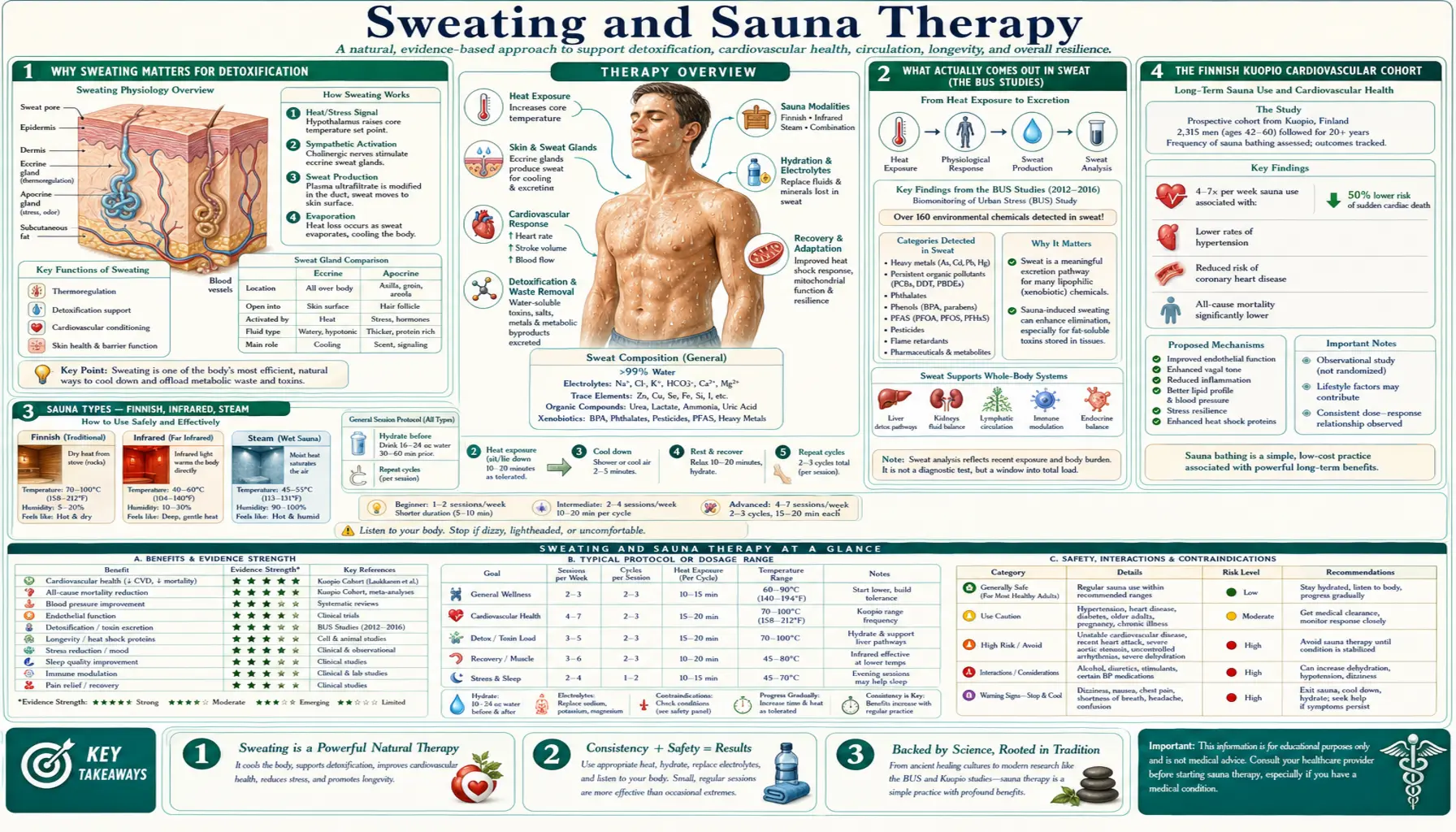
Sweating is the only excretion route in the human body that directly mobilizes both water-soluble and certain lipophilic toxins across the skin, bypassing the liver-kidney-bile-stool route entirely. Stephen Genuis at the University of Alberta and Margaret Sears's team have demonstrated through chromatographic analysis that arsenic, cadmium, lead, mercury, BPA, phthalates, and PCBs all appear in induced sweat — often at concentrations exceeding paired serum and urine samples on the same individuals. The Finnish Kuopio Ischemic Heart Disease prospective cohort has demonstrated a dose-dependent reduction in cardiovascular and all-cause mortality with sauna frequency, with 4-7 sessions per week associated with roughly 40% lower all-cause mortality compared to once per week. Both traditional Finnish and far-infrared sauna deliver measurable detoxification benefit; proper hydration, electrolyte replacement, and contraindication screening determine whether the protocol is safe for any individual.
Table of Contents
- Why Sweating Matters for Detoxification
- What Actually Comes Out in Sweat (the BUS Studies)
- Sauna Types — Finnish, Infrared, Steam
- The Finnish Kuopio Cardiovascular Cohort
- Practical Protocol: Frequency, Duration, Temperature
- Hydration and Electrolyte Replacement
- Exercise-Induced Sweating as a Complement
- The Hubbard / Niacin Protocol Controversy
- Cautions and Contraindications
- Key Research Papers
- Connections
- Featured Videos
Why Sweating Matters for Detoxification
The human body has three primary routes for exiting xenobiotic toxins: urine (kidney filtration of water-soluble metabolites), feces (biliary excretion of liver-conjugated metabolites and unabsorbed binder complexes), and sweat (eccrine and apocrine gland secretion across the skin). For decades, mainstream toxicology dismissed the sweat route as quantitatively negligible. The Genuis and Sears chromatographic data published from 2010 onward demonstrated that view was wrong — for several important toxin classes, sweat concentrations equal or exceed serum and urine concentrations measured on the same individuals on the same day.
Eccrine sweat glands are distributed across virtually all skin surface area in humans (~2-5 million glands, highest density on palms and soles) and produce sweat at rates that can exceed 1-2 L/hour during heavy thermal load. The eccrine sweat profile is dominated by water, sodium chloride, potassium, urea, lactate, and bicarbonate — but chromatographic analysis reveals trace heavy metals, lipophilic persistent organic pollutants, and endocrine disruptors at biologically meaningful concentrations.
The physiological rationale for sweat as a detoxification route makes sense at a tissue level: many of the toxins of greatest concern (heavy metals like mercury and cadmium, lipophilic PCBs, BPA, phthalates) preferentially deposit in adipose tissue and in dermal/subcutaneous fat. Heat-induced lipolysis and increased dermal blood flow mobilize these stores; sweat then becomes a direct exit pathway rather than requiring the toxin to recirculate to the liver for biotransformation.
What Actually Comes Out in Sweat (the BUS Studies)
The "BUS" studies — Blood, Urine, Sweat — led by Stephen Genuis at the University of Alberta are the foundational quantitative work. The 2011 paper (Arch Environ Contam Toxicol 61:344-357) measured 120 compounds across 20 volunteers, taking paired blood, urine, and induced-sweat samples on the same day. Selected findings:
- Heavy metals — arsenic, cadmium, lead, and mercury all appeared in sweat, often at higher concentrations than in blood or urine. For mercury, sweat concentrations were higher than both blood and urine in a majority of subjects. For lead, sweat was a more sensitive marker than blood (lead has a serum half-life of ~30 days but a body burden half-life measured in years to decades, with most body lead sequestered in bone).
- BPA (bisphenol A) — the 2012 paper showed BPA in sweat in 16 of 20 subjects. Some subjects had detectable BPA in sweat with non-detectable serum and urine, suggesting sweat may mobilize sequestered BPA from dermal/adipose stores.
- Phthalates — DEHP and its metabolites detected in sweat in nearly all subjects; sweat:serum ratios for some phthalate metabolites exceeded 1.
- PCBs and persistent organic pollutants — detectable in sweat, although with variable concentrations and analytical challenges due to the lipid-poor sweat matrix.
The Sears 2012 systematic review (J Environ Public Health, PubMed 22505948) reviewed 24 studies measuring arsenic, cadmium, lead, and mercury in sweat. Key conclusions: sweat is a documented excretion route for all four metals; sweat concentrations are highly variable between individuals and within individuals across sessions; induced sweating in deficient or burdened individuals may be a clinically useful adjunct to standard detoxification.
The limitations of this evidence base should be acknowledged: most BUS studies are small (n=20-30), the analytical methods have evolved across studies, and we lack large randomized trials of sauna-based detoxification with clinical endpoints. What the existing studies do establish unambiguously is that toxins exit the body in sweat; whether the magnitude of that exit is clinically meaningful depends on the toxin and the individual.
Sauna Types — Finnish, Infrared, Steam
Three sauna technologies dominate the consumer market, each with a different thermal mechanism:
- Traditional Finnish (dry) sauna — wood-paneled room with an electric or wood-fired stove, air temperature 70-100°C (160-210°F), humidity 10-20%. Heat transfer is dominated by convection and radiation from the hot air and surfaces. This is the technology used in all of the Finnish Kuopio cohort cardiovascular studies, and it is the type with the strongest mortality evidence base.
- Far-infrared (FIR) sauna — carbon panel or ceramic emitter saunas radiating in the far-infrared band (~5-15 micron wavelength), air temperature 45-60°C (115-140°F). The mechanism is direct dermal absorption of infrared radiation, which warms the body without requiring high air temperature. Often tolerated better by people who find traditional sauna heat overwhelming. The detoxification evidence base is smaller than for Finnish sauna but includes the Beever 2009 cardiovascular risk-factor trial (PubMed 19366910) and several smaller studies.
- Steam room (humid sauna) — tile-enclosed room with steam generator, air temperature 40-50°C (105-120°F), humidity ~100%. Sweat does not evaporate (the air is already saturated), so the body must dissipate heat through other routes; perceived heat is intense at lower air temperatures than dry sauna. Steam rooms produce more sweat for a given session because evaporative cooling is blocked.
For toxin mobilization, all three technologies produce sweat in similar quantities at equivalent session lengths and induced core temperatures. The FIR sauna's claim of "deep tissue penetration" of infrared radiation is partially supported (FIR does penetrate a few millimeters of dermis directly, more than convective heat would) but the dominant mechanism remains thermal dermal sweat production.
For cardiovascular and longevity benefits, the Finnish dry sauna has by far the strongest evidence base because the prospective cohort data (Kuopio) used traditional Finnish saunas exclusively.
The Finnish Kuopio Cardiovascular Cohort
The Kuopio Ischemic Heart Disease (KIHD) prospective cohort, led by Jari Laukkanen at the University of Eastern Finland, has produced the largest body of evidence on sauna use and longevity. The cohort enrolled 2,315 middle-aged Finnish men in 1984-1989 and followed them prospectively. Key findings (Laukkanen T et al., JAMA Intern Med 2015, PubMed 25705824):
- Compared with one sauna session per week, 2-3 sessions per week were associated with a 22% lower risk of sudden cardiac death, 23% lower fatal coronary heart disease, and 24% lower all-cause mortality.
- 4-7 sessions per week were associated with a 63% lower risk of sudden cardiac death, 48% lower fatal coronary heart disease, and 40% lower all-cause mortality.
- Session duration also mattered: >19 minutes per session was associated with lower mortality than <11 minutes.
- The associations remained robust after adjustment for traditional cardiovascular risk factors, suggesting a genuine independent effect of sauna use rather than confounding by health behavior.
The 2016 paper (Laukkanen JA et al., Age Ageing, PubMed 27932366) extended the analysis to dementia and Alzheimer's outcomes, finding that 4-7 sauna sessions per week were associated with a 66% lower risk of any dementia and 65% lower risk of Alzheimer's disease specifically, compared with one session per week.
Subsequent papers from the same cohort have linked sauna frequency to lower stroke incidence, lower respiratory disease mortality, and lower blood pressure.
The proposed mechanisms for the cardiovascular and longevity benefit overlap with but extend beyond detoxification: improved endothelial function and arterial compliance, heat-shock protein induction, mild controlled hyperthermia as a stress-adaptation hormetic stimulus, autonomic nervous system rebalancing, and the cardiovascular workout effect (heart rate during a hot sauna session can match moderate exercise).
Practical Protocol: Frequency, Duration, Temperature
A reasonable starting protocol for someone using sauna for detoxification:
- Frequency: begin with 2-3 sessions per week; work toward 4-5 per week if well tolerated. Daily use is documented in the Kuopio cohort but should be reached gradually.
- Duration: 15-30 minutes per session for traditional Finnish; 30-45 minutes for FIR (lower temperature means longer to reach equivalent sweat volume).
- Temperature: Finnish dry — 75-85°C (170-185°F) for general detox; FIR — 50-60°C (120-140°F).
- Sessions per visit: some protocols use multiple 15-min rounds with 5-10 min cooling breaks (cold shower or cool air) between rounds. The cold contrast is a vascular workout in itself and increases total sweat volume.
- Pre-session: arrive hydrated (16-20 oz water 30-60 min before); avoid alcohol within several hours; avoid heavy meals immediately beforehand.
- Post-session: shower off mobilized toxins from the skin surface (do not let sweat dry on skin); replace fluids and electrolytes; rest 15-30 min before strenuous activity.
For mercury or persistent organic pollutant detoxification specifically, pairing sauna with oral binders (chlorella, charcoal, or cholestyramine, taken at a separate time from food and medications) is the standard functional-medicine approach — the binder catches biliary-excreted mercury before reabsorption while the sauna mobilizes the dermal route in parallel.
Hydration and Electrolyte Replacement
Sweat contains significant sodium, potassium, magnesium, and trace minerals. A typical 30-min sauna session produces 0.5-1.5 L of sweat with ~30-50 mmol/L sodium (about 700-1,100 mg/L), 5 mmol/L potassium, lower but non-trivial magnesium and zinc. Repeated heavy sauna sessions without replacement can deplete these significantly.
A practical electrolyte protocol for regular sauna users:
- Sodium — 1/4 tsp sea salt (~500 mg sodium) in 12-16 oz of water immediately before or after; more if multiple sessions or hot weather. The frequent advice to "avoid salt" is the wrong direction for active sauna users; sweat sodium loss is real and significant.
- Potassium — banana, orange juice, coconut water, or a tablet potassium supplement (~99 mg per tablet) post-session. Avoid high-dose potassium supplements without medical supervision (cardiac risk if elevated).
- Magnesium — 200-400 mg elemental magnesium (glycinate or malate forms tolerate best) at bedtime. Sweat magnesium loss compounds an already-widespread dietary insufficiency.
- Trace minerals — a small electrolyte mix (LMNT, Re-Lyte, or homemade with sea salt + lite salt + magnesium powder) is convenient. Sports drinks are generally suboptimal because of high sugar and inadequate sodium.
Failure to replace electrolytes after heavy sauna use produces fatigue, muscle cramping, headache, lightheadedness, and (rarely but seriously) cardiac arrhythmia.
Exercise-Induced Sweating as a Complement
Exercise-induced sweating provides many of the same detoxification benefits as sauna and is freely available without specialized equipment. The BUS studies measured sweat composition from both passive sauna and exercise sweat; both contained measurable heavy metals and persistent organic pollutants. Exercise has the additional benefits of cardiovascular conditioning, muscle activation, and lymphatic pumping that passive sauna does not provide.
A combined approach — exercise plus sauna in the same session, "sauna after workout" — is highly synergistic. Heat after exercise extends the sweat session, prolongs heat-shock protein induction, and stacks the detoxification benefit. This is the protocol that Finnish athletes and military have used for decades, and it is the pattern represented in much of the longevity data from Finland.
The Hubbard / Niacin Protocol Controversy
L. Ron Hubbard, the founder of Scientology, developed a sauna-based detoxification protocol in the 1970s that combined niacin (nicotinic acid) loading with extended low-temperature sauna sessions and exercise. The protocol was originally promoted as treatment for drug residues and persistent toxins. It was subsequently adopted by the New York City firefighter health program after September 11, 2001, for clearance of WTC dust-related toxin burden.
The Cecchini 2006 paper (Toxicol Ind Health 22:5, pp 273-282) reported clinical and laboratory improvements in a cohort of 484 firefighters who completed the protocol. The niacin component (often 50-500 mg) produces a vasodilatory flush that proponents argue mobilizes lipophilic toxins from dermal fat stores, though the mechanism remains debated and the protocol has been criticized for lack of randomized controlled validation.
For most individuals doing routine detox sauna, niacin loading is not required. The flush is uncomfortable for many people; the no-flush forms (inositol hexanicotinate, nicotinamide) do not produce the vasodilation and therefore would not, on the protocol's own logic, contribute. If using niacin alongside sauna, begin with 50-100 mg and titrate up only as tolerated; avoid combining with statins (rhabdomyolysis risk) or with significant liver disease.
Cautions and Contraindications
- Unstable angina, recent myocardial infarction, severe aortic stenosis, decompensated heart failure — heat-induced vasodilation can drop blood pressure and increase cardiac demand in ways the diseased heart cannot tolerate. Consult cardiology before sauna use.
- Uncontrolled hypertension — sauna lowers blood pressure long-term but raises heart rate acutely; in fragile patients this can be problematic. Stable controlled hypertension is generally fine.
- Pregnancy — first-trimester core hyperthermia has been associated with neural tube defects in some studies; pregnant women should consult obstetric advice before sauna use, and many obstetricians recommend avoidance throughout pregnancy.
- Alcohol intoxication — absolute contraindication. Alcohol blunts the perception of heat and dehydration risk, and the combination has caused multiple sauna fatalities (well-documented in Finnish forensic data).
- Diuretic medications, vasodilators — can amplify the blood pressure drop and dehydration; coordinate dosing with prescriber.
- Active infection with fever — the febrile body already has elevated core temperature; sauna can push it into dangerous territory.
- Seizure disorders — heat can lower seizure threshold in some patients; review with neurology.
- Children and the very elderly — reduced thermoregulatory capacity; shorter sessions, lower temperatures, close supervision.
- Implanted devices — pacemakers and ICDs generally tolerate sauna but specific manufacturer guidance varies; insulin pumps should be removed before high-temperature sauna (heat can degrade insulin).
Key Research Papers
- Genuis SJ et al., Blood, Urine, and Sweat (BUS) Study — PubMed 21057782: Genuis BUS Study
- Sears ME et al., Arsenic, cadmium, lead, and mercury in sweat: a systematic review — PubMed 22505948: Sears heavy metals in sweat review
- Genuis SJ et al., Human elimination of phthalate compounds: blood, urine, and sweat — PubMed 22253637: Phthalates BUS
- Genuis SJ et al., Human elimination of bisphenol A Search PubMed
- Laukkanen T et al., Sauna bathing and cardiovascular events / all-cause mortality (KIHD) — PubMed 25705824: Kuopio sauna mortality
- Laukkanen JA et al., Sauna bathing reduces risk of dementia and Alzheimer's — PubMed 27932366: Sauna and dementia
- Laukkanen T et al., Acute effects of sauna bathing on cardiovascular function Search PubMed
- Patrick RP & Johnson TL, Sauna use as a lifestyle practice (Experimental Gerontology review) — Search PubMed
- Crinnion WJ, Sauna as a valuable clinical tool for detoxification — PubMed 21951023: Crinnion sauna detox
- Beever R, Far-infrared sauna for cardiovascular risk factors Search PubMed
- Hannuksela ML & Ellahham S, Benefits and risks of sauna bathing Search PubMed
- Cecchini MA et al., Sauna-based detoxification of WTC firefighters Search PubMed
Connections
- All Remedies
- Detox Protocols Benefits Hub
- Detox Protocols (Main)
- Liver Phase 1 and Phase 2
- Binders: Charcoal & Chlorella
- Coffee Enemas
- Heavy Metals
- Mercury
- Lead
- Cadmium
- Arsenic
- BPA
- Phthalates
- Cardiology
- Magnesium
- Potassium
- Sodium
- Niacin (B3)
- Heavy Metal Testing