Celery Juice — Benefits Deep Dive
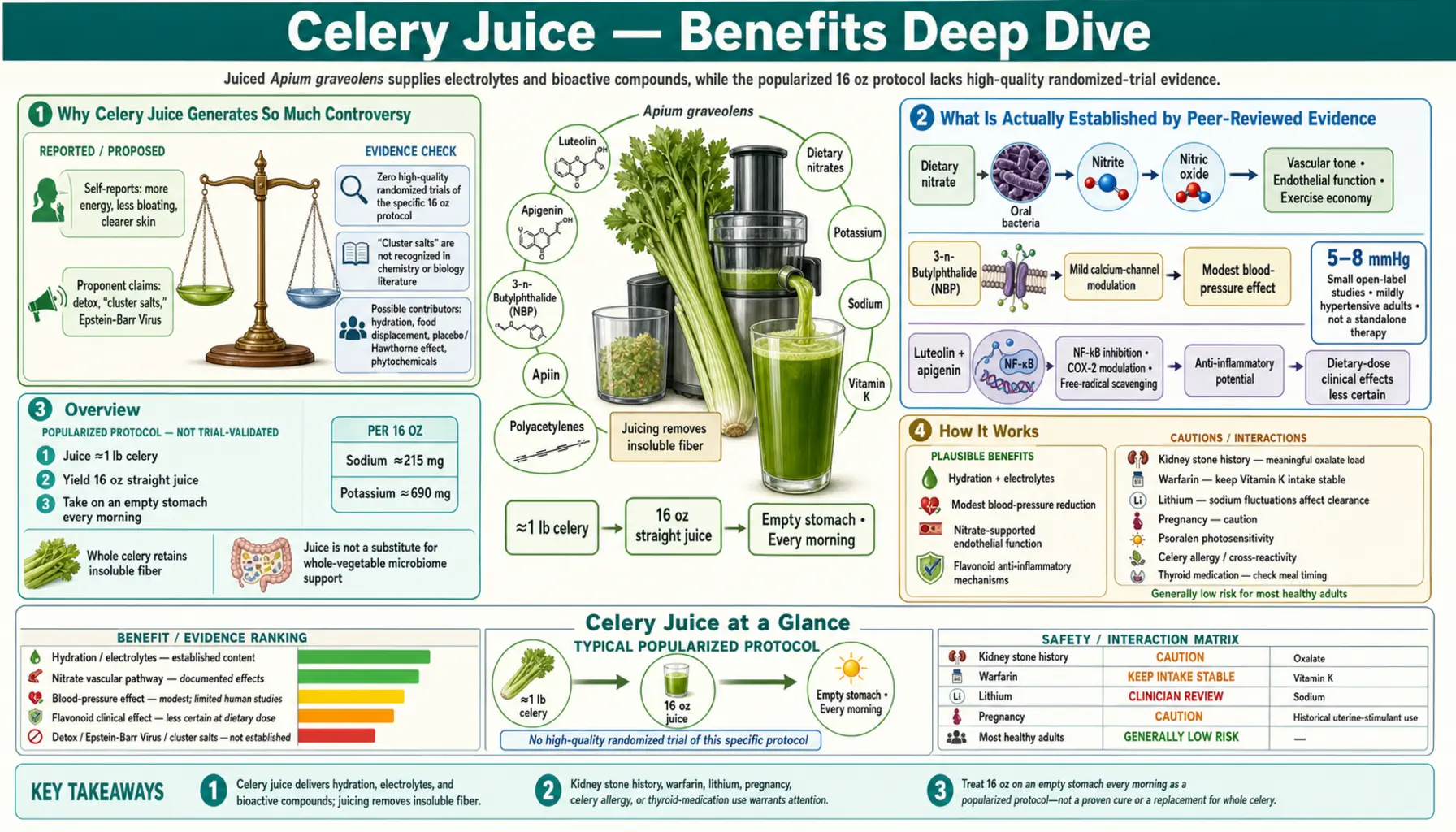
Few wellness practices have generated as much polarized commentary in the past decade as the 16-ounce-of-celery-juice-on-an-empty-stomach-every-morning protocol popularized by Anthony William ("Medical Medium") starting in 2015. Proponents report dramatic improvements in chronic fatigue, autoimmune conditions, digestive complaints, and skin clarity. Skeptics — including most academic gastroenterologists and registered dietitians — point to the near-total absence of randomized controlled trial evidence for the specific protocol and to the fact that the proposed mechanism (William's "undiscovered cluster salts") is not recognized in any biochemistry textbook. The truth, like most wellness phenomena, is somewhere in between. Celery (Apium graveolens) is a legitimately interesting nutritional plant containing measurable amounts of luteolin, apigenin, 3-n-butylphthalide, apiin, polyacetylenes, nitrates, potassium, sodium, and Vitamin K. Several of those compounds have peer-reviewed pharmacology behind them. The four deep-dive pages below separate the unambiguously verifiable nutritional and phytochemical facts from the proprietary metaphysical claims, presenting both sides so readers can make informed decisions.
Deep-Dive Articles
Anthony William Origin Story
How a non-credentialed author rebranded a humble garden vegetable into a multi-billion-dollar wellness movement. The "Spirit of Compassion" claim, the four New York Times bestsellers, the celebrity endorsements (Pharrell, Gwyneth Paltrow, Sylvester Stallone), the Goop ecosystem, and the institutional pushback from registered dietitians, gastroenterologists, and the FTC. Includes the chronology of the Medical Medium books and the rise of #CeleryJuice on Instagram.
Bioactive Compounds
What is actually in celery, in measurable peer-reviewed quantities. Luteolin and apigenin (flavonoids with documented anti-inflammatory action), 3-n-butylphthalide (the calcium-channel-modulating compound behind celery's mild blood-pressure-lowering effect), apiin, dietary nitrates, polyacetylenes (falcarinol, falcarindiol), potassium, sodium, Vitamin K, and the soluble fiber lost during juicing.
Claimed Detox Benefits
The proponent claims in their own words: liver detox, "undiscovered cluster salts," heavy metal mobilization, Epstein-Barr Virus eradication, restored stomach acid, reduced bloating, autoimmune remission, fibromyalgia relief, and chronic fatigue resolution. Presented neutrally so readers can compare each claim to what evidence does or does not exist for it on the companion Evidence and Skepticism page.
Evidence and Skepticism
The peer-reviewed counterpoint. Why "cluster salts" do not appear in PubMed. The placebo and Hawthorne effect, the loss of soluble fiber when juicing, the high oxalate content (problematic for kidney stone formers), the psoralen photosensitivity issue, the potential interactions with thyroid medication, anticoagulants, and lithium. What plausible benefits are real (modest blood pressure reduction, nitrate-driven endothelial function, hydration, luteolin/apigenin anti-inflammatory action) and which are not.
Table of Contents
- Deep-Dive Articles
- Why Celery Juice Generates So Much Controversy
- What Is Actually Established by Peer-Reviewed Evidence
- Research Papers: Celery Flavonoids (Luteolin, Apigenin)
- Research Papers: 3-n-Butylphthalide and Cardiovascular Effects
- Research Papers: Juicing vs Whole Vegetable, Fiber Loss
- Research Papers: Cautions (Oxalate, Psoralen, Drug Interactions)
- External Authoritative Resources
- Connections
- Featured Videos
Why Celery Juice Generates So Much Controversy
Celery juice as a discrete wellness protocol exists in an unusual cultural position. On one side, millions of users report subjective improvements: more energy, less bloating, clearer skin, calmer autoimmune flares, better sleep. On the other side, the academic medical and dietetic establishment is almost uniformly skeptical, ranging from polite dismissal in Mayo Clinic explainers to outright denunciation in Forbes columns by gastroenterologists and registered dietitians who classify the specific claims as pseudoscientific.
Both observations can be partially correct simultaneously. The reasons are worth understanding:
- The protocol is conflated with the proponent's broader belief system. Anthony William, the originator of the "16 oz of straight celery juice on an empty stomach every morning" protocol, attributes his medical guidance to a metaphysical entity he calls "Spirit of Compassion" and proposes the existence of "undiscovered cluster salts" that do not appear in any chemistry or biology literature. When mainstream clinicians dismiss the celery juice protocol, they are often dismissing the package, not the vegetable.
- The vegetable itself contains real bioactive compounds. Celery's flavonoids (especially luteolin and apigenin) have well-documented anti-inflammatory and modest neuroprotective properties in peer-reviewed pharmacology. 3-n-Butylphthalide (NBP) is an investigational drug for ischemic stroke in China and contributes to celery's mild blood-pressure-lowering effect. Dietary nitrates support endothelial function. None of these benefits require any metaphysical framework to be real.
- Self-reports and randomized-controlled-trial absence are both true. Tens of thousands of users report symptom improvement. Zero high-quality randomized trials of the specific "16 oz neat celery juice first thing in the morning" protocol exist. Both facts coexist. The improvements may be driven by placebo, by the displacement of coffee or sugary breakfast, by the hydration and potassium load, by the flavonoid pharmacology, or by some combination — we do not know.
- The intervention is essentially harmless for most adults. This is unusual. Most contested wellness protocols carry meaningful risk; daily celery juice does not for the average healthy adult. For specific populations — kidney stone formers (oxalate load), patients on warfarin (Vitamin K), patients on lithium (sodium-mediated clearance), pregnant women (mild uterine-stimulant historical use) — cautions apply. For the bulk of the population, the worst likely outcome is having spent money on celery and reflecting that it did not work for them.
The four deep-dive pages below try to disentangle these threads. The first is cultural history of how the protocol became a phenomenon. The second covers the verifiable phytochemistry. The third presents the proponent claims in their own framing, neutrally and without endorsement. The fourth places those claims next to what the peer-reviewed evidence actually shows, including the legitimate cautions.
What Is Actually Established by Peer-Reviewed Evidence
Setting aside both proponent enthusiasm and reflexive skepticism, here is what is reasonably well-established about celery in human nutrition and pharmacology:
- Mild blood pressure reduction. Celery seed extracts and celery juice both produce modest, reproducible reductions in systolic blood pressure in mildly hypertensive adults — on the order of 5-8 mmHg in small open-label studies. The proposed mechanism is 3-n-butylphthalide acting as a mild calcium-channel modulator. Effect size is not clinically meaningful as a standalone therapy but is real.
- Anti-inflammatory phytochemistry. Luteolin and apigenin are among the better-studied dietary flavonoids, with peer-reviewed evidence of NF-kB pathway inhibition, COX-2 modulation, and free-radical scavenging. Whether dietary doses from a single vegetable serving produce systemic clinical effects in humans is less certain.
- Nitrate-driven endothelial function. Celery is a moderate dietary nitrate source (not as concentrated as beetroot or arugula but meaningful). Dietary nitrate is reduced to nitrite by oral bacteria and then to nitric oxide systemically, with documented effects on vascular tone and exercise economy.
- Hydration and electrolytes. Sixteen ounces of celery juice provides approximately 215 mg sodium and 690 mg potassium — meaningful electrolyte content, particularly for adults who otherwise drink coffee first thing and may be mildly dehydrated.
- Fiber loss. Juicing removes the insoluble fiber that gives whole celery its bowel-regulating effect. The juice retains some soluble compounds but is not a substitute for the whole vegetable in terms of gut microbiome support.
- Oxalate content. Celery is moderate-to-high oxalate. Daily 16 oz juice from approximately 1 lb of celery delivers a meaningful oxalate load that is problematic for adults with a history of calcium-oxalate kidney stones, regardless of any other benefits.
- Vitamin K content. Celery is not exceptionally high in Vitamin K compared with leafy greens, but daily 16 oz is enough to interact with warfarin dosing if intake is sudden or inconsistent. Patients on warfarin should keep intake stable.
What is not established by peer-reviewed evidence: that celery juice cures Epstein-Barr Virus, that it dissolves "undiscovered cluster salts" of unspecified heavy metals, that it restores stomach acid in any well-defined way, or that it is uniquely effective compared with consuming equivalent quantities of the whole vegetable in salads or stir-fries. These are proponent claims rather than peer-reviewed findings, and they are explored separately on the Claimed Detox Benefits page with the corresponding skeptical analysis on the Evidence and Skepticism page.
Research Papers: Celery Flavonoids (Luteolin, Apigenin)
- Luteolin pharmacology and anti-inflammatory mechanisms — PubMed: Luteolin anti-inflammatory
- Apigenin chemistry, dietary sources, and bioavailability — PubMed: Apigenin bioavailability
- Apigenin and chronic disease — literature review — PubMed: Apigenin chronic disease
- Luteolin in Apium graveolens (celery) — quantitative content — PubMed: Luteolin in celery
- Apiin and apigenin glycosides in celery juice — PubMed: Apiin in celery
- Polyphenol bioavailability after juicing — PubMed: Juicing and bioavailability
- Luteolin neuroprotection in models of cognitive decline — PubMed: Luteolin neuroprotection
- Apigenin and gut microbiota interactions — PubMed: Apigenin and microbiota
- Flavonoid intake and cardiovascular outcomes (epidemiology) — PubMed: Flavonoid intake CV outcomes
- Polyacetylenes (falcarinol, falcarindiol) in Apiaceae — PubMed: Apiaceae polyacetylenes
Research Papers: 3-n-Butylphthalide and Cardiovascular Effects
- 3-n-Butylphthalide (NBP) pharmacology — the bioactive celery phthalide — PubMed: 3-n-Butylphthalide pharmacology
- Celery seed extract and blood pressure — PubMed: Celery and BP
- NBP for ischemic stroke (Chinese investigational drug) — PubMed: NBP for stroke
- Apium graveolens and antihypertensive activity — PubMed: Apium graveolens antihypertensive
- Calcium channel modulation by phthalides — PubMed: Phthalides and calcium channels
- Dietary nitrate and blood pressure — PubMed: Dietary nitrate and BP
- Inorganic nitrate metabolism and vascular health — PubMed: Nitrate-NO pathway
- Vegetable juice consumption and cardiovascular risk — PubMed: Vegetable juice and CV risk
- Potassium intake and blood pressure regulation — PubMed: Potassium and BP
- Sodium-potassium ratio and cardiovascular outcomes — PubMed: Na/K ratio CV outcomes
Research Papers: Juicing vs Whole Vegetable, Fiber Loss
- Juicing vs whole fruit consumption — glycemic and satiety effects — PubMed: Juicing vs whole
- Soluble and insoluble fiber — cardiometabolic outcomes — PubMed: Fiber and cardiometabolic
- Loss of phytochemicals during juicing extraction — PubMed: Juicing extraction loss
- Polyphenol retention in fresh juice vs whole vegetable — PubMed: Polyphenol retention
- Fresh-pressed vs commercial pasteurized vegetable juice — PubMed: Fresh vs pasteurized
- Dietary fiber and gut microbiome diversity — PubMed: Fiber and microbiome
- Fasting-state vegetable juice consumption studies — PubMed: Empty-stomach juice
- Cold-pressed juice nutrient retention — PubMed: Cold-pressed juice
- Vegetable juice and weight management — PubMed: Juice and weight
- Whole-food vs juice randomized comparison trials — PubMed: Whole vs juice RCT
Research Papers: Cautions (Oxalate, Psoralen, Drug Interactions)
- Dietary oxalate and calcium-oxalate kidney stone risk — PubMed: Oxalate and kidney stones
- Oxalate content of common vegetables (including celery) — PubMed: Vegetable oxalate content
- Psoralens (furocoumarins) in celery and photosensitivity — PubMed: Celery psoralen photosensitivity
- Phytophotodermatitis from celery harvesting (occupational) — PubMed: Celery phytophotodermatitis
- Vitamin K, warfarin, and dietary green vegetable intake — PubMed: Warfarin and Vitamin K diet
- Lithium and dietary sodium fluctuation — PubMed: Lithium and sodium
- Celery allergy and cross-reactivity (mugwort, birch, latex) — PubMed: Celery allergy
- Apium graveolens in pregnancy — uterine stimulation historical use — PubMed: Celery in pregnancy
- Thyroid medication absorption and meal timing — PubMed: Levothyroxine timing
- Placebo effect in wellness and dietary protocols — PubMed: Placebo in dietary protocols
External Authoritative Resources
- Mayo Clinic — What are the health benefits of celery juice?
- Academy of Nutrition and Dietetics — Registered Dietitian commentary on celery juice trend
- PubMed — All celery / Apium graveolens research
- PubMed — Celery flavonoids (luteolin, apigenin)
- PubMed Central — 3-n-Butylphthalide pharmacology
Connections
- All Remedies
- Celery Juice (Hub)
- Celery Juice for Blood Pressure
- Celery Juice and Kidney Disease
- Anthony William Origin Story
- Bioactive Compounds
- Claimed Detox Benefits
- Evidence and Skepticism
- Celery (Whole Food)
- Luteolin
- Apigenin
- Hypertension
- Kidney Stones
- Vitamin K
- Potassium