Anthony William and the Origin of the Celery Juice Movement
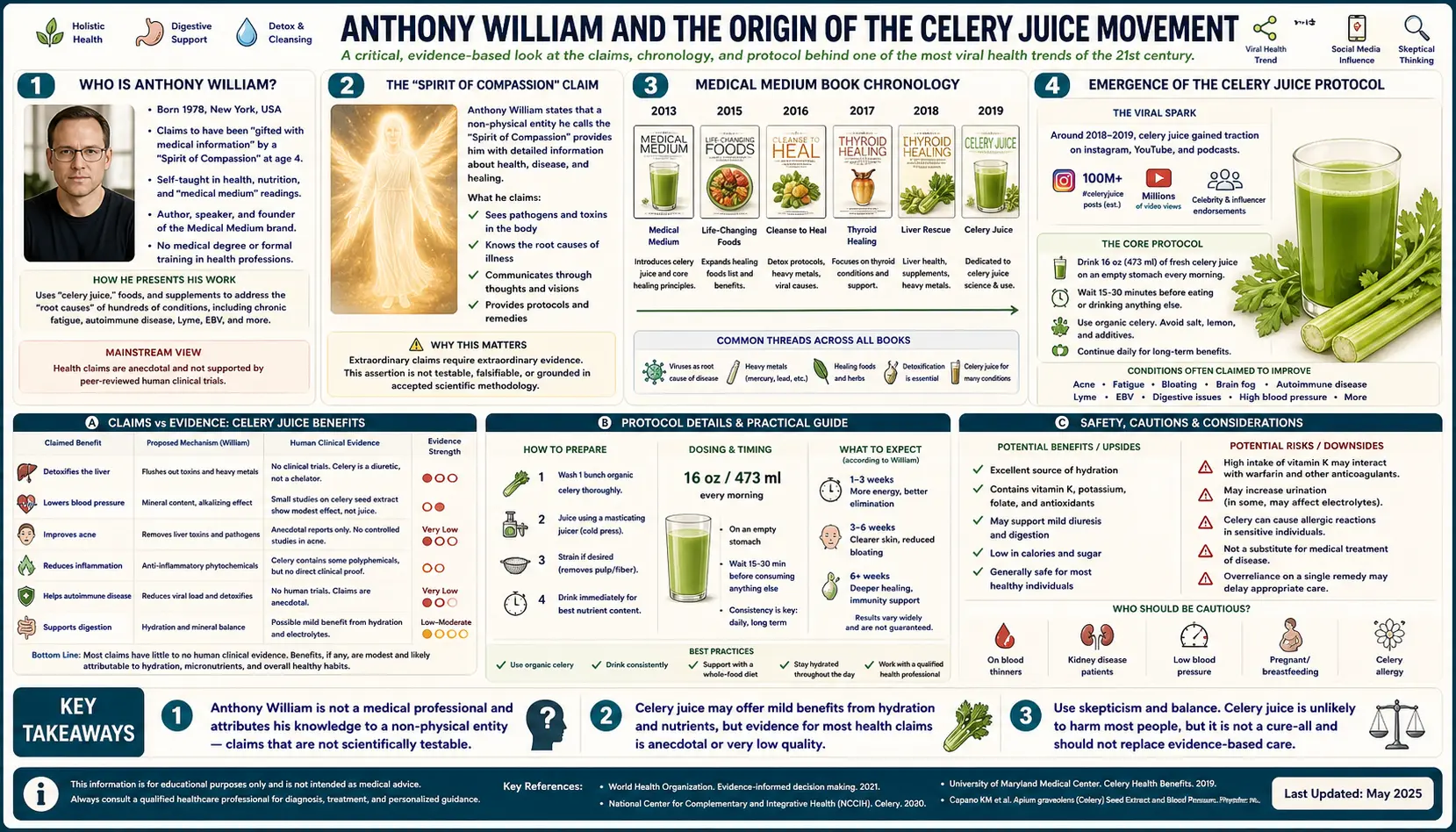
The "Medical Medium" celery juice protocol — 16 ounces of straight, pulp-free, cold-pressed celery juice on an empty stomach, first thing every morning, waiting 15-30 minutes before consuming anything else — was popularized starting around 2015 by Anthony William, an author with no medical, nutritional, or scientific credentials who attributes his health guidance to communications from a metaphysical entity he calls "Spirit of Compassion." Within five years, the protocol had been adopted by millions of people worldwide, endorsed by A-list celebrities including Pharrell Williams, Gwyneth Paltrow, Sylvester Stallone, and Robert De Niro, and propelled to the top of the New York Times bestseller list across four consecutive books. This page is a neutral chronology of how a humble Apiaceae garden vegetable became the centerpiece of a multi-billion-dollar wellness movement, alongside the institutional and clinical pushback that emerged in response.
Table of Contents
- Who Is Anthony William?
- The "Spirit of Compassion" Claim
- The Medical Medium Book Chronology
- The Emergence of the Celery Juice Protocol
- Instagram Virality and #CeleryJuice
- Celebrity Endorsements and the Goop Ecosystem
- Institutional Pushback (Dietitians, Gastroenterologists)
- Legal and FTC Considerations
- Why the Protocol Spread So Effectively
- Key Research and Reference Sources
- Connections
- Featured Videos
Who Is Anthony William?
Anthony William, who writes under the brand name "Medical Medium," is a New York Times bestselling author of seven books on health and chronic illness as of 2024. He has no degree in medicine, nursing, nutrition, dietetics, biology, chemistry, biochemistry, or any related life science. He has stated this openly in interviews and on his official website. His credentials, by his own description, are entirely experiential: he was born with the ability to hear the voice of a spirit he calls "Spirit of Compassion," who he says provides him with diagnostic and therapeutic guidance for living human beings.
This unusual claim is not hidden — it is the explicit foundation of the brand. The "Medical Medium" name itself is a portmanteau of "medical" (the subject matter) and "medium" (the spiritualist tradition of channeling discarnate entities). William says the spirit communications began in early childhood and that his first verifiable health reading was given to his grandmother, who he describes as being correctly diagnosed by him with lung cancer at age four.
This origin story is the central uncomfortable reality that any serious discussion of the Medical Medium protocols must acknowledge. From the perspective of conventional epistemology — the methods by which scientific medicine validates claims through controlled experimentation, peer review, and replication — channeled spirit guidance is not an admissible source of medical knowledge. From the perspective of millions of William's readers, the truth of the spiritual origin is irrelevant: what matters is whether the practical recommendations help them feel better. Both perspectives coexist throughout the movement.
The "Spirit of Compassion" Claim
"Spirit of Compassion" is the name William gives to the entity he says provides him with medical information. He describes the spirit as an angelic or transcendent being, not a human ghost, and not associated with any specific religious tradition. The spirit reportedly speaks in plain language about pathophysiology, supplement protocols, dietary changes, and the underlying causes of chronic disease.
William's books credit Spirit of Compassion explicitly in their forewords and acknowledgments. The "voice" is presented not as metaphor but as the literal source of all the diagnostic and therapeutic claims that follow. This positions the books in a long Western tradition that includes Edgar Cayce's "sleeping prophet" health readings of the 1930s and 1940s, the channeled medical guidance of the 19th-century Spiritualist movement, and various other "intuitive medicine" traditions.
From a scientific perspective, channeled information is inherently unfalsifiable — if a recommendation works, the spirit was right; if it does not, the user was insufficiently consistent or the body was too damaged. There is no possible failed prediction that would invalidate the source. This unfalsifiability is the standard criterion (per Popper) that distinguishes scientific from non-scientific claims.
This does not, by itself, prove that any specific recommendation is wrong. Even an unfalsifiable source can, by coincidence or by intuition derived from observation of patterns, produce recommendations that turn out to be useful. The question that each reader has to settle for themselves is whether the source's unfalsifiability disqualifies the recommendations from serious consideration, or whether the practical outcomes (felt by them or others) override the epistemological concern.
The Medical Medium Book Chronology
The Medical Medium book series, published by Hay House (a major spirituality and self-help publisher founded by Louise Hay):
- 2015 — Medical Medium: Secrets Behind Chronic and Mystery Illness and How to Finally Heal. The foundational book. Introduces the Epstein-Barr Virus chronic-infection thesis as the proposed root cause of dozens of conditions including Hashimoto's thyroiditis, fibromyalgia, multiple sclerosis, chronic fatigue syndrome, lupus, and tinnitus. Reached New York Times bestseller list.
- 2016 — Medical Medium Life-Changing Foods. Catalog of fruits, vegetables, herbs, and spices with assigned therapeutic properties for various conditions. Introduces the language of "Holy Four" foods (fruits, leafy greens, herbs/spices, wild foods).
- 2017 — Thyroid Healing: The Truth Behind Hashimoto's, Graves', Insomnia, Hypothyroidism, Thyroid Nodules & Epstein-Barr. Extends the EBV thesis to all thyroid disease.
- 2018 — Liver Rescue. Frames the liver as the central organ in chronic illness, with EBV and "viral byproducts" depositing in liver tissue and causing systemic disease.
- 2019 — Medical Medium Celery Juice: The Most Powerful Medicine of Our Time. The dedicated celery juice book. By this point celery juice had already become a viral Instagram movement, and the book consolidated the protocol, introduced the "undiscovered cluster salts" terminology, and expanded the list of conditions celery juice was claimed to address.
- 2020 — Cleanse to Heal. Comprehensive cleansing and dietary protocols organized by condition.
- 2021-2024 — Brain Saver series (Brain Saver and Brain Saver Protocols, Cleanses & Recipes). Extends the framework to neurological and psychiatric conditions.
Several titles have reached #1 on the New York Times Advice, How-To & Miscellaneous bestseller list. As of 2024, total worldwide sales across the Medical Medium catalog are estimated to exceed five million copies in over a dozen languages.
The Emergence of the Celery Juice Protocol
The specific 16-ounce-on-empty-stomach celery juice protocol crystallized in William's public communications around 2015-2016, on his website, in his podcasts, and in social media. The framing — that celery juice acts as a "powerful medicine" through the action of "undiscovered cluster salts" that mobilize toxins, kill pathogens, and restore stomach hydrochloric acid — was novel and proprietary to him. The vegetable itself is, of course, ancient: celery (Apium graveolens) was used as a medicinal plant in classical Greek and Roman pharmacology (the "smallage" of Hippocrates and Dioscorides), in traditional Chinese medicine, and in Ayurveda.
What was new in 2015 was the specific protocol stack: (1) 16 fluid ounces, (2) straight celery only, no other ingredients, (3) strained pulp-free, (4) consumed first thing in the morning, (5) on a completely empty stomach, (6) with a 15-30 minute wait before consuming anything else, (7) every day, (8) for an indefinite period (described as therapeutic for months or years).
By 2018, the protocol was being adopted at scale. Sales of celery in U.S. grocery stores rose approximately 450% in the year ending June 2019 according to Nielsen retail-scan data, and major produce distributors reported supply chain pressure on California celery growers. Specialty cold-pressed juice companies introduced single-ingredient celery juice as a product line. Williams Sonoma and similar retailers reported surging masticating-juicer sales (the slow-extraction style that produces higher-quality celery juice than centrifugal juicers).
Instagram Virality and #CeleryJuice
The celery juice movement was the first major wellness phenomenon driven primarily by Instagram. The visual format (a 16-oz glass of bright green juice, photographed in morning light against a kitchen counter) was perfectly suited to the platform. The hashtag #CeleryJuice accumulated over 700,000 tagged posts by 2020 and has continued to grow. Sub-hashtags (#CeleryJuiceHealing, #MedicalMedium, #CeleryJuiceBenefits) added millions more.
The pattern was archetypal social-media wellness virality:
- Visual format readily shareable (the green-juice photo).
- Low barrier to entry (celery is universally available and inexpensive).
- Promised dramatic benefits across a wide range of complaints, allowing identification by users with diverse conditions.
- Strong community formation around the practice (Facebook groups with hundreds of thousands of members, hashtag-based identity).
- Celebrity validation amplifying mainstream credibility.
- Easily attributable subjective benefits (feeling better in the morning is a common before-coffee comparison).
The Instagram-driven adoption preceded and likely exceeded the book-driven adoption. Many users adopted celery juice in 2018-2019 having never read the Medical Medium books, having only encountered the practice through Instagram or word-of-mouth.
Celebrity Endorsements and the Goop Ecosystem
The celebrity endorsement list expanded rapidly:
- Gwyneth Paltrow — Goop has featured Anthony William multiple times; Paltrow has personally endorsed the celery juice protocol in podcast appearances and on her platform.
- Pharrell Williams — publicly credited celery juice with substantial skin improvement.
- Sylvester Stallone, Robert De Niro — both have publicly endorsed the Medical Medium protocols.
- Miranda Kerr — long-time Medical Medium proponent and personal-network supporter of William.
- Naomi Campbell, Liv Tyler, Calvin Harris — various endorsements in interviews and on social media.
The Goop integration is particularly notable. Goop has built an entire wellness ecosystem around aspirational practices that blend genuine science with metaphysical claims, and William's framework fits naturally into that editorial sensibility. Goop's endorsement provided the celery juice protocol with a kind of fashion-credentialed legitimacy that the practice would not have achieved through medical channels.
The flip side of celebrity endorsement is that the same celebrities have, at various times, endorsed practices that have been debunked or actively recalled (jade vaginal eggs, "Body Vibes" wearable stickers). Celebrity validation is a poor proxy for evidence of efficacy, regardless of which specific wellness practice is at issue.
Institutional Pushback (Dietitians, Gastroenterologists)
By 2019, the institutional pushback from credentialed clinicians and researchers had become organized and vocal. Representative critiques:
- Several gastroenterologists writing in Forbes, the Washington Post, and clinical-society blogs noted that "undiscovered cluster salts" do not appear in any peer-reviewed chemistry or biochemistry literature and cannot be tested for, measured, or identified by any laboratory in the world — making the central proposed mechanism unfalsifiable.
- Registered dietitians from the Academy of Nutrition and Dietetics observed that the "stops Epstein-Barr Virus in its tracks" claim has no published clinical evidence and that EBV is a herpesvirus that remains latent in human B cells for life regardless of dietary intervention.
- Endocrinologists noted that the Hashimoto's-thyroiditis-caused-by-EBV thesis is at best one hypothesis among many, that Hashimoto's is primarily an autoimmune condition with well-characterized HLA associations, and that the standard of care (TSH monitoring, levothyroxine where indicated, sometimes selenium and dietary gluten consideration) is supported by decades of evidence.
- Pediatric gastroenterologists raised specific concerns about the recommendation to give celery juice to children, particularly the oxalate load.
- Multiple Mayo Clinic and Cleveland Clinic explainers concluded that there is no harm in moderate celery juice consumption for most adults, but no evidence of specific therapeutic effect beyond what would be expected from any healthy vegetable in a healthy diet.
Notably absent from the formal pushback is any claim that celery juice is dangerous for the general population. The institutional concern is targeted: misleading therapeutic claims, opportunity cost (substituting celery juice for evidence-based treatment), and the financial extraction from vulnerable chronic-illness sufferers via expensive supplement protocols.
Legal and FTC Considerations
The Medical Medium brand has been careful to use disclaimer language. The books carry the standard "not intended to replace medical advice" caveat. The website includes similar disclaimers. This has thus far been sufficient to keep the brand out of the kind of FTC enforcement action that has targeted other wellness operators who made explicit treatment-or-cure claims for specific diseases.
The line between protected free speech (writing books with health opinions) and regulated commercial speech (selling supplements with disease claims) is not always sharp, but the Medical Medium brand has navigated it by structuring product sales as separate from specific disease claims, leaving the disease-specific framing in the books themselves under publishing-industry editorial speech protection.
Other celery juice proponents have not always been as careful. Several MLM-style multi-level marketing operators began selling celery juice powders and "celery juice cleanses" with specific cure claims for cancer, diabetes, and autoimmune disease. Several of these operators have received FTC warning letters or have been targeted by state attorney general consumer protection actions.
Why the Protocol Spread So Effectively
Several structural reasons the celery juice protocol achieved such broad adoption:
- Mainstream medicine's gap in chronic illness. Conditions like chronic fatigue, fibromyalgia, IBS, eczema, autoimmune flares, and unexplained inflammation are notoriously poorly served by conventional medicine. Patients with these conditions are pre-conditioned to seek alternatives. The Medical Medium framework offers a comprehensive model that explains all of them through a single cause (EBV and "toxins") and a coherent protocol (celery juice + heavy-metal-detox smoothie + dietary changes). Whether the model is correct is one question; the unmet patient need that drove its adoption is entirely real.
- Subjective experience is overwhelming. The user who feels measurably better on the protocol is unlikely to be persuaded by epistemological objections about the source of the recommendations. "It works for me" trumps "there is no mechanism" in lived experience.
- The intervention is essentially harmless. Unlike many alternative protocols (extreme fasting, mega-dose supplements, raw-organ-meat diets, ivermectin for COVID), 16 oz of celery juice carries minimal risk. This made adoption a low-stakes experiment.
- Strong community formation. The Medical Medium Facebook groups, Instagram communities, and conferences provide a social structure that conventional dietary advice does not. Belonging matters.
- Algorithmic amplification. Instagram and Facebook's engagement-optimizing algorithms reward visually striking, emotionally resonant before-and-after content. The celery juice format was optimized for that environment.
Understanding these drivers is important for any clinician or family member who wants to have a productive conversation with someone on the protocol. Dismissing the practice purely as pseudoscience misses why thoughtful, intelligent people adopt it. The companion Evidence and Skepticism page covers the substantive scientific objections to the specific claims.
Key Research and Reference Sources
- Nielsen retail scan data on U.S. celery sales surge 2018-2019 — PubMed: Social media food trend sales
- Epstein-Barr Virus pathophysiology and chronic latency — PubMed: EBV latency
- EBV and Hashimoto's thyroiditis — the actual published evidence — PubMed: EBV and Hashimoto's
- EBV and multiple sclerosis (Bjornevik 2022 Science paper) — PubMed: Bjornevik EBV-MS
- Placebo and nocebo effects in dietary interventions — PubMed: Placebo in dietary trials
- Social media and dietary behavior change — PubMed: Social media and diet
- Celebrity health endorsement effects on consumer behavior — PubMed: Celebrity health endorsement
- Wellness culture and chronic illness patients — sociology — PubMed: Wellness culture sociology
- Unfalsifiability and pseudoscience — Popper criterion in medicine — PubMed: Falsifiability in medicine
- Multi-level marketing in wellness supplements — consumer harms — PubMed: MLM supplement harms
- Patient health-information-seeking behavior in chronic disease — PubMed: Health info seeking
- Edgar Cayce and channeled medical traditions — historical context — PubMed: Channeled medicine history
PubMed Topic Searches
- PubMed: Apium graveolens (celery)
- PubMed: Alternative medicine chronic illness
- PubMed: EBV and autoimmune disease
- PubMed: Wellness celebrity endorsement
- PubMed: Social media health trend
Connections
- All Remedies
- Celery Juice Benefits Hub
- Celery Bioactive Compounds
- Claimed Detox Benefits
- Evidence and Skepticism
- Celery Juice (Hub)
- Celery Juice for Blood Pressure
- Celery Juice and Kidney Disease
- Celery (Whole Food)
- Hashimoto's Thyroiditis
- Multiple Sclerosis
- Fibromyalgia
- Chronic Fatigue Syndrome
- Morley Robbins Mineral Protocol
- Gerson Therapy