Whipple, Minot & Murphy: Pernicious Anemia, the Liver Cure, and the Road to Vitamin B12
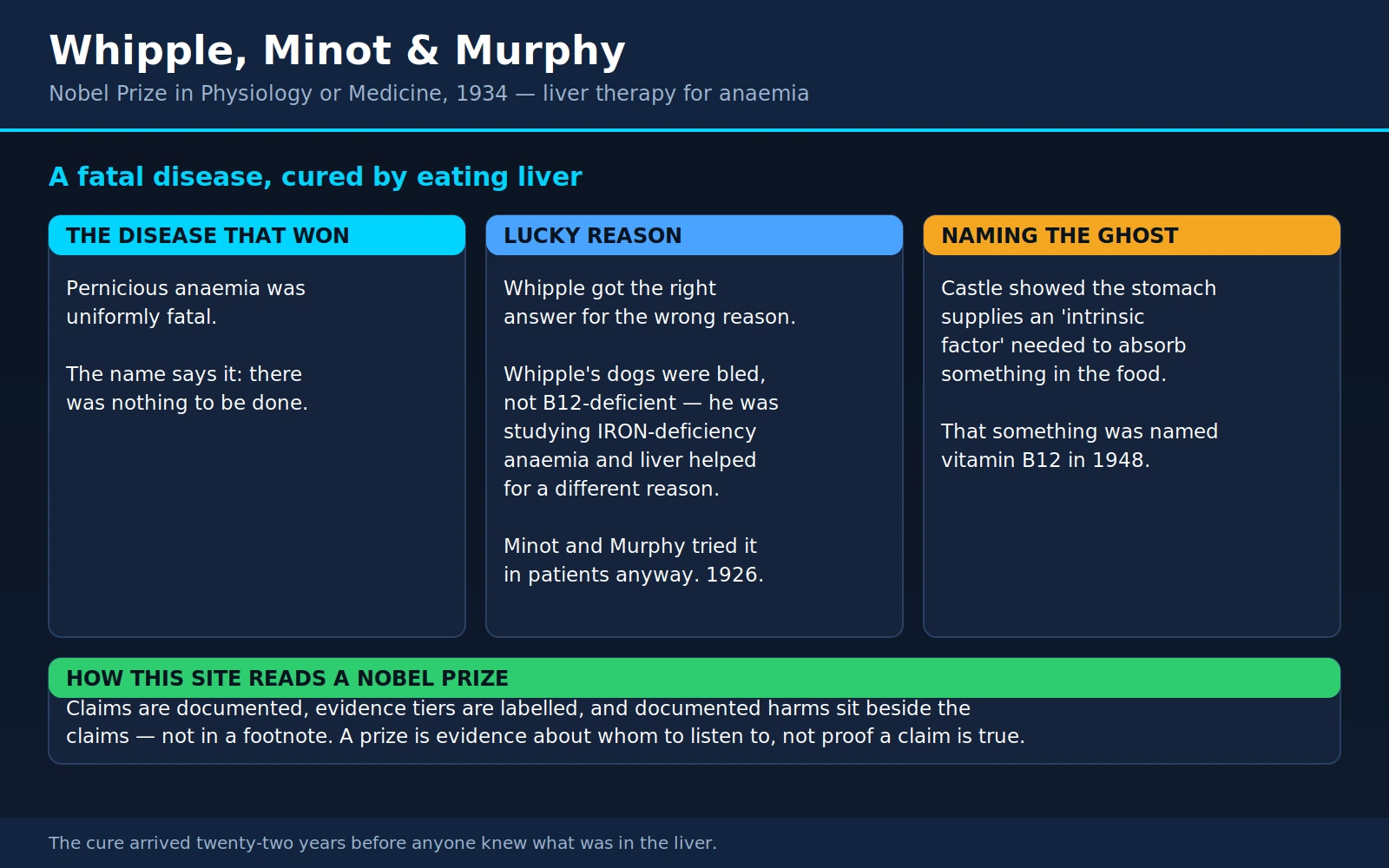
Table of Contents
- The Disease That Always Won
- Three Men, Three Kinds of Work
- Whipple's Dogs: Right Answer, Lucky Reason
- The Liver Diet, 1926
- Castle's Gastric Ghost: Intrinsic Factor
- Naming the Ghost: Vitamin B12, 1948
- What Pernicious Anemia Actually Is
- B12 Deficiency Today: Risk, Testing, Treatment
- Food Sources: Liver Is Still the Champion
- Where Mainstream Medicine Agrees — and What the Record Complicates
- Key Research Papers
- Connections
- Featured Videos
1. The Disease That Always Won
Before 1926, a diagnosis of pernicious anemia was a death sentence with a timetable. The English physician Thomas Addison first described it in 1849; the German clinician Anton Biermer, who saw enough cases to know how they ended, gave it the name that stuck in 1872: progressive pernicious anemia. "Pernicious" was not a flourish. It meant exactly what it said — the disease progressed, remissions were brief and cruel when they came at all, and nearly every patient was dead within one to three years of diagnosis.
The way it killed was slow and strange. It usually began as a creeping exhaustion that rest did not touch — climbing a flight of stairs became a project, then a day's work did, then getting dressed. The skin took on a peculiar lemon-tinted pallor, not the plain white of ordinary anemia but pale yellow, because the disease destroys red blood cells even as it fails to make them, and the wreckage tints the skin the way a fading bruise does. The tongue became smooth, glossy, and sore — the little papillae that give a tongue its velvet texture simply wasted away, so that hot food and citrus burned. And then came the part no one could explain: the feet went numb. Patients described walking on cotton wool, or on someone else's feet — the floor was down there somewhere, but the feet had forgotten it. Balance failed in the dark, when the eyes could no longer compensate for what the feet no longer reported. Some patients drifted into confusion, depression, even psychosis before the anemia itself looked severe.
Doctors could describe all of this in exquisite detail. They could measure the falling red cell count and note, under the microscope, that the surviving red cells were strangely large. What they could not do was change the outcome. Arsenic was tried, and transfusions, and rest cures, and every tonic in the pharmacopeia. The disease shrugged them all off.
It had a type, too. Pernicious anemia mostly struck adults in middle age and beyond, was somewhat more common in people of northern European descent, and kept conspicuous company with other conditions we now recognize as autoimmune — thyroid disease, vitiligo, premature graying. Families sometimes carried it across generations. None of that was understood at the time; it was simply the pattern experienced clinicians learned to dread. In the mid-1920s, pernicious anemia was killing roughly six thousand Americans a year, and the textbooks classified it — reasonably, on the evidence — as incurable.
Then, inside a single decade, three American physicians turned it into a manageable condition. The 1934 Nobel Prize in Physiology or Medicine went to all three of them jointly, "for their discoveries concerning liver therapy in cases of anaemias." The story of how they did it — including the parts they got wrong on the way to being right — is one of the best illustrations in all of medicine of how science actually moves: crookedly, luckily, and forward.
2. Three Men, Three Kinds of Work
The liver cure was not one discovery but a relay, and each of the three men ran a different leg.
George Hoyt Whipple (1878–1976) was the laboratory man. A New Hampshire doctor's son trained at Johns Hopkins, he was a pathologist by temperament as much as by title — patient, methodical, happiest running long experiments with careful controls. After early work in Panama and San Francisco (the rare intestinal disorder he described in 1907 still carries his name, Whipple's disease), he became the founding dean of the new medical school at the University of Rochester in 1921. It was there, with his longtime collaborator Frieda Robscheit-Robbins, that he ran the animal experiments that gave the whole story its starting clue. He never treated a pernicious anemia patient in the work that won him the prize; his contribution came entirely from dogs.
George Richards Minot (1885–1950) was the clinician — a Boston physician from an old medical family, trained at Harvard, with an almost obsessive interest in what his patients ate. Colleagues teased him for taking diet histories of everyone, including patients whose diseases had nothing obvious to do with food. And Minot carried a private stake in the power of new medicine that few of his colleagues could match: in 1921 he was diagnosed with severe diabetes — in that era, another death sentence with a timetable. He was kept barely alive on a starvation diet, wasting to roughly 120 pounds, until the newly discovered insulin reached him early in 1923. Frederick Banting's insulin did not just save one more diabetic; it saved the man who was about to cure pernicious anemia. Boston physicians said it plainly afterward: no insulin, no Minot — and no Minot, no liver cure.
William Parry Murphy (1892–1987) was the junior partner and the engine of the clinical work. A schoolteacher's son from Wisconsin who taught high-school math and physics to pay his way, he reached Harvard Medical School on a scholarship and joined Minot as a young associate at the Peter Bent Brigham Hospital. What Murphy brought was relentlessness. Someone had to find the patients, persuade desperately ill people to eat what they were told to eat, come back day after day for blood counts, and count — by eye, at the microscope, thousands upon thousands of cells — the one measurement that would prove the treatment worked. That someone was Murphy. It is fashionable to describe him as the least famous of the three; it would be more accurate to say that without his particular kind of stamina there would have been nothing for anyone to be famous about.
A pathologist with dogs, a clinician with a theory about food, and a junior doctor who would not let go: that was the team, though Whipple never worked in the same building as the other two. What connected them was a single organ.
3. Whipple's Dogs: Right Answer, Lucky Reason
Whipple's question sounded simple: does diet affect how fast the body rebuilds blood? Starting around 1917 in San Francisco and continuing at Rochester through the 1920s, he and Robscheit-Robbins worked out a way to ask it precisely. They bled dogs — carefully, repeatedly — until each dog's hemoglobin sat at roughly a third of normal, then kept it there with periodic further bleeding. Against that steady, standardized anemia, they could feed one food at a time and measure exactly how much new hemoglobin the dog built over a two-week stretch. It was slow, unglamorous, beautifully controlled work: one variable, one number, hundreds of dogs, years of patience.
The results sorted foods into a clear league table. A bland basal diet barely supported blood-making at all. Bread and milk did little. Muscle meat and heart helped. And one food stood alone at the top, so far ahead of everything else that it looked like a different category: liver. Dogs fed liver poured out new hemoglobin faster than dogs fed anything else Whipple tried. The key papers, published with Robscheit-Robbins in 1925, said it plainly: liver, followed by heart and skeletal muscle, held a "favorable influence" on blood regeneration that other foods could not match.
Now for the honest footnote, which deserves to be told as plainly as the triumph. Whipple's dogs did not have pernicious anemia. They had blood-loss anemia — which is iron-deficiency anemia. Every bleeding drained iron out of them, and what a bled dog needs to rebuild hemoglobin is, above all, iron. Liver is one of the most iron-rich foods that exists. So when liver topped Whipple's league table, it was very likely winning mostly on its iron — a nutrient that has nothing to do with pernicious anemia, a disease in which iron absorption is not the problem and iron supplements do not help. The experiment pointed at the right food largely for the wrong reason.
It was still the clue that mattered. Liver happens to be extravagantly rich in both iron and the then-unimagined vitamin B12, because liver is the body's warehouse for both. A model built on iron-hungry dogs therefore pointed, by biochemical coincidence, straight at the one common food dense enough in B12 to treat pernicious anemia by mouth. Historians of medicine have chewed on this irony for a century, and the fairest reading is this: Whipple asked a rigorous question, got a true answer — liver rebuilds blood in his model, and it genuinely does — and the answer turned out to generalize one disease further than his experiment could justify. Minot, who had been following Whipple's papers closely, took the leap the data invited but did not strictly license. Science advances crookedly. The dogs were wrong about why; they were right about what, and in 1926 what was the thing dying patients needed.
4. The Liver Diet, 1926
Minot's idea was almost insultingly simple for a disease that had defeated medicine for seventy-five years: if liver rebuilds blood in Whipple's dogs, feed liver — a lot of it — to patients with pernicious anemia. Beginning in earnest in 1925, Minot and Murphy put patients on a diet built around up to half a pound of liver every single day — roughly 120 to 240 grams, lightly cooked or nearly raw, alongside muscle meat, fruit, and vegetables. Not a garnish. Not a weekly serving. A daily half-pound, forever.
The problem was proving quickly that it worked, because pernicious anemia was famous for spontaneous partial remissions that could fool an optimistic doctor for months. This is where the story turns on a laboratory number, and it is worth understanding, because the same number is still printed on blood work today. A reticulocyte is a newborn red blood cell, fresh out of the bone marrow, still carrying a lacy remnant of its manufacturing machinery that picks up a special stain. Normally only about one percent of circulating red cells are this young. Count the reticulocytes and you are not measuring the slow-moving total blood count — you are reading the factory's output gauge, live. If a treatment truly switches a stalled marrow back on, the reticulocyte count surges within days, long before the anemia itself visibly improves. It was the perfect early readout, and Murphy counted relentlessly.
The surge came. Within about a week of starting the liver diet, patient after patient shot out a burst of new reticulocytes — a "reticulocyte crisis," the marrow roaring back to life — followed over the next weeks by a steadily climbing red cell count, returning color, returning appetite, returning strength. People who had been dying got up. In May 1926, Minot and Murphy stood before the Association of American Physicians in Atlantic City and reported remissions in 45 consecutive patients — in a disease whose natural course was death, forty-five out of forty-five, with the reticulocyte curves to prove the treatment and not chance had done it. The paper published in JAMA that August is one of the landmark articles of twentieth-century medicine. There was no control group, and none was needed; when a uniformly fatal disease starts losing every time, the effect is its own statistics.
Two honest asides belong here. First, the cure had a human cost that modern readers, reaching for a supplement bottle, can barely imagine: the price of staying alive was choking down a half-pound of liver every day for the rest of your life. Patients gagged, wept, negotiated, relapsed when they quit, and went back to it because the alternative was the graveyard. Doctors' records from those years are full of liver recipes, liver milkshakes, and pleading. Second, relief arrived quickly: within about two years, the Harvard physical chemist Edwin Cohn produced concentrated liver extracts — first taken by mouth in small doses, later given as injections — that packed the anti-anemia principle of pounds of liver into something tolerable. The extracts made the therapy livable, turned the question "what in liver does this?" into a chemistry problem, and started a twenty-year hunt for the active molecule.
5. Castle's Gastric Ghost: Intrinsic Factor
The liver diet worked, but it made no sense — and one man in the same Boston hospital system noticed exactly why it made no sense. Healthy people ate far less liver than half a pound a day and never developed pernicious anemia; patients had usually eaten perfectly ordinary diets before falling ill. So the disease could not simply be a dietary lack of something in liver. William B. Castle, a young Harvard physician working at the Thorndike Laboratory of Boston City Hospital, framed the right question: what if the defect was not in the patient's food but in the patient's stomach? It was known that pernicious anemia patients' stomachs were atrophied and made no acid. Perhaps a normal stomach contributed something that let the food factor be absorbed — and the pernicious stomach had lost it.
His experiment, run in 1928–29, has become one of the legendary self-experiments in medicine, and it deserves to be described frankly, because its slight outrageousness is the point. Castle ate about 300 grams of rare ground beef, waited an hour while his healthy stomach worked on it, then recovered the partially digested contents from his own stomach and delivered the material through a tube into patients with pernicious anemia, day after day. Their reticulocytes surged and their blood counts rose — the same response the liver diet produced. The controls nailed it down: the same beef given directly, without a healthy stomach's processing, did nothing; gastric juice essentially alone did nothing. Only the combination — food factor plus something from a normal stomach — switched the marrow back on.
Castle named the two halves with deliberately plain words: an "extrinsic factor" in food, and an "intrinsic factor" made by the normal stomach, which together allowed the anti-anemia principle to be absorbed. Pernicious anemia, he concluded, was at bottom a stomach disease: the intrinsic factor was missing, so the extrinsic factor in a normal diet passed straight through, unabsorbed. The reason the Minot–Murphy diet worked was brute force — a half-pound of liver carried so much of the extrinsic factor that a trickle of absorption without any intrinsic factor was finally enough. Every piece of that reasoning has held up. The extrinsic factor turned out to be vitamin B12; intrinsic factor turned out to be a real, isolatable gastric protein that still bears Castle's plain name; and the absorption chemistry he inferred from meals of regurgitated hamburger is in every physiology textbook.
Castle received almost every honor American medicine could give — except the one in Stockholm. The 1934 Nobel went to Whipple, Minot, and Murphy for the liver therapy; the man who explained why the therapy worked, and thereby defined the disease itself, was left out, and Nobel historians regularly list him among the notable omissions. It is worth saying honestly and without melodrama: the prize rewarded the cure, not the understanding, and the understanding was Castle's.
6. Naming the Ghost: Vitamin B12, 1948
For twenty years after Castle, the "extrinsic factor" remained a ghost — a something-in-liver that chemists chased through ever-more-concentrated extracts without cornering it. Two tools finally trapped it. The first was a humble laboratory shortcut: the microbiologist Mary Shorb found a bacterium (Lactobacillus lactis) whose growth depended on the same liver factor, which meant a candidate extract could be tested in a day on a lawn of bacteria instead of a month on a patient. The second was industrial-scale chemistry. In April 1948, Karl Folkers and his team at Merck in the United States announced tiny red crystals — crystalline "vitamin B12," pried out of tons of liver. Weeks later, working independently, E. Lester Smith at Glaxo in England reported the same red crystals. That same year, patients injected with a few millionths of a gram of the crystals produced the classic reticulocyte surge. The half-pound of liver had been distilled to a red speck.
The molecule itself turned out to be a marvel. Working through the 1950s, the Oxford crystallographer Dorothy Hodgkin solved its complete three-dimensional structure by X-ray analysis — at the time the largest molecule ever solved that way, work that contributed to her 1964 Nobel Prize in Chemistry. At the center of the structure sits a single atom of cobalt, which is why the B12 family is called the cobalamins and why the crystals are red. B12 is the only vitamin built around a metal atom, the largest and most structurally complex vitamin known, and — a detail with practical consequences below — it is manufactured in nature only by bacteria and archaea. No plant and no animal can make it; animals merely collect and store it. Liver, the storage depot, was never magic. It was a warehouse.
For patients, the ghost's capture changed everything again. Injections of pure B12 — reliable, painless compared with the old extracts, absurdly effective in microgram doses — replaced the liver plates and the crude shots. A disease that in 1925 killed within three years became, by the 1950s, a condition managed with a periodic injection: diagnosed, treated, and lived with for a normal lifespan. The word "pernicious" survives in the name today purely as a historical fossil — kept, perhaps, as a reminder of what the disease was for the seventy-five years when it always won. From Whipple's first bled dogs to Hodgkin's finished structure, the road ran roughly forty years through pathology, clinical medicine, self-experimentation, microbiology, industrial chemistry, and crystallography — six Nobel-caliber disciplines to understand one food, one stomach, and one red molecule.
7. What Pernicious Anemia Actually Is
With a century of hindsight, the whole mechanism can be laid out in one chain, and every link was foreshadowed by the story above.
Pernicious anemia is an autoimmune disease of the stomach. The immune system attacks the stomach's parietal cells — the acid-making cells of the stomach lining — and often attacks intrinsic factor itself with a second antibody. As the parietal cells are destroyed (a process called autoimmune atrophic gastritis, which is why those old clinical notes described shrunken, acid-less stomachs), the stomach loses its ability to make intrinsic factor. No intrinsic factor means dietary B12 cannot be escorted to its specialized absorption site in the last stretch of the small intestine, the terminal ileum. The body's B12 stores — several years' worth, held mostly in the liver — drain slowly down, which is why the disease creeps rather than crashes. This autoimmune character is also why pernicious anemia keeps company with thyroid disease and vitiligo, the pattern the old clinicians noticed without being able to name.
The blood becomes megaloblastic. B12 (with folate) is required to make DNA. Starve the bone marrow of it and developing red cells can grow but struggle to divide, so the marrow ships out red cells that are too large and too few — the strange big cells the early microscopists saw. On a modern complete blood count, this shows up as an elevated MCV (mean corpuscular volume — the average size of your red cells) alongside a falling count. Many of the malformed cells are destroyed before they ever leave the marrow, and that ongoing wreckage releases pigment that explains the historic lemon-yellow tint: pallor from the anemia, plus a wash of mild jaundice from the destruction.
And then there is the part anemia cannot explain. B12 has a second, entirely separate job: maintaining the myelin insulation of the nervous system. Deficiency damages the spinal cord in a characteristic pattern called subacute combined degeneration — "combined" because it strikes both the dorsal columns, which carry position and vibration sense up from the feet (hence the numb feet that forgot the floor, and the balance that failed in the dark), and the lateral corticospinal tracts, which carry movement commands down (hence weakness and stiffness). Peripheral nerves, the optic nerve, memory, and mood can all be involved. Crucially, the nerve damage does not need the anemia. In a landmark 1988 study, Lindenbaum and colleagues showed that roughly a quarter of patients with clear neurological or psychiatric disease from B12 deficiency had no anemia and normal-sized red cells. A normal blood count does not rule out B12 deficiency — a fact that still catches doctors today, and the single most practical sentence on this page.
The folate-masking trap deserves its own paragraph, because it is a trap. Folate (vitamin B9) works hand-in-hand with B12 in DNA synthesis, and a large dose of folic acid can partially bypass the blockage — in the blood only. Give folic acid to someone whose real problem is B12 deficiency and the anemia visibly improves: the blood count rises, the MCV drifts down, everyone relaxes. Meanwhile the spinal cord, which folate cannot rescue, goes on quietly demyelinating. The classic result is a patient whose "anemia was cured" while they progressed toward an irreversible neurological injury. This is why any megaloblastic anemia should have B12 checked before folate is given alone, and why the neurological exam matters even when the blood work looks reassuring.
8. B12 Deficiency Today: Risk, Testing, Treatment
Classic autoimmune pernicious anemia is still with us, but it is now the minority story. Most B12 deficiency today comes from quieter causes, and several of them are common enough that this section may apply to you or someone at your table.
Who is at risk:
- Vegans and vegetarians without supplementation. Plants contain no B12 at all (the reason is in section 9). Body stores can coast for years after the diet changes, which makes the eventual deficiency sneakier, not milder. This is the one risk group where the fix is unambiguous and cheap: a supplement or reliably fortified foods, non-negotiable.
- Older adults. With age, atrophic gastritis and low stomach acid become common, and acid is what pries B12 loose from food protein. Many older adults can absorb crystalline B12 (the supplement form) perfectly well while absorbing food-bound B12 poorly — one reason deficiency is so frequent past 60 even on a good diet.
- Metformin users. The most-prescribed diabetes drug interferes with B12 uptake in the ileum. In a randomized placebo-controlled trial running over four years, metformin lowered B12 levels by about 19% and pushed a meaningful fraction of patients into outright deficiency. Anyone on long-term metformin — especially with numbness or tingling, which is too easily filed under "diabetic neuropathy" — deserves periodic B12 checks.
- Long-term acid blockers. Proton-pump inhibitors and H2 blockers suppress the acid that releases food-bound B12. Years of continuous use is the risk pattern, not an occasional antacid.
- Stomach or intestinal surgery. Gastrectomy and gastric-bypass procedures remove or bypass the very cells that make intrinsic factor; lifelong supplementation is standard after them.
- Crohn's disease and celiac disease. Both can damage the terminal ileum or its function — the one patch of intestine where the intrinsic-factor escort is honored. Ileal resection for Crohn's makes the problem permanent.
Testing, honestly. The standard serum B12 test is a decent screen and a mediocre judge. Its gray zone is wide — results roughly in the 200–400 pg/mL band can accompany genuine deficiency or genuine health — and in true pernicious anemia the test can occasionally read falsely normal, because the patient's own intrinsic-factor antibodies interfere with the assay chemistry. When the question matters — unexplained neuropathy, unexplained macrocytosis, a borderline result — the better confirmations are the two metabolites that pile up when cells are actually starved of B12: methylmalonic acid (MMA), the more specific of the pair, and homocysteine, which also rises in folate deficiency. Elevated MMA with a borderline B12 is functional deficiency until proven otherwise (with the caveat that impaired kidney function raises MMA too). If pernicious anemia specifically is the question, intrinsic-factor antibodies are highly specific when positive, though they miss a good share of real cases.
Treatment, honestly. For decades the reflex has been injections — typically 1,000 µg of B12 intramuscularly, given frequently at first to refill the empty stores, then monthly-or-so for life in pernicious anemia. Injections work, and for serious neurological deficits, or whenever adherence is shaky, they remain the confident choice. But the evidence is clear that high-dose oral B12 — 1,000 to 2,000 µg daily — works even when intrinsic factor is completely absent. The reason is a quiet back door: about 1% of any swallowed dose crosses the gut by passive diffusion, no escort required. One percent of 2,000 µg is 20 µg — several times the daily requirement. In a randomized trial, 2,000 µg daily by mouth matched a standard injection schedule and, by four months, produced better B12 levels and lower MMA; the Cochrane review of the question reached the same conclusion from the trials available. Injections are not wrong — they are simply no longer the only correct answer, and for the needle-averse that is worth knowing. Either way, in pernicious anemia the treatment is for life: the stomach does not grow its parietal cells back.
Forms, without the marketing. Supplements come mainly as cyanocobalamin (cheap, stable, and the form used in most of the trials above) and methylcobalamin (one of the two forms your cells actually use, and marketed hard on that basis). The honest tiering: whatever form you swallow, your cells strip it down and rebuild the coenzyme forms they need, so the "bioactive form" argument mostly dissolves in biochemistry, and no good clinical evidence shows methylcobalamin outperforming cyanocobalamin at equivalent doses — while cyanocobalamin is the better-studied and more shelf-stable molecule. If you prefer methylcobalamin, it works; just don't pay a premium believing it superior. (Hydroxocobalamin, common in injections outside the US, holds levels longer per shot — a genuine practical difference, and the one form-versus-form claim with solid footing.)
9. Food Sources: Liver Is Still the Champion
A century after Minot's patients gagged their way to remission, the league table Whipple's dogs drew up has barely moved. Liver is still, by a wide margin, the most B12-dense food that exists. A modest 3-ounce serving of beef liver carries roughly 70 µg of B12 — about thirty times the 2.4 µg adult daily requirement — along with the iron that fooled Whipple so productively, plus copper, retinol, and folate. Readers of this site will recognize the theme: our whole-food copper sources page makes the case for beef liver as the single most nutrient-dense common food, and the B12 story is the oldest and best-proven plank in that case. Once a week, not half a pound a day — the 1926 dose was brute force against a broken stomach, not a model for anyone with working absorption.
The rest of the table, in rough order:
- Clams — the one food that rivals or beats liver per bite; a serving can carry many times the daily requirement.
- Sardines — several days' worth per tin, with the omega-3s and calcium thrown in.
- Fish generally — salmon, herring, trout, tuna all deliver a full day's B12 or more per serving.
- Beef — a reliable ~2–3 µg per serving; lamb similar.
- Eggs — about 0.5 µg each, nearly all of it in the yolk. Eat the yolk.
- Milk, yogurt, and cheese — roughly 1 µg per cup of whole milk; dairy B12 is well absorbed and, for vegetarians who eat dairy and eggs, does most of the work.
Why plants have none: B12 is made only by bacteria and archaea — no plant, fungus, or animal synthesizes it. Grazing animals get theirs from bacterial fermentation in their own gut (which requires cobalt in the soil — the vitamin's metal heart shapes agriculture), and the vitamin then concentrates up the food chain into flesh, eggs, milk, and above all the liver, the storage organ. A plant can no more contain B12 than it can contain hemoglobin. Claims for spirulina and most algae rest largely on look-alike molecules that human cells cannot use and that can even distort blood testing — they are not a B12 source. For fully plant-based readers the honest answer is the one from section 8: fortified foods eaten deliberately — fortified nutritional yeast and fortified plant milks — or, more simply and more reliably, a supplement. This is the one nutrient where "food first" has an asterisk, because the relevant food is an animal.
10. Where Mainstream Medicine Agrees — and What the Record Complicates
Where mainstream medicine agrees
Almost everything on this page is settled science of the most bankable kind. Pernicious anemia is an autoimmune gastritis that destroys intrinsic-factor production; B12 deficiency causes megaloblastic anemia and subacute combined degeneration; the deficiency is fully treatable and the neurological damage largely preventable with timely B12; high-dose oral therapy is a legitimate alternative to injections; liver and shellfish are the richest food sources; plant-based diets require supplementation. The 1934 prize itself is uncontroversial: liver therapy was the first effective treatment for a uniformly fatal disease, and the line from Whipple's dogs through Minot and Murphy's wards to the red crystals of 1948 is one of medicine's proudest, best-documented roads. No serious historian or hematologist disputes the trio's importance.
What the record complicates
The same well-documented road has bends the Nobel citation smooths over, and this site's habit is to name them. Whipple's iron accident: the model that launched the cure was, mechanistically, the wrong model — iron-deficient dogs pointing at a B12-deficiency disease — and the prize thus partly rewarded a beautifully executed experiment for a conclusion it did not really contain. Castle's omission: the man who worked out why liver therapy worked, and in doing so defined the disease, was left off the prize entirely; most modern accounts rank this among the Nobel committee's clearest misses. The uncredited collaborators: Frieda Robscheit-Robbins co-authored the core dog papers as Whipple's full scientific partner over decades — Whipple himself, to his credit, said so and shared his prize money with her — and Mary Shorb's bacterial assay was the practical key that let the chemists finally corner the vitamin in 1948. Neither woman's name appears on any prize. None of this diminishes what Whipple, Minot, and Murphy did; it locates it honestly inside a larger relay, which is how the crooked road of real science almost always looks up close.
11. Key Research Papers
- Minot GR, Murphy WP. Landmark article (JAMA 1926): Treatment of pernicious anemia by a special diet. JAMA 1983;250(24):3328-35
- Kass L. William B. Castle and intrinsic factor. Ann Intern Med 1978;89(6):983-91
- Scott JM, Molloy AM. The discovery of vitamin B12. Ann Nutr Metab 2012;61(3):239-45
- Sinclair L. Recognizing, treating and understanding pernicious anaemia. J R Soc Med 2008;101(5):262-4
- Stabler SP. Clinical practice: Vitamin B12 deficiency. N Engl J Med 2013;368(2):149-60
- Green R. Vitamin B12 deficiency from the perspective of a practicing hematologist. Blood 2017;129(19):2603-2611
- Lindenbaum J, Healton EB, Savage DG, et al. Neuropsychiatric disorders caused by cobalamin deficiency in the absence of anemia or macrocytosis. N Engl J Med 1988;318(26):1720-8
- Kuzminski AM, Del Giacco EJ, Allen RH, Stabler SP, Lindenbaum J. Effective treatment of cobalamin deficiency with oral cobalamin. Blood 1998;92(4):1191-8
- Vidal-Alaball J, Butler CC, Cannings-John R, et al. Oral vitamin B12 versus intramuscular vitamin B12 for vitamin B12 deficiency. Cochrane Database Syst Rev 2005;(3):CD004655
- de Jager J, Kooy A, Lehert P, et al. Long term treatment with metformin in patients with type 2 diabetes and risk of vitamin B-12 deficiency: randomised placebo controlled trial. BMJ 2010;340:c2181
Live PubMed Searches
- Pernicious anemia liver therapy history
- Intrinsic factor and vitamin B12 absorption
- Vitamin B12 deficiency: neurological disease
- Oral vitamin B12 versus injection
- Metformin and vitamin B12 deficiency
12. Connections
- All Notable Doctors
- Frederick Banting — the insulin that kept Minot alive long enough to cure pernicious anemia
- Christiaan Eijkman — beriberi, thiamine, and another cure found partly by accident
- Albert Szent-Györgyi — vitamin C isolated, the same golden age of vitamin discovery
- Henrik Dam & Edward Doisy — vitamin K, the clotting-factor parallel to this story
- Nobel Prize in Medicine — the laureates' wing this page belongs to
- Vitamin B12 — the full profile of the molecule this whole story was chasing
- Vitamin B12 Deficiency — symptoms, stages, and recovery in practical depth
- Vitamin B12 Benefits — what adequate B12 does beyond preventing anemia
- Complete Blood Count — where a high MCV first raises the question
- Methylmalonic Acid (MMA) — the confirmation test when serum B12 equivocates
- Homocysteine — the second metabolite that rises when B12 runs low
- Hematology — the blood-disease category pernicious anemia defined for a century
- Whole-Food Copper Sources — this site's case for beef liver, the food that started it all
- Covered in depth on its own page: Pernicious Anemia