Albert Szent-Györgyi: The Man Who Discovered Vitamin C
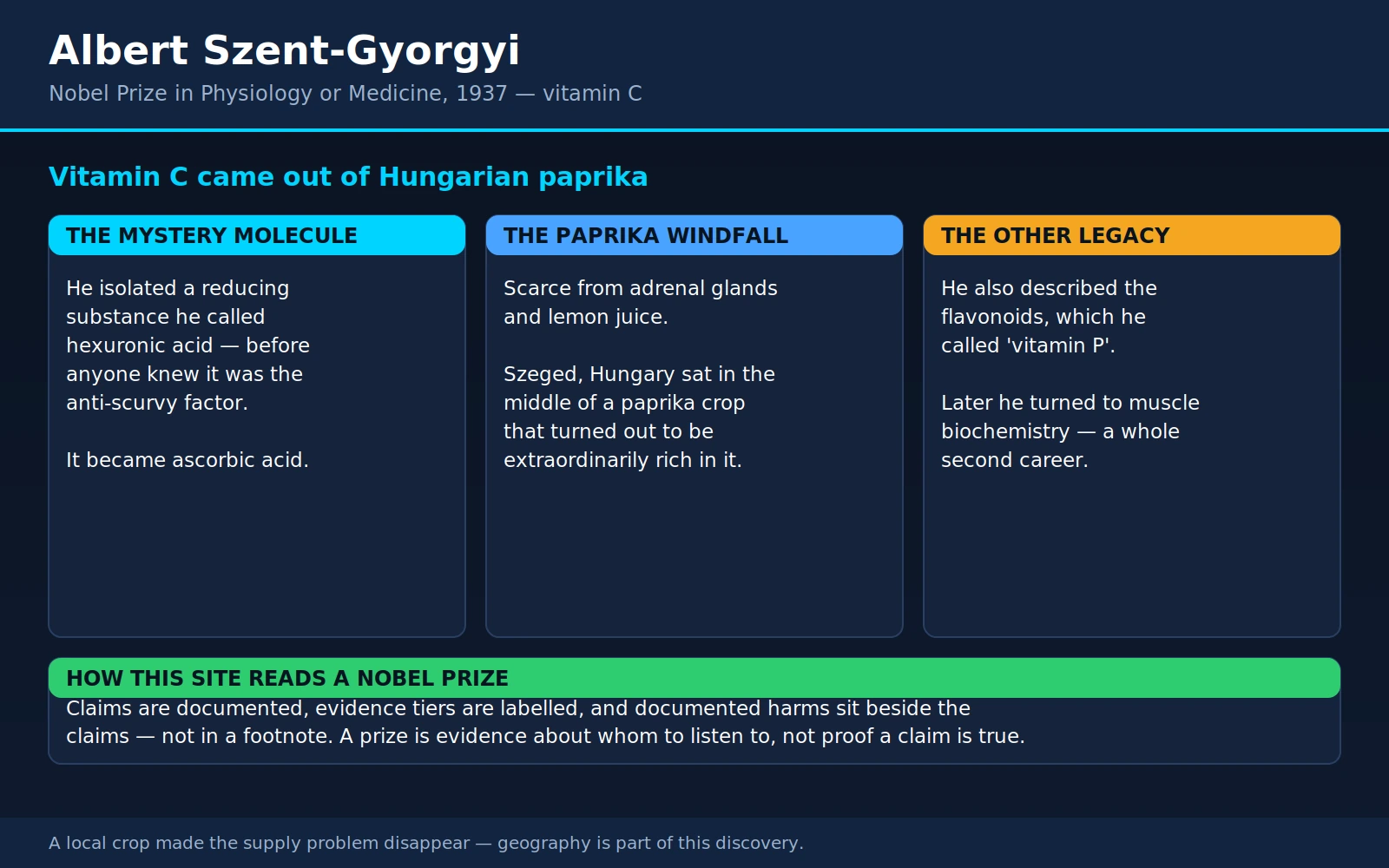
Table of Contents
- Overview
- From Budapest to the Bench
- Hexuronic Acid — the Mystery Molecule
- Szeged and the Paprika Windfall
- The 1937 Nobel Prize
- Vitamin P: The Flavonoids
- War, Resistance, and Escape
- Second Act: Muscle and Beyond
- Szent-Györgyi and the Vitamin C Debates
- What It Means for Readers Today
- Key Research Papers
- Connections
- Featured Videos
1. Overview
Albert Szent-Györgyi (1893–1986) was a Hungarian physiologist and biochemist who did something almost nobody in the history of science has managed: he made foundational discoveries in three separate fields. He isolated and identified vitamin C — the molecule people had been dying for lack of since the age of sail — and won the 1937 Nobel Prize in Physiology or Medicine for it and for his work on cellular respiration. He discovered the flavonoids, the vast family of plant compounds (his “vitamin P”) that today anchors an entire wing of nutrition research. And in his fifties he essentially founded modern muscle biochemistry by showing that muscle contraction comes down to two proteins, actin and myosin, powered by ATP.
The life around the science was just as remarkable: a decorated and disillusioned World War I medic, a wandering postdoc who nearly quit science, a professor in a paprika town whose local crop turned out to be the richest vitamin C source anyone had found, an anti-Nazi resister hunted by the Gestapo, and finally an American émigré theorizing about cancer and electrons at Woods Hole into his nineties. This page tells his story in plain language — what he actually established, which parts are his own colorful retellings, and what his discoveries mean for your plate today.
2. From Budapest to the Bench
Szent-Györgyi was born in Budapest on September 16, 1893, into a family thick with scientists — his uncle, Mihály Lenhossék, was a prominent anatomist at the University of Budapest, where Albert began medical school in 1911. World War I interrupted his studies: he served as an army medic on the Russian and Italian fronts and was decorated for bravery under fire.
What happened next he told openly for the rest of his life, so we present it as his own account: by 1916, convinced the war was lost and pointless, and believing he could do more good as a scientist than as a corpse, he shot himself through the upper arm, reported it as an enemy wound, and was sent home. He finished his medical degree in Budapest in 1917 while working in his uncle's field of anatomy and physiology.
The decade after the war was a long, poorly funded wander through European laboratories — Pozsony (Bratislava), Prague, Berlin, Hamburg, Leiden, and Groningen in the Netherlands — as he taught himself physical chemistry and chased one stubborn question: how do living cells “burn” their fuel? Why does a cut potato turn brown while a cut lemon does not? When his position in Groningen evaporated, he was close to abandoning science altogether. By his own telling, the turning point came at the 1926 International Physiological Congress in Stockholm, where he heard Frederick Gowland Hopkins — Cambridge's great biochemist and a discoverer of the vitamin concept itself — cite his obscure work on biological oxidation. Szent-Györgyi introduced himself, and Hopkins arranged a Rockefeller Foundation fellowship. At Cambridge, in Hopkins's laboratory, everything finally came together.
3. Hexuronic Acid — the Mystery Molecule
The browning question turned out to be the door to vitamin C. Plants that brown when cut are running an oxidation reaction; plants that resist browning, Szent-Györgyi reasoned, must contain a reducing agent — a chemical that donates electrons and holds oxidation back. Working at Cambridge in 1927–28, he isolated a small amount of exactly such a substance from cabbage and citrus. Then came the surprise: the same substance showed up in an animal tissue, the adrenal cortex. To get enough of it, he spent time at the Mayo Clinic in Rochester, Minnesota, where nearby slaughterhouses could supply adrenal glands by the crate, and returned with roughly 25 grams of purified crystals — a fortune, by the standards of the chemistry involved.
The compound was a six-carbon, sugar-like acid with formula C6H8O6. Its naming became one of biochemistry's best-loved jokes, and Szent-Györgyi told the story on himself for decades (so treat the details as his retelling): not knowing what the sugar was, he proposed calling it ignose (“I don't know” plus the sugar suffix -ose), and when the journal editor Arthur Harden rejected that, he offered godnose. Harden was not amused. The compound entered the literature under the deliberately cautious name hexuronic acid, in his 1928 paper in the Biochemical Journal.
Why did he care about it? Not, at first, because of scurvy. Szent-Györgyi's obsession was oxidation biology — the electron traffic of biological combustion — and here was a powerful, naturally occurring electron donor sitting in both plants and adrenal glands. He suspected hexuronic acid might also be the long-sought antiscorbutic (anti-scurvy) factor that nutrition researchers were hunting, but he was cautious about saying so, and by his own later admission he found the vitamin-hunting field uncomfortably fashionable and crowded. Proving the connection required an animal experiment he had not yet run.
4. Szeged and the Paprika Windfall
In 1930 Szent-Györgyi returned to Hungary to take the chair of Medicinal Chemistry at the University of Szeged. In the autumn of 1931 an American postdoctoral fellow of Hungarian descent, Joseph Svirbely, arrived from Charles Glen King's laboratory in Pittsburgh — and Svirbely brought precisely the skill the problem needed: the guinea pig scurvy bioassay. Guinea pigs, like humans (and unlike most animals), cannot make their own vitamin C, so they develop scurvy on a deficient diet. Svirbely fed scorbutic diets with and without added hexuronic acid. The animals given about a milligram a day stayed healthy; the controls sickened. By the spring of 1932 the conclusion was unavoidable: hexuronic acid was vitamin C. Their papers in the Biochemical Journal in 1932 and 1933 laid out the case (see the citations below). King's laboratory announced a similar conclusion in the same season, and a priority dispute simmered for years; the Nobel committee ultimately credited Szent-Györgyi's isolation and identification. With the sugar chemist Walter Norman Haworth, who worked out the molecule's structure, Szent-Györgyi renamed it ascorbic acid — literally, “no-scurvy acid.”
One enormous problem remained: supply. Adrenal glands were scarce in Hungary, and the obvious plant sources resisted purification — lemon juice is so loaded with sugars that pulling clean crystals out of it was a nightmare. The solution was growing all around him. Szeged is the paprika capital of Hungary, and by the story he loved to tell (present it as his own oft-repeated anecdote), the discovery happened at his dinner table: his wife served him fresh red paprika, he did not feel like eating it, and he excused himself by saying he would rather find out what was in it. By midnight he knew the pepper was a treasure house — paprika (Capsicum annuum) turned out to be one of the richest vitamin C sources ever measured, and conveniently low in the interfering sugars.
What followed was one of the great acts of scientific generosity of the era. During the paprika harvests his laboratory processed the crop by the ton and produced kilograms of pure crystalline vitamin C — at a time when other laboratories counted their supply in milligrams — and shipped it free to researchers around the world. That windfall is a large part of why the field moved so fast: Haworth had the structure by 1933, and Tadeus Reichstein's synthesis the same year opened the way to industrial production. Within a few years, a deficiency disease that had killed an estimated two million sailors over the centuries had become a solved problem of chemistry.
5. The 1937 Nobel Prize
In 1937 Szent-Györgyi was awarded the Nobel Prize in Physiology or Medicine — in the official wording, “for his discoveries in connection with the biological combustion processes, with special reference to vitamin C and the catalysis of fumaric acid” (Nobel Prize summary, 1937). Notice that the citation has two halves, and both matter.
The vitamin C half is the story above. The fumaric acid half is less famous but arguably just as important. Working with pigeon breast muscle at Szeged in the mid-1930s, Szent-Györgyi showed that a small set of four-carbon organic acids — fumarate, malate, succinate, and oxaloacetate — do not simply get burned as fuel: tiny amounts of them catalytically accelerate the whole of cellular respiration, being consumed and regenerated in a cycle. He had found a crucial arc of the wheel. In 1937 — the same year as his prize — Hans Krebs closed the loop and described the full citric acid cycle, the central roundabout of metabolism taught in every biology course since; Krebs received his own Nobel Prize in 1953, and biochemists still sometimes call part of the pathway the Szent-Györgyi–Krebs cycle.
Two footnotes to the prize year. First, 1937 was a double vitamin C year in Stockholm: Haworth shared the Chemistry prize in part for determining ascorbic acid's structure — done largely with Szeged paprika crystals. Second, Szent-Györgyi is widely reported to have offered his Nobel prize money to Finland during the 1939–40 Winter War — a gesture consistent with everything else in his biography, though we flag it as a widely repeated account rather than something we can document from primary records.
6. Vitamin P: The Flavonoids
In the mid-1930s, Szent-Györgyi and his Szeged clinical colleague István Rusznyák noticed something odd. In certain patients with fragile, leaky capillaries — the kind of bleeding tendency that shows up as easy bruising and bleeding gums — crude paprika or lemon extracts sometimes worked where pure crystalline vitamin C did not. Whatever was helping was riding along in the impurities. They traced the activity to the plant pigment fraction — the flavonoids (they called their citrus preparation “citrin”) — and in 1936 published the observation in Nature under a bold name: “Vitamin P,” for permeability.
The name did not stick, and honesty requires saying why: later researchers could not establish that flavonoids are a true vitamin. No deficiency disease appears when they are absent from the diet, no daily requirement could be defined, and by around 1950 official nomenclature bodies recommended dropping the term. On the narrow claim, Szent-Györgyi lost the point.
On the broad claim, he won an entire field. The observation that citrus flavonoids influence capillary strength launched decades of research on rutin, hesperidin, quercetin, and their thousands of cousins — work that runs in a direct line to today's research on flavonoid-rich diets, tea catechins, berry anthocyanins, and vascular health. Rutin in particular was studied for capillary fragility for decades and remains a popular supplement with genuinely interesting (if still evolving) evidence. If you want to follow that thread, start with our Rutin page — it is, in a real sense, a grandchild of the 1936 Nature letter.
7. War, Resistance, and Escape
Szent-Györgyi was an outspoken anti-fascist through the late 1930s, at a time when Hungary was sliding into alliance with Nazi Germany. As a professor and university rector in Szeged he used his standing to protect and assist persecuted colleagues, and as the war deepened he crossed from dissent into outright resistance. In 1943, under the cover of a scientific lecture trip, he traveled to Istanbul carrying secret peace feelers from the government of Prime Minister Miklós Kállay to Allied diplomats — an attempt to negotiate Hungary's exit from the Axis. The mission leaked to the Germans. Hitler is reported to have demanded his arrest by name; whatever the precise wording in Berlin, the practical result is well documented: the Gestapo hunted him, and after German forces occupied Hungary in March 1944 he lived in hiding, moving between safe houses, sheltered for a time under Swedish diplomatic protection in Budapest, and narrowly avoiding capture until the city fell in 1945.
He emerged from the war a national hero and threw himself into rebuilding Hungarian science — helping reorganize the Academy of Sciences and serving briefly in the postwar National Assembly. But as the Soviet grip on Hungary closed, he concluded that honest science and honest politics would again be impossible, and in 1947 he emigrated to the United States. He settled at the Marine Biological Laboratory in Woods Hole, Massachusetts, founded the Institute for Muscle Research there, became a U.S. citizen, and worked at Woods Hole for the remaining four decades of his life. He died there on October 22, 1986, at 93.
8. Second Act: Muscle and Beyond
Most scientists would have coasted on the Nobel. Szent-Györgyi instead switched fields — and did it during wartime, in the Szeged years between 1939 and 1944. Asking the next logical question after cellular combustion (“the energy is made — what spends it?”), his group took apart the machinery of muscle. In his laboratory, Brunó Straub discovered actin; with Ilona Banga, Szent-Györgyi showed that the long-known protein myosin combines with actin to form actomyosin. The decisive experiment has become a classic: muscle fibers extracted with glycerol — essentially dead scaffolding, stripped of everything soluble — visibly contract in a dish when ATP is added. Contraction, reduced to its parts: actin, myosin, ATP. He later described watching that first artificial contraction as the most thrilling moment of his scientific life (his own words, often quoted). This work is the foundation on which the sliding-filament model of the 1950s and all of modern muscle physiology were built, and it earned him the Lasker Award in 1954.
At Woods Hole his interests kept moving — further than the evidence could follow, which he knew and did not mind. He spent his late decades on what he called “submolecular biology”: the idea that the interesting action in living matter happens at the level of electrons — charge transfer, free radicals, quantum behavior in proteins — and that cancer might ultimately be a disorder of this electronic state, a cell stuck in a primitive, proliferative mode. He co-founded the National Foundation for Cancer Research in 1973 to fund the program, and wrote a string of small, strange, readable books about it. Evidence label: hypothesis-generating, not established. Cancer biology went the way of genes and signaling pathways, not bioelectronics, and his specific cancer theory was never validated. But his instinct that redox chemistry — the electron traffic he had chased since the browning potato — matters deeply in health and disease looks better with every decade of free-radical and antioxidant research. He also became a prominent peace activist, writing The Crazy Ape (1970) against the arms race and the Vietnam War.
9. Szent-Györgyi and the Vitamin C Debates
Here is a distinction worth keeping sharp, because the internet constantly blurs it: Szent-Györgyi discovered the molecule; the megadose movement came later, and mostly from someone else. The famous claims about gram-level vitamin C for colds, cancer, and everything in between date from the 1970s and are identified above all with Linus Pauling — a double Nobel laureate, but not the vitamin's discoverer. Szent-Györgyi in his later years was sympathetic to the idea that intakes well above the bare anti-scurvy minimum might serve “full health,” and he corresponded warmly with Pauling; he was no megadose skeptic. But he never ran the trials, and the evidence question is entirely separate from the discovery. For the actual evidence story — what decades of controlled trials found about vitamin C doses, colds, and cancer — see our Linus Pauling page and the main Vitamin C article.
What genuinely was Szent-Györgyi's own position, and it is a good one: food first. He got his vitamin C from paprika, and his vitamin P episode gave him a scientific reason for the preference — in his own capillary observations, the crude plant extract sometimes outperformed the pure crystal, because whole plants deliver vitamin C packaged with flavonoids and much else. The man who made vitamin C pills possible kept pointing back at the pepper. A quip widely attributed to him — “a vitamin is a substance that makes you ill if you don't eat it” — captures his definition-minded humor, and another widely attributed line — that discovery is “seeing what everybody has seen and thinking what nobody has thought” — has become the unofficial motto of his career. (Both are quoted everywhere; original sourcing is loose, so enjoy them as attributed.)
10. What It Means for Readers Today
Scurvy is rare now — but not extinct, and marginal vitamin C status is not rare at all. Outright scurvy (weeks-to-months of near-zero intake: exhaustion, bleeding gums, easy bruising, corkscrew body hairs, wounds that will not heal) still turns up in people with very restricted diets, alcohol dependence, malabsorption, or severe food insecurity. Far more common is the gray zone below optimal — low-normal blood levels seen in smokers, people who eat little fruit or vegetables, some older adults, and people on dialysis. The fatigue and gum problems of low vitamin C respond quickly once intake rises.
Food covers it, and Szent-Györgyi's own discovery is still the champion: red peppers — the fresh cousins of his paprika — are among the richest common sources, with a single red bell pepper providing well over the daily requirement. Citrus, kiwifruit, strawberries, broccoli, Brussels sprouts, and cabbage (his original browning-resistant plant) round out the list; vitamin C is heat-sensitive, so raw and lightly cooked preparations preserve more. Roughly 75–90 mg a day meets the official adult requirement, and around 200 mg a day from food takes blood levels close to saturation. For a full ranked food list with amounts, see our Vitamin C food sources page.
And keep his distinction: the discovery of vitamin C — solid, Nobel-certified, universally accepted — is a different claim from any particular assertion about high doses, which must stand or fall on trial evidence of its own. Honoring Szent-Györgyi does not require believing every later claim made in vitamin C's name; it requires what he practiced — curiosity, honest bookkeeping about what is proven versus suspected, and a plate with something red on it.
11. Key Research Papers
- Svirbely JL, Szent-Györgyi A. The chemical nature of vitamin C. Biochem J 1932;26(3):865-70
- Svirbely JL, Szent-Györgyi A. The chemical nature of vitamin C. Biochem J 1933;27(1):279-85
- Szent-Györgyi A. Observations on the function of peroxidase systems and the chemistry of the adrenal cortex. Biochem J 1928;22:1387-1409. (The original hexuronic acid paper; historical work not indexed in PubMed.)
- Rusznyák I, Szent-Györgyi A. Vitamin P: flavonols as vitamins. Nature 1936;138:27. (The letter that founded flavonoid research; historical work not indexed in PubMed.)
Live PubMed Searches
- Szent-Györgyi and vitamin C
- Ascorbic acid discovery history
- Flavonoids and capillary fragility
- Actomyosin, ATP, and muscle contraction
- Vitamin C deficiency and scurvy
Connections
- All Notable Doctors
- Linus Pauling — the man who carried vitamin C from discovery to megadose controversy
- Dr. Abram Hoffer — orthomolecular medicine's clinical program, built on B3 and vitamin C
- Vitamin C — the full article on the molecule he named
- Vitamin C & Collagen — why scurvy is a connective-tissue disease
- Vitamin C & ICU Recovery — the modern high-dose hospital research
- Rutin — the flavonoid tradition his “vitamin P” began
- All Antioxidants — the field his redox biology anticipated