Methylmalonic Acid (MMA)
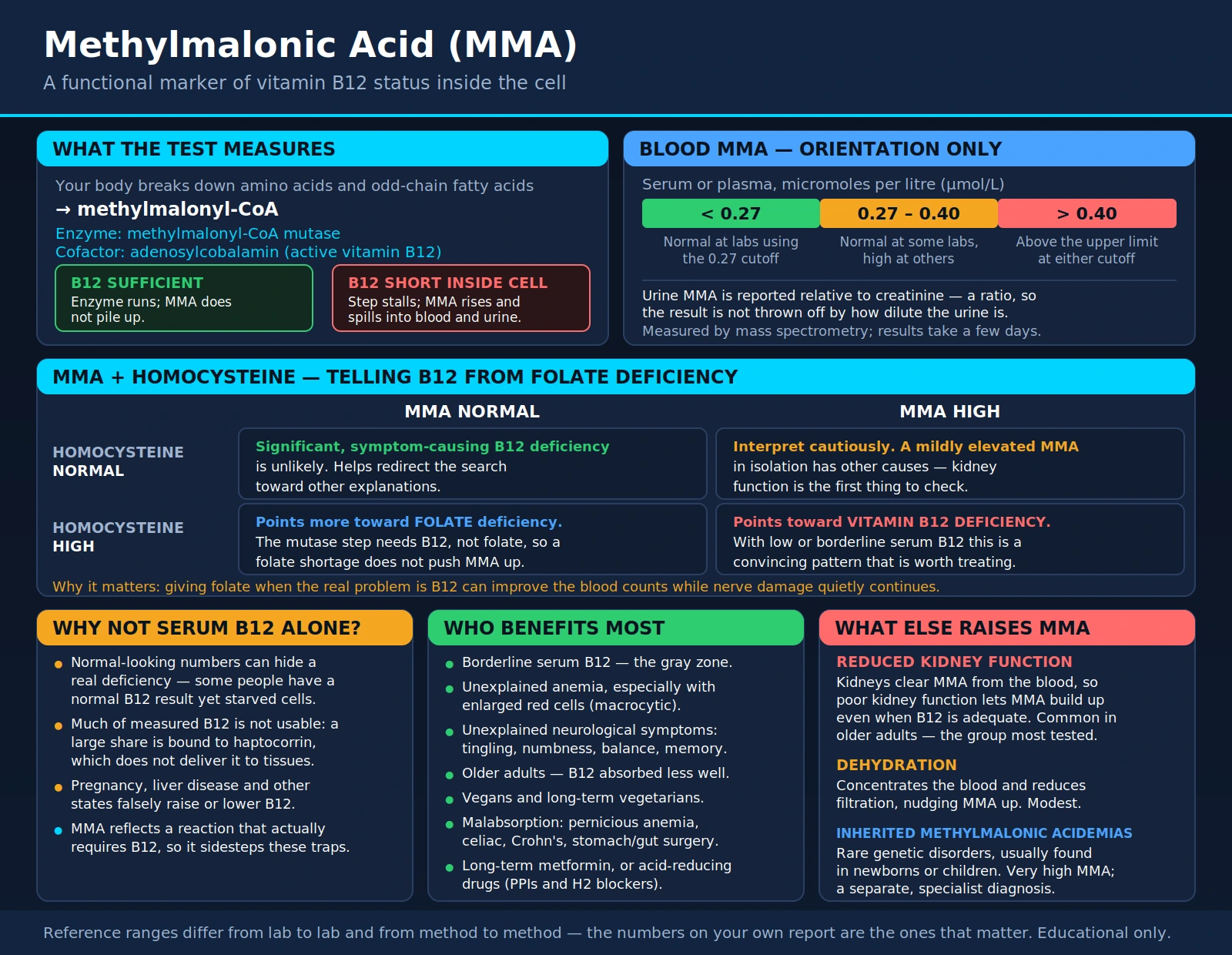
The methylmalonic acid (MMA) test measures a small molecule in your blood or urine that quietly builds up when your body runs short of usable vitamin B12 inside its cells. That makes it one of the most useful tools doctors have for answering a deceptively tricky question: are you actually low on vitamin B12? A standard B12 blood level is helpful, but it can be misleading — some people have a "normal-looking" B12 number while their cells are genuinely starved. Because MMA reflects what is happening inside the cells, it often catches a true deficiency earlier and more reliably. This page explains, in plain language, what MMA is, why the test is ordered, how to make sense of a result, and the important caveats (like kidney function) that can raise MMA for reasons unrelated to B12.
Interactive Visualization Vitamin B12’s Impossible Journey Five stages, two carrier proteins, a working stomach and one specific stretch of gut. Break any link — a PPI, metformin, pernicious anaemia — and absorption collapses. Launch →
Table of Contents
- What MMA Is and Where It Comes From
- Why This Test Is Ordered: Finding Vitamin B12 Deficiency
- Why Not Just Measure B12 Directly?
- Telling B12 Deficiency from Folate Deficiency
- Who Benefits Most from an MMA Test
- Making Sense of Your Result
- Caveats: Kidneys, Dehydration, and Rare Inherited Conditions
- How the Test Is Done
- Related Tests Your Doctor May Order
- When to Talk to a Doctor
- Research Papers
- Connections
- Featured Videos
What MMA Is and Where It Comes From
Methylmalonic acid is a normal by-product of how your body breaks down certain building blocks — some amino acids (the parts of protein) and odd-chain fatty acids. During that breakdown, your cells create a substance called methylmalonyl-CoA, which then needs to be converted into a different molecule so it can be used for energy. That single conversion step is handled by an enzyme with a long name: methylmalonyl-CoA mutase.
Here is the key point: that enzyme cannot do its job without vitamin B12. Specifically, it needs an active form of B12 (adenosylcobalamin) as a helper, or "cofactor." Think of B12 as a special key that switches the enzyme on. When there is plenty of usable B12 inside the cell, the enzyme runs smoothly and methylmalonic acid does not pile up. But when the cell is short on functional B12, the conversion stalls — and the leftover methylmalonyl-CoA is converted into methylmalonic acid instead, which then spills into the blood and out into the urine.
So a rising MMA level is essentially a chemical fingerprint of a cell that cannot complete a B12-dependent reaction. That is why doctors treat MMA not just as a random lab value, but as a window into whether your cells truly have enough working B12 — a concept called a functional marker.
Why This Test Is Ordered: Finding Vitamin B12 Deficiency
The flagship reason to measure MMA is to confirm or detect vitamin B12 deficiency, especially in the early or borderline stages when the diagnosis is genuinely uncertain. When your cells are truly low on functional B12, the mutase enzyme slows, and MMA goes up. When B12 is adequate, MMA stays normal.
This gives the test two complementary strengths:
- An elevated MMA supports a real deficiency. If MMA is high — often alongside an elevated homocysteine (another molecule that accumulates when B12 is low) — it is strong biochemical evidence that your cells are not getting enough working B12, even if you feel only mildly unwell.
- A normal MMA makes significant deficiency unlikely. Because MMA is a sensitive marker, a clearly normal value is reassuring: it argues against an important, symptom-causing B12 deficiency. This makes MMA useful for "ruling out" as well as "ruling in."
This is why MMA shines in the gray zone. Many people land in a borderline range where their symptoms are vague and their standard B12 number is neither clearly low nor clearly fine. In exactly that situation, MMA helps tip the balance toward a confident answer rather than a guess.
Why Not Just Measure B12 Directly?
It is a fair question — if we want to know about B12, why not simply measure B12? The honest answer is that the ordinary serum B12 test is useful but imperfect. It measures the total amount of B12 circulating in your blood, but not all of that B12 is actually available to your cells, and the blood level does not always match what is happening inside them.
A few well-documented problems with relying on the serum B12 number alone:
- Normal-looking numbers can hide a real deficiency. Some people have a B12 result in the "normal" range yet still have B12-deprived cells — a mismatch that a functional marker like MMA can uncover.
- Much of measured B12 is not usable. A large share of circulating B12 is bound to a protein (haptocorrin) that does not deliver it to tissues, which can inflate the total number without helping your cells.
- Certain conditions falsely raise or lower B12. Pregnancy, liver disease, and some other states can shift the number in misleading directions.
Because MMA reflects a reaction that actually requires B12 to proceed, it sidesteps some of these traps. When the standard B12 result and the clinical picture disagree, MMA (frequently paired with homocysteine) is the tie-breaker many clinicians reach for.
Telling B12 Deficiency from Folate Deficiency
This is one of the most genuinely useful things MMA can do, and it is worth understanding clearly. Vitamin B12 and folate (vitamin B9) are chemical partners: they work together in the body, and a shortage of either one can cause a very similar type of anemia (large, immature red blood cells) and overlapping symptoms. That makes them easy to confuse.
Here is the distinction that MMA helps draw:
- MMA is elevated in B12 deficiency, but normal in folate deficiency. The mutase reaction needs B12, not folate — so folate shortage does not cause MMA to rise.
- Homocysteine rises in both. Both B12 and folate are needed to keep homocysteine low, so a high homocysteine cannot, by itself, tell the two apart.
Putting those together gives a helpful pattern: high MMA + high homocysteine points toward B12 deficiency, whereas normal MMA + high homocysteine points more toward folate deficiency. Getting this right matters, because treating the wrong one can cause harm — giving folate to someone whose real problem is B12 can improve the blood counts while the nerve damage from untreated B12 deficiency quietly continues.
Who Benefits Most from an MMA Test
Not everyone needs an MMA test. It is most valuable when the diagnosis is uncertain or when someone is at higher-than-average risk of quietly slipping into B12 deficiency. Groups where the test earns its keep include:
- People with a borderline serum B12 level — the classic "gray zone" where a functional marker adds real clarity.
- People with unexplained anemia, particularly the type with enlarged red blood cells (macrocytic anemia).
- People with unexplained neurological symptoms — tingling, numbness, pins-and-needles, balance problems, or memory and mood changes — where B12 deficiency is on the list of possible causes.
- Older adults, who absorb B12 less efficiently and in whom deficiency is common and easily missed.
- Vegans and long-term vegetarians, because B12 comes almost entirely from animal foods, making dietary shortfall likely without supplementation.
- People with malabsorption — conditions like pernicious anemia, celiac disease, Crohn's disease, or a history of stomach or intestinal surgery that reduce B12 uptake.
- People on long-term metformin (a common diabetes medication) or acid-reducing drugs (proton pump inhibitors and H2 blockers), both of which can lower B12 absorption over time.
Making Sense of Your Result
Reference ranges differ from lab to lab and from method to method, so the numbers printed on your report are the ones that matter. As a rough orientation only:
- Blood (serum or plasma) MMA is often reported as normal below roughly 0.27 micromoles per liter (µmol/L), though some laboratories use a cutoff closer to 0.40 µmol/L. Values above the lab's upper limit — and especially values several times higher — raise concern for functional B12 deficiency.
- Urine MMA is usually reported relative to creatinine (a way to correct for how dilute the urine is), so it appears as a ratio rather than a single number.
How the result is interpreted always depends on the whole picture — your symptoms, your B12 and homocysteine levels, your blood counts, and your kidney function:
- Elevated MMA with low or borderline B12 and elevated homocysteine is a convincing pattern for true B12 deficiency that is worth treating.
- Normal MMA makes an important, symptom-causing B12 deficiency unlikely, and can help redirect the search toward other explanations.
- A mildly elevated MMA in isolation should be interpreted cautiously, because other things (covered next) can nudge it upward.
In short, MMA is rarely read alone. It is most powerful as one piece of a small panel, and your clinician weighs it together with everything else.
Caveats: Kidneys, Dehydration, and Rare Inherited Conditions
MMA is a sensitive marker, but sensitivity cuts both ways: a few things besides B12 deficiency can raise it, and a good interpretation accounts for them.
Reduced kidney function
The most important false-alarm cause is impaired kidney function. Your kidneys clear MMA from the blood, so when they are not working well, MMA can build up even when B12 is perfectly adequate. Because reduced kidney function is common — especially in older adults, who are also the people most likely to be tested — clinicians routinely consider kidney status when reading an elevated MMA.
Dehydration
Being significantly dehydrated can concentrate the blood and reduce kidney filtration, nudging MMA upward. This is usually a modest effect, but it is one more reason a single borderline value is confirmed rather than acted on blindly.
Rare inherited methylmalonic acidemias
There is a separate, much rarer world in which MMA is central: the inherited disorders called methylmalonic acidemias. These are genetic conditions, typically identified in newborns or young children, in which the mutase enzyme (or the machinery that supplies its B12 cofactor) is faulty from birth. They cause very high MMA and are a distinct, specialized diagnosis handled by metabolic experts — not the everyday adult B12-deficiency question this page focuses on. It is worth knowing they exist so the term "methylmalonic acidemia" is not confused with the ordinary MMA test used to check B12 status in adults.
How the Test Is Done
MMA can be measured in blood or urine, and both are straightforward for you as the patient.
- Blood test: a technician draws a small sample from a vein in your arm, just like a routine blood test. No special preparation is usually required, though your clinician may ask about timing relative to other tests or medications.
- Urine test: you provide a urine sample, and the lab reports MMA relative to creatinine so the result is not thrown off by how concentrated the urine is.
Behind the scenes, laboratories typically measure MMA using highly precise chemistry methods (such as mass spectrometry) that can detect these small molecules accurately. From your side, though, it is simply a blood draw or a urine cup. Results usually take a few days, because the specialized analysis is often run in batches or sent to a reference laboratory.
Related Tests Your Doctor May Order
MMA is most informative as part of a small cluster of tests that, together, build a clear picture of B12 and folate status:
- Serum vitamin B12 — the first-line screen; MMA is often used to interpret a borderline B12 result.
- Homocysteine — rises in both B12 and folate deficiency; pairing it with MMA helps separate the two.
- Folate (vitamin B9) — checked alongside B12 because their deficiencies look alike and must be told apart.
- Holotranscobalamin ("active B12") — measures the fraction of B12 actually available to cells, another way to sharpen a borderline result.
- Complete blood count (CBC) with MCV — looks for anemia and, in particular, enlarged red blood cells (a high MCV, called macrocytosis) that often accompany B12 or folate deficiency.
- Kidney function tests — important context, since reduced kidney function can raise MMA on its own.
Your clinician chooses among these based on your symptoms and risk factors; you rarely need all of them at once.
When to Talk to a Doctor
If you have symptoms that could point to B12 deficiency — ongoing fatigue, a sore or smooth tongue, tingling or numbness in the hands or feet, unsteadiness, or new problems with memory or mood — it is worth raising with a clinician, especially if you are older, follow a plant-based diet, or take metformin or long-term acid-reducers. Ask whether checking B12 status, including MMA when the picture is unclear, makes sense for you.
The reassuring part is that B12 deficiency is very treatable, usually with oral supplements or injections, and people often feel markedly better once it is corrected. The urgent part is that untreated B12 deficiency can cause nerve damage that may become permanent. That combination — easy to fix, but harmful if ignored — is exactly why a sensitive functional marker like MMA is so valuable: it helps catch the problem while it is still fully reversible. This page is educational and not a substitute for personal medical advice; use it to have a more informed conversation with your own clinician.
Research Papers
- Stabler SP. Vitamin B12 deficiency. New England Journal of Medicine. 2013;368(2):149-160. doi:10.1056/NEJMcp1113996 — A widely cited clinical review that describes MMA and homocysteine as sensitive functional markers for diagnosing B12 deficiency.
- Savage DG, Lindenbaum J, Stabler SP, Allen RH. Sensitivity of serum methylmalonic acid and total homocysteine determinations for diagnosing cobalamin and folate deficiencies. The American Journal of Medicine. 1994;96(3):239-246. doi:10.1016/0002-9343(94)90149-X — Foundational study showing MMA and homocysteine are highly sensitive for detecting cobalamin and folate deficiency.
- Carmel R. Biomarkers of cobalamin (vitamin B-12) status in the epidemiologic setting: a critical overview of context, applications, and performance characteristics of cobalamin, methylmalonic acid, and holotranscobalamin II. The American Journal of Clinical Nutrition. 2011;94(1):348S-358S. doi:10.3945/ajcn.111.013441 — Compares the strengths and limits of the main B12 markers, including MMA.
- Green R. Vitamin B12 deficiency from the perspective of a practicing hematologist. Blood. 2017;129(19):2603-2611. doi:10.1182/blood-2016-10-569186 — A practical review of how to diagnose and manage B12 deficiency, including the role of MMA in ambiguous cases.
- Green R, Allen LH, Bjørke-Monsen AL, et al. Vitamin B12 deficiency. Nature Reviews Disease Primers. 2017;3:17040. doi:10.1038/nrdp.2017.40 — A comprehensive overview of B12 deficiency biology, diagnosis, and treatment.
- Allen RH, Stabler SP, Savage DG, Lindenbaum J. Metabolic abnormalities in cobalamin (vitamin B12) and folate deficiency. The FASEB Journal. 1993;7(14):1344-1353. doi:10.1096/fasebj.7.14.7901104 — Explains the biochemistry linking B12 to methylmalonic acid and homocysteine accumulation.
- Klee GG. Cobalamin and folate evaluation: measurement of methylmalonic acid and homocysteine vs vitamin B12 and folate. Clinical Chemistry. 2000;46(8):1277-1283. doi:10.1093/clinchem/46.8.1277 — Reviews the laboratory case for using metabolite markers to evaluate B12 and folate status.
- Hannibal L, Lysne V, Bjørke-Monsen AL, et al. Biomarkers and algorithms for the diagnosis of vitamin B12 deficiency. Frontiers in Molecular Biosciences. 2016;3:27. doi:10.3389/fmolb.2016.00027 — Proposes practical algorithms combining B12, MMA, homocysteine, and holotranscobalamin.
- Nexo E, Hoffmann-Lücke E. Holotranscobalamin, a marker of vitamin B-12 status: analytical aspects and clinical utility. The American Journal of Clinical Nutrition. 2011;94(1):359S-365S. doi:10.3945/ajcn.111.013458 — Describes "active B12," a complementary marker often interpreted alongside MMA.
- Oberley MJ, Yang DT. Laboratory testing for cobalamin deficiency in megaloblastic anemia. American Journal of Hematology. 2013;88(6):522-526. doi:10.1002/ajh.23421 — Reviews how MMA and related tests are used to work up macrocytic anemia.
- Vashi P, Edwin P, Popiel B, et al. Methylmalonic acid and homocysteine as indicators of vitamin B-12 deficiency in cancer. PLOS ONE. 2016;11(1):e0147843. doi:10.1371/journal.pone.0147843 — Illustrates MMA and homocysteine detecting B12 deficiency missed by serum B12 alone.
- Devalia V, Hamilton MS, Molloy AM. Guidelines for the diagnosis and treatment of cobalamin and folate disorders. British Journal of Haematology. 2014;166(4):496-513. doi:10.1111/bjh.12959 — National guideline outlining when second-line markers such as MMA are appropriate.
Connections
- All Lab Tests
- Vitamin B12’s Impossible Journey — interactive animation
- Vitamin B12 Test
- Homocysteine Test
- Folate Test
- Complete Blood Count (CBC)
- Kidney Function Tests
- MTHFR Gene Testing
- Vitamin B12
- Vitamin B12 Deficiency
- Folate (Vitamin B9)
- Pernicious Anemia
- Anemia
- Peripheral Neuropathy