Chicken Liver
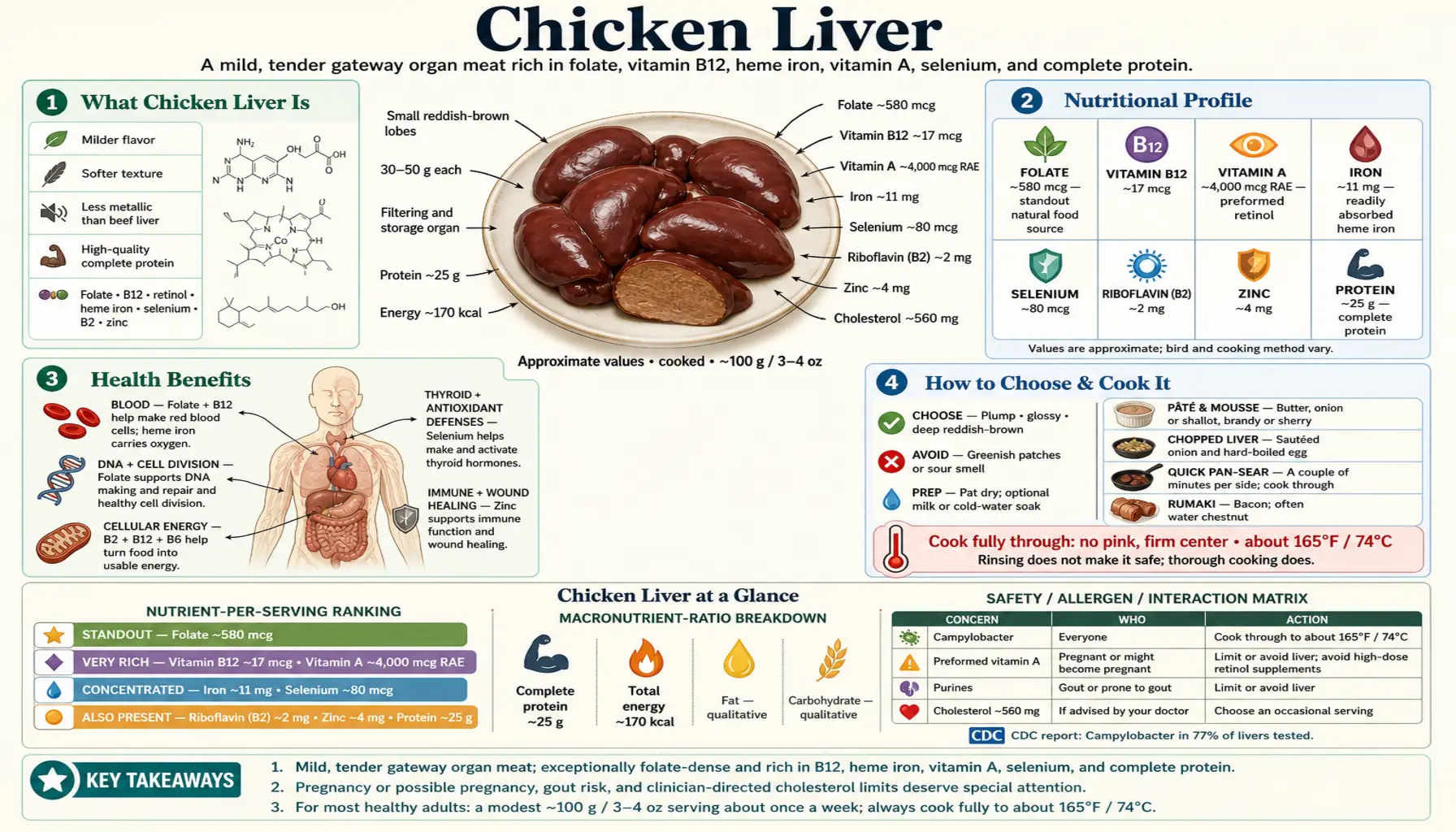
Chicken liver is often described as the gentlest introduction to organ meats. It is commonly described as milder, softer, and less "irony" than beef liver; it is the classic base for pâté and old-fashioned chopped liver, it is typically inexpensive, and it is widely sold. USDA FoodData Central lists it as rich in folate, vitamin B12, iron, vitamin A (as retinol), selenium, choline, and protein. Two hazards are documented in the research: undercooked chicken-liver pâté has caused Campylobacter outbreaks, and liver is rich in preformed vitamin A, which is the basis of guidance on liver in pregnancy.
Table of Contents
What Chicken Liver Is
Chicken liver is exactly what it sounds like — the liver of the chicken, sold as small, reddish-brown lobes; USDA FoodData Central lists one whole cooked liver at 44 grams. Like all liver, it is a filtering and storage organ, which is why it is so densely packed with vitamins and minerals.
What sets it apart from other organ meats is how approachable it is often said to be. Compared with beef liver, chicken liver is commonly described as milder in flavor, softer in texture, and less "irony" or metallic-tasting. Beef liver can be intense and chewy; chicken liver turns silky and almost buttery when gently cooked, which is why it is often called a "gateway" organ meat.
It is also the traditional foundation of some of the best-loved liver dishes: smooth French-style pâté and liver mousse, Jewish-deli chopped liver, and bacon-wrapped rumaki. It is typically an inexpensive cut and is widely sold fresh or frozen.
Nutritional Profile
The figures below are USDA FoodData Central values for 100 grams of cooked (simmered) chicken liver (SR Legacy food 171061; FDC also lists a 3-oz serving as 85 g and one liver as 44 g). FDC does not give a %DV for this food; the FDA Daily Value used on food labels is shown beside each nutrient for reference. Amounts vary with the bird and the cooking method.
- Calories: 167 kcal
- Protein: 24.46 g (FDA Daily Value 50 g)
- Folate: 578 µg DFE, all of it food folate (FDA Daily Value 400 µg DFE)
- Vitamin B12: 16.85 µg (FDA Daily Value 2.4 µg)
- Vitamin A: 3,981 µg RAE, of which retinol 3,978 µg (FDA Daily Value 900 µg RAE)
- Iron: 11.63 mg (FDA Daily Value 18 mg)
- Copper: 0.496 mg (FDA Daily Value 0.9 mg)
- Choline: 290 mg (FDA Daily Value 550 mg)
- Selenium: 82.4 µg (FDA Daily Value 55 µg)
- Riboflavin (vitamin B2): 1.993 mg (FDA Daily Value 1.3 mg)
- Vitamin B6: 0.755 mg
- Zinc: 3.98 mg (FDA Daily Value 11 mg)
- Cholesterol: 563 mg (FDA Daily Value 300 mg)
The FDA's label guidance describes 20% DV or more per serving as "high" and 5% DV or less as "low".
The headline comparison is folate. Per 100 g, FDC lists 578 µg of folate in cooked chicken liver and 253 µg in cooked (braised) beef liver (SR Legacy 168626).
The comparison runs the other way for vitamin A, B12 and copper. Per 100 g, FDC lists braised beef liver at 9,442 µg RAE vitamin A, 70.58 µg vitamin B12 and 14.283 mg copper, against 3,981 µg RAE, 16.85 µg and 0.496 mg for simmered chicken liver. On iron, FDC lists chicken liver higher: 11.63 mg against 6.54 mg for beef liver.
Health Benefits
The points below describe what the nutrients listed above do in the body; they are not results of trials of chicken liver itself.
Building healthy red blood cells
Chicken liver contains three nutrients involved in making blood: folate, vitamin B12, and iron. Folate and B12 are both required to make red blood cells; a shortage of either causes anemia and the tiredness, weakness, and shortness of breath that come with it. Iron lets red cells carry oxygen. Liver iron is often described as heme iron, the more readily absorbed form, but an isotope study of calf organs found heme iron made up only 13.6% of the iron in liver (against 64% in muscle meat); the heme share of chicken liver iron was not reported in that study.
A standout source of folate
Folate does more than build blood — it is essential for making and repairing DNA and for healthy cell division, which is why folate needs rise during any period of rapid growth. FDC lists 578 µg DFE of folate per 100 g of cooked chicken liver, against an FDA Daily Value of 400 µg DFE. Folate needs are high around conception; the neural-tube-defect prevention evidence reviewed by Czeizel and colleagues comes from the Hungarian trials of periconceptional folic acid-containing multivitamin supplements, which prevented about 90% of neural-tube defects — not from liver. Liver's preformed vitamin A content is the reason UK NHS guidance on pregnancy treats liver differently (see the cautions below).
Energy metabolism
Chicken liver contains several B vitamins — FDC lists riboflavin (B2) at 1.993 mg, B12 at 16.85 µg and B6 at 0.755 mg per 100 g cooked — which act as cofactors in the enzymes cells use to turn food into usable energy. It also contains choline (290 mg per 100 g), used in cell membranes and in making the neurotransmitter acetylcholine, and copper (0.496 mg), used in iron metabolism.
Thyroid and immune support
FDC lists 82.4 µg of selenium per 100 g of cooked chicken liver, against an FDA Daily Value of 55 µg. Selenium is part of the enzymes that activate thyroid hormone and of antioxidant enzymes. Chicken liver also contains zinc (3.98 mg per 100 g), which is involved in immune function, wound healing, and taste and smell.
How It Is Prepared
Fresh chicken livers are typically plump, glossy, and deep reddish-brown. A soak in milk or cold water before cooking is a traditional practice for mellowing the flavor.
Chicken liver appears in a handful of classic preparations:
- Pâté and mousse: sautéed livers blended smooth with butter, onion or shallot, and a splash of brandy or sherry — the most famous use of chicken liver.
- Chopped liver: the deli classic — cooked livers chopped with sautéed onion and hard-boiled egg.
- Quick pan-sear: the everyday method — livers patted dry, seasoned, and seared in a hot pan with a little fat. Cooked through but not past it they stay tender; cooked much longer they turn dry and grainy.
- Rumaki: bite-sized livers (often with water chestnut) wrapped in bacon and broiled.
Food-safety reports put thorough cooking ahead of texture: like other chicken, raw livers can carry Campylobacter bacteria, and undercooked livers are a documented cause of outbreaks — see the cautions below. The CDC report states that chicken livers should be cooked to an internal temperature of 165°F (74°C), including before they are blended into pâté.
What Sources Report on Amounts
The main limit on liver intake in the guidance is vitamin A. The Institute of Medicine (2001) set the Tolerable Upper Intake Level for adults at 3,000 µg of preformed vitamin A per day; FDC lists 3,978 µg of retinol in 100 g of cooked chicken liver.
UK NHS guidance on vitamin A states: "Liver is a very rich source of vitamin A. Do not eat liver or liver products, such as pâté, more than once a week," and "If you eat liver every week, do not take supplements that contain vitamin A." The same page states that more than an average of 1.5 mg (1,500 µg) of vitamin A a day over many years may affect the bones.
FDC lists less vitamin A in chicken liver than in beef liver (3,981 against 9,442 µg RAE per 100 g), but both are concentrated sources of retinol.
Cautions
The research documents two hazards that apply to everyone (vitamin A excess and Campylobacter) and raises concerns for particular groups.
Vitamin A and pregnancy
Chicken liver is rich in preformed vitamin A (retinol) — the active form — and high intakes of preformed vitamin A early in pregnancy are linked to birth defects (teratogenicity). In a cohort of 22,748 pregnant women (Rothman et al., NEJM 1995), the prevalence of cranial-neural-crest defects was 3.5 times higher among babies of women consuming more than 15,000 IU of preformed vitamin A a day from food and supplements than among those consuming 5,000 IU or less; the excess was concentrated in intakes before the seventh week of gestation, and the authors concluded that high dietary intake of preformed vitamin A appears to be teratogenic. UK NHS guidance states that "if you're pregnant you should avoid eating liver or liver products". This concern applies to chicken liver even though FDC lists it lower in vitamin A than beef liver — it is still a concentrated retinol source. (These findings and the IOM upper level concern preformed vitamin A from animal foods and supplements, not the carotenoids in plants.)
Food safety: cook it through
This is the big one for chicken liver specifically. Raw chicken livers frequently carry Campylobacter — a study cited in a 2015 CDC report isolated the bacteria from 77% of chicken livers cultured, and in that outbreak investigation five of nine raw liver samples grew C. jejuni — and undercooked chicken-liver pâté has caused documented outbreaks of food poisoning in both the United States (Ohio and Oregon, 2013–2014) and Europe (49 cases after a 2011 wedding in the East of England, where the risk rose with the amount of pâté eaten). The CDC report notes that pâté is often undercooked to preserve texture and that diners may be unable to tell whether it was cooked thoroughly once partially cooked livers are blended and chilled. It states that washing is insufficient to make chicken livers safe and that they should be cooked to an internal temperature of 165°F (74°C). In that outbreak the livers had been rinsed with a chlorine solution before packaging.
Purines and gout
A purine analysis of 270 foods (Kaneko et al., 2014) lists organs such as the liver among the purine-rich foods; the body breaks purines down into uric acid, and frequent, high intake of purine-rich foods raises serum uric acid. In a 12-year study of 47,150 men (Choi et al., NEJM 2004), the highest fifth of meat intake carried a relative risk of new gout of 1.41 against the lowest fifth. The research therefore raises a concern for people who have gout or high uric acid.
Cholesterol
FDC lists 563 mg of cholesterol per 100 g of cooked chicken liver (FDA Daily Value 300 mg). A 2020 American Heart Association science advisory found that observational studies generally do not show a significant association between dietary cholesterol and cardiovascular disease, while most meta-analyses of intervention studies link intakes above current average levels with higher total or LDL cholesterol. Decisions about diet for people managing blood cholesterol belong with a clinician.
Key Research Papers
- U.S. Department of Agriculture, FoodData Central. Chicken, liver, all classes, cooked, simmered (SR Legacy 171061). fdc.nal.usda.gov — Source for the per-100 g figures on this page (folate 578 µg DFE, vitamin B12 16.85 µg, vitamin A 3,981 µg RAE, retinol 3,978 µg, iron 11.63 mg, copper 0.496 mg, choline 290 mg, selenium 82.4 µg, cholesterol 563 mg).
- U.S. Department of Agriculture, FoodData Central. Beef, variety meats and by-products, liver, cooked, braised (SR Legacy 168626). fdc.nal.usda.gov — The comparison food: per 100 g, vitamin A 9,442 µg RAE, folate 253 µg, vitamin B12 70.58 µg, copper 14.283 mg, iron 6.54 mg.
- Scott MK, Geissler A, Poissant T, et al. Campylobacteriosis outbreak associated with consuming undercooked chicken liver pâté — Ohio and Oregon, December 2013–January 2014. MMWR Morb Mortal Wkly Rep. 2015;64(14):399. cdc.gov — CDC report; cites a study that isolated Campylobacter from 77% of chicken livers cultured, and states livers should be cooked to 165°F (74°C). — PubMed PMID: 25879900
- Edwards DS, Milne LM, Morrow K, et al. Campylobacteriosis outbreak associated with consumption of undercooked chicken liver pâté in the East of England, September 2011: identification of a dose–response risk. Epidemiol Infect. 2014;142(2):352–357. — Found a clear dose–response link between amount of undercooked chicken-liver pâté eaten and risk of illness. — doi:10.1017/S0950268813001222
- Rothman KJ, Moore LL, Singer MR, Nguyen US, Mannino S, Milunsky A. Teratogenicity of high vitamin A intake. N Engl J Med. 1995;333(21):1369–1373. — Cohort of 22,748 pregnant women linking high preformed vitamin A intake in early pregnancy to cranial-neural-crest birth defects. — doi:10.1056/NEJM199511233332101
- Czeizel AE, Dudás I, Vereczkey A, Bánhidy F. Folate deficiency and folic acid supplementation: the prevention of neural-tube defects and congenital heart defects. Nutrients. 2013;5(11):4760–4775. — Review of the Hungarian periconceptional folic acid-containing multivitamin trials (about 90% of neural-tube defects prevented). — doi:10.3390/nu5114760
- Institute of Medicine, Food and Nutrition Board. Dietary Reference Intakes for Vitamin A, Vitamin K, Arsenic, Boron, Chromium, Copper, Iodine, Iron, Manganese, Molybdenum, Nickel, Silicon, Vanadium, and Zinc. Washington, DC: National Academy Press; 2001. — Adult Tolerable Upper Intake Level of 3,000 µg/day of preformed vitamin A. — nap.nationalacademies.org
- U.S. Food and Drug Administration. Daily Value on the Nutrition and Supplement Facts Labels. — Daily Values cited on this page; 5% DV or less is low, 20% DV or more is high. — fda.gov
- NHS (UK). Vitamin A. — Guidance on liver and liver products (no more than once a week; avoided in pregnancy). — nhs.uk
- Valenzuela C, de Romaña DL, Olivares M, Morales MS, Pizarro F. Total iron and heme iron content and their distribution in beef meat and viscera. Biol Trace Elem Res. 2009;132(1–3):103–111. — Heme iron was 64% of iron in meat cuts but 13.6% in calf liver. — PubMed PMID: 19475341
- Kaneko K, Aoyagi Y, Fukuuchi T, Inazawa K, Yamaoka N. Total purine and purine base content of common foodstuffs for facilitating nutritional therapy for gout and hyperuricemia. Biol Pharm Bull. 2014;37(5):709–721. — PubMed PMID: 24553148
- Choi HK, Atkinson K, Karlson EW, Willett W, Curhan G. Purine-rich foods, dairy and protein intake, and the risk of gout in men. N Engl J Med. 2004;350(11):1093–1103. — PubMed PMID: 15014182
- Carson JAS, Lichtenstein AH, Anderson CAM, Appel LJ, Kris-Etherton PM, Meyer KA, Petersen K, Polonsky T, Van Horn L; American Heart Association. Dietary cholesterol and cardiovascular risk: a science advisory from the American Heart Association. Circulation. 2020;141(3):e39–e53. — PubMed PMID: 31838890
Connections
- All Food
- Chicken Liver Nutrients
- Beef Liver
- Pork Liver
- Cod Liver
- Organ Meats
- Chicken — the bird this liver comes from, and its own nutrient profile.