Furchgott, Ignarro & Murad: Nitric Oxide, the Molecule That Relaxes Your Arteries
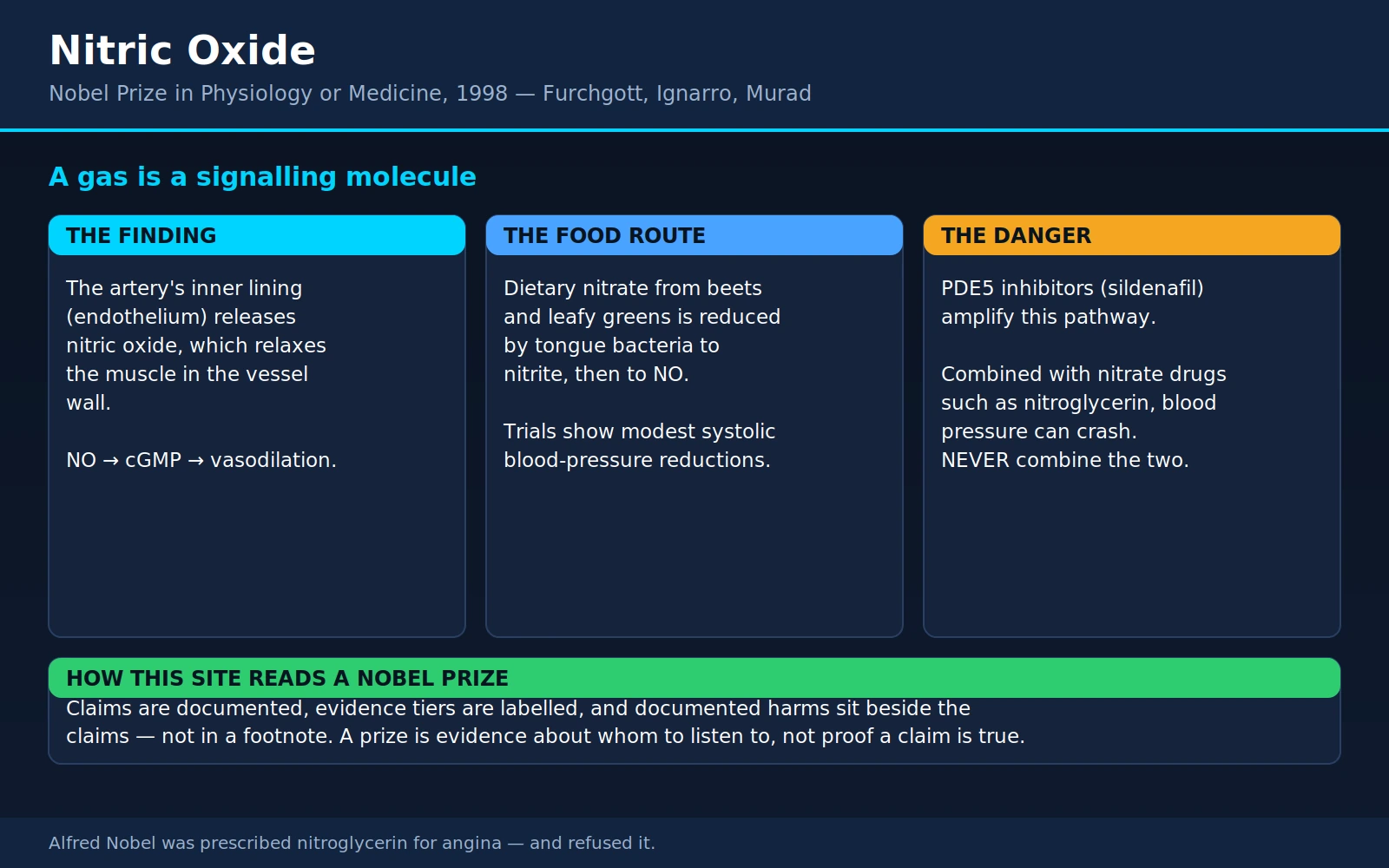
Table of Contents
- The Prize and the Three Men
- Murad First: Explaining a Hundred-Year-Old Drug
- The Alfred Nobel Irony
- Furchgott's Sandwich
- Naming the Messenger
- What Nitric Oxide Does in Your Body
- Viagra, Honestly
- The Food Route to Nitric Oxide
- Where Medicine Agrees — and Where Claims Outrun Evidence
- What This Means for You Today
- Key Research Papers
- Connections
- Featured Videos
1. The Prize and the Three Men
In October 1998, the Karolinska Institute awarded the Nobel Prize in Physiology or Medicine to three American pharmacologists "for their discoveries concerning nitric oxide as a signalling molecule in the cardiovascular system." Strip away the formal language and the citation says something genuinely strange: your blood vessels are controlled by a gas. Not a hormone stored in a gland, not a protein docking neatly into a receptor — a tiny, unstable, faintly toxic gas, one nitrogen atom bound to one oxygen atom, the same molecule found in cigarette smoke, smog, and acid rain. Your own cells manufacture it on purpose, a puff at a time, and use it to tell your arteries when to relax.
When the idea first surfaced, it sounded absurd, and it is worth pausing on why. Everything then known about chemical signalling involved molecules a cell could store, package, and release on command — insulin waiting in vesicles, adrenaline in granules. Nitric oxide can be stored by nobody. It lives for a few seconds, passes through cell membranes as if they were not there, and reacts with the first hemoglobin molecule it meets. A signalling system built on it would have no storage, no receptor on the cell surface, and no off switch except the molecule's own self-destruction. That turned out to be exactly the point: nitric oxide is a message that erases itself, perfect for second-by-second fine-tuning of blood flow. In 1992, before the Nobel, the journal Science had already named nitric oxide its "Molecule of the Year."
Robert F. Furchgott (1916–2009) was the eldest of the three — a soft-spoken, meticulous pharmacologist born in Charleston, South Carolina, who spent most of his career at SUNY Downstate Medical Center in Brooklyn studying, with almost monastic patience, how strips of rabbit artery respond to drugs. He was in his sixties when a botched experiment handed him the observation of his life, and he had the humility to notice it and the rigor to nail it down.
Louis J. Ignarro (born 1941) grew up in Brooklyn and Long Island, the son of an Italian immigrant carpenter who could not read or write; he became a pharmacologist at Tulane and then UCLA, and brought to the field the chemist's toolkit — spectroscopy, free-radical chemistry — that let the mystery molecule finally be identified. Ferid Murad (1936–2023) was born in Whiting, Indiana, above the family restaurant, to an Albanian immigrant father and an American mother; he trained as one of the first physician-scientists in the country's earliest MD-PhD program and worked the problem from the opposite end — not from the artery, but from a drug that had been relaxing arteries since the 1870s without anyone knowing how.
The three never worked as a team. They were rivals as often as colleagues, publishing in parallel, occasionally disputing credit. But their three lines of work — a drug explained, an accident understood, a molecule named — interlocked into one of the great physiological discoveries of the twentieth century, one that reaches from the cardiology ward to the produce aisle. This page tells all three stories, and then follows the molecule into the territory this site cares about most: what it means for your heart, your blood pressure, and your dinner plate.
2. Murad First: Explaining a Hundred-Year-Old Drug
The story properly begins not with a discovery but with an embarrassment: for a full century, medicine's best emergency treatment for chest pain worked by a mechanism nobody could explain. In 1867, the Scottish physician Lauder Brunton found that inhaling amyl nitrite eased angina — the crushing chest pain of a heart muscle starved for blood. In 1879, William Murrell reported in The Lancet that tiny doses of nitroglycerin — the explosive — did the same thing, longer and better. A tablet under the tongue, and within minutes the pain lifts. Doctors prescribed it from the 1870s onward, through two world wars and into the space age, on pure empirical faith. It worked. Nobody knew why.
Ferid Murad answered the question in 1977, at the University of Virginia. He had spent years studying an enzyme called guanylyl cyclase, which manufactures a small messenger molecule called cyclic GMP (cGMP) inside cells. His group — the key papers carry the names of his fellows Shoji Katsuki and William Arnold — showed that nitroglycerin and its chemical cousins all share one property: in the body they release nitric oxide gas, and that gas switches guanylyl cyclase on. The enzyme floods the cell with cGMP, and in the smooth muscle wrapped around a blood vessel, rising cGMP is the order to let go. The muscle slackens, the vessel widens, blood pressure in the system falls, the heart's workload drops, and the starved heart muscle's oxygen arithmetic comes back into balance. The pain stops.
In two 1977 papers — one showing nitroglycerin and nitroprusside stimulating the enzyme, the other showing that pure nitric oxide gas itself does it directly — Murad's team had explained a hundred-year-old drug in a single stroke: nitroglycerin is simply a delivery vehicle for nitric oxide. Then Murad made the leap that mattered more than the explanation. If a drug works by releasing a gas that relaxes blood vessels, perhaps the body makes the same gas itself, on purpose, as part of its normal machinery. He proposed the idea in the late 1970s and could not yet prove it. Proof would come from a laboratory in Brooklyn, by accident.
3. The Alfred Nobel Irony
Before Brooklyn, a detour the Nobel committee itself could not resist telling. Alfred Nobel made his fortune on nitroglycerin. The oily liquid, first synthesized in 1847, was a terrifyingly unstable explosive — it killed Nobel's own younger brother Emil in a factory accident in 1864 — and Nobel's genius was to tame it: soaked into porous clay, it became dynamite, patented in 1867, the invention that built his empire and endowed his prizes.
The factories that made Nobel rich also produced medicine's first accidental clinical trial. Workers who handled nitroglycerin all week developed pounding headaches every Monday — their blood vessels dilating from absorbed explosive — which faded as tolerance built, only to return after every weekend away. And a few workers with angina noticed something stranger: their chest pain eased on workdays. The explosive was treating them.
Late in his life, Nobel himself developed severe angina. His physicians prescribed the standard remedy: nitroglycerin, tactfully sold under the medical name "Trinitrin." Nobel refused to take it. In 1896 he wrote to a colleague: "Isn't it the irony of fate that I have been prescribed nitroglycerin, to be taken internally! They call it Trinitrin, so as not to scare the chemist and the public." He died of a stroke weeks later, on December 10, 1896 — the date on which Nobel Prizes are still presented. A hundred and two years afterward, the prize endowed by nitroglycerin's manufacturer was handed to the three men who finally explained why the medicine he refused would have eased his pain. The 1998 committee acknowledged the irony out loud. History rarely closes a loop that cleanly.
4. Furchgott's Sandwich
Robert Furchgott had been studying strips of rabbit artery in organ baths since the 1950s — hanging them from force transducers, dripping drugs onto them, recording whether they tightened or relaxed. And for years his field lived with a nagging contradiction: acetylcholine, a nerve messenger that reliably dilates blood vessels in a living animal, usually made isolated artery strips contract. The living body said one thing; the laboratory preparation said the opposite. Most people shrugged. Anomalies like that get filed under "tissue is funny" and forgotten.
In 1978, a fortunate accident in Furchgott's lab put the contradiction under a spotlight: prepared one way, a strip of aorta contracted to acetylcholine as usual; prepared another way, the same artery relaxed, the way vessels do in a living animal. Furchgott chased the difference and found it was mechanical, and almost embarrassingly humble. The inside of every blood vessel is lined with a single, fragile layer of flat cells — the endothelium. The standard way of cutting helical strips rubbed that lining off without anyone noticing or caring, because the endothelium was assumed to be biological wallpaper: a passive, non-stick coating for blood to slide over. Preparations that happened to spare the lining relaxed. Preparations that scrubbed it off contracted. The wallpaper was the sensor. Acetylcholine was not talking to the vessel's muscle at all; it was talking to the endothelium, and the endothelium was passing the order along.
Furchgott and his colleague John Zawadzki published the result in Nature in 1980, under a title that gives away the whole discovery: "The obligatory role of endothelial cells in the relaxation of arterial smooth muscle by acetylcholine." Then came the experiment every pharmacology student now learns as Furchgott's sandwich. Take a strip of artery with its lining rubbed off — it cannot relax to acetylcholine on its own. Press it against a second strip whose lining is intact. Now the stripped one relaxes too. Something — some short-lived chemical messenger — was being released by the intact lining, diffusing across the gap, and ordering the neighboring muscle to let go.
Furchgott named the mystery substance EDRF: endothelium-derived relaxing factor. It was a name that admitted ignorance, and the ignorance lasted six years. EDRF was maddening to study — it survived only seconds, it was destroyed on contact with hemoglobin, and it was protected by an enzyme that mops up free radicals. Every one of those frustrations was, in hindsight, a fingerprint.
5. Naming the Messenger
By the mid-1980s Louis Ignarro, working at Tulane and then UCLA, had spent a decade on nitric oxide chemistry from the drug side — extending Murad's work on how nitroglycerin-family compounds and NO activate guanylyl cyclase. He began laying the two columns side by side: everything known about EDRF, everything known about nitric oxide. Half-life of seconds — both. Destroyed by hemoglobin — both. Protected by superoxide dismutase — both. Activates guanylyl cyclase and raises cGMP — both. Same activators, same inhibitors, same fingerprint, line after line.
In July 1986, at a symposium on vasodilation in Rochester, Minnesota, Furchgott and Ignarro — independently, in back-to-back conference talks — announced the same conclusion: EDRF is nitric oxide. The body's own artery-relaxing messenger and the gas released by Alfred Nobel's explosive were one and the same molecule. Murad's speculation from a decade earlier was correct: the drug had been mimicking a natural system all along.
Proof in print came within the year, from two directions. In June 1987, Salvador Moncada's group at the Wellcome Research Laboratories in England — Palmer, Ferrige, and Moncada in Nature — used a chemiluminescence assay to actually measure nitric oxide streaming off cultured endothelial cells, in quantities sufficient to account for all of EDRF's activity. In December 1987, Ignarro's group published spectroscopic evidence in PNAS that EDRF from artery and vein behaved chemically as nitric oxide. Moncada's lab went on to show, in 1988, where the gas comes from: endothelial cells synthesize it from the amino acid L-arginine — a fact that matters later in this article.
Here the record demands honesty. The 1998 prize went to Furchgott, Ignarro, and Murad; Nobel rules allow at most three names, and Salvador Moncada's exclusion is one of the famous Nobel snubs. His group's 1987 Nature paper was the decisive quantitative identification — published six months before Ignarro's — and his lab mapped much of the pathway's biochemistry afterward. Many scientists in the field said openly that the prize should have included him, and Furchgott himself acknowledged Moncada's contributions generously. Science is done by more people than prizes can hold; this page uses the three laureates' names for the story, but the story has at least four authors.
6. What Nitric Oxide Does in Your Body
Once nitric oxide had a name, it turned up everywhere. It was the first gas ever shown to work as a biological signalling molecule, and it rewired how physiology thinks about communication between cells. Four roles matter most for a general reader.
Your built-in blood-pressure manager. The endothelium — that "wallpaper" — is now understood as the body's largest endocrine organ: laid flat, the lining of your vessels would cover several tennis courts. Its cells constantly sense the friction of blood rushing past, and answer by releasing nitric oxide, moment to moment, vessel by vessel — dilating arteries where flow demands it, keeping your blood pressure trimmed like a sailboat in shifting wind. Nitric oxide also makes the vessel lining slippery, discouraging platelets from clumping and white cells from sticking — the first step of atherosclerosis. A healthy endothelium is quietly pumping out this gas every second of your life; an endothelium that has lost the knack — from smoking, high blood sugar, high blood pressure, inactivity — is one of the earliest measurable steps toward heart disease, detectable years before anything shows on a scan.
A weapon. Your immune system uses the same molecule at a thousand times the dose. Macrophages — the immune system's heavy infantry — carry an inducible enzyme (iNOS) that, when infection is detected, floods the local area with nitric oxide to gas bacteria and parasites directly. One molecule, two dialects: a whisper to relax an artery, a shout to kill a microbe.
A nerve signal. Certain nerves release nitric oxide instead of the classical neurotransmitters, and the example every reader has heard of is the one that made this molecule a household word: the nerves supplying the penis release nitric oxide, which raises cGMP in the smooth muscle of the erectile arteries, which relax and let blood inflate the tissue. An erection is, biochemically, a nitric-oxide event. Hold that thought for the next section.
A rescue therapy for newborns. Some full-term babies are born with persistent pulmonary hypertension — the blood vessels of the lungs refuse to open at birth, and the baby turns blue despite breathing pure oxygen. Because nitric oxide is a gas, it can be added directly to the air a ventilated baby breathes: it reaches exactly the lung vessels that are ventilated, relaxes them, and is destroyed by hemoglobin the instant it enters the bloodstream, so it never touches the rest of the circulation. A Cochrane review of the randomized trials found inhaled nitric oxide roughly halves the need for ECMO — the drastic last-resort heart-lung bypass — in these infants. It is as elegant a bedside application of basic science as medicine owns, and it was approved by the FDA in 1999, one year after the Nobel.
7. Viagra, Honestly
No account of nitric oxide is complete — or honest — without the little blue pill, so here is the true version. In the late 1980s, chemists at Pfizer's laboratories in Sandwich, England, designed a compound called UK-92,480 — later sildenafil — as a heart drug. The logic ran straight through Murad's pathway: nitric oxide raises cGMP, and an enzyme called PDE5 (phosphodiesterase type 5) breaks cGMP back down. Block the breakdown enzyme, the reasoning went, and you amplify the body's own nitric-oxide signal — a subtler way to relax vessels and treat angina than nitroglycerin itself.
As an angina drug, sildenafil was a flop: the early-1990s trials showed unimpressive effects on chest pain. But in a ten-day tolerability study, healthy volunteers kept reporting an unexpected side effect — erections — and, as the trial team later told it, some participants were conspicuously reluctant to return their leftover tablets. Pfizer had the wit to follow the side effect. It made perfect mechanistic sense: PDE5 happens to be the dominant cGMP-destroying enzyme in exactly one tissue — the erectile tissue of the penis. Sildenafil does not create arousal and cannot cause an erection by itself; it holds the door open for a nitric-oxide signal that arousal must first send. The FDA approved Viagra in March 1998. Seven months later, Furchgott, Ignarro, and Murad won the Nobel Prize — for the physiology, not for the pill, though headline writers merged the two forever. The timing was pure, glorious coincidence.
Now the warning, and it is the one fact from this page to carry for life. Nitrate drugs — nitroglycerin tablets and sprays, isosorbide mononitrate and dinitrate, and also the recreational "poppers" (amyl nitrite) — pour nitric oxide into the system: they turn the cGMP tap on. PDE5 inhibitors — sildenafil (Viagra), tadalafil (Cialis), vardenafil (Levitra) — hold the cGMP drain shut. Take both, and the pressure in the sink has nowhere to go but the floor: the combination can drop blood pressure catastrophically, enough to starve the heart and brain of blood. In formal interaction studies, adding sildenafil multiplied nitroglycerin's blood-pressure-lowering effect several-fold. This is why the combination is absolutely contraindicated — never take a nitrate within 24 hours of sildenafil or vardenafil, or within 48 hours of the longer-lasting tadalafil — and why an emergency-room doctor treating chest pain will ask, before giving nitroglycerin, whether you have taken an ED drug recently. Answer honestly. The question is not moral curiosity; it is plumbing.
8. The Food Route to Nitric Oxide
Your body has two ways to make this molecule, and the second one runs straight through the vegetable drawer — which brings the Nobel story onto this site's home territory. The first route is the enzyme route: endothelial cells build nitric oxide from the amino acid L-arginine, with oxygen as a raw material. The second is the nitrate–nitrite–NO pathway, and it is stranger: dietary nitrate from vegetables is absorbed, concentrated by your salivary glands into your saliva, and reduced to nitrite by bacteria living on the back of your tongue — a chemical step your own cells cannot perform. You swallow that nitrite, and stomach acid and blood chemistry convert it onward to nitric oxide, most readily in tissues where oxygen is scarce — exactly where extra blood flow helps most. You are in a genuine symbiosis with your tongue bacteria: they run a step of your cardiovascular chemistry, and roughly 80 percent of the raw material comes from vegetables.
Here is the honest tier-by-tier reading of the evidence, from strongest to weakest:
- Dietary nitrate and beetroot juice — genuinely supported, modest effect. Beets, spinach, arugula (the champion, gram for gram), lettuce, and celery are the rich sources. A meta-analysis of randomized trials (Siervo 2013) found inorganic nitrate and beetroot juice lowered systolic blood pressure by roughly 4 mm Hg on average — a real, reproducible, food-achievable effect, though modest next to medication, and trials run weeks rather than decades. Dietary nitrate also shows measurable effects on endurance exercise — slightly lower oxygen cost of work, modestly longer time to exhaustion — clearest in recreational athletes and mostly fading in elites, whose systems are already tuned.
- L-citrulline — promising, thinner file. Oral arginine is an inefficient supplement: the gut and liver destroy most of it (an enzyme called arginase gets there first) before it reaches your arteries. L-citrulline — abundant in watermelon — slips past that checkpoint and is converted to arginine by the kidneys, raising blood arginine more effectively than arginine itself. A meta-analysis of the small randomized trials (Barkhidarian 2019) found systolic blood-pressure reductions of a few mm Hg. Promising is the right word; proven is not.
- L-arginine — sound logic, mixed trials, one hard warning. Some trials show small blood-pressure benefits; many show nothing. And one randomized trial that added high-dose arginine after heart attacks in older adults was stopped early when more deaths occurred in the arginine group than on placebo. If you have had a heart attack, high-dose arginine is not a casual supplement — ask your cardiologist.
- Cocoa flavanols — small but real. The flavanols in dark chocolate nudge the endothelium's own NO enzyme; meta-analyses of randomized trials show improved endothelial-function measures and blood-pressure reductions of about 2 mm Hg. A square of dark chocolate is a legitimate, if gentle, member of this pathway — the sugar in milk chocolate is not.
- Exercise — the best nitric-oxide "supplement" ever tested. The friction of fast-moving blood is the endothelium's main training signal: regular aerobic exercise measurably upregulates the NO-producing enzyme and restores endothelial function even in people who have already lost it. No capsule comes close. A brisk daily walk is, quite literally, nitric-oxide therapy.
One consumer note: the sports-supplement industry sells a wall of "NO booster" pre-workout powders on the strength of this Nobel story, and the marketing routinely outruns the data. The "pump" they advertise is mostly not measured nitric oxide, the arginine doses are the inefficient route, and the best-evidenced ingredients in those tubs — when they work at all — are usually the citrulline and the plain caffeine. The vegetables are cheaper and better documented.
9. Where Medicine Agrees — and Where Claims Outrun Evidence
Where mainstream medicine agrees
- Nitric oxide's role as the endothelium's vessel-relaxing messenger is settled textbook physiology — among the most-cited discoveries in modern biomedicine.
- Nitroglycerin and the nitrate drugs remain standard, guideline-backed care for angina, explained by Murad's mechanism.
- The PDE5-inhibitor–nitrate interaction is universally accepted as an absolute contraindication.
- Inhaled nitric oxide is approved, evidence-backed therapy for term newborns with hypoxic respiratory failure and pulmonary hypertension.
- Endothelial dysfunction — blunted NO signalling — is an accepted early marker on the road to atherosclerosis and hypertension.
- Dietary nitrate from vegetables produces modest, real blood-pressure reductions in randomized trials — one plank of why vegetable-heavy eating patterns lower cardiovascular risk.
Where claims outrun evidence
- "NO supplements reverse heart disease." No supplement in this family has outcome-trial evidence — fewer heart attacks, longer life. The trials measure blood pressure and blood-flow surrogates over weeks.
- Arginine for cardiovascular outcomes. The logic is upstream of the evidence: trials are mixed, and the post-heart-attack trial above argues for caution, not enthusiasm.
- "Natural Viagra" claims. Food-route NO support is gentle background maintenance; it does not approach the pharmacological effect of a PDE5 inhibitor, whatever the label implies.
- Nitrate megadosing. More beet juice is not proportionally better; the salivary pathway saturates, and the trials used moderate doses (typically one to two cups of juice).
- "Mouthwash causes heart attacks." A real finding (next section) stretched past its data — the demonstrated effect is a few mm Hg of blood pressure, in specific conditions, mainly with prescription-strength antiseptic.
- Anti-aging NO programs. Endothelial function does decline with age and exercise genuinely helps; branded "NO restoration" protocols and lozenges are far ahead of their trial support.
10. What This Means for You Today
If you ever land in an emergency room with chest pain, the staff will ask — before giving nitroglycerin — whether you have taken sildenafil, tadalafil, vardenafil, or poppers in the past day or two. Now you know why the question is asked and why it must be answered honestly: nitrate plus PDE5 inhibitor is the one combination in this story that can kill within the hour. The same applies in reverse: if you use nitrate medicines for angina, ED pills are off the table unless your cardiologist explicitly manages the switch.
If you drink beet juice and your urine turns pink, you have beeturia: the beet pigment betanin passing through unchanged, seen in roughly one person in eight. It is harmless and is not blood — though genuinely red or persistent discoloration without beets deserves a doctor's look. Consider it a receipt that the delivery arrived.
Mind the mouthwash — a genuinely quirky finding. Because a step of the vegetable-to-NO pathway is performed by tongue bacteria, sterilizing your mouth can switch the pathway off. In a controlled study (Kapil 2013), a week of twice-daily chlorhexidine antiseptic rinse cut oral nitrate-to-nitrite conversion by around 90 percent, dropped circulating nitrite by a quarter, and raised blood pressure by 2–3.5 mm Hg in healthy volunteers within days. The practical read: brush and floss as normal — gum disease is itself hard on the endothelium — but if you are drinking beet juice for your blood pressure while gargling strong antiseptic daily, you are paying for a delivery the mouthwash keeps burning down. Routine cosmetic rinses are less implicated than prescription-strength chlorhexidine; the finding is real, just not apocalyptic.
And the cheerful summary: the best day-to-day nitric-oxide program known to science is embarrassingly ordinary. A salad of arugula and spinach, some roasted beets, a square of dark chocolate, no cigarettes — smoking is an endothelium killer — and a brisk walk long enough to get your blood moving fast over that vast, gas-breathing inner lining. Three Nobel laureates, one explosive, one accidental blockbuster pill, and the moral of the story is: eat your greens and take the walk. Medicine has delivered stranger conclusions.
11. Key Research Papers
- Katsuki S, Arnold W, Mittal C, Murad F. Stimulation of guanylate cyclase by sodium nitroprusside, nitroglycerin and nitric oxide in various tissue preparations and comparison to the effects of sodium azide and hydroxylamine. J Cyclic Nucleotide Res 1977;3(1):23-35
- Arnold WP, Mittal CK, Katsuki S, Murad F. Nitric oxide activates guanylate cyclase and increases guanosine 3':5'-cyclic monophosphate levels in various tissue preparations. Proc Natl Acad Sci U S A 1977;74(8):3203-7
- Furchgott RF, Zawadzki JV. The obligatory role of endothelial cells in the relaxation of arterial smooth muscle by acetylcholine. Nature 1980;288(5789):373-6
- Palmer RM, Ferrige AG, Moncada S. Nitric oxide release accounts for the biological activity of endothelium-derived relaxing factor. Nature 1987;327(6122):524-6
- Ignarro LJ, Buga GM, Wood KS, Byrns RE, Chaudhuri G. Endothelium-derived relaxing factor produced and released from artery and vein is nitric oxide. Proc Natl Acad Sci U S A 1987;84(24):9265-9
- Webb DJ, Freestone S, Allen MJ, Muirhead GJ. Sildenafil citrate and blood-pressure-lowering drugs: results of drug interaction studies with an organic nitrate and a calcium antagonist. Am J Cardiol 1999;83(5A):21C-28C
- Siervo M, Lara J, Ogbonmwan I, Mathers JC. Inorganic nitrate and beetroot juice supplementation reduces blood pressure in adults: a systematic review and meta-analysis. J Nutr 2013;143(6):818-26
- Kapil V, Haydar SM, Pearl V, Lundberg JO, Weitzberg E, Ahluwalia A. Physiological role for nitrate-reducing oral bacteria in blood pressure control. Free Radic Biol Med 2013;55:93-100
- Barkhidarian B, Khorshidi M, Shab-Bidar S, Hashemi B. Effects of L-citrulline supplementation on blood pressure: a systematic review and meta-analysis. Avicenna J Phytomed 2019;9(1):10-20
- Barrington KJ, Finer N, Pennaforte T, Altit G. Nitric oxide for respiratory failure in infants born at or near term. Cochrane Database Syst Rev 2017;1(1):CD000399
Live PubMed Searches
- Nitric oxide and the endothelium: history
- Beetroot juice and blood pressure
- Citrulline, arginine, and nitric oxide
- PDE5 inhibitor and nitrate interaction
- Dietary nitrate and exercise performance
Connections
- All Notable Doctors
- Nobel Prize in Medicine — the laureates' wing this page belongs to
- Otto Warburg — another Nobel story about oxygen, cells, and metabolism
- Frederick Banting — insulin: a different lifesaving messenger, decoded
- Beets — the flagship dietary-nitrate food behind the blood-pressure trials
- Spinach — leafy-green nitrate source in the same pathway
- Arugula — gram for gram, the highest-nitrate common salad green
- Dark Chocolate — cocoa flavanols and endothelial function
- Arginine — the amino acid the NO-making enzyme runs on
- Citrulline — the better-absorbed route to raising arginine
- Cardiology — the organ system the 1998 prize citation names
- Hypertension — where endothelial nitric oxide meets daily life
- Angina — the condition nitroglycerin has treated since the 1870s