 — May 29, 2026
· A Silent Kidney Crisis, Now Counted
— May 29, 2026
· A Silent Kidney Crisis, Now Counted
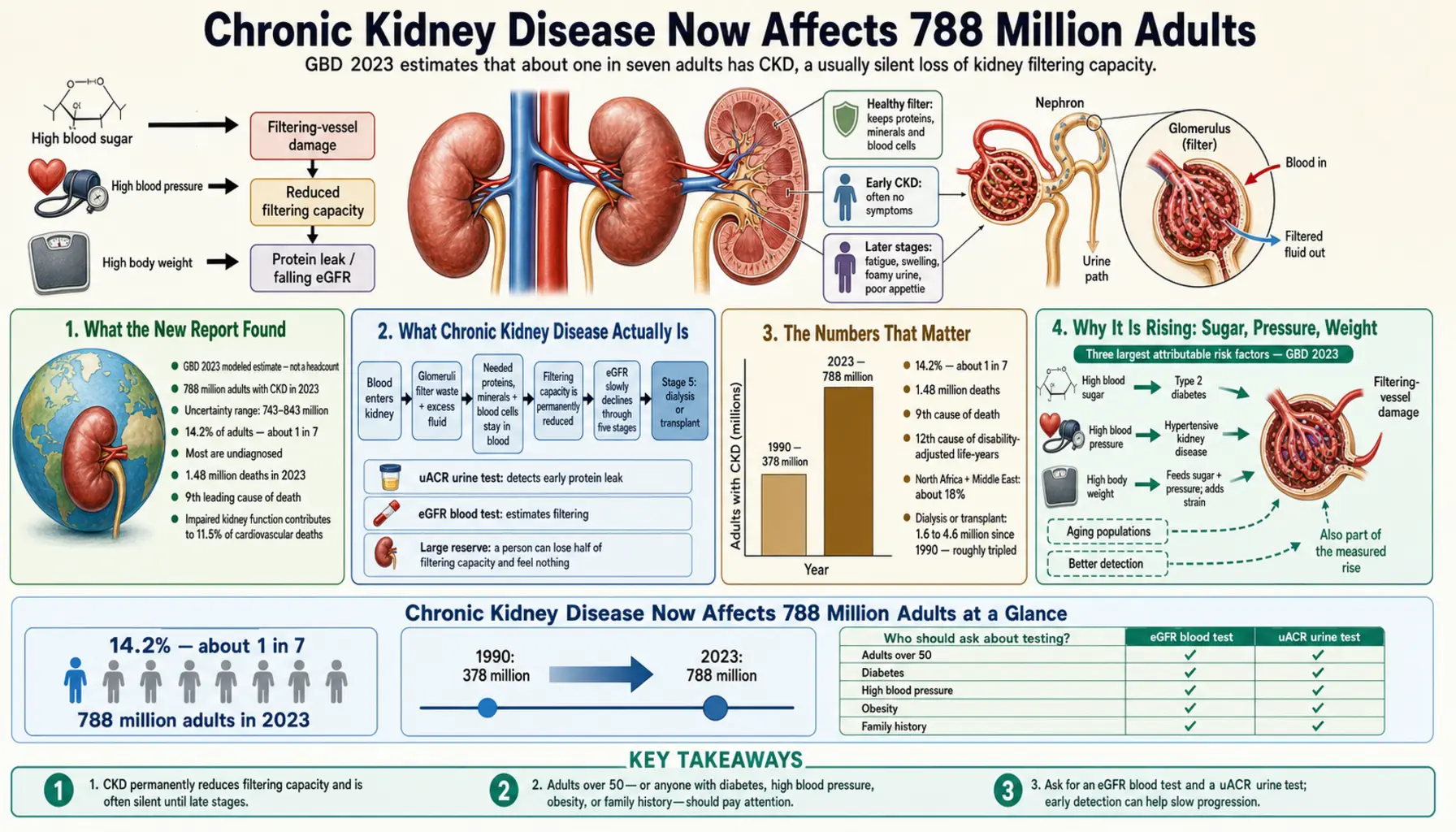
In late May 2026, a wave of coverage — including a widely shared ScienceDaily report dated May 29 and a companion news release from NYU Langone Health — drew fresh public attention to what the coverage called the most comprehensive global estimate of chronic kidney disease in nearly a decade. The underlying study, the Global Burden of Disease (GBD) 2023 analysis of kidney disease, was published in The Lancet and led by researchers at NYU Grossman School of Medicine, the University of Glasgow, and the Institute for Health Metrics and Evaluation. The coverage ran under the headline “A silent kidney crisis is spreading far faster than experts expected.” The paper itself reports that the number of adults with chronic kidney disease (CKD) roughly doubled between 1990 and 2023, while the age-standardised rate rose by a smaller margin, as Section 4 explains.
Table of Contents
- 1. What the New Report Found
- 2. What Chronic Kidney Disease Actually Is
- 3. The Numbers That Matter
- 4. Why It Is Rising: Sugar, Pressure, Weight
- 5. How CKD Is Detected and Slowed
- 6. Honest Caveats
- 7. Key Points
- Sources
- Key Research Papers
- Connections
- Featured Videos
1. What the New Report Found
The GBD 2023 kidney-disease analysis estimates that about 788 million adults worldwide were living with chronic kidney disease in 2023, up from roughly 378 million in 1990. That is more than a doubling in a single generation. Expressed as an age-standardised rate, an estimated 14.2% of adults — roughly one in seven — have some degree of CKD. The report attributes about 1.48 million deaths in 2023 directly to kidney disease, which now ranks as the ninth leading cause of death globally, and it estimates that impaired kidney function contributes to roughly 11.5% of all cardiovascular deaths. A 2026 review in Nephrology Dialysis Transplantation put the mortality figure in its title: one death from chronic kidney disease every 20 seconds.
The coverage calls it a “silent” crisis because early CKD usually produces no symptoms. In the GBD analysis most people with CKD had stage 1–3 disease, a combined prevalence of 13.9% of adults. Screening research finds that few people with CKD know they have it: in a 2016 International Society of Nephrology study of 75,058 people in 12 low- and middle-income countries, 6% of those with CKD in general-population cohorts, and 10% in high-risk cohorts, were aware of it.
2. What Chronic Kidney Disease Actually Is
The kidneys are a pair of fist-sized filters that clean waste and excess fluid from the blood while holding on to the proteins, minerals, and blood cells the body needs. Chronic kidney disease means that filtering capacity is permanently reduced and, usually, slowly declining. It is graded in five stages by the estimated glomerular filtration rate, or eGFR — how much blood the kidneys clean per minute — from near-normal stage 1 to stage 5 kidney failure, where dialysis or a transplant is needed to stay alive.
The catch is that the kidneys have a large reserve: a person can lose a large share of filtering capacity without symptoms. Symptoms — fatigue, swelling, foamy urine, poor appetite — tend to arrive only in later stages, when much of the damage is done. A modeled global tally like this one is built from population surveys and registries as well as clinic records, so it also counts people who have never been diagnosed.
3. The Numbers That Matter
Key figures from the analysis:
- 788 million adults with CKD in 2023 (uncertainty range 743–843 million), versus 378 million in 1990.
- 14.2% age-standardized prevalence among adults — about one in seven.
- 1.48 million deaths attributed to CKD in 2023 (uncertainty range 1.30–1.65 million); the 9th leading cause of death worldwide.
- CKD ranked the 12th leading cause of disability-adjusted life-years (a combined measure of years lost to death and to illness).
- The highest age-standardised prevalence was in North Africa and the Middle East, at about 18% of adults.
- A companion GBD 2023 analysis in The Lancet Global Health estimated 4.59 million people on dialysis or living with a kidney transplant in 2023, after a steady rise over three decades; prevalence was highest in high-income regions and lowest in sub-Saharan Africa.
4. Why It Is Rising: Sugar, Pressure, Weight
The report names high fasting blood sugar, high body-mass index, and high systolic blood pressure as leading risk factors for the disability-adjusted life-years lost to CKD — the same metabolic trio behind much of the world’s heart disease. Elevated blood glucose from type 2 diabetes damages the kidney’s delicate filtering vessels over years, a process described under diabetic nephropathy. Chronically high blood pressure does parallel damage, driving hypertensive kidney disease, and rising body-mass index feeds both while adding strain of its own.
Much of the measured rise reflects larger and older populations: kidney function declines naturally with age, so more people cross diagnostic thresholds simply by living longer. The age-standardised prevalence, which removes the effect of a population growing older, rose by a relative 3.5% between 1990 and 2023, while the number of adults with CKD more than doubled.
5. How CKD Is Detected and Slowed
The report’s main risk factors are measurable and modifiable, and chronic kidney disease is detected by laboratory tests rather than by symptoms. The 2024 KDIGO (Kidney Disease: Improving Global Outcomes) clinical practice guideline advises testing people at risk for, or living with, CKD with both a urine albumin measurement and an assessment of filtration rate. People commonly described as at higher risk include those with diabetes, high blood pressure, cardiovascular disease, obesity, or a family history of kidney failure. The two tests are:
- A blood test for eGFR, which estimates how well the kidneys are filtering. It is usually calculated from serum creatinine; an equation combining creatinine with cystatin C was more accurate than either marker alone in the CKD-EPI validation study, and KDIGO 2024 recommends the combined estimate where cystatin C is available — see Kidney Function Tests.
- A urine albumin-to-creatinine ratio (uACR), which detects small amounts of the protein albumin leaking into the urine — often an early sign of damage that can appear before eGFR falls. See Microalbumin / ACR and Urinalysis.
The KDIGO 2024 guideline covers blood-sugar management, a systolic blood pressure target below 120 mm Hg, when tolerated, for adults with high blood pressure and CKD, sodium intake below 2 g a day, weight loss in people with obesity, and review of over-the-counter medicines and dietary or herbal remedies that may harm the kidneys. Drinking extra water has been tested directly: in the CKD WIT randomized trial of 631 adults with stage 3 CKD, coaching to increase water intake did not significantly slow the decline in kidney function after one year, although the authors note the trial may have been underpowered.
Three drug classes have slowed kidney decline in large placebo-controlled trials. SGLT2 inhibitors lowered the risk of the trials’ kidney-and-cardiovascular composite outcomes in people with or without type 2 diabetes: dapagliflozin in DAPA-CKD (4,304 participants, hazard ratio 0.61) and empagliflozin in EMPA-KIDNEY (6,609 participants, hazard ratio 0.72). The nonsteroidal mineralocorticoid receptor antagonist finerenone lowered the risk of CKD progression in FIDELIO-DKD (5,734 participants, hazard ratio 0.82), with more stops for high blood potassium than on placebo (2.3% vs 0.9%). The GLP-1 receptor agonist semaglutide lowered the risk of major kidney disease events by 24% in FLOW (3,533 participants). The finerenone and semaglutide trials enrolled only people with type 2 diabetes. The GBD authors conclude that appropriate screening and implementation programmes “are needed to translate advances in CKD treatment into improved patient outcomes.”
6. Honest Caveats
This is a modeled estimate, not a headcount. The Global Burden of Disease project combines published studies, death registration records, kidney-failure treatment registries, and household surveys, and uses statistical models to fill gaps where direct data are thin. That is why every figure carries an uncertainty range — the 788 million estimate spans 743 to 843 million — and is a modeled approximation, not an exact count. The NYU Langone release adds that CKD may be even more common than current estimates suggest, because many people are never tested.
A point about dating this story, too: the peer-reviewed analysis appeared in The Lancet in November 2025 (online November 7, in the November 22 issue); what happened in late May 2026 was a fresh round of media and institutional coverage that pushed the findings back into public view. The findings are unchanged — the “news” here is renewed attention to a study published several months earlier, not a brand-new result.
7. Key Points
The GBD 2023 analysis estimates that chronic kidney disease affects roughly one in seven adults, about 788 million people, and caused about 1.48 million deaths in 2023 — roughly one every 20 seconds. Early disease usually causes no symptoms. The leading risk factors the analysis names — high blood sugar, high blood pressure, and high body-mass index — are already targets of routine preventive care, and two routine laboratory tests, eGFR and the urine albumin-to-creatinine ratio, detect the disease before symptoms appear; the KDIGO 2024 guideline calls for both in people at risk. Trials of SGLT2 inhibitors, finerenone and semaglutide have shown slower kidney decline. Because early CKD is silent, it is found by testing rather than by symptoms.
Sources
- GBD 2023 Chronic Kidney Disease Collaborators. Global, regional, and national burden of chronic kidney disease in adults, 1990–2023, and its attributable risk factors: a systematic analysis for the Global Burden of Disease Study 2023. The Lancet. 2025;406(10518):2461–2482. doi:10.1016/S0140-6736(25)01853-7 · PMID 41213283
- The Lancet, full text: Global, regional, and national burden of chronic kidney disease in adults, 1990–2023
- ScienceDaily (May 29, 2026): A silent kidney crisis is spreading far faster than experts expected
- Institute for Health Metrics and Evaluation (IHME) research summary: Global, regional, and national burden of chronic kidney disease in adults, 1990–2023
- Review: The updated global burden of chronic kidney disease: one death every 20 seconds. Nephrology Dialysis Transplantation. 2026;41(10):1899–1908. doi:10.1093/ndt/gfag040
- Underlying data record: GBD 2023 Chronic Kidney Disease Estimates, 1990–2023 (GHDx)
Key Research Papers
The primary papers behind this article’s figures, each checked against its PubMed record and abstract.
- GBD 2023 Chronic Kidney Disease Collaborators (2025). Global, regional, and national burden of chronic kidney disease in adults, 1990–2023, and its attributable risk factors: a systematic analysis for the Global Burden of Disease Study 2023. The Lancet 406(10518):2461-2482. — PubMed PMID: 41213283
- GBD 2023 Kidney Failure with Replacement Therapy Collaborators (2025). Global, regional, and national prevalence of kidney failure with replacement therapy and associated aetiologies, 1990–2023: a systematic analysis for the Global Burden of Disease Study 2023. The Lancet Global Health 13(8):e1378-e1395. — PubMed PMID: 40712611
- Ortiz A, Lees JS, Torra R, Stel VS, Kramer A, Mark PB (2026). The updated global burden of chronic kidney disease: one death every 20 seconds. Nephrology Dialysis Transplantation 41(10):1899-1908. — PubMed PMID: 41739048
- Ene-Iordache B, Perico N, Bikbov B, Carminati S, Remuzzi A, Perna A, et al. (2016). Chronic kidney disease and cardiovascular risk in six regions of the world (ISN-KDDC): a cross-sectional study. The Lancet Global Health 4(5):e307-e319. — PubMed PMID: 27102194
- Levin A, Ahmed SB, Carrero JJ, Foster B, Francis A, Hall RK, et al. (2024). Executive summary of the KDIGO 2024 Clinical Practice Guideline for the Evaluation and Management of Chronic Kidney Disease: known knowns and known unknowns. Kidney International 105(4):684-701. — PubMed PMID: 38519239
- Inker LA, Schmid CH, Tighiouart H, Eckfeldt JH, Feldman HI, Greene T, et al. (2012). Estimating glomerular filtration rate from serum creatinine and cystatin C. New England Journal of Medicine 367(1):20-29. — PubMed PMID: 22762315
- Clark WF, Sontrop JM, Huang SH, Gallo K, Moist L, House AA, et al. (2018). Effect of coaching to increase water intake on kidney function decline in adults with chronic kidney disease: the CKD WIT randomized clinical trial. JAMA 319(18):1870-1879. — PubMed PMID: 29801012
- Heerspink HJL, Stefánsson BV, Correa-Rotter R, Chertow GM, Greene T, Hou FF, et al. (2020). Dapagliflozin in patients with chronic kidney disease. New England Journal of Medicine 383(15):1436-1446. — PubMed PMID: 32970396
- The EMPA-KIDNEY Collaborative Group; Herrington WG, Staplin N, Wanner C, Green JB, Hauske SJ, et al. (2023). Empagliflozin in patients with chronic kidney disease. New England Journal of Medicine 388(2):117-127. — PubMed PMID: 36331190
- Bakris GL, Agarwal R, Anker SD, Pitt B, Ruilope LM, Rossing P, et al. (2020). Effect of finerenone on chronic kidney disease outcomes in type 2 diabetes. New England Journal of Medicine 383(23):2219-2229. — PubMed PMID: 33264825
- Perkovic V, Tuttle KR, Rossing P, Mahaffey KW, Mann JFE, Bakris G, et al. (2024). Effects of semaglutide on chronic kidney disease in patients with type 2 diabetes. New England Journal of Medicine 391(2):109-121. — PubMed PMID: 38785209
PubMed Topic Searches
Connections
- Chronic Kidney Disease
- Nephrology & Hepatology
- Diabetic Nephropathy
- Hypertensive Nephropathy
- Acute Kidney Injury
- Kidney Stones
- Kidney Function Tests (eGFR)
- Cystatin C
- Microalbumin / ACR
- Urinalysis
- Type 2 Diabetes
- Hypertension
- Cardiovascular Disease
- Lab Tests
- May 11, 2026 — Methylene Blue and the Kidneys
- News Archive