Microalbumin & Albumin-to-Creatinine Ratio (ACR)
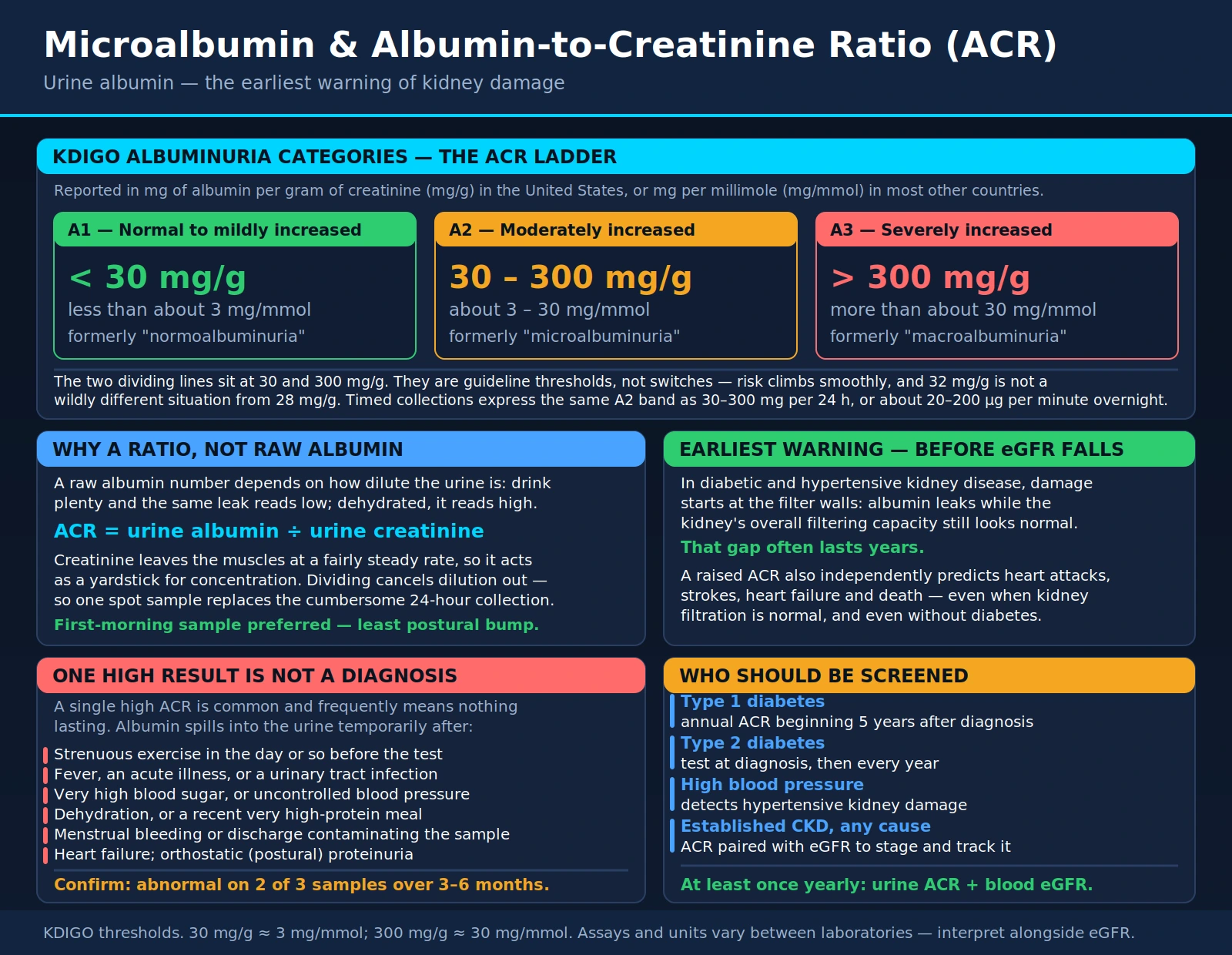
The urine albumin test — still widely called the "microalbumin" test — is one of the most valuable and underappreciated checks in all of medicine. It looks for tiny amounts of a blood protein called albumin leaking into your urine, long before you would ever feel anything wrong. In people with diabetes or high blood pressure, a rising albumin level is often the very first sign that the kidneys are under strain — showing up years before the standard blood test of kidney filtration (eGFR) starts to slip. Because a small tube of urine can flag trouble this early, catching it opens a wide window to protect your kidneys and your heart with treatments that genuinely work. This page explains what the test measures, how to read your result, why a single high number is not a diagnosis, and what a positive result actually means for you.
Interactive Visualization Kidney Nephron — watch blood become urine Follow blood into the glomerulus and see filtration and reabsorption turn 180 litres of filtrate into urine — then toggle dehydration or diabetes. Launch →
Table of Contents
- What the Test Measures
- Why It's the Earliest Warning Sign
- The Categories: A1, A2, A3
- Reading Your Result: The Numbers
- Why One High Result Isn't a Diagnosis
- Spot Sample vs. 24-Hour Collection
- Who Should Be Screened
- What to Do About a Positive Result
- Research Papers
- Connections
- Featured Videos
What the Test Measures
Albumin is the most abundant protein in your blood. It does important jobs — holding fluid inside your vessels, carrying hormones and medicines, and more. Healthy kidneys are built to keep albumin in the blood. The filtering units of the kidney, called glomeruli, act like fine sieves: they let water and small waste products pass into the urine while holding back valuable proteins like albumin. In a healthy person, only a trace of albumin slips through, and much of even that is reabsorbed before urine leaves the body.
When those filters are damaged — most often by the slow injury of diabetes or high blood pressure — they begin to leak. Albumin that should have stayed in the blood starts appearing in the urine. Measuring that leak is the whole point of the test. The more albumin in the urine, the more the filters are struggling.
The word "microalbumin" causes a lot of confusion, so it is worth clearing up: it does not mean a special small kind of albumin. Albumin is albumin. "Micro" simply refers to the small amount being measured — levels far too low for an ordinary dipstick to catch, requiring a more sensitive laboratory method. Because that name misleads people into thinking the finding is trivial, kidney specialists have moved away from it (more on that below).
The albumin-to-creatinine ratio (ACR)
Here is the clever part. The amount of albumin in a urine sample depends heavily on how concentrated the urine is. Drink a lot of water and your urine is dilute, so any single reading looks low; get a bit dehydrated and the same leak looks high. That would make a one-time "milligrams of albumin" measurement almost useless.
The fix is to measure albumin alongside a second substance called creatinine. Creatinine is a waste product your muscles release into the urine at a fairly steady rate, so it acts as a built-in yardstick for how concentrated the sample is. Dividing the albumin by the creatinine cancels out the dilution effect:
- ACR = urine albumin ÷ urine creatinine. The result is reported as milligrams of albumin per gram of creatinine (mg/g) in the United States, or milligrams per millimole (mg/mmol) in most other countries.
Because the ratio corrects for concentration, you do not need to collect urine all day. A single "spot" sample — ideally your first urine of the morning — gives a reliable, reproducible number. That convenience is a big reason the ACR has become the standard way to screen for and monitor kidney damage worldwide.
Why It's the Earliest Warning Sign
Most people assume the main kidney blood test — the one that produces an eGFR (estimated glomerular filtration rate) from your blood creatinine — is the first thing to change when kidneys are in trouble. For the two most common causes of kidney disease, that is usually backwards.
In diabetic and hypertensive kidney disease, damage typically begins at the filter walls, which start leaking albumin while the kidney's overall filtering capacity is still normal. The result is a period — often lasting years — when the eGFR looks completely reassuring but albumin is quietly rising in the urine. The kidneys have enormous reserve, so the eGFR can hold steady until a substantial amount of damage has accumulated. Albuminuria flags the problem while there is still the most to gain from acting.
There is a second, equally important reason this test matters: albumin in the urine is not only a kidney signal. Large studies have shown that a raised ACR independently predicts heart attacks, strokes, heart failure, and death — even in people whose kidney filtration is normal, and even in people without diabetes. A leaky kidney filter appears to be a visible marker of blood-vessel damage happening throughout the body. So a single, inexpensive urine test does double duty: it warns of kidney trouble and refines your cardiovascular risk. That combination is why modern guidelines pair the ACR with eGFR as the two pillars of assessing kidney health.
The Categories: A1, A2, A3
Kidney guidelines sort ACR results into three bands. You may see them under two different naming systems, because the language changed and both are still in use.
The older terms, which you will still hear from many clinicians and see on some lab reports, were:
- Normoalbuminuria — a normal amount of albumin.
- Microalbuminuria — a small but abnormal amount; the classic early-warning zone.
- Macroalbuminuria (also called overt proteinuria) — a large amount, signaling more established damage.
The current terms, recommended by the international kidney body KDIGO and now used to "stage" chronic kidney disease, replace those with plain-language categories:
- A1 — Normal to mildly increased (was normoalbuminuria).
- A2 — Moderately increased (was microalbuminuria).
- A3 — Severely increased (was macroalbuminuria).
Why "microalbuminuria" was retired
The shift away from "micro-" and "macro-" was deliberate. Those prefixes wrongly suggested two different substances (a "micro" albumin and a "macro" albumin) when in reality it is the same protein at different amounts on a single continuous scale. The word "micro" also made a genuinely important finding sound minor. Renaming the bands A1/A2/A3 and describing them as "mildly/moderately/severely increased" keeps the focus where it belongs: on a rising quantity of one protein, with higher numbers meaning more risk. In practice, many doctors and labs still say "microalbumin," so it helps to know both vocabularies map onto the same thing.
Reading Your Result: The Numbers
Here are the standard ACR cutoffs, given in both unit systems so you can match whatever your lab reports. These reflect KDIGO staging thresholds:
- A1 (normal to mildly increased): less than 30 mg/g, which is less than about 3 mg/mmol.
- A2 (moderately increased) — the old "microalbuminuria": 30 to 300 mg/g, or roughly 3 to 30 mg/mmol.
- A3 (severely increased) — the old "macroalbuminuria": greater than 300 mg/g, or more than about 30 mg/mmol.
A convenient way to remember it: the two key dividing lines sit at 30 and 300 mg/g. Cross the first (30) and you have entered the moderately-increased zone that warrants attention; cross the second (300) and the leak is substantial.
If your urine is instead measured by an older method that reports a raw albumin excretion rate from a timed collection, the matching landmarks are 30 to 300 milligrams per 24 hours for the moderate band, or about 20 to 200 micrograms per minute on an overnight timed sample. These are simply different ways of expressing the same underlying leak.
A few things worth understanding about the numbers. They are guideline thresholds, not magic switches — someone at 32 mg/g is not in a wildly different situation from someone at 28, and risk climbs smoothly as the number rises rather than jumping at the cutoff. Values can also run a little higher in some healthy circumstances, and the sexes differ slightly (creatinine output relates to muscle mass, so the same albumin leak can produce a marginally different ratio in a very muscular versus a very slight person). What matters most is the overall picture and the trend over repeated tests, interpreted by your clinician alongside your eGFR, blood pressure, and blood sugar.
Why One High Result Isn't a Diagnosis
This is one of the most important points on the page, because a single abnormal ACR is common and frequently means nothing lasting. Albumin can spill into the urine temporarily for all sorts of everyday reasons that have nothing to do with permanent kidney disease. Known triggers of transient elevation include:
- Strenuous exercise in the day or so before the test — vigorous activity can transiently raise urine albumin.
- Fever or an acute illness of almost any kind.
- A urinary tract infection (UTI), or blood in the urine.
- Very high blood sugar or sharply uncontrolled blood pressure at the moment of testing.
- Dehydration, or, in the opposite direction, a recent very high-protein meal.
- Menstrual bleeding or vaginal discharge contaminating the sample.
- Heart failure and other acute stresses on the circulation.
- In some healthy young people, a harmless pattern called orthostatic (postural) proteinuria, where protein leaks only when upright — another reason a first-morning sample (taken right after lying down all night) is preferred.
Because of all this, guidelines are emphatic that one positive test is not enough to diagnose persistent (chronic) albuminuria. The standard is to repeat the test and require that it be abnormal on at least two of three samples collected over roughly three to six months, after ruling out obvious temporary causes such as infection or recent hard exercise. Only a leak that persists across repeated, clean samples counts as a marker of ongoing kidney damage. If you get one high result, the right response is not alarm — it is a sensible repeat under better conditions.
Spot Sample vs. 24-Hour Collection
There are two broad ways to measure how much albumin your kidneys are losing, and the field has shifted decisively toward the easier one.
The old reference method was the 24-hour urine collection: you save every drop of urine for a full day in a large container and the lab measures the total albumin. In theory it is comprehensive. In practice it is cumbersome and surprisingly inaccurate in real life — people forget a void, add an extra one, spill, or mistime the start and finish, and any of those errors throws off the total. It is inconvenient enough that many patients simply do not complete it correctly.
The modern standard is the spot urine ACR described earlier: a single small sample, with the albumin-to-creatinine ratio automatically correcting for how dilute or concentrated it happens to be. It is far more practical, reproducible enough for screening and monitoring, and it is what major guidelines now recommend as the first-line test. A first-morning spot sample is the preferred version because overnight rest minimizes the exercise-related and postural bumps that can nudge a daytime sample upward; a random sample taken any time is an acceptable second choice.
A timed overnight collection (reporting micrograms of albumin per minute) sits between the two and is used in some settings, but for most people, most of the time, the first-morning spot ACR gives an accurate answer with the least hassle — and being easy to repeat is itself a virtue, since confirming a result over time is central to interpreting it correctly.
Who Should Be Screened
Because the test catches trouble so early and the treatments are so effective, professional guidelines recommend routine ACR screening for the groups at meaningful risk of kidney damage. In broad strokes:
- Type 1 diabetes: begin annual ACR testing starting five years after diagnosis, since kidney changes take time to develop after onset.
- Type 2 diabetes: test at diagnosis and then every year. Type 2 often smolders undetected for years before it is found, so kidney damage may already be underway when the diabetes is first diagnosed.
- High blood pressure (hypertension): checking the ACR helps detect hypertensive kidney damage and sharpens overall cardiovascular risk assessment.
- Established chronic kidney disease (CKD), from any cause: the ACR is paired with eGFR to stage the disease and track it over time.
- Others at elevated risk — for example people with cardiovascular disease, a strong family history of kidney failure, or certain higher-risk backgrounds — may also benefit; this is an individual discussion with your clinician.
The consistent theme across the American Diabetes Association's annual standards and the KDIGO kidney guidelines is at least once-yearly measurement of urine ACR together with a blood eGFR in these groups. Two small, cheap tests, done annually, are enough to catch the great majority of early kidney disease while it is still highly treatable.
What to Do About a Positive Result
A confirmed, persistent rise in your ACR is not a verdict — it is an early, actionable finding, and this is exactly where the test earns its keep. The goal is to lower the albumin leak and slow or prevent progression, using a combination of proven medicines and everyday changes. Treatment is individualized by your doctor, but the modern toolkit includes:
ACE inhibitors and ARBs
These blood-pressure medicines — ACE inhibitors (drug names ending in "-pril," such as lisinopril or ramipril) and ARBs (ending in "-sartan," such as losartan or irbesartan) — do more than lower blood pressure. They reduce the pressure specifically inside the kidney's filters, which directly cuts the albumin leak and has been shown to slow the progression of kidney disease. Landmark trials in people with diabetic kidney disease established this benefit, and these drugs are a cornerstone of treatment whenever albuminuria is present. Two practical notes: an ACE inhibitor and an ARB should not be taken together (the combination raises risk without added benefit), and your doctor will check a blood test for potassium and kidney function after starting or increasing the dose.
SGLT2 inhibitors
A newer class called SGLT2 inhibitors (drug names ending in "-flozin," such as dapagliflozin, canagliflozin, and empagliflozin) was originally developed to lower blood sugar in type 2 diabetes but turned out to have striking kidney and heart benefits. Major trials showed they reduce albuminuria, slow the decline of kidney function, and lower the risk of kidney failure and cardiovascular events — and, importantly, this protection extends to many people with chronic kidney disease even without diabetes. They are now recommended, alongside an ACE inhibitor or ARB, for many people with albuminuric kidney disease. Other options, such as the nonsteroidal mineralocorticoid-receptor antagonist finerenone, are used in specific situations, particularly diabetic kidney disease.
The foundations still matter most
Medicines work best on top of good control of the underlying drivers. That means keeping blood pressure and blood sugar in their target ranges, not smoking (smoking accelerates kidney damage), moderating dietary sodium, staying physically active, and maintaining a healthy weight. Repeat ACR testing is then used to see whether the plan is working — a falling number is a genuinely good sign that the leak, and the risk behind it, is being brought under control. Because early kidney disease causes no symptoms, this monitoring is how you and your clinician "see" progress that you cannot feel.
Research Papers
- Stevens PE, Ahmed SB, Carrero JJ, et al. KDIGO 2024 Clinical Practice Guideline for the Evaluation and Management of Chronic Kidney Disease. Kidney International. 2024;105(4S):S117–S314. doi:10.1016/j.kint.2023.10.018 — The international guideline that stages CKD by eGFR and albuminuria (A1/A2/A3) and formalizes the shift away from "micro/macroalbuminuria."
- American Diabetes Association (ElSayed NA, Aleppo G, et al.) 11. Chronic Kidney Disease and Risk Management: Standards of Care in Diabetes—2024. Diabetes Care. 2024;47(Suppl 1):S219–S230. doi:10.2337/dc24-S011 — The ADA's annual recommendations on when to screen the urine ACR in diabetes and how to treat a positive result.
- Chronic Kidney Disease Prognosis Consortium (Matsushita K, van der Velde M, et al.) Association of estimated glomerular filtration rate and albuminuria with all-cause and cardiovascular mortality in general population cohorts: a collaborative meta-analysis. The Lancet. 2010;375(9731):2073–2081. doi:10.1016/S0140-6736(10)60674-5 — The huge pooled analysis showing that higher albuminuria independently predicts death, separate from eGFR.
- Gerstein HC, Mann JFE, Yi Q, et al. Albuminuria and Risk of Cardiovascular Events, Death, and Heart Failure in Diabetic and Nondiabetic Individuals. JAMA. 2001;286(4):421–426. doi:10.1001/jama.286.4.421 — Evidence from the HOPE study that any degree of albuminuria raises cardiovascular risk, even below the old "microalbuminuria" cutoff.
- Ninomiya T, Perkovic V, de Galan BE, et al. Albuminuria and Kidney Function Independently Predict Cardiovascular and Renal Outcomes in Diabetes. Journal of the American Society of Nephrology. 2009;20(8):1813–1821. doi:10.1681/ASN.2008121270 — An ADVANCE-trial analysis confirming that albuminuria and eGFR each add prognostic information in type 2 diabetes.
- Miller WG, Bruns DE, Hortin GL, et al. Current Issues in Measurement and Reporting of Urinary Albumin Excretion. Clinical Chemistry. 2009;55(1):24–38. doi:10.1373/clinchem.2008.106567 — A key laboratory-medicine review on how urine albumin and the ACR are measured, standardized, and reported.
- Parving HH, Lehnert H, Brøchner-Mortensen J, et al. The Effect of Irbesartan on the Development of Diabetic Nephropathy in Patients with Type 2 Diabetes. New England Journal of Medicine. 2001;345(12):870–878. doi:10.1056/NEJMoa011489 — The IRMA-2 trial showing an ARB reduces progression from moderate (A2) to severe (A3) albuminuria.
- Brenner BM, Cooper ME, de Zeeuw D, et al. Effects of Losartan on Renal and Cardiovascular Outcomes in Patients with Type 2 Diabetes and Nephropathy. New England Journal of Medicine. 2001;345(12):861–869. doi:10.1056/NEJMoa011161 — The RENAAL trial establishing that an ARB slows progression to kidney failure in diabetic nephropathy.
- Perkovic V, Jardine MJ, Neal B, et al. Canagliflozin and Renal Outcomes in Type 2 Diabetes and Nephropathy. New England Journal of Medicine. 2019;380(24):2295–2306. doi:10.1056/NEJMoa1811744 — The CREDENCE trial, a landmark showing an SGLT2 inhibitor protects the kidneys in albuminuric diabetic kidney disease.
- Heerspink HJL, Stefánsson BV, Correa-Rotter R, et al. Dapagliflozin in Patients with Chronic Kidney Disease. New England Journal of Medicine. 2020;383(15):1436–1446. doi:10.1056/NEJMoa2024816 — The DAPA-CKD trial extending SGLT2-inhibitor kidney protection to people with CKD and albuminuria, including many without diabetes.
Connections
- All Lab Tests
- Kidney Nephron — interactive animation
- Kidney Function Tests
- Urinalysis
- Kidney Disease