 — February 26, 2026
· Oral Semaglutide and the Heart in Type 2 Diabetes
— February 26, 2026
· Oral Semaglutide and the Heart in Type 2 Diabetes
A secondary analysis of SOUL, a cardiovascular outcomes trial of 9,650 adults with type 2 diabetes, found that the pill form of semaglutide — the same medicine that is also given as a once-weekly injection — was associated with fewer heart-failure events in one group of participants: those who already had heart failure. The finding comes with important limits, which the sections below set out alongside the numbers.
Table of Contents
- The Finding
- What Oral Semaglutide Is
- What the Trial Actually Showed
- Who the Findings Apply To
- Limits of the Evidence
- Key Points
- Sources
- Key Research Papers
- Connections
- Featured Videos
The Finding
In a paper published online in JAMA Internal Medicine on February 2, 2026 (print issue of April 2026) and announced in an Oregon Health & Science University news release on February 26, 2026, researchers led by first author Rodica Pop-Busui, M.D., Ph.D., of Oregon Health & Science University reported that daily oral semaglutide lowered the risk of heart-failure events in people with type 2 diabetes who already had a history of heart failure. Among that subgroup, the risk of the combined outcome — heart-failure hospitalization, an urgent heart-failure visit, or cardiovascular death — was about 22% lower with the drug than with placebo, and serious adverse events were no more common.
What Oral Semaglutide Is
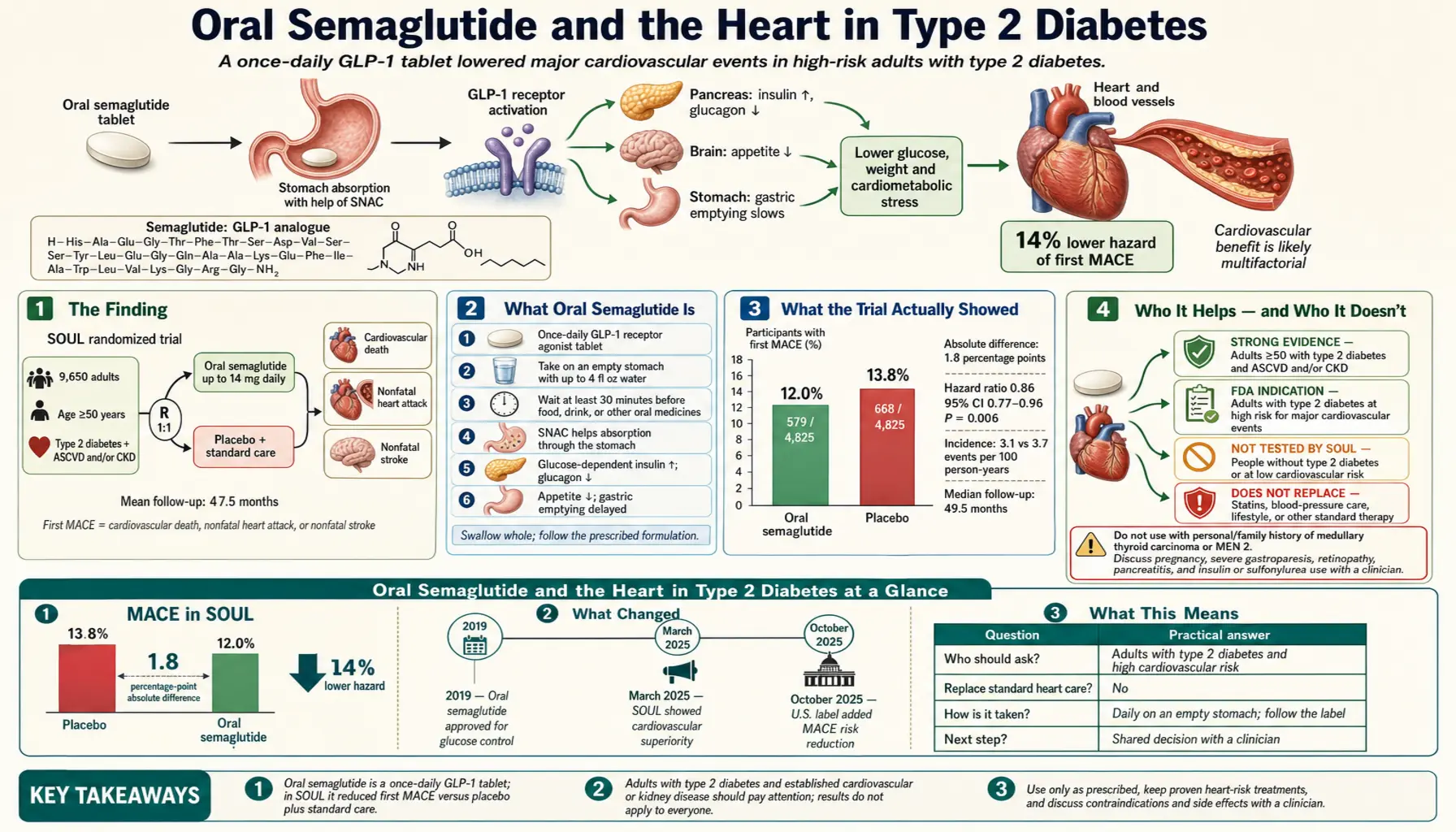
Semaglutide is a GLP-1 receptor agonist — a class of medicines that mimic a gut hormone the body releases after eating. GLP-1 drugs lower blood sugar, slow the emptying of the stomach and reduce appetite. A 2025 meta-analysis of 10 placebo-controlled outcome trials (71,351 people with type 2 diabetes) found that long-acting GLP-1 drugs, injected or oral, lowered major cardiovascular events by 14%, heart-failure hospitalization by 14%, a composite kidney outcome by 17% and death from any cause by 12%. Semaglutide is also given as a once-weekly injection. The version studied here is the once-daily tablet, taken first thing in the morning on an empty stomach; in SOUL the dose was stepped up from 3 mg to 7 mg after four weeks and to 14 mg after another four weeks.
The data come from SOUL (the Semaglutide Cardiovascular Outcomes trial), a double-blind, placebo-controlled trial at 444 centers in 33 countries that enrolled 9,650 adults aged 50 or older who had type 2 diabetes plus atherosclerotic heart or blood-vessel disease and/or chronic kidney disease. Participants were followed for a mean of about four years (47.5 months). The main SOUL result, published in 2025, showed fewer major cardiovascular events (cardiovascular death, nonfatal heart attack or nonfatal stroke) overall: 12.0% on oral semaglutide versus 13.8% on placebo (hazard ratio 0.86; 95% confidence interval 0.77–0.96). This new report is a closer look at one piece of that picture: heart failure.
What the Trial Actually Showed
Of the 9,650 participants, 2,229 (23.1%) had a history of heart failure when they entered the trial: 991 with preserved ejection fraction, 592 with reduced ejection fraction and 646 whose subtype was not known. The main results:
- People with prior heart failure: oral semaglutide was associated with a 22% lower risk of the combined heart-failure outcome (hazard ratio 0.78; 95% confidence interval 0.63–0.96). The confidence interval stays below 1.0, but the difference between this group and participants without heart failure did not reach statistical significance (P for interaction = .06).
- The benefit clustered in one type of heart failure. Among people with HFpEF — heart failure with preserved ejection fraction, where the heart muscle stiffens rather than weakens — the estimate was larger (hazard ratio 0.59; 95% CI 0.39–0.86). Among people with reduced ejection fraction (HFrEF), there was no measurable benefit (hazard ratio 0.98; 95% CI 0.70–1.38).
- People without heart failure at baseline saw no heart-failure benefit (hazard ratio 1.01; 95% CI 0.84–1.20): no difference between drug and placebo on this particular outcome. The reduction in major cardiovascular events, by contrast, was similar with and without a history of heart failure (hazard ratios 0.83 and 0.86).
- Serious adverse events were similar. In the heart-failure group, serious adverse events occurred in 53.8% of participants on semaglutide and 57.1% on placebo, which the authors describe as similar; they call the safety findings in people with heart failure, including HFrEF, reassuring for the clinicians who treat them.
In plain terms: in this analysis the heart-failure reduction was seen in participants who already had heart failure, mainly the preserved-ejection-fraction type, and not in participants without heart failure, with no increase in serious adverse events.
Who the Findings Apply To
The findings apply most directly to people with type 2 diabetes and established heart failure — particularly the preserved-ejection-fraction (HFpEF) kind — who also have atherosclerotic cardiovascular disease and/or chronic kidney disease, the population SOUL enrolled. In that group, the oral GLP-1 drug was associated with fewer heart-failure hospitalizations, urgent heart-failure visits and cardiovascular deaths than placebo, without more serious adverse events. Participants were clinically stable at entry; people recently hospitalized, with unstable heart failure or with the most severe (NYHA class IV) heart failure were excluded, so the results may not apply to them. The data concern the once-daily tablet rather than the weekly injection.
In participants with diabetes but no heart failure, the analysis found no heart-failure benefit, although the trial's reduction in major cardiovascular events applied to them as well. In participants with the reduced-ejection-fraction (HFrEF) type, the estimate was flat. For HFrEF, SGLT2 inhibitors have their own dedicated outcome trials: in DAPA-HF (4,744 patients with an ejection fraction of 40% or less), dapagliflozin lowered worsening heart failure or cardiovascular death (hazard ratio 0.74), and in EMPEROR-Reduced (3,730 patients), empagliflozin lowered cardiovascular death or heart-failure hospitalization (hazard ratio 0.75), in patients with or without diabetes. Among SOUL participants with heart failure, the results did not differ meaningfully by whether they were already taking an SGLT2 inhibitor, a mineralocorticoid receptor antagonist or a loop diuretic.
Limits of the Evidence
Several limits apply to these findings:
- It was a secondary analysis. SOUL was designed to test major cardiovascular events, not heart failure specifically. The heart-failure composite was the prespecified main outcome of this analysis, but the trial was not powered to compare treatment effects between subgroups, and the heart-failure analyses were not adjusted for multiple comparisons. Subgroup findings of this kind are generally read as hypothesis-generating rather than proof; confirming them would take a trial designed around heart failure.
- The strongest signal came from a small slice. The HFpEF result rested on 991 people. Smaller numbers mean wider uncertainty, and the effect size in a dedicated trial could differ. Heart-failure subtype was taken from investigator-reported records rather than a standardized assessment, and nearly 30% of participants with heart failure could not be assigned a subtype.
- Absorption depends on how the tablet is taken. The FDA label directs that oral semaglutide be taken on an empty stomach with up to 4 ounces (120 mL) of plain water, followed by a wait of at least 30 minutes before eating, drinking, or taking other oral medicines. In a pharmacokinetic study in healthy volunteers, a dose taken 30 minutes after a meal produced limited or no measurable semaglutide in the blood, and exposure rose with longer fasting after the dose.
- Side effects and cautions are real. The FDA label lists nausea, abdominal pain, diarrhea, decreased appetite, vomiting and constipation as the most common adverse reactions, and reports that most nausea, vomiting and diarrhea occurred during dose escalation. Its approved uses are limited to adults with type 2 diabetes. A boxed warning notes that semaglutide causes thyroid C-cell tumors in rodents, and the label lists a personal or family history of medullary thyroid carcinoma, or MEN 2, as a contraindication. The label also warns of acute pancreatitis and acute gallbladder disease.
- Cost and access. GLP-1 medicines are expensive, and insurance coverage varies. Benefits also depend on staying on the drug: in the STEP 1 trial extension, adults with obesity or overweight, without diabetes, who stopped once-weekly injected semaglutide regained about two-thirds of their prior weight loss within a year, and most cardiometabolic improvements moved back toward baseline.
Key Points
- Among SOUL participants with type 2 diabetes and a history of heart failure, oral semaglutide was associated with a 22% lower risk of heart-failure hospitalization, an urgent heart-failure visit or cardiovascular death than placebo (hazard ratio 0.78), with the clearest effect in HFpEF.
- No heart-failure benefit was seen in participants without heart failure or in those with HFrEF; the trial’s reduction in major cardiovascular events was similar with or without heart failure (P for interaction = .77).
- Serious adverse events were similar on drug and placebo in the heart-failure group.
- As a secondary analysis with small subgroups and an interaction P value of .06, the result is described by its authors as supporting a potential benefit of oral semaglutide in reducing heart-failure events in people with type 2 diabetes and heart failure. It did not compare the drug with the HFrEF medicines that have their own dedicated trials.
- The finding fits a wider pattern: across 10 outcome trials in type 2 diabetes, long-acting GLP-1 drugs used for blood-sugar control have also lowered cardiovascular, heart-failure and kidney events.
- Oral semaglutide is a prescription medicine; decisions about starting or stopping it belong with a clinician who knows the person’s full history.
Sources
- Pop-Busui R, et al. Oral Semaglutide and Heart Failure Outcomes in Persons With Type 2 Diabetes: A Secondary Analysis of the SOUL Randomized Clinical Trial. JAMA Internal Medicine. 2026;186(4):426–436. doi:10.1001/jamainternmed.2025.7774
- Full article (JAMA Network): jamanetwork.com — SOUL heart-failure secondary analysis
- PubMed record: PMID 41627802
- Oregon Health & Science University news release (February 26, 2026): Oral semaglutide lowers risk of heart failure events in people with Type 2 diabetes
- SOUL trial registration: ClinicalTrials.gov NCT03914326
- FDA prescribing information for oral semaglutide tablets (label revised January 30, 2026), via the National Library of Medicine: DailyMed
Key Research Papers
Primary papers behind the figures in this article. Each entry was checked against PubMed and Crossref, and the SOUL heart-failure analysis also against its full text, before it was written down.
- Pop-Busui R, Rasmussen S, Deanfield JE, Buse JB, Marx N, Mulvagh SL, et al. (2026). Oral Semaglutide and Heart Failure Outcomes in Persons With Type 2 Diabetes: A Secondary Analysis of the SOUL Randomized Clinical Trial. JAMA Internal Medicine 186(4):426-436. — PubMed PMID: 41627802
- McGuire DK, Marx N, Mulvagh SL, Deanfield JE, Inzucchi SE, Pop-Busui R, et al. (2025). Oral Semaglutide and Cardiovascular Outcomes in High-Risk Type 2 Diabetes. New England Journal of Medicine 392(20):2001-2012. — PubMed PMID: 40162642
- Lee MMY, Sattar N, Pop-Busui R, Deanfield J, Emerson SS, Inzucchi SE, et al. (2025). Cardiovascular and Kidney Outcomes and Mortality With Long-Acting Injectable and Oral Glucagon-Like Peptide 1 Receptor Agonists in Individuals With Type 2 Diabetes: A Systematic Review and Meta-analysis of Randomized Trials. Diabetes Care 48(5):846-859. — PubMed PMID: 40156846
- Bækdal TA, Breitschaft A, Donsmark M, Maarbjerg SJ, Søndergaard FL, Borregaard J (2021). Effect of Various Dosing Conditions on the Pharmacokinetics of Oral Semaglutide, a Human Glucagon-Like Peptide-1 Analogue in a Tablet Formulation. Diabetes Therapy 12(7):1915-1927. — PubMed PMID: 34080123
- McMurray JJV, Solomon SD, Inzucchi SE, Køber L, Kosiborod MN, Martinez FA, et al. (2019). Dapagliflozin in Patients with Heart Failure and Reduced Ejection Fraction. New England Journal of Medicine 381(21):1995-2008. — PubMed PMID: 31535829
- Packer M, Anker SD, Butler J, Filippatos G, Pocock SJ, Carson P, et al. (2020). Cardiovascular and Renal Outcomes with Empagliflozin in Heart Failure. New England Journal of Medicine 383(15):1413-1424. — PubMed PMID: 32865377
- Wilding JPH, Batterham RL, Davies M, Van Gaal LF, Kandler K, Konakli K, et al. (2022). Weight regain and cardiometabolic effects after withdrawal of semaglutide: The STEP 1 trial extension. Diabetes, Obesity and Metabolism 24(8):1553-1564. — PubMed PMID: 35441470