Poria Mushroom (Wolfiporia cocos) -- Fu Ling
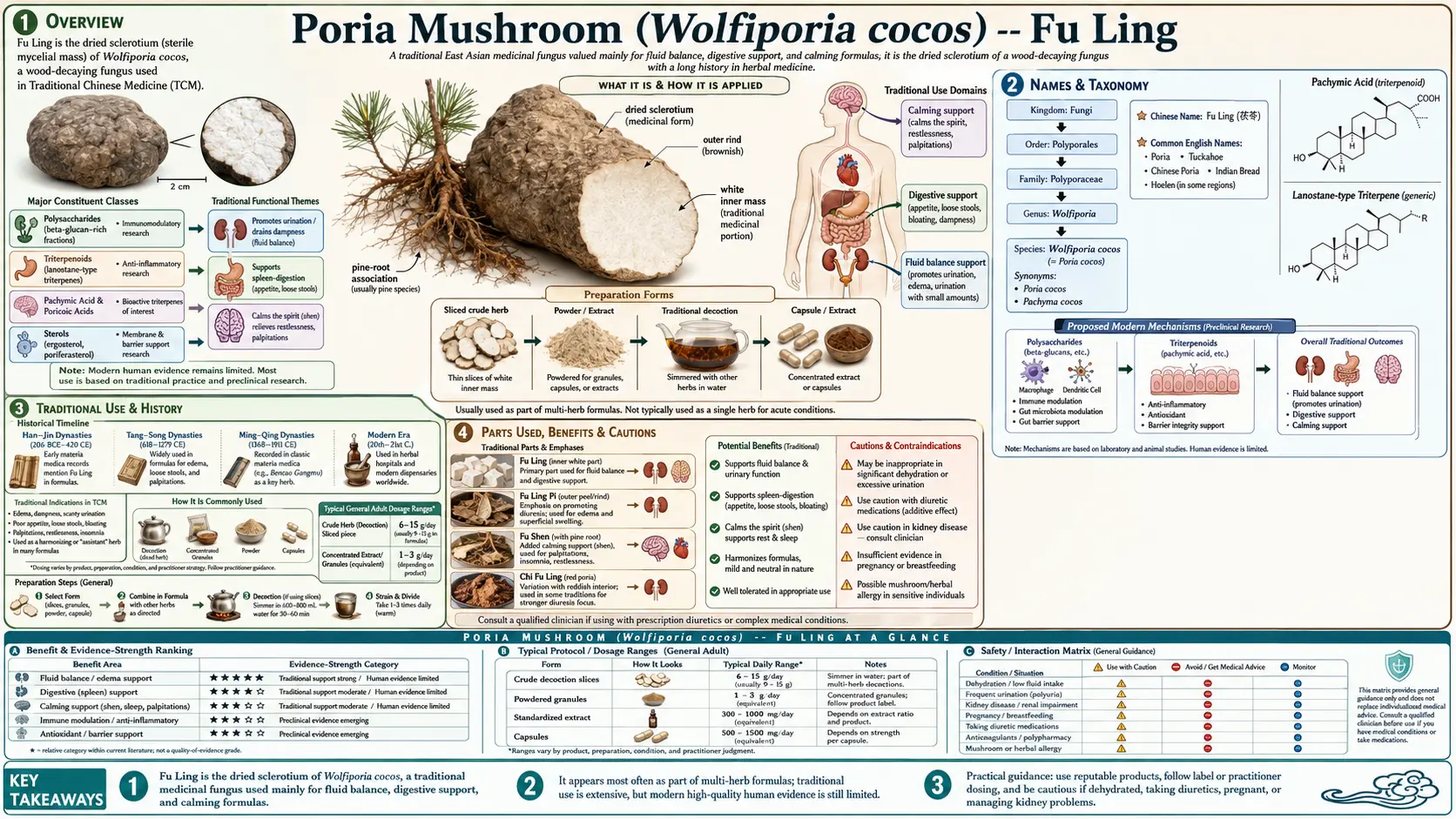
Poria (Wolfiporia cocos), known in Chinese medicine as Fu Ling, is one of the most widely used fungi in the East-Asian herbal tradition. Unlike the familiar capped mushrooms, the part used is a hidden, potato-like underground mass called a sclerotium that grows on the roots of pine trees. For more than two thousand years it has been valued as a gentle, "harmonizing" medicine -- prized for calming the mind, supporting digestion, and helping the body shed excess fluid. Modern laboratory science has begun to map the chemistry behind these uses, but it is important to be honest from the outset: the great majority of contemporary evidence for Poria comes from cell and animal studies, not from large human trials. This page summarizes both the long traditional record and what the early science actually shows.
Table of Contents
- Overview
- Names & Taxonomy
- Traditional Use & History
- Parts Used
- Active Compounds
- Diuretic & Fluid Balance
- Calming, Sleep & Anxiety
- Digestive & Spleen Support
- Kidney & Renal Effects
- Anti-inflammatory, Immune & Antioxidant
- Metabolic & Blood Sugar
- Forms & Dosage
- Safety & Cautions
- Research Papers
- Connections
- Featured Videos
Overview
Poria is a wood-decay fungus that forms a dense, starchy sclerotium -- essentially a survival storehouse the fungus builds underground while its thread-like body (mycelium) digests pine roots and stumps. Harvesters traditionally locate the buried mass by probing the soil around dead or dying pines. Once dug up, the sclerotium is cleaned, sliced, and dried for use. It has very little taste of its own, which is part of why traditional physicians considered it "neutral" and suitable for long-term use and for combining with stronger herbs.
In the framework of Traditional Chinese Medicine (TCM), Poria is classified as a herb that "drains dampness and promotes urination," "strengthens the spleen," and "quiets the spirit (Shen)." Translated loosely into everyday terms, it was used for fluid retention and puffiness, for sluggish digestion with bloating or loose stools, and for restlessness, palpitations, and trouble sleeping. Because it is mild and well tolerated, it appears in an enormous number of classical formulas rather than being used alone.
Scientifically, Poria's profile is dominated by two compound families: large sugar molecules called polysaccharides (chiefly a beta-glucan named pachyman) and a set of fat-soluble triterpenes (such as pachymic acid and the poricoic acids). Researchers attribute the fluid-related and metabolic effects largely to the triterpenes and the immune and gut effects largely to the polysaccharides -- though, again, most of this remains preclinical.
Names & Taxonomy
The currently accepted scientific name is Wolfiporia cocos (F.A. Wolf) Ryvarden & Gilb. Older literature -- and many supplement labels -- still use the synonym Poria cocos (Schw.) Wolf, and you may also encounter Poria cocos or Pachyma hoelen. It belongs to the polypore fungi (order Polyporales), a group of bracket and shelf fungi, even though the medicinal part is the underground sclerotium rather than a shelf-shaped cap.
Common names reflect its wide geographic reach:
- Fu Ling (茯苓) -- the standard Chinese name; the single most important name to recognize on formulas and labels.
- Hoelen -- a name carried over into Japanese Kampo medicine and older Western pharmacy texts.
- Tuckahoe and "Indian bread" -- North American names. Related Wolfiporia sclerotia were dug and eaten by some Native American peoples as a starchy famine food.
Traditional Use & History
Poria is a cornerstone of East-Asian materia medica. It is listed in the Shennong Bencao Jing (the foundational Chinese herbal compiled roughly two thousand years ago), where it was placed among the superior, long-life tonics. From there it spread into the Japanese Kampo tradition and into Korean medicine. It is worth stating plainly that Poria is an East-Asian medicine: it is not part of the Ayurvedic tradition of India, and you should be skeptical of marketing that blurs those distinct systems.
In TCM, Poria is one of the most-prescribed single herbs, valued because it does its work gently and combines well. It appears in many famous classical formulas, including:
- Si Jun Zi Tang ("Four Gentlemen Decoction") -- a foundational spleen-and-digestion tonic where Poria supports the stomach and helps drain dampness.
- Gui Zhi Fu Ling Wan ("Cinnamon and Poria Pill") -- a classic formula for circulation and fixed lower-abdominal masses.
- Wu Ling San and Zhu Ling Tang -- fluid-regulating formulas where Poria is a primary diuretic herb.
The traditional concept of "draining dampness" maps reasonably well onto the modern observations of mild diuresis and reduced fluid retention, while the "quieting the Shen" use lines up with the sedative and mood-related effects seen in animal studies. These are encouraging parallels -- not proof -- and they explain why Poria has remained in continuous clinical use for so long.
Parts Used
Traditional practice distinguishes several portions of the dried sclerotium, each with its own emphasis:
- Bai Fu Ling ("white Poria") -- the pale inner flesh, the most commonly used part, emphasized for strengthening the spleen and draining dampness.
- Chi Fu Ling ("red Poria") -- the reddish layer just beneath the outer skin, traditionally directed more toward "clearing heat" and promoting urination.
- Fu Shen -- a piece of the sclerotium that has grown around an embedded pine root; this central root-bearing portion is the part most associated with calming the mind and easing palpitations and insomnia.
- Fu Ling Pi -- the dark outer "skin," used specifically for edema and swelling.
This careful subdivision is a feature of the traditional pharmacy. Modern chemical work confirms that different parts of the sclerotium do differ measurably in their compound profiles, which gives a partial rationale for the old distinctions.
Active Compounds
Poria's bioactivity is generally attributed to two main groups of molecules:
- Polysaccharides. The dominant carbohydrate is pachyman, a largely insoluble (1→3)-beta-glucan. In its raw form pachyman is poorly soluble and weakly active, so researchers often chemically modify it -- for example into carboxymethyl-pachyman (CMP) or other derivatized polysaccharides -- to improve solubility and unlock immune-modulating, anti-inflammatory, and antioxidant activity in the lab.
- Triterpenes. This fat-soluble fraction includes pachymic acid, dehydrotumulosic acid, dehydropachymic acid, and the poricoic acids (poricoic acid A and related compounds). These are the molecules most strongly linked in research to the fluid-regulating, kidney-protective, anti-inflammatory, and metabolic effects.
- Ergosterol and other sterols -- the fungal equivalent of cholesterol, also a precursor the fungus uses to make vitamin D-like compounds.
A practical implication: because the active triterpenes are fat-soluble and concentrated in particular layers of the sclerotium, the form and preparation of a Poria product can meaningfully affect what compounds you actually receive.
Diuretic & Fluid Balance
The single most consistent traditional use of Poria is to help the body release excess water -- the classical "drains dampness, promotes urination" action. This is also the use with the clearest mechanistic story in modern research, although the studies remain largely preclinical.
In rat studies, a Poria sclerotium preparation produced a diuretic effect that was linked to suppression of renal aquaporin-2, a water channel the kidney uses to reabsorb water back into the body. Down-regulating that channel means more water stays in the urine and is excreted. Complementary cell work found that Poria influenced water-channel (aquaporin) expression in kidney collecting-duct cells under salt and water stress. Together these findings offer a credible biological explanation for why the herb has long been used for puffiness, fluid retention, and as a "water-moving" component of formulas such as Wu Ling San.
What this does not establish is that Poria is an effective or appropriate treatment for diagnosed conditions like heart failure or kidney disease in people. Those conditions require medical management; Poria's diuretic activity is better understood as the validated kernel behind a traditional use than as a substitute for proven therapy.
Calming, Sleep & Anxiety
Poria -- and especially the Fu Shen root-bearing portion -- has been used for centuries to "quiet the spirit": to ease restlessness, palpitations, anxiety, and difficulty sleeping. Modern preclinical work offers partial support. In animal models, Poria-containing preparations have shown sedative and anxiety-reducing behavior, and researchers have pointed to effects on the brain's GABA signaling (the main calming neurotransmitter system, and the same system targeted by many conventional sleep and anti-anxiety drugs).
One published study combined Poria with the fungus Cordyceps and reported antidepressant-like effects in mice, linked to changes in the p38 MAPK stress-signaling pathway. These results are biologically interesting and align with the traditional "Shen-calming" reputation, but they are animal findings. There is no robust body of human trial evidence showing that Poria reliably treats clinical anxiety, depression, or insomnia. It is fair to describe Poria as a traditionally calming herb with early supportive science -- not as a proven sleep aid.
Digestive & Spleen Support
In TCM, "strengthening the spleen" refers broadly to supporting digestion, appetite, and the body's handling of food and fluids -- a picture that, in everyday terms, includes bloating, poor appetite, and loose stools. Poria is a central herb for this purpose, which is why it anchors digestive tonics like Si Jun Zi Tang.
Modern research increasingly frames part of this benefit through the gut microbiome. The beta-glucan polysaccharides in Poria are not fully digested by human enzymes; instead they can reach the colon and act as food for gut bacteria. Laboratory and animal studies report that Poria polysaccharides can shift the balance of the gut microbiota and increase beneficial short-chain fatty acids -- the compounds gut bacteria make from fiber that nourish the intestinal lining. This "prebiotic-like" behavior provides a plausible modern bridge to the herb's long digestive reputation, while remaining preclinical at this stage.
Kidney & Renal Effects
Beyond simple diuresis, the Poria triterpenes -- particularly the poricoic acids -- have attracted research attention for protecting the kidney in laboratory models of disease. In animal and cell studies, poricoic acid A has been reported to reduce renal fibrosis (the scarring process that progressively damages kidneys) in settings such as high-salt diets and high-glucose stress, and to protect kidney filtering cells (podocytes). Proposed mechanisms include calming endoplasmic-reticulum stress, supporting healthy mitochondrial recycling (mitophagy), and modulating the gut microbiota and short-chain fatty acid metabolism.
Review articles focused on Poria's triterpenoids consistently highlight this renoprotective theme as one of the most promising directions for the herb. The honest caveat is unchanged: these are preclinical, mechanism-level findings. They make Poria's triterpenes an interesting subject for future kidney research; they do not demonstrate that taking Poria prevents or reverses kidney disease in humans, and people with kidney disease should make any decisions with their care team.
Anti-inflammatory, Immune & Antioxidant
The polysaccharide side of Poria's chemistry is where the immune and antioxidant research clusters. Like the beta-glucans in many other medicinal mushrooms, pachyman and its chemically modified forms (such as carboxymethyl-pachyman) can engage immune-cell receptors and adjust immune signaling in laboratory systems.
Published studies report that carboxymethylated Poria polysaccharides can modulate immune activity, reduce inflammatory signaling, inhibit the growth of certain tumor cells in culture, and scavenge free radicals (antioxidant activity) -- a combination of effects driven by the molecule's structure and degree of chemical modification. Some research also explores Poria polysaccharides as immune adjuvants, ingredients added to enhance the body's response. Antioxidant activity has likewise been documented in test-tube assays.
These are encouraging laboratory signals consistent with the broader medicinal-mushroom literature. As elsewhere on this page, the appropriate framing is potential rather than proof: cell-based "anti-tumor" and "immune-boosting" results do not translate automatically into treatments, and Poria should not be presented as a cancer or immune therapy.
Metabolic & Blood Sugar
A smaller but growing line of preclinical research examines Poria's triterpenes for metabolic effects. Pachymic acid has been studied in animal models of non-alcoholic fatty liver disease (NAFLD), where it was reported to reduce fat accumulation in the liver, with effects linked to FGF21 signaling and inhibition of the p38 MAPK pathway. Other laboratory work has looked at effects on glucose handling and insulin signaling.
These findings fit a recurring pattern in mushroom and triterpene research -- promising signals in liver and glucose metabolism at the cellular and animal level. They are early-stage, and there is not yet solid human evidence that Poria improves blood sugar, body weight, or liver fat in people. It is best regarded as a candidate for further metabolic study rather than a metabolic remedy.
Forms & Dosage
Poria is most authentically used as part of a multi-herb formula chosen by a trained practitioner, but it is also sold on its own in several forms:
- Dried sliced sclerotium for decoction (simmering in water as a tea). In TCM practice, single-herb daily amounts of roughly 9–15 grams of the dried herb are typical within a formula, simmered and the liquid consumed -- though the right amount depends entirely on the formula and the individual.
- Powder -- the dried sclerotium ground fine; it is nearly tasteless and is sometimes stirred into food, porridge, or congee in the traditional "medicinal food" style.
- Capsules, tablets, and extracts -- modern supplement formats, sometimes standardized to polysaccharide or triterpene content.
Because the active triterpenes are fat-soluble while the beta-glucans are water-soluble, no single preparation captures everything in the sclerotium. There is no established, evidence-based "standard dose" of Poria for any specific health outcome in Western terms; traditional dosing reflects formula context rather than clinical-trial data. Choose reputable products, and if you are using Poria for a defined health concern, do so under qualified guidance.
Safety & Cautions
Poria has an excellent traditional safety reputation. It is regarded as a mild, food-grade herb that is well tolerated even with prolonged use, and it has been consumed for centuries without notable toxicity in normal culinary and medicinal amounts. That said, a few sensible cautions apply:
- Diuretic and additive effects. Because Poria has mild diuretic activity, there is a theoretical concern about combining it with prescription diuretics ("water pills") or in people prone to dehydration or electrolyte imbalance.
- Medication interactions. As a component of complex formulas with effects on the kidney, fluids, and possibly glucose, Poria could in principle interact with diuretics, blood-pressure or blood-sugar medications. If you take prescription drugs, discuss it with a pharmacist or physician.
- Pregnancy and breastfeeding. Some classical texts caution against using fluid-draining herbs during pregnancy. Robust safety data are lacking, so pregnant and breastfeeding individuals should avoid medicinal doses unless advised by a qualified practitioner.
- Allergy and quality. Allergic reactions to fungi are possible, and as with any supplement, product quality and correct species identification matter. Buy from reputable sources.
Educational disclaimer: This page is for general information only and is not medical advice. The bulk of the modern evidence for Poria comes from cell and animal studies, not large human trials, so its traditional uses should not be read as proven medical treatments. Nothing here is intended to diagnose, treat, cure, or prevent any disease. Talk with a qualified healthcare professional before using Poria, especially if you are pregnant or breastfeeding, have kidney, heart, or liver conditions, or take prescription medications.
Research Papers
Selected peer-reviewed literature. Links resolve to PubMed or DOI.
- Lei J, Gong D, Duan L, et al. A multidimensional perspective on Poria cocos, an ancient fungal traditional Chinese medicine. Journal of Ethnopharmacology. 2025;348:119869.
- Guo ZY, Wu X, Zhang SJ, et al. Poria cocos: traditional uses, triterpenoid components and their renoprotective pharmacology. Acta Pharmacologica Sinica. 2025;46(4):836-851.
- Xiong Q, Li Z, Yang D, et al. Progress in the study of bioactivity, chemical composition and pharmacological mechanism of Wolfiporia cocos. Frontiers in Pharmacology. 2025;16:1521235.
- Wu ZL, Ren H, Lai WY, et al. Sclederma of Poria cocos exerts its diuretic effect via suppression of renal aquaporin-2 expression in rats with chronic heart failure. Journal of Ethnopharmacology. 2014;155(1):563-571.
- Lee SM, Lee YJ, Yoon JJ, et al. Effect of Poria cocos on hypertonic stress-induced water channel expression and apoptosis in renal collecting duct cells. Journal of Ethnopharmacology. 2012;141(1):368-376.
- Liu H, Yang J, Tang Y, et al. Carboxymethyl polysaccharides from Poria cocos: structure, immunomodulatory, anti-inflammatory, tumor cell proliferation inhibition and antioxidant activity. International Journal of Biological Macromolecules. 2025;299:140104.
- Wang X, Xu Y, Wang Y, et al. Poricoic acid A protects against high-salt-diet induced renal fibrosis by modulating gut microbiota and SCFA metabolism. Plant Foods for Human Nutrition. 2025;80(2):115.
- Lai Y, Lan X, Chen Z, et al. The role of Wolfiporia cocos polysaccharides in regulating the gut microbiota and its health benefits. Molecules. 2025;30(6):1373.
- Huang YJ, Wu HY, Chang WT, et al. A formulation of combined Poria cocos and Cordyceps militaris rice ameliorates depressive-like effects by downregulating p38 MAPK signaling pathways. Journal of Traditional and Complementary Medicine. 2025;15(4):414-422.
- Nie L, Ma D, Deng X, et al. Pachymic acid alleviates non-alcoholic fatty liver disease via FGF21-mediated inhibition of the p38 MAPK pathway. Food Science & Nutrition. 2026;14(5):e71855.
Connections
- Medicinal Mushrooms (overview)
- Reishi Mushroom
- Lion's Mane Mushroom
- Chaga Mushroom
- Turkey Tail Mushroom
- Ergothioneine
- Herbs
- Remedies
- Vitamins
- Minerals
- Food
- Codonopsis (Dang Shen) — the gentle, non-stimulant qi tonic used in place of ginseng
- Atractylodes (Bai Zhu) — the spleen-qi and digestion tonic paired with it in the classical Four Gentlemen formula
- White Peony Root (Bai Shao) — source of Total Glucosides of Paeony, an approved rheumatoid-arthritis drug in China
- Chen Pi (Aged Tangerine Peel) — Poria's partner in Er Chen Tang, the archetypal phlegm formula; the “two aged herbs” of the name are chen pi and aged pinellia, with poria and licorice joining them.