Poria for Immune Support
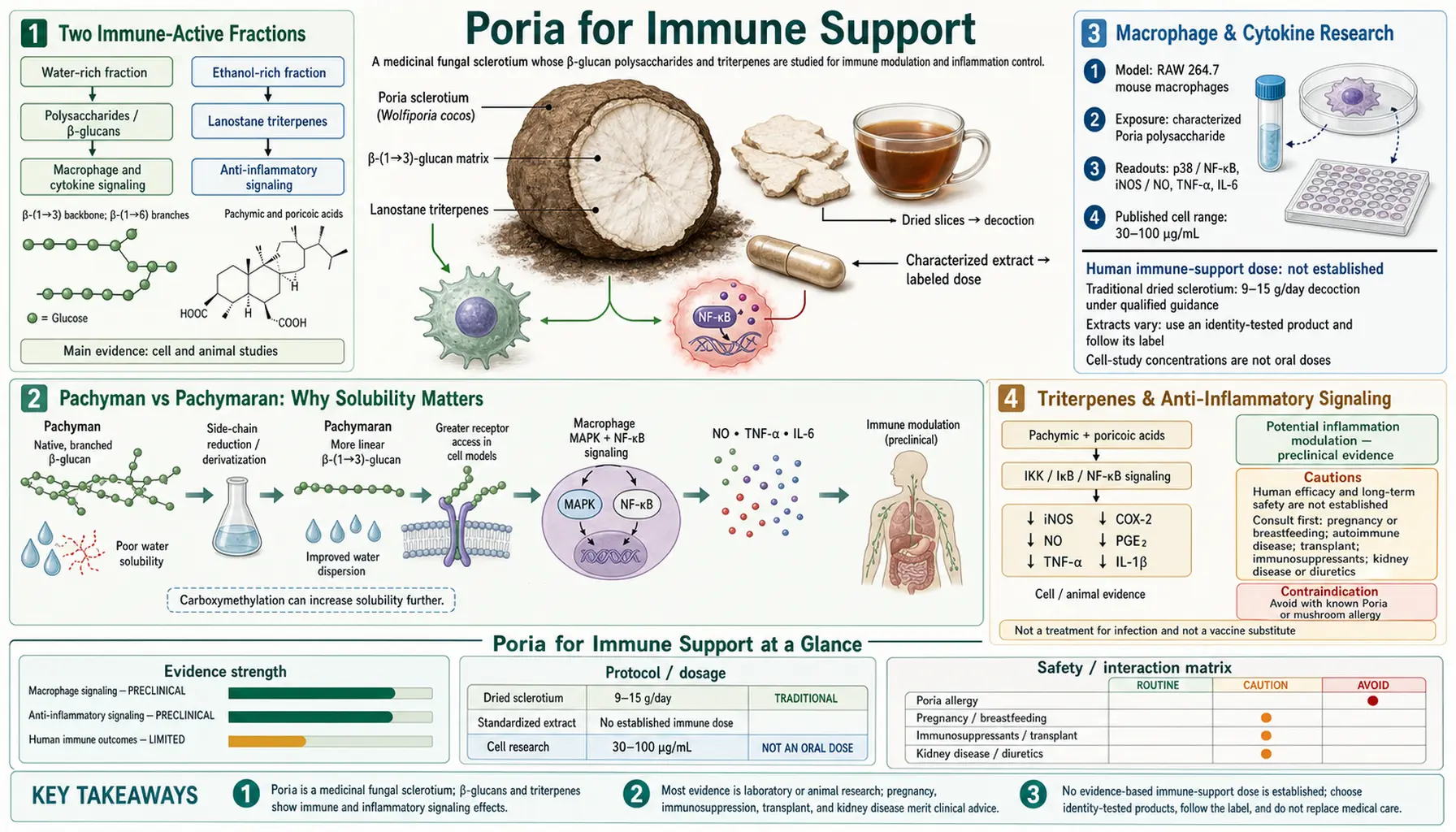
Like many medicinal fungi, Poria (Wolfiporia extensa, "Fu Ling") contains two families of biologically active molecules that draw immunological interest: beta-glucan polysaccharides — the water-insoluble pachyman and its water-soluble derivative pachymaran — and lanostane triterpenes such as pachymic acid and the poricoic acids. In laboratory studies these compounds activate immune cells, shift cytokine signaling, quench free radicals, and dampen inflammatory pathways. That is a legitimately interesting profile. But the honest headline is the same as on Poria's other pages: the immune research is overwhelmingly preclinical (test tubes and animals), the antitumor work is early-stage and not a basis for treating any cancer, and there is little human clinical evidence that eating Poria measurably strengthens immunity. This page reviews the immune chemistry carefully and places Poria in realistic context among the better-studied immune mushrooms.
Table of Contents
- Two Immune-Active Fractions
- Pachyman vs Pachymaran: Why Solubility Matters
- Macrophage & Cytokine Research
- Triterpenes & Anti-Inflammatory Signaling
- Antioxidant Activity
- Antitumor & Immune-Adjuvant Research
- Where Poria Fits Among Immune Mushrooms
- Forms, Extract Types & Cautions
- Key Research Papers
- Connections
- Featured Videos
Two Immune-Active Fractions
Poria's immunological interest comes from two chemically distinct groups of molecules, each studied for different effects:
- Polysaccharides (the bulk of the sclerotium). Poria is roughly 80–90% polysaccharide by dry weight, dominated by pachyman, a beta-1,3-glucan. Beta-glucans are the classic "immune-active" mushroom molecules: the immune system has receptors (such as Dectin-1) that recognize fungal beta-glucans as a signal of possible infection, which can trigger immune-cell activation. Pachyman itself is water-insoluble, which limits its activity — a key point covered in the next section.
- Lanostane triterpenes (a smaller but potent fraction). Molecules like pachymic acid, dehydropachymic acid, and the poricoic acids are studied less for stimulating immunity and more for calming inflammation — interacting with inflammatory signaling pathways such as NF-κB. So Poria's two fractions pull in complementary directions: polysaccharides toward immune activation, triterpenes toward anti-inflammatory regulation.
This dual chemistry is part of why Poria is described in tradition as "harmonizing" rather than aggressively stimulating — though it is important not to over-read a tidy modern story into an old traditional label.
Pachyman vs Pachymaran: Why Solubility Matters
One of the most important technical facts about Poria's immune chemistry is that its native beta-glucan, pachyman, is water-insoluble — and water-insoluble beta-glucans tend to show weak biological activity because the body cannot readily disperse or absorb them. This is a recurring theme across all mushroom beta-glucans: solubility and molecular structure strongly influence whether a glucan does anything measurable.
Researchers addressed this by chemically modifying pachyman — through debranching, carboxymethylation, or sulfation — to create pachymaran and other water-soluble derivatives. These modified glucans are much more water-soluble and, in laboratory studies, considerably more immunologically active than raw pachyman. Much of the reported immune and antitumor activity of "Poria polysaccharide" actually refers to these chemically modified derivatives, not to the pachyman you would get from simply eating the mushroom.
This distinction matters enormously for interpreting claims. A study showing that carboxymethyl-pachymaran activates immune cells does not mean a Poria decoction or capsule delivers the same effect — the active material was engineered in a lab. It is a common and misleading leap to cite modified-glucan research as evidence for whole-Poria supplements. Honest reading requires checking which form was actually tested.
Macrophage & Cytokine Research
The core of the immune-activation research examines how Poria polysaccharides (mostly the water-soluble derivatives) affect macrophages — the front-line immune cells that engulf pathogens and coordinate immune responses. In cell-culture and rodent studies, these polysaccharides have been reported to:
- Activate macrophages, increasing their phagocytic (pathogen-engulfing) activity.
- Stimulate the release of signaling cytokines such as TNF-α, interleukins, and nitric oxide.
- Influence natural killer (NK) cell and T-cell activity in some models.
- Restore immune parameters in animals whose immune systems were experimentally suppressed.
Two honest cautions apply. First, this is nearly all in vitro and in rodents; immune-cell activation in a dish does not reliably predict a clinically useful effect in a healthy person. Second, "more immune activation" is not automatically good — the immune system is a balance, and indiscriminate stimulation is undesirable in people with autoimmune conditions or those on immune-modulating drugs. The goal of a healthy immune system is appropriate regulation, not maximal activation.
Triterpenes & Anti-Inflammatory Signaling
Poria's triterpene fraction has been studied mostly for the opposite effect: calming excessive inflammation. Pachymic acid, the best-studied Poria triterpene, has shown anti-inflammatory activity in cell and animal models, with a proposed mechanism involving inhibition of the NF-κB pathway — a master switch that turns on many inflammatory genes. Related triterpenes (dehydropachymic acid, poricoic acids, polyporenic acid C) have shown similar anti-inflammatory signals in preclinical work.
Anti-inflammatory chemistry is genuinely relevant to health, since chronic low-grade inflammation underlies many conditions. But the same rules apply: these are preclinical findings, often using isolated compounds at high concentrations, and they do not demonstrate that consuming Poria reduces inflammation in humans or treats any inflammatory disease. For an anti-inflammatory botanical with more extensive human study, see our page on Turmeric.
Antioxidant Activity
Poria polysaccharides and extracts show antioxidant (free-radical-scavenging) activity in standard laboratory assays — they can neutralize reactive molecules in a test tube and reduce oxidative-stress markers in some animal models. This is a nearly universal finding for plant and fungal extracts and is often cited as a general "health" benefit.
It is worth being sober about what antioxidant assay results mean. A compound that scavenges radicals in a cuvette may behave completely differently inside the human body, where absorption, metabolism, and the body's own sophisticated antioxidant systems dominate. Test-tube antioxidant activity is a reason for interest, not evidence of a clinical benefit. The claim "Poria is a powerful antioxidant" is technically true in a lab assay and largely unproven as a human health effect.
Antitumor & Immune-Adjuvant Research
Because modified fungal beta-glucans (like lentinan from shiitake and PSK from turkey tail) have a history as immune-adjuvants in cancer care in some countries, Poria's modified polysaccharides and its triterpenes have also been studied for antitumor activity. In preclinical models, Poria-derived compounds have shown effects such as inhibiting the growth of cancer cell lines, inducing apoptosis (programmed cell death) in tumor cells, and enhancing immune responses against tumors in mice.
This research must be framed with the utmost care, because cancer is exactly the area where preliminary lab findings are most dangerously over-interpreted:
- These are cell-line and animal studies. Effects on cultured cancer cells or in mice routinely fail to translate to humans.
- Poria is not a cancer treatment. There is no adequate human clinical trial evidence that Poria treats, cures, or prevents any cancer.
- Herbal products can interfere with cancer therapy. Some supplements interact with chemotherapy, radiation, or immunotherapy. Anyone in cancer care must discuss any supplement with their oncology team before use.
The reasonable statement is: Poria contains compounds that show antitumor and immune-adjuvant activity in the laboratory, which is why it is studied — and that is entirely different from a demonstrated benefit in people. Turkey tail (see Turkey Tail) has considerably more clinical adjuvant research than Poria does.
Where Poria Fits Among Immune Mushrooms
Placed honestly next to the better-known immune fungi, Poria is a lesser-studied member of the group for immune purposes specifically:
- Reishi and Turkey Tail — the most studied immune mushrooms, with some human clinical and adjuvant data.
- Shiitake (source of lentinan) and Maitake — well-known beta-glucan sources with more immune research than Poria.
- Chaga, Cordyceps, and Agaricus blazei — other immune-marketed mushrooms, mostly on preclinical footing.
Poria's traditional identity was never primarily "immune mushroom" — it was the fluid-draining, Spleen-strengthening, spirit-calming herb. The immune framing is largely a modern reinterpretation of its beta-glucan and triterpene chemistry. That chemistry is real and worth researching, but if immune support is your specific goal, the mushrooms above have more evidence behind them. See also Immune Boosting for a broader overview.
Forms, Extract Types & Cautions
Form matters more here than anywhere. As explained above, raw pachyman is water-insoluble and weakly active, while the immunologically interesting activity comes from chemically modified, water-soluble derivatives made in a lab. A plain Poria decoction, powder, or basic capsule is not the same as the modified polysaccharides used in most immune research. Be skeptical of products that cite modified-glucan studies to sell whole-Poria supplements.
Forms available: dried sclicerotium for decoction, powder, water or ethanol extracts, and standardized extract capsules. Traditional decoction amounts are roughly 9–15 grams, but no dose is tied to a proven immune outcome.
Cautions:
- Autoimmune conditions & immunosuppressants. Because some Poria compounds can activate immune cells in the lab, people with autoimmune disease or those taking immune-suppressing medication (after transplant, or for autoimmune conditions) should be cautious and consult their clinician — immune stimulation could be counterproductive.
- Cancer care. Do not use Poria (or any supplement) during cancer treatment without your oncology team's approval; interactions with therapy are possible.
- Poria is mildly diuretic — the cautions from our Fluid Balance page also apply here.
- Pregnancy and breastfeeding: insufficient safety data; avoid unless directed by a qualified practitioner.
- Quality and contaminant testing vary for an underground-grown fungus; choose reputable, tested sources.
- Supplements do not replace the basics of immune health — sleep, nutrition, exercise, and vaccination do far more than any mushroom.
Key Research Papers
- Lu MK et al. Sulfated modification of Poria cocos polysaccharide and its antitumor / immunomodulatory activity. — PubMed
- Pachyman and pachymaran: water-insoluble vs water-soluble beta-glucan and bioactivity. — PubMed
- Poria cocos polysaccharides and macrophage activation / cytokine production. — PubMed
- Pachymic acid inhibits NF-κB and inflammatory signaling. — PubMed
- Antioxidant activity of Poria cocos polysaccharides. — PubMed
- Poria cocos triterpenes: apoptosis and antitumor activity in cancer cell lines (preclinical). — PubMed
- Ríos JL (2011). Chemical constituents and pharmacological properties of Poria cocos. Planta Medica. — PubMed
- Esteban CI (2009). Medicinal interest of Poria cocos (= Wolfiporia extensa). Rev Iberoam Micol. — PubMed
PubMed Topic Searches
- PubMed: Poria cocos immunomodulation
- PubMed: Pachyman beta-glucan immune
- PubMed: Pachymic acid anti-inflammatory
- PubMed: Poria cocos antitumor
External Authoritative Resources
- PubMed — Poria cocos immune & polysaccharide research
- NCCIH — Mushrooms and Health (evidence overview)
- NCI — Complementary & Alternative Medicine in Cancer Care
Connections
- Poria Mushroom (Main Hub)
- Poria Benefits Hub
- Poria for Fluid Balance
- Poria for Digestive Health
- Poria for Calm & Sleep
- Reishi Mushroom
- Turkey Tail Mushroom
- Shiitake Mushroom
- Maitake Mushroom
- Chaga Mushroom
- Cordyceps Mushroom
- Astragalus
- Turmeric
- Immune Boosting
- All Mushrooms