Poria for Calm & Sleep
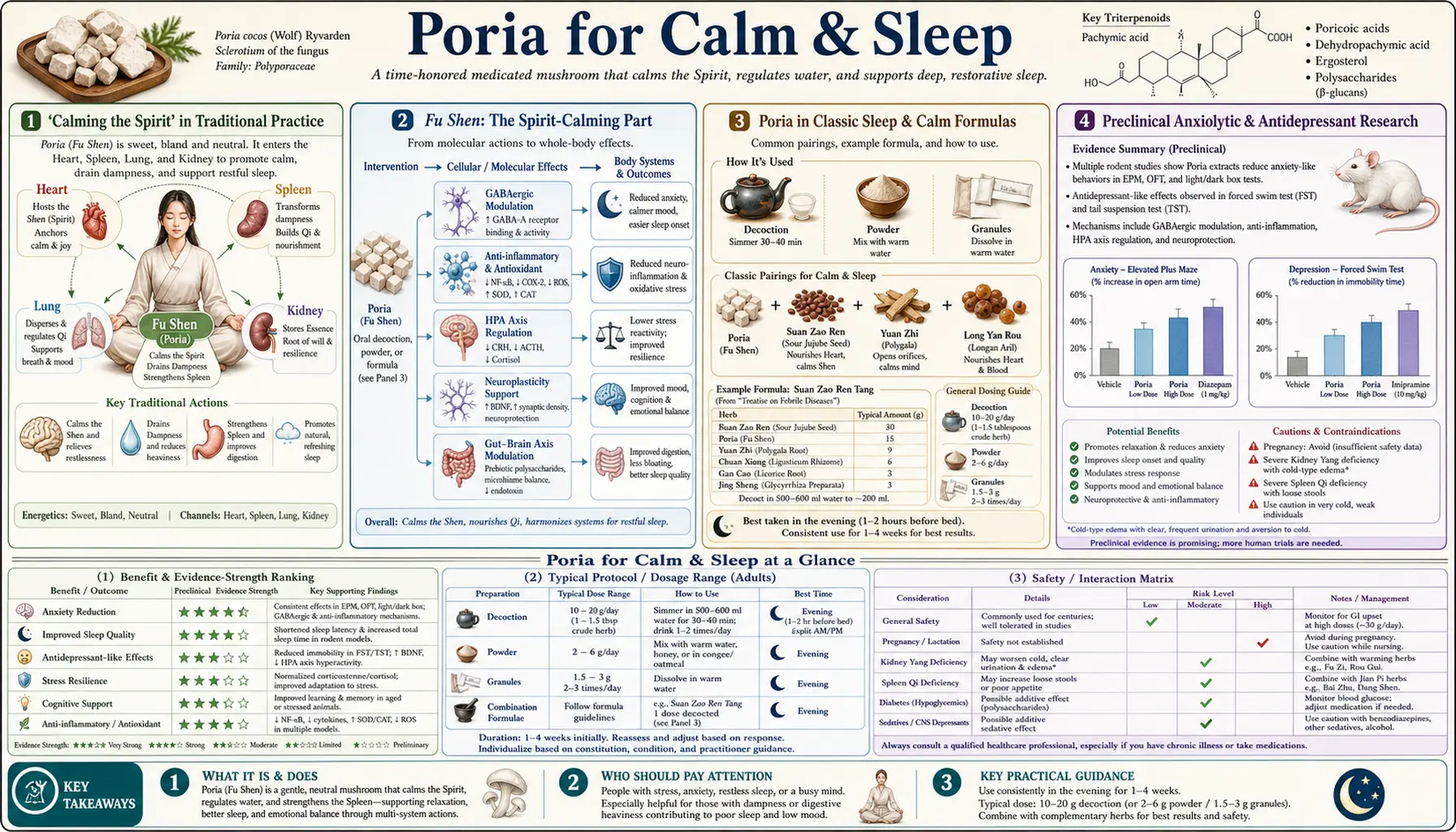
Beyond fluid and digestion, Poria (Wolfiporia extensa, "Fu Ling") has a third traditional identity: an herb that "calms the spirit." The portion of the sclerotium that grows wrapped around the pine root — called Fu Shen — was specifically reserved in Chinese medicine for restlessness, palpitations, anxiety, and disturbed sleep, and Poria anchors several of the most famous classical sleep-and-calm formulas. This is the benefit page where honesty matters most, because calming and sleep claims are where herbal marketing most often outruns the science. The traditional record is real and detailed; the modern research is almost entirely preclinical; and rigorous human trials of Poria on its own for sleep or anxiety are, as far as the published literature shows, essentially nonexistent. This page lays out what tradition claims, what the lab research suggests, and exactly where the evidence runs out.
Table of Contents
- "Calming the Spirit" in Traditional Practice
- Fu Shen: The Spirit-Calming Part
- Poria in Classic Sleep & Calm Formulas
- Preclinical Anxiolytic & Antidepressant Research
- Proposed Mechanisms — Still Speculative
- The Human Evidence Gap for Sleep
- Poria in Context Among Calming Botanicals
- Realistic Expectations, Forms & Cautions
- Key Research Papers
- Connections
- Featured Videos
"Calming the Spirit" in Traditional Practice
In Traditional Chinese Medicine, one of Poria's three classical functions is to "quiet the heart and calm the spirit" (ning xin an shen). The TCM "Heart" (Xin), like the "Spleen," is a functional concept — it governs not only circulation but also the mind, consciousness, and emotional steadiness (the "spirit," or shen). A "disturbed spirit" describes a familiar cluster: restlessness, anxiety, a racing or pounding heartbeat (palpitations), poor concentration, and difficulty falling or staying asleep.
Poria was reached for when this restlessness was thought to arise alongside "dampness" or a weak digestive-transformative function — the idea being that fluid metabolism, digestion, and emotional calm were connected, and that steadying the body's "transformation" also steadied the mind. Whether or not one accepts the underlying theory, the practical pattern is clear: Poria has a long history of use for mild anxiety, nervous restlessness, and sleep that is light or easily disturbed — typically as a gentle, supporting calming herb rather than a strong sedative.
Fu Shen: The Spirit-Calming Part
Poria offers a nice illustration of how specific traditional herbalism could be. The sclerotium was divided into parts with different indications (covered on our Fluid Balance page), and one part in particular — Fu Shen, literally "Poria spirit" — was singled out for calming.
Fu Shen is the portion of the sclerotium that grows enclosing the pine root at its center. Traditional practice held that this root-embracing part had a special affinity for the "spirit" and was the preferred form for palpitations, anxiety, forgetfulness, and insomnia — while the outer skin (Fu Ling Pi) was preferred for swelling and the white flesh for digestion. From a modern chemistry standpoint there is no strong evidence that Fu Shen differs dramatically from the rest of the sclerotium in its active compounds, so this distinction is best understood as a traditional refinement rather than a proven pharmacological difference. Still, it tells you exactly which traditional role we are discussing on this page.
Poria in Classic Sleep & Calm Formulas
Poria's calming reputation is expressed almost entirely through multi-herb formulas — it is a supporting member of some of the most enduring sleep-and-anxiety prescriptions in Chinese medicine:
- Suan Zao Ren Tang ("Sour Jujube Decoction") — the classic formula for insomnia and irritability from "deficiency," built around sour jujube seed with Poria (often Fu Shen), anemarrhena, ligusticum, and licorice.
- Gui Pi Tang ("Restore the Spleen Decoction") — a widely used formula for anxiety, palpitations, poor sleep, and fatigue linked to "Heart and Spleen deficiency," which includes Poria/Fu Shen among a dozen herbs.
- An Shen ("calm the spirit") formulas broadly — Poria is a frequent ingredient across this whole category.
The essential caveat, repeated here because it matters most for sleep claims: these formulas contain many active herbs, and the sour jujube seed (Suan Zao Ren) in particular is itself a well-known traditional sedative. When a study or a practitioner reports that "a Poria formula improved sleep," the calming effect cannot be attributed to Poria — it may be driven largely by the other ingredients. There is no clean way, from formula studies, to say what Poria contributes on its own.
Preclinical Anxiolytic & Antidepressant Research
The modern research on Poria and mood/sleep is almost entirely in animals. In rodent behavioral models — the kinds of tests used to screen for sedative, anti-anxiety, and antidepressant activity — some studies have reported that Poria extracts or isolated Poria triterpenes produce anxiolytic-like or antidepressant-like effects. Poria also appears in preclinical studies of traditional "calming" formulas (such as Kai Xin San) where it is one of several components.
These results are worth noting because they are consistent with the traditional use — but they must be read with real caution:
- Animal behavioral models are screening tools, not proof of a human effect; many compounds that look promising in a mouse fail in people.
- The doses are often high and the extracts non-standardized, so they do not translate to a human serving size.
- Positive results in the "calming" direction are exactly what publication patterns tend to favor, so the literature may overstate consistency.
In short: the preclinical signal is real and points the same way as tradition, but it is a long way from demonstrating that Poria helps a person sleep or feel less anxious.
Proposed Mechanisms — Still Speculative
Where researchers have proposed how Poria might calm the nervous system, the leading ideas involve the brain's main inhibitory and mood-regulating chemistry:
- GABAergic activity — GABA is the brain's primary "braking" neurotransmitter, and most sedatives (including benzodiazepines and many calming herbs) work by enhancing it. Some preclinical work has suggested Poria constituents may interact with GABA signaling, which would be a plausible calming mechanism. For background, see our page on GABA.
- Monoaminergic effects — a few studies propose effects on serotonin and other monoamine systems relevant to mood, consistent with the antidepressant-like behavioral findings.
- Anti-inflammatory / antioxidant effects in the brain — a more general mechanism sometimes invoked, tying the calming research to Poria's broader anti-inflammatory chemistry.
Every one of these is a hypothesis derived from preclinical data, not an established mechanism confirmed in humans. They should be read as "here is a plausible way this could work if the effect is real," not as settled pharmacology.
The Human Evidence Gap for Sleep
This deserves its own section because it is the honest heart of the matter. If you search the clinical literature for randomized, placebo-controlled trials of Poria as a single, standardized agent for insomnia, anxiety, or depression in humans, you essentially do not find them. What you find instead is:
- Human trials of multi-herb formulas (Suan Zao Ren Tang, Gui Pi Tang, and others) that happen to contain Poria — where any benefit cannot be attributed to Poria.
- Preclinical animal studies of Poria or its compounds.
- Mechanistic and chemistry papers.
That means the popular framing of Poria as a "sleep mushroom" rests on tradition and rodent data, not on human clinical proof. It does not mean Poria does nothing — it means the specific, confident sleep claims often made for it are not supported by the kind of evidence that would justify them. Persistent insomnia and anxiety are also treatable conditions in their own right; see Insomnia and Anxiety for evidence-based approaches, and talk to a clinician rather than relying on an herb alone.
Poria in Context Among Calming Botanicals
It helps to place Poria honestly next to other traditional calming plants, several of which have more direct human evidence:
- Valerian and Passionflower — Western herbs with at least some human sleep/anxiety trials, though results are mixed.
- Chamomile and Lemon Balm — gentle, food-like calming herbs with modest human data.
- L-Theanine — an amino acid from tea with human studies on relaxation without sedation.
- Ashwagandha — an adaptogen with several human trials for stress and sleep.
Compared to these, Poria's human evidence base is thinner. If your primary goal is sleep or anxiety support, the honest positioning is that Poria is a traditional, gentle option best used within its historical formula context — not a first-line, evidence-backed choice on its own.
Realistic Expectations, Forms & Cautions
Set expectations honestly. Poria is not a strong sedative and there is no human trial telling you it will reliably improve your sleep. If you try it, treat it as a mild, traditional supportive herb, ideally within a properly-prescribed formula, and do not expect a drug-like effect.
Forms. Dried sclerotium (including Fu Shen) for decoction, powder, extract capsules, and traditional calming formulas. Traditional decoction amounts are roughly 9–15 grams, but again this is a traditional figure, not a validated dose for sleep.
Cautions:
- Do not combine Poria (or Poria formulas) with sedatives, sleep medications, or alcohol without medical advice — additive sedation is a theoretical risk with any calming herb.
- Persistent insomnia or anxiety is a medical issue. Chronic poor sleep and anxiety disorders respond to specific, effective treatments; do not substitute an herb for proper care. See Insomnia (clinical).
- Poria is mildly diuretic — taking it near bedtime could, in theory, mean more nighttime urination, which would work against sleep.
- Pregnancy and breastfeeding: insufficient safety data; avoid unless directed by a qualified practitioner.
- Tell your clinician and pharmacist about any herbal products, especially if you take psychiatric or sleep medications.
Key Research Papers
- Anxiolytic-like and sedative activity of Poria cocos extract in rodent behavioral models. — PubMed
- Antidepressant-like effects of Poria cocos and its triterpenes in mice. — PubMed
- Suan Zao Ren Tang (Poria-containing formula) for insomnia: clinical and preclinical studies. — PubMed
- Gui Pi Tang for anxiety, palpitations, and disturbed sleep. — PubMed
- Proposed GABAergic mechanisms of Poria constituents. — PubMed
- Kai Xin San (Poria-containing formula) and antidepressant/cognitive research. — PubMed
- Ríos JL (2011). Chemical constituents and pharmacological properties of Poria cocos. Planta Medica. — PubMed
PubMed Topic Searches
- PubMed: Poria cocos anxiety
- PubMed: Poria cocos sleep / insomnia
- PubMed: Suan Zao Ren Tang insomnia
- PubMed: Poria cocos antidepressant
External Authoritative Resources
- PubMed — Poria cocos anxiety & sleep research
- NCCIH — Sleep Disorders and Complementary Health Approaches
- MedlinePlus — Insomnia
Connections
- Poria Mushroom (Main Hub)
- Poria Benefits Hub
- Poria for Fluid Balance
- Poria for Digestive Health
- Poria for Immune Support
- Insomnia
- Anxiety
- Insomnia (Clinical)
- Valerian
- Passionflower
- Chamomile
- Lemon Balm
- L-Theanine
- GABA
- Ashwagandha