Iodine for Breast Health
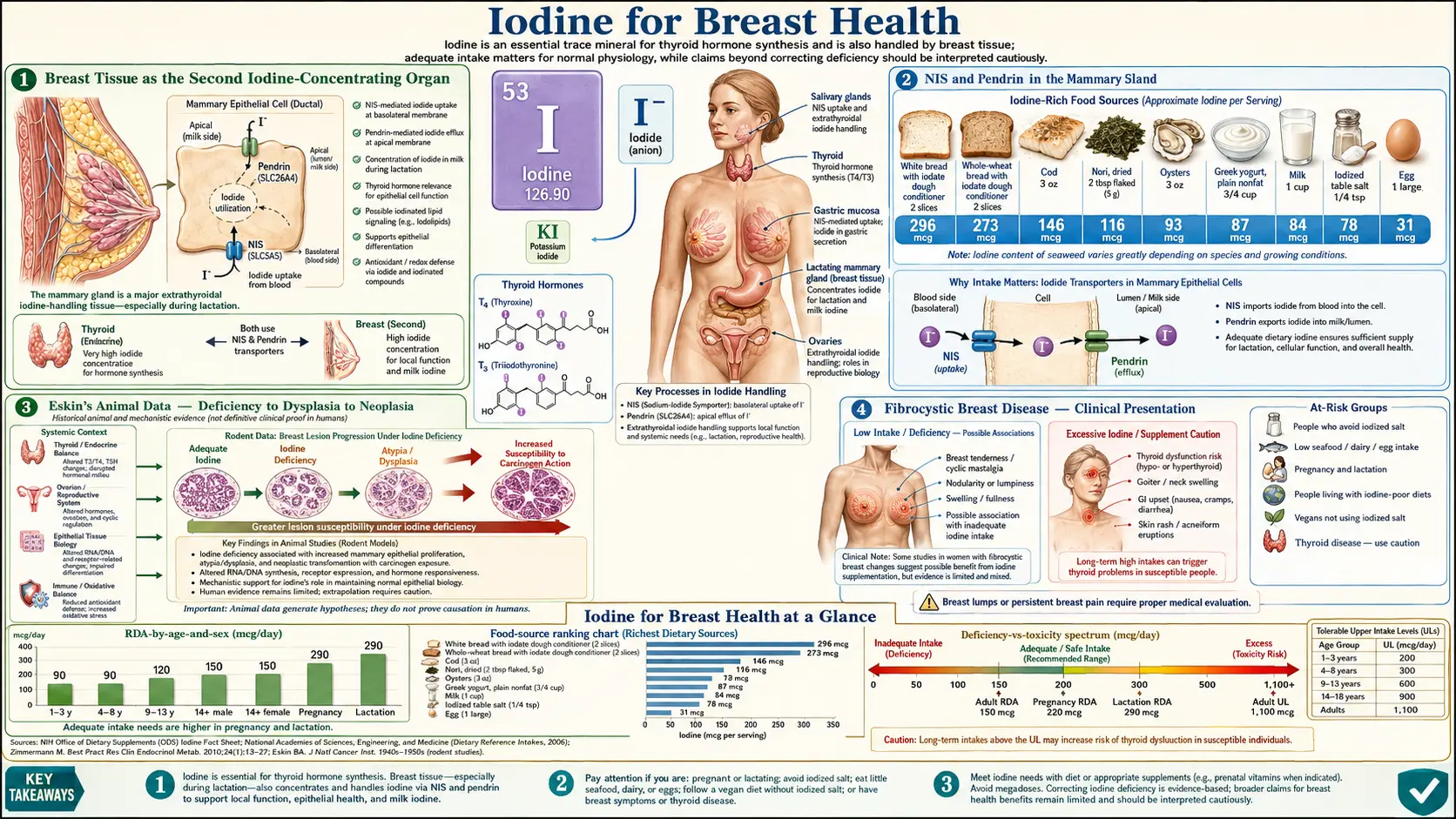
The breast is one of several tissues outside the thyroid that take up iodine. The lactating mammary gland actively transports iodide into milk through the sodium-iodide symporter (NIS) and the pendrin transporter (Tazebay 2000; Rillema and Hill 2003). A research literature, much of it from cell and animal studies, describes molecular iodine (I₂) as an antioxidant and antiproliferative agent in breast tissue, acting partly through iodine-containing lipids (iodolactones) that bind PPAR receptors (Aceves 2005; Aceves 2013). Reviewers have linked the high seaweed iodine intake in Japan, estimated at 1,000-3,000 µg/day (Zava 2011), with the low incidence of benign and cancerous breast disease there (Aceves 2005), while noting that there is as yet no direct evidence that iodine is the protective element in the Japanese diet (Smyth 2003; see breast cancer). The human trial evidence is limited to fibrocystic breast disease and cyclic breast pain (Ghent 1993; Kessler 2004) and one small randomized pilot study in breast cancer (Moreno-Vega 2019).
Table of Contents
- Breast Tissue as an Iodine-Concentrating Organ
- NIS and Pendrin in the Mammary Gland
- Eskin's Animal Data — Deficiency to Dysplasia to Neoplasia
- Fibrocystic Breast Disease — Clinical Presentation
- The Ghent 1993 Molecular Iodine Studies
- The Aceves Group — Iodolactones and Apoptosis
- The Japan Low-Breast-Cancer-Rate Hypothesis
- The Dosing Controversy — Iodide vs Molecular Iodine
- What the Research Reports for Specific Groups
- Key Research Papers
- Connections
- Featured Videos
Breast Tissue as an Iodine-Concentrating Organ
Iodide is present in milk at concentrations more than an order of magnitude higher than in the mother's plasma (Rillema and Hill 2003). In a study of rodent and human tissue, a mammary form of NIS mediated active iodide transport in the healthy lactating gland but not in the non-lactating gland; NIS was detected in more than 80% of the human breast cancer samples analyzed and in none of the normal, non-lactating samples from breast-reduction surgery (Tazebay 2000). Molecular iodine is taken up differently: in MCF-7 breast cancer cells its uptake did not depend on NIS or pendrin and behaved like a facilitated diffusion system (Arroyo-Helguera 2006).
The mechanisms proposed for iodine in breast tissue come mostly from cell and animal studies:
- Antioxidant action — the Aceves group reviews molecular iodine as an antioxidant in the mammary gland; in rats, the protective effect of I₂ against chemically induced mammary cancer went with the lowest levels of lipoperoxidation in the mammary gland (Aceves 2005; García-Solís 2005)
- Iodolactone formation — molecular iodine reacts with arachidonic acid to form 6-iodolactone (6-IL, 6-iodo-5-hydroxy-8,11,14-eicosatrienoic acid); in MCF-7 cells, 6-IL bound PPAR proteins with high affinity and increased PPAR-γ expression (Arroyo-Helguera 2006; Nuñez-Anita 2009)
- Estrogen-pathway effects — in estrogen-responsive MCF-7 cells, Lugol's solution (5% I₂, 10% KI) raised the mRNA of several estrogen-metabolism genes (CYP1A1, CYP1B1, AKR1C1) and lowered the estrogen-responsive genes TFF1 and WISP2, which the authors describe as an anti-estrogen effect (Stoddard 2008). In the 2019 pilot trial in breast cancer, by contrast, tumors from women given I₂ showed increased estrogen receptor expression (Moreno-Vega 2019)
NIS and Pendrin in the Mammary Gland
The mammary gland expresses two iodide transporters:
- Sodium-iodide symporter (NIS, encoded by SLC5A5) — the same active iodide-concentrating transporter expressed in the thyroid. In the mammary gland it is hormonally regulated and mediates active iodide transport in the lactating gland (Tazebay 2000).
- Pendrin (encoded by SLC26A4) — an iodide transporter originally identified in the thyroid (where its mutation causes Pendred syndrome, combined deafness with goiter). In mice, mammary pendrin was high in lactating tissue and lower in mid-pregnant and virgin tissue; prolactin stimulated its expression, and pendrin inhibitors abolished the prolactin effect on iodide uptake (Rillema and Hill 2003).
NIS transports iodide (I⁻), not molecular iodine (I₂). In MCF-7 cells, I₂ uptake was independent of NIS, pendrin, sodium and energy; radioiodine was incorporated into protein and lipid fractions only when the cells were given I₂; and I₂ and 6-IL, but not potassium iodide, significantly inhibited proliferation (Arroyo-Helguera 2006). The working model in this literature is:
- Iodide enters breast cells via NIS (Tazebay 2000)
- Molecular iodine enters by a NIS-independent route the authors describe as facilitated diffusion (Arroyo-Helguera 2006)
- Iodine bound into lipids — including 6-IL formed from arachidonic acid — is proposed as the mediator of the antiproliferative effect (Arroyo-Helguera 2008; Aceves 2009)
On this basis, proponents of high-dose iodine favor preparations that contain both forms — Lugol's solution, or a high-dose iodine/iodide tablet of the same mixture — over potassium iodide (KI), which supplies iodide only. In a rat study, continuous molecular iodine inhibited chemically induced mammary cancer, an effect the authors did not find with iodide (García-Solís 2005). Seaweed supplies iodine in several chemical forms (Aceves 2005).
Eskin's Animal Data — Deficiency to Dysplasia to Neoplasia
Eskin's laboratory published studies on iodine and the breast from the late 1960s onward. The 1967 JAMA paper reported mammary gland dysplasia in iodine-deficient rats (Eskin 1967; no abstract is indexed in PubMed), and a 1975 study reported rat mammary atypia produced by blocking iodine uptake with perchlorate (Eskin 1975). Eskin's 1977 review of the laboratory work described:
- Breast parenchyma showing atypia, dysplasia and even neoplasia when iodine is lacking, in rodents and in humans
- Iodine-deficient breast tissue being more susceptible to carcinogens, with lesions appearing earlier and in greater profusion
- Metabolic changes in iodine-deficient breasts: altered RNA/DNA ratios, estrogen receptor proteins and cytosol iodine levels
- Increased radioactive iodine uptake in breast atypia and malignancy on radionuclide studies
Eskin concluded that iodine appears to be a compulsory element for breast tissue growth and development (Eskin 1977). The deficiency findings are from animal studies. Eskin was a co-author of the later human studies of molecular iodine in fibrocystic breast disease (Ghent 1993).
Fibrocystic Breast Disease — Clinical Presentation
Fibrocystic breast disease (FBD), also called fibrocystic change or benign breast disease, is a common benign breast condition in women of reproductive age. Its usual features:
- Bilateral breast pain (mastalgia), often cyclic with the menstrual cycle (worse in the week before menses, easing after menses)
- Palpable, often tender, mobile breast nodularity — typically rope-like or fine-nodular density rather than discrete dominant masses
- The upper outer quadrants of both breasts are most commonly affected
- Breast swelling and a sensation of heaviness or fullness
- Nipple discharge can occur (usually clear or pale yellow); bloody discharge is a sign that is evaluated for malignancy
- Symptoms typically begin in the reproductive years and often ease after menopause
Risk depends on the tissue findings. In a Mayo Clinic cohort of 9,087 women with benign breast disease followed for a median of 15 years, the relative risk of breast cancer was 1.27 for nonproliferative lesions, 1.88 for proliferative changes without atypia and 4.24 for atypical hyperplasia; no increased risk was found among women with nonproliferative findings and no family history of breast cancer (Hartmann 2005).
A meta-analysis of randomized trials in breast pain found pain relief over placebo with bromocriptine, danazol and tamoxifen and no advantage for evening primrose oil; the authors reported tamoxifen as having the fewest side effects (Srivastava 2007). Iodine trials were not part of that analysis.
The Ghent 1993 Molecular Iodine Studies
Ghent and colleagues at Queen's University in Kingston, Ontario, with Eskin as a co-author, reviewed three clinical studies begun in 1975 in the Canadian Journal of Surgery (Ghent 1993):
- Study 1 (uncontrolled) — 233 women received sodium iodide for 2 years and 588 received protein-bound iodide for 5 years. 70% of those on sodium iodide had clinical improvement, but the rate of side effects was high; 40% of those on protein-bound iodide improved.
- Study 2 (prospective controlled crossover) — 145 women still symptomatic on protein-bound iodide were switched to molecular iodine 0.08 mg/kg, and 108 started on molecular iodine. 74% of the crossover group improved clinically, and objective improvement was noted in 72% of those who started on molecular iodine. By 1989, 1,365 women were being treated with molecular iodine in this series.
- Study 3 (prospective, controlled, double-blind) — 23 women received molecular iodine 0.07-0.09 mg/kg body weight and 33 received an aqueous mixture of brown vegetable dye and quinine. 65% of the treatment group had subjective and objective improvement; in the control group there was a subjective placebo effect in 33% and an objective deterioration of 3%.
The authors concluded that the fibrocystic breast reacts differently to sodium iodide, protein-bound iodide and molecular iodine, and that molecular iodine, which they described as nonthyrotropic, was the most beneficial (Ghent 1993). The controlled study was small, and the larger series were uncontrolled.
Kessler (2004) reported a randomized, double-blind, placebo-controlled multicenter trial in 111 otherwise healthy euthyroid women with cyclic breast pain and breast fibrosis, comparing molecular iodine at 1.5, 3.0 or 6.0 mg/day with placebo for 6 months. Improvement in the Lewin overall pain scale was associated with dose in all treated groups compared with placebo (p < 0.01). Reductions in all three physician assessments (pain, tenderness and nodularity) were observed after 5 months in the 3.0 and 6.0 mg/day groups but not in the 1.5 mg/day or placebo groups, and more than 50% of the 6.0 mg/day group recorded a clinically significant reduction in overall pain. All doses were associated with an acceptable safety profile, and no dose-related increase in any adverse event was observed (Kessler 2004). The author was affiliated with a pharmaceutical company developing molecular iodine.
The Aceves Group — Iodolactones and Apoptosis
Aceves and colleagues at the Institute of Neurobiology of the National Autonomous University of Mexico (UNAM) have published much of the mechanistic work on molecular iodine in breast tissue. Findings from this group and others, all from cell or animal studies unless stated:
- In cell culture, low-to-moderate I₂ concentrations (10-20 µM) caused cell-cycle arrest in normal MCF-12F breast cells and caspase-dependent apoptosis in MCF-7 breast cancer cells; normal cells underwent apoptosis only at a high concentration (40 µM). The authors propose that I₂ acts through intracellular formation of 6-IL and note that mammary cancer cells contain high concentrations of arachidonic acid (Arroyo-Helguera 2008)
- A laboratory in Lucknow, India, found that iodine induced apoptosis in the MCF-7, MDA-MB-453, ZR-75-1 and T-47D breast cancer cell lines but not in MDA-MB-231; in MCF-7 cells the apoptosis was caspase-independent and mitochondria-mediated, with lower Bcl-2 and raised Bax (Shrivastava 2006)
- 6-IL bound PPAR proteins specifically and with high affinity, activated PPAR response elements, increased PPAR-γ and decreased PPAR-α expression in MCF-7 cells (Nuñez-Anita 2009)
- In rats with N-methyl-N-nitrosourea (MNU)-induced mammary cancer, continuous I₂ treatment reduced cancer incidence to 30% compared with 72.7% in controls, and interrupting treatment resulted in a higher incidence than in controls (García-Solís 2005). In another MNU study, four weeks of I₂ reduced tumor incidence (62.5% vs 100%) and size, with more 6-IL in tumor tissue and induction of PPAR-γ (Aceves 2009)
- In rats given doxorubicin for MNU-induced mammary cancer, I₂ added antitumor effects and protected against markers of cardiotoxicity (creatine kinase MB, cardiac lipoperoxidation and heart damage) (Alfaro 2013)
The human data come from one randomized pilot study. Thirty women with early (stage II) breast cancer received molecular iodine 5 mg/day or placebo for 7-35 days before surgery, and 30 with advanced (stage III) disease received I₂ or placebo alongside neoadjuvant chemotherapy (FEC/TE); after surgery all patients received chemotherapy plus I₂ for 170 days. The authors reported attenuated side effects, response rates of 0, 33%, 73% and 100% in the control, I₂, chemotherapy and chemotherapy-plus-I₂ groups, and a five-year disease-free survival of 82% in patients given I₂ before and after surgery against 46% in those given it only after surgery; they registered a phase III trial on the basis of these results (Moreno-Vega 2019). The survival comparison was between timing groups, all of which received iodine after surgery, not against no iodine.
The Japan Low-Breast-Cancer-Rate Hypothesis
Breast cancer incidence rates have historically been 4-7 times higher in the United States than in China or Japan. In a population-based case-control study of Chinese, Japanese and Filipino American women (597 cases, 966 controls), Asian-American women born in the West had a breast cancer risk 60% higher than those born in the East; risk was higher again when grandparents had been born in the West and among migrants who had lived in the West for a decade or longer, and rates in Asian-Americans born in the West approximated the U.S. White rate. The authors concluded that exposure to Western lifestyles had a substantial impact on breast cancer risk (Ziegler 1993); the study did not single out iodine or any one dietary factor.
Iodine from seaweed is one of the dietary differences proposed. Japanese iodine intake, largely from seaweed, has been estimated at 1,000-3,000 µg/day (Zava 2011) — about 25 times Western intake, by the Aceves group's description — and high seaweed iodine intake has been associated with the low incidence of benign and cancerous breast disease in Japanese women (Aceves 2005; Aceves 2013; Cann 2000). Zava and Zava note that researchers frequently overestimate or underestimate Japanese intake, which they say results in misleading and potentially dangerous diet and supplementation recommendations (Zava 2011).
The research also reports thyroid effects of high intake in Japan: among people without thyroid antibodies, those from coastal areas where iodine-rich seaweed is abundant had a higher prevalence of hypothyroidism than those from non-coastal areas (12.1% versus 2.3%), and in a small study seaweed consumption was associated with papillary thyroid cancer in postmenopausal women (Leung and Braverman 2014).
The hypothesis remains correlational. Smyth wrote that there is as yet no direct evidence that iodine, iodinated compounds, or a combination of iodine and selenium is the anti-mammary-carcinogenic element in the Japanese diet (Smyth 2003), and Cann and colleagues concluded that rigorous retrospective and prospective studies are needed to confirm a preventive role for iodine and selenium (Cann 2000). No randomized trial found for this page has tested whether iodine supplementation changes breast cancer incidence.
The Dosing Controversy — Iodide vs Molecular Iodine
The form and dose of iodine for breast tissue remain contested. The U.S. Recommended Dietary Allowance (RDA) for iodine is 150 µg/day for adults, 220 µg/day in pregnancy and 290 µg/day in lactation (Leung 2012), and the adult Tolerable Upper Intake Level (UL) is 1,100 µg/day (Leung and Braverman 2014). The positions in the literature:
- Endocrinology literature — intakes above 150 µg/day are generally well tolerated, but in susceptible people (those with pre-existing thyroid disease, the elderly, fetuses and newborns) excess iodine can cause hypothyroidism or hyperthyroidism (Leung and Braverman 2014). The acute Wolff-Chaikoff effect is a transient fall in thyroid hormone synthesis after large iodide doses, from which the gland normally escapes within about two days (Eng 1999; Leung and Braverman 2014); people who fail to escape develop iodine-induced hypothyroidism. In a five-year Chinese cohort, more-than-adequate or excessive iodine intake was associated with more hypothyroidism and autoimmune thyroiditis (Teng 2006).
- Molecular-iodine researchers — Aceves and colleagues proposed that the International Council for the Control of Iodine Deficiency Disorders recommend an intake of at least 3 mg/day of I₂ in specific pathologies to obtain the extrathyroidal benefits their review describes (Aceves 2013). The milligram-dose trials in breast pain used molecular iodine at 0.07-0.09 mg/kg (Ghent 1993) and 1.5-6.0 mg/day (Kessler 2004).
- High-dose practitioners — the physician Guy Abraham, Jorge Flechas and David Brownstein argue that the RDA is the minimum that prevents visible thyroid disease rather than the optimum for the breast and other iodine-concentrating tissues. The protocol as Brownstein describes it uses 12.5-50 mg of iodine per day (combined iodide plus molecular iodine, as in Lugol's solution or a high-dose iodine/iodide tablet), with selenium, magnesium, vitamin C and unrefined salt described as companion nutrients, an iodine loading test developed by Abraham, and thyroid laboratory follow-up. Those doses are far above the adult UL. These accounts appear in books and in The Original Internist and are not indexed in PubMed (Abraham 2005; Brownstein), and no large randomized trials of the protocol were found for this page.
The thyroid side of this debate — the Wolff-Chaikoff effect and its escape, who fails to escape, and the high-dose protocol set beside the research — is covered on the Thyroid Function deep-dive; related conditions are covered on the Hashimoto's Thyroiditis and Cancer pages.
What the Research Reports for Specific Groups
- Fibrocystic breast disease and cyclic breast pain — the trials found for this page used molecular iodine at 0.07-0.09 mg/kg (Ghent 1993) or 1.5-6.0 mg/day for 6 months (Kessler 2004). Practitioners describe pairing iodine with selenium; the abstracts of those trials do not describe selenium co-treatment.
- Family history of breast cancer — in the Mayo Clinic benign-breast-disease cohort, the strength of family history was a risk factor independent of the tissue findings (Hartmann 2005). No trial found for this page has tested iodine supplementation for breast cancer prevention; the evidence is the epidemiology and the animal and cell studies above (Smyth 2003; Cann 2000).
- Breast cancer under treatment — the human evidence for molecular iodine alongside chemotherapy is one randomized pilot study (Moreno-Vega 2019); the cardioprotection finding is from rats (Alfaro 2013). Molecular iodine is not part of standard breast cancer treatment, and a phase III trial was registered after the pilot (Moreno-Vega 2019).
- Pregnancy and lactation — the RDA is 220 µg/day in pregnancy and 290 µg/day in lactation (Leung 2012). Fetuses and newborns are among the groups the research identifies as susceptible to iodine-induced thyroid dysfunction (Leung and Braverman 2014). No trial of the high-dose protocols in pregnancy was found for this page.
- Hashimoto's thyroiditis — Eng and colleagues describe iodine-induced hypothyroidism as common in patients with Hashimoto's thyroiditis (Eng 1999). In the Chinese cohort, among people with thyroid antibodies but normal thyroid function at baseline, raised TSH developed more often with higher iodine intake (Teng 2006). Practitioners who use iodine in Hashimoto's describe starting with selenium and introducing iodine at a few hundred micrograms a day with antibody follow-up; this approach has not been tested in trials found for this page.
- Thyroid nodules — nodular goiter, latent Graves' disease and long-standing iodine deficiency are risk factors for iodine-induced hyperthyroidism (the Jod-Basedow phenomenon) (Leung and Braverman 2014); autonomous nodules are another setting in which iodides may induce hyperthyroidism (Vagenakis and Braverman 1975).
- Bromide — proponents of high-dose iodine describe bromide from potassium bromate in baked goods, brominated flame retardants, brominated vegetable oils and bromine hot-tub sanitizers as competing with iodine uptake in the breast, and describe transient “bromide detox” symptoms (skin rash, metallic taste, headache) when iodine is started. No study testing these claims was found for this page.
Decisions about iodine supplements belong with a clinician.
Key Research Papers
- Eskin BA, Bartuska DG, Dunn MR, Jacob G, Dratman MB (1967). Mammary gland dysplasia in iodine deficiency. Studies in rats. JAMA 200(8):691-695 — PubMed PMID: 6071498
- Eskin BA (1977). Iodine and mammary cancer. Advances in Experimental Medicine and Biology 91:293-304 — PubMed PMID: 343535
- Ghent WR, Eskin BA, Low DA, Hill LP (1993). Iodine replacement in fibrocystic disease of the breast. Canadian Journal of Surgery 36(5):453-460 — PubMed PMID: 8221402
- Kessler JH (2004). The effect of supraphysiologic levels of iodine on patients with cyclic mastalgia. Breast Journal 10(4):328-336 — PubMed PMID: 15239792
- Aceves C, Anguiano B, Delgado G (2005). Is iodine a gatekeeper of the integrity of the mammary gland? Journal of Mammary Gland Biology and Neoplasia 10(2):189-196 — PubMed PMID: 16025225
- Arroyo-Helguera O, Rojas E, Delgado G, Aceves C (2008). Signaling pathways involved in the antiproliferative effect of molecular iodine in normal and tumoral breast cells: evidence that 6-iodolactone mediates apoptotic effects. Endocrine-Related Cancer 15(4):1003-1011 — PubMed PMID: 18827038
- Nuñez-Anita RE, Arroyo-Helguera O, Cajero-Juárez M, López-Bojorquez L, Aceves C (2009). A complex between 6-iodolactone and the peroxisome proliferator-activated receptor type gamma may mediate the antineoplastic effect of iodine in mammary cancer. Prostaglandins & Other Lipid Mediators 89(1-2):34-42 — PubMed PMID: 19443248
- Smyth PP (2003). The thyroid, iodine and breast cancer. Breast Cancer Research 5(5):235-238 — PubMed PMID: 12927031
- Cann SA, van Netten JP, van Netten C (2000). Hypothesis: iodine, selenium and the development of breast cancer. Cancer Causes & Control 11(2):121-127 — PubMed PMID: 10710195
- Stoddard FR 2nd, Brooks AD, Eskin BA, Johannes GJ (2008). Iodine alters gene expression in the MCF7 breast cancer cell line: evidence for an anti-estrogen effect of iodine. International Journal of Medical Sciences 5(4):189-196 — PubMed PMID: 18645607
- García-Solís P, Alfaro Y, Anguiano B, Delgado G, et al. (2005). Inhibition of N-methyl-N-nitrosourea-induced mammary carcinogenesis by molecular iodine (I2) but not by iodide (I-) treatment: evidence that I2 prevents cancer promotion. Molecular and Cellular Endocrinology 236(1-2):49-57 — PubMed PMID: 15922087
- Moreno-Vega A, Vega-Riveroll L, Ayala T, Peralta G, et al. (2019). Adjuvant effect of molecular iodine in conventional chemotherapy for breast cancer. Randomized pilot study. Nutrients 11(7):1623 — PubMed PMID: 31319484
- Eskin BA, Shuman R, Krouse T, Merion JA (1975). Rat mammary gland atypia produced by iodine blockade with perchlorate. Cancer Research 35(9):2332-2339 — PubMed PMID: 167953
- Tazebay UH, Wapnir IL, Levy O, Dohan O, et al. (2000). The mammary gland iodide transporter is expressed during lactation and in breast cancer. Nature Medicine 6(8):871-878 — PubMed PMID: 10932223
- Rillema JA, Hill MA (2003). Prolactin regulation of the pendrin-iodide transporter in the mammary gland. American Journal of Physiology. Endocrinology and Metabolism 284(1):E25-E28 — PubMed PMID: 12388138
- Arroyo-Helguera O, Anguiano B, Delgado G, Aceves C (2006). Uptake and antiproliferative effect of molecular iodine in the MCF-7 breast cancer cell line. Endocrine-Related Cancer 13(4):1147-1158 — PubMed PMID: 17158760
- Shrivastava A, Tiwari M, Sinha RA, Kumar A, et al. (2006). Molecular iodine induces caspase-independent apoptosis in human breast carcinoma cells involving the mitochondria-mediated pathway. Journal of Biological Chemistry 281(28):19762-19771 — PubMed PMID: 16679319
- Aceves C, García-Solís P, Arroyo-Helguera O, Vega-Riveroll L, et al. (2009). Antineoplastic effect of iodine in mammary cancer: participation of 6-iodolactone (6-IL) and peroxisome proliferator-activated receptors (PPAR). Molecular Cancer 8:33 — PubMed PMID: 19500378
- Alfaro Y, Delgado G, Cárabez A, Anguiano B, Aceves C (2013). Iodine and doxorubicin, a good combination for mammary cancer treatment: antineoplastic adjuvancy, chemoresistance inhibition, and cardioprotection. Molecular Cancer 12:45 — PubMed PMID: 23705792
- Aceves C, Anguiano B, Delgado G (2013). The extrathyronine actions of iodine as antioxidant, apoptotic, and differentiation factor in various tissues. Thyroid 23(8):938-946 — PubMed PMID: 23607319
- Zava TT, Zava DT (2011). Assessment of Japanese iodine intake based on seaweed consumption in Japan: a literature-based analysis. Thyroid Research 4:14 — PubMed PMID: 21975053
- Ziegler RG, Hoover RN, Pike MC, Hildesheim A, et al. (1993). Migration patterns and breast cancer risk in Asian-American women. Journal of the National Cancer Institute 85(22):1819-1827 — PubMed PMID: 8230262
- Hartmann LC, Sellers TA, Frost MH, Lingle WL, et al. (2005). Benign breast disease and the risk of breast cancer. New England Journal of Medicine 353(3):229-237 — PubMed PMID: 16034008
- Srivastava A, Mansel RE, Arvind N, Prasad K, et al. (2007). Evidence-based management of mastalgia: a meta-analysis of randomised trials. Breast 16(5):503-512 — PubMed PMID: 17509880
- Leung AM, Braverman LE (2014). Consequences of excess iodine. Nature Reviews Endocrinology 10(3):136-142 — PubMed PMID: 24342882
- Leung AM, Braverman LE, Pearce EN (2012). History of U.S. iodine fortification and supplementation. Nutrients 4(11):1740-1746 — PubMed PMID: 23201844
- Teng W, Shan Z, Teng X, Guan H, et al. (2006). Effect of iodine intake on thyroid diseases in China. New England Journal of Medicine 354(26):2783-2793 — PubMed PMID: 16807415
- Eng PH, Cardona GR, Fang SL, Previti M, Alex S, Carrasco N, Chin WW, Braverman LE (1999). Escape from the acute Wolff-Chaikoff effect is associated with a decrease in thyroid sodium/iodide symporter messenger ribonucleic acid and protein. Endocrinology 140(8):3404-3410 — PubMed PMID: 10433193
- Vagenakis AG, Braverman LE (1975). Adverse effects of iodides on thyroid function. Medical Clinics of North America 59(5):1075-1088 — PubMed PMID: 1099355
- Abraham GE (2005). The historical background of the iodine project. The Original Internist. The author's own account of the high-dose iodine project; not indexed in PubMed or Crossref.
- Brownstein D. Iodine: Why You Need It, Why You Can't Live Without It (book). The author's own descriptions of clinical experience with high-dose iodine; not indexed in PubMed.
PubMed Topic Searches
Connections
- All Minerals
- Iodine Benefits Hub
- Iodine Overview
- Iodine for Thyroid Function
- Iodine for Brain Development
- Iodine for Metabolism & Energy
- Selenium (cofactor)
- Cancer
- Hashimoto's Thyroiditis
- Thyroid Disorders
- Infertility
- Vitamin D3
- Omega-3 Fatty Acids
- Heavy Metals
- Fluoride
- Breast Cancer — the malignancy behind the Japan low-incidence and molecular-iodine apoptosis research.
- Deficiency
- Toxicity
- History