Iodine for Metabolism & Energy
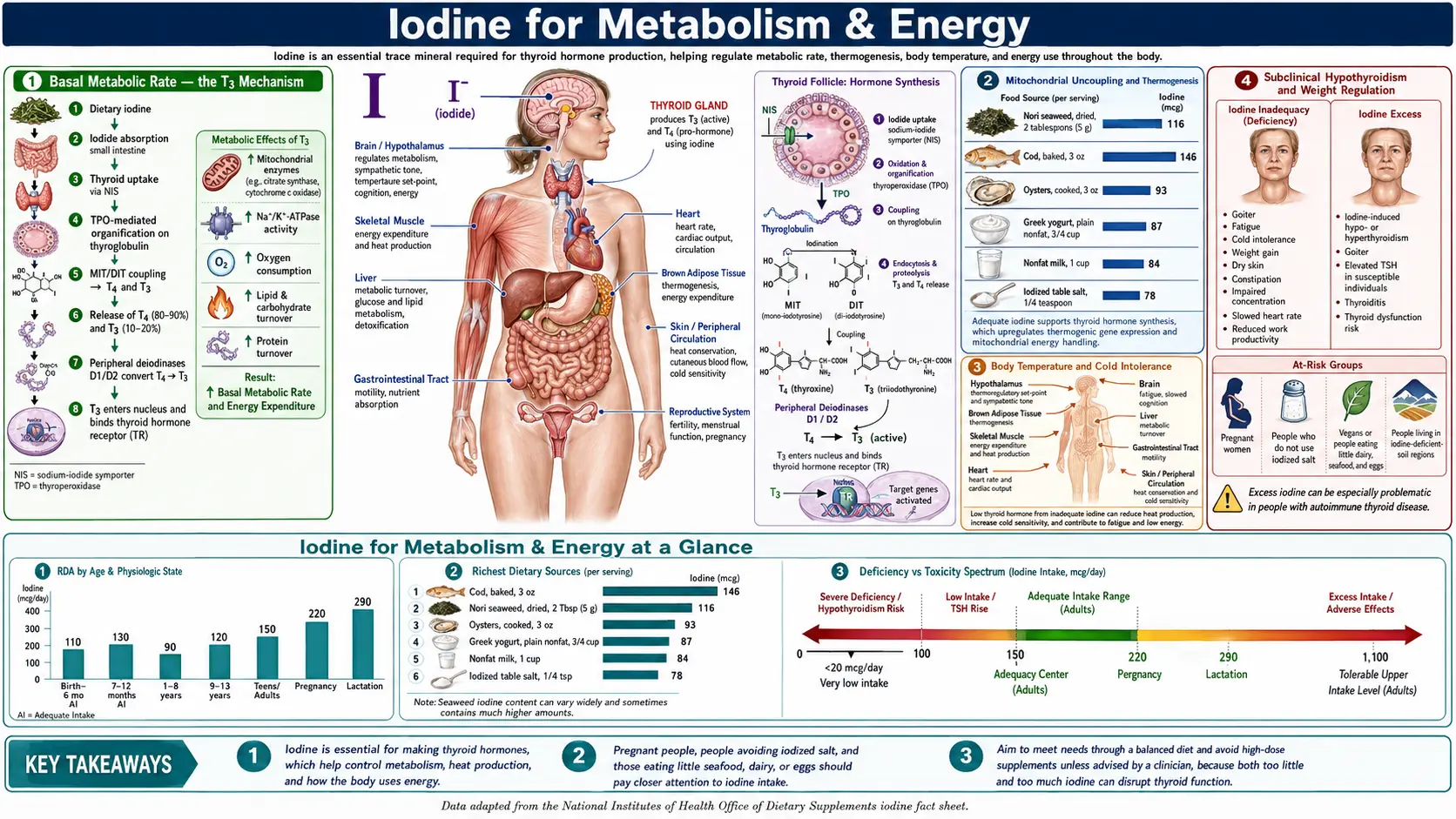
Iodine is a micronutrient that is essential for the production of thyroid hormones (Leung and Braverman 2014), and thyroid hormone has long been accepted as an important determinant of overall energy expenditure and the basal metabolic rate (BMR) — regulating heat production is one of its major tasks in adults (Kim 2008). Thyroxine (T4) is activated in tissues to the active form, triiodothyronine (T3), and this local activation by the type 2 deiodinase is a key mechanism of thyroid-hormone control of metabolism (Mullur 2014). Hypothyroidism can be caused by severe iodine deficiency, but in iodine-replete areas it is more frequently caused by chronic autoimmune thyroiditis (Chaker 2022). This page reports what the research says about thyroid hormone and resting energy use, heat production and brown fat, subclinical hypothyroidism and weight, fatigue, the deiodinase enzymes, metabolic syndrome, the doses used in iodine trials, the official intake limits, and what happens to the thyroid when iodine intake is too high.
Table of Contents
- Basal Metabolic Rate — the T3 Mechanism
- Mitochondrial Uncoupling and Thermogenesis
- Body Temperature and Cold Intolerance
- Subclinical Hypothyroidism and Weight Regulation
- Fatigue and Thyroid Function
- Deiodinases — the T4-to-T3 Conversion Step
- Iodine and Metabolic Syndrome
- Symptoms, Thyroid Tests and Iodine Status Testing
- Iodine Doses in Studies, Intake Limits and Excess Iodine
- Key Research Papers
- Connections
- Featured Videos
Basal Metabolic Rate — the T3 Mechanism
Basal metabolic rate is the energy the body uses at rest, without external work. Kim (2008) describes thyroid hormone as an important determinant of both overall energy expenditure and BMR, while noting that despite a wealth of data on its cellular effects, it remains unclear which T3-responsive energy-using processes matter most for setting the basal metabolic rate.
The mechanisms described in the review literature include:
- Receptor isoforms — the thyroid hormone receptor isoforms α and β are expressed differently from tissue to tissue and have distinct roles in thyroid-hormone signaling (Mullur 2014).
- Obligatory heat production — thyroid hormone increases obligatory thermogenesis by stimulating numerous metabolic pathways, and may specifically stimulate some heat-producing mechanisms such as the Na/K-ATPase ion pump and calcium cycling in muscle (Silva 1995).
- Facultative heat production — thyroid hormone plays an essential role in facultative (adaptive) thermogenesis by interacting with the sympathetic nervous system; peripherally it potentiates sympathetic effects at the level of the adrenergic receptor and beyond (Silva 1995).
- Local activation of T4 — the type 2 deiodinase (D2), expressed in the hypothalamus, white fat, brown adipose tissue and skeletal muscle, converts T4 to T3 locally and is required for adaptive thermogenesis (Mullur 2014).
- Cholesterol, glucose and liver — the thyroid hormone receptor regulates cholesterol and carbohydrate metabolism through direct actions on gene expression and cross-talk with other nuclear receptors, and thyroid hormone modulates hepatic insulin sensitivity, especially for the suppression of gluconeogenesis (glucose production) in the liver (Mullur 2014).
- Heart and blood vessels — thyroid hormone receptors are present in heart muscle and vascular tissue, and minor changes in thyroid hormone concentration can affect cardiovascular physiology; the proposed links between thyroid dysfunction and cardiovascular disease include endothelial dysfunction, changes in blood pressure, systolic and diastolic dysfunction of the heart muscle, and dyslipidemia (Razvi 2018).
The size of the drop in BMR in overt and subclinical hypothyroidism is not stated in the abstracts of the reviews cited on this page, so no percentage is given here.
Mitochondrial Uncoupling and Thermogenesis
Energy can be spent either doing work or producing heat (thermogenesis). Adaptive thermogenesis — the regulated production of heat — is influenced by environmental temperature and diet, and mitochondria are central to how energy is dissipated (Lowell and Spiegelman 2000).
- Brown adipose tissue (BAT) — in rodents and newborn humans, brown fat helps regulate energy expenditure by thermogenesis mediated by uncoupling protein 1 (UCP1). In 1,972 patients who had PET-CT scans for other reasons, Cypess and colleagues found substantial depots of UCP1-positive brown fat in a region from the front of the neck to the chest, including the supraclavicular area; positive scans were seen in 7.5% of women and 3.1% of men, and detection was less likely with older age, warmer outdoor temperature at the time of the scan, beta-blocker use and, among older patients, higher body-mass index (Cypess 2009).
- Thyroid hormone in brown fat — the brown-fat T4-5′-deiodinase plays a central role in controlling heat production: when norepinephrine stimulates it, it supplies high concentrations of T3 to brown fat (Silva 1995).
Thyroid hormone analogues have been studied as drugs. Eprotirome, a liver-selective thyroid hormone receptor agonist, was developed to lower LDL cholesterol. Its phase 3 trial in familial hypercholesterolaemia (236 patients) was stopped early when another study found cartilage damage in dogs; at 6 weeks the 100 µg dose had lowered LDL cholesterol, but liver enzymes rose in both eprotirome groups, and the authors concluded that the findings raise serious doubts about selective thyroid hormone mimetics as an approach to lowering LDL cholesterol (Sjouke 2014). In obese people with normal thyroid function, Pearce found no consistent evidence that thyroid hormone treatment induces weight loss, while noting that thyroid hormone analogues may eventually be useful for weight loss (Pearce 2012).
Body Temperature and Cold Intolerance
A Cochrane review lists cold intolerance among the possible common presenting symptoms of Hashimoto's thyroiditis, together with anxiety, low mood, depression, dry skin, puffy eyes, muscle cramps, fatigue, a deep voice, constipation, slow thinking and poor memory (van Zuuren 2013).
Symptoms alone are a weak guide to thyroid status. In a Danish population-based study of 140 people with newly diagnosed overt autoimmune hypothyroidism and 560 matched controls, 13 of 34 symptoms were more common in the hypothyroid group; the most frequent were tiredness (81%), dry skin (63%) and shortness of breath (51%), and the strongest associations were with tiredness, hair loss and dry skin. None of the individual symptoms had high likelihood ratios, and the authors concluded that neither the presence nor the absence of any single symptom was reliable for deciding who has their thyroid tested, so that even minor suspicion of hypothyroidism justifies a blood test (Carlé 2014).
Subclinical Hypothyroidism and Weight Regulation
Subclinical hypothyroidism is defined as an elevated thyrotropin (TSH) level with a normal free thyroxine (FT4) level, and it affects up to 10% of the adult population. According to a 2019 review it is most often caused by autoimmune thyroiditis; TSH tends to rise with age without thyroid disease, which has likely led to an overestimate of its true prevalence in people over 70 (Biondi 2019). The review reports that:
- people with thyroid peroxidase (TPO) antibodies have a greater risk of progressing to overt hypothyroidism
- subclinical hypothyroidism may be associated with an increased risk of heart failure, coronary artery disease events and coronary heart disease death
- middle-aged patients may have cognitive impairment, nonspecific symptoms such as fatigue, and altered mood
- there is no evidence that levothyroxine treatment is beneficial in people aged 65 or older, and most individuals can be observed without treatment (Biondi 2019)
The TRUST trial randomized 737 adults aged 65 or older with persisting subclinical hypothyroidism to levothyroxine (starting at 50 µg a day, or 25 µg in people under 50 kg or with coronary heart disease, then adjusted to TSH) or placebo. After one year there was no difference in hypothyroid-symptom or tiredness scores, and no benefit on secondary outcomes (Stott 2017).
On weight, Pearce's review reports that weight decreases after treatment of hypothyroidism, but that after levothyroxine treatment of overt hypothyroidism the loss appears modest and mainly water rather than fat. In large population studies, TSH is typically positively associated with body weight and BMI even in people with normal thyroid function, and both TSH and T3 are typically higher in obese than in lean people — an effect likely mediated at least in part by leptin, that is, a consequence of body fat rather than its cause (Pearce 2012).
The metabolic-syndrome context is covered on the Metabolic Syndrome and Obesity pages.
Fatigue and Thyroid Function
Tiredness was the most common symptom (81%) among people with newly diagnosed overt autoimmune hypothyroidism in the Danish case-control study, and the symptom most strongly associated with the diagnosis — yet no single symptom was reliable enough on its own to identify who had the disease (Carlé 2014). In middle-aged people with subclinical hypothyroidism, fatigue is among the nonspecific symptoms described (Biondi 2019); in older adults with subclinical hypothyroidism, levothyroxine did not improve tiredness scores compared with placebo over one year (Stott 2017).
The link from fatigue to iodine specifically is indirect: iodine is needed to make thyroid hormone, and severe iodine deficiency is one cause of hypothyroidism, but in iodine-replete areas the more frequent cause is chronic autoimmune thyroiditis (Chaker 2022).
Fatigue evaluation is covered on the Fatigue page and Brain Fog page.
Deiodinases — the T4-to-T3 Conversion Step
The iodothyronine deiodinases initiate or terminate thyroid hormone action. Research on them long focused on their role in preserving serum T3 during iodine deficiency; more recently, it has been shown that the activating deiodinase (D2) and the inactivating deiodinase (D3) can raise or lower thyroid-hormone signaling locally, in a tissue- and time-specific way, without changes in serum hormone levels, with roles that include energy homeostasis in adults (Gereben 2008). The three enzymes — types 1, 2 and 3 (D1, D2, D3) — are selenoproteins (selenodeiodinases) (Bianco 2002).
- D2 — plays a significant role in human plasma T3 production (Bianco 2002) and in local T3 production in the hypothalamus, white fat, brown fat and skeletal muscle (Mullur 2014).
- D3 — inactivates thyroid hormone (Gereben 2008); overexpression of D3 can cause “consumptive hypothyroidism” (Bianco 2002).
- Illness and drugs — deiodination changes during illness and during amiodarone therapy (Bianco 2002).
- Calorie restriction — the fall in T3 that accompanies reduced calorie intake is regulated centrally (via falls in leptin and melanocortin) and peripherally via decreased deiodinase activity, which Krotkiewski describes as aimed at sparing protein and energy (Krotkiewski 2002).
Selenium trials report mixed thyroid results. In a double-blind trial in 100 New Zealanders aged 60-80 (a population with marginal selenium status; their median urinary iodine of 48 µg/L indicated moderate iodine deficiency), 100 µg/day of selenium as L-selenomethionine for 3 months raised plasma selenium and glutathione peroxidase activity but had no significant effect on TSH, free T3, free T4 or the T3:T4 ratio (Thomson 2009). In 70 women with autoimmune thyroiditis who were all taking levothyroxine, 200 µg/day of sodium selenite for 3 months lowered TPO antibody concentrations (to 63.6% of baseline, versus 88% with placebo), while mean TSH, free T4 and free T3 were unchanged in both groups (Gärtner 2002). For combined T4/T3 (levothyroxine plus liothyronine) treatment, a 2022 review states that further research is needed on its potential benefit for symptom relief, patient satisfaction and long-term adverse effects (Chaker 2022).
The selenium-iodine relationship is covered on the Selenium page and the Thyroid Function deep-dive page in this Benefits set.
Iodine and Metabolic Syndrome
The link between thyroid function and metabolic syndrome is unsettled. A 2019 review reports that thyroid hormone levels even within the low-normal range are associated with various metabolic abnormalities, but the risk of metabolic syndrome itself remains controversial; hyperthyroidism might be associated only with insulin resistance and dysglycemia; autoimmune thyroid disease may be a risk factor for metabolic abnormalities even with low-normal thyroid function; and the relationship between TSH, free T3, free T4 and metabolic measures may be affected by age, sex, BMI, insulin resistance, smoking, iodine intake and inflammatory markers (Mehran 2019).
Trials that gave iodine to overweight adults:
- Iodine-deficient overweight women, Morocco — 163 iodine-deficient overweight or obese women received 200 µg of oral iodine or placebo daily for 6 months. Median urinary iodine rose from 38 to 77 µg/L; TSH was 33% lower than with placebo and T4 was higher. Among women with high baseline cholesterol (above 5 mmol/L), total cholesterol fell 11%, and at 6 months 21.5% of treated women remained hypercholesterolemic versus 34.8% of controls; the fall in the prevalence of high LDL cholesterol was not significant. Body weight was not among the outcomes reported in the abstract (Herter-Aeberli 2015).
- Kelp powder, Japan — in 50 overweight Japanese adults, an iodine-reduced kelp powder supplying 1.03 mg of iodine a day for 8 weeks did not raise thyroid hormone levels; body fat percentage fell in men but not women compared with placebo, and the authors link the effect to the kelp's high alginate content (Aoe 2021).
No trial was found for this page that tested iodine supplementation for weight loss, energy or metabolic-syndrome outcomes in people who were not iodine deficient.
Symptoms, Thyroid Tests and Iodine Status Testing
Tiredness, hair loss and dry skin were the symptoms most strongly associated with overt autoimmune hypothyroidism in the Danish study, but no single symptom reliably identified people with the disease (Carlé 2014). Three findings from the research bear on a person who has such symptoms, thyroid antibodies and normal thyroid blood tests:
- Antibodies and progression — in subclinical hypothyroidism, TPO antibodies mark a greater risk of progressing to overt hypothyroidism (Biondi 2019).
- Antibodies and iodine — iodine-induced hypothyroidism is common in patients with Hashimoto's thyroiditis (Eng 1999). In a five-year Chinese cohort, among people with normal thyroid function and thyroid antibodies at baseline, raised TSH developed more often in regions with more-than-adequate or excessive iodine intake than in a mildly deficient region (Teng 2006). In a case series, two patients with Hashimoto's thyroiditis developed severe, symptomatic hypothyroidism after taking a high-dose over-the-counter iodine/iodide tablet (Hoang 2013).
- Measuring an individual's iodine status — the median urinary iodine concentration is a good indicator of a population's iodine status, but there is no established biomarker for an individual's iodine status. In 22 Swiss women, about 10 repeat spot or 24-hour urine samples were needed to estimate one person's iodine status with 20% precision (König 2011). The assessment methods described in the major review literature are urinary iodine concentration, goiter, newborn TSH and blood thyroglobulin (Zimmermann 2009); urinary iodine and thyroglobulin are also the biomarkers emphasized for assessing excess intake (Farebrother 2019).
The “iodine loading test” used in some high-dose iodine protocols (described on the Thyroid Function page) is not among those assessment methods, and no study validating it against an independent measure of body iodine was found in PubMed or Europe PMC searches for this page.
Iodine Doses in Studies, Intake Limits and Excess Iodine
Official intake levels
For adults who are not pregnant or breastfeeding, the U.S. Institute of Medicine recommends a daily iodine intake of 150 µg and states a Tolerable Upper Intake Level (UL) of 1,100 µg per day — the approximate threshold below which notable adverse effects are unlikely in the healthy population (Leung and Braverman 2014). The Institute of Medicine recommends 220 µg a day in pregnancy and 290 µg a day during breastfeeding (Leung 2012). Zimmermann's review states that achieving optimal iodine intakes from iodized salt, in the range of 150-250 µg/day for adults, may minimize the amount of thyroid dysfunction in populations (Zimmermann 2009).
Doses used in the studies on this page
- 200 µg of iodine a day for 6 months in iodine-deficient overweight women (Herter-Aeberli 2015)
- 80 µg of iodine a day, alone or with 100 µg of selenium, for 3 months in older New Zealanders; iodine alleviated their moderate iodine deficiency and lowered elevated thyroglobulin, without significant changes in TSH or thyroid hormones (Thomson 2009)
- 1.03 mg of iodine a day from iodine-reduced kelp powder for 8 weeks, with no rise in thyroid hormones (Aoe 2021)
- Selenium: 100 µg/day as L-selenomethionine (Thomson 2009) and 200 µg/day as sodium selenite (Gärtner 2002)
No randomized trial testing an escalating milligram-dose iodine schedule for weight, energy or metabolic outcomes was found for this page. Such schedules reach doses above the 1,100 µg UL. The high-dose protocols promoted by some practitioners are described, with the research set beside them, on the Thyroid Function page.
The Wolff-Chaikoff effect
In 1948 Wolff and Chaikoff reported that organic binding of iodide in the thyroid fell when plasma iodide levels were raised (the acute Wolff-Chaikoff effect), and that the gland adapted, or “escaped”, in about 2 days despite continuing high plasma iodide. In rats, the escape is explained by a fall in iodide transport into the thyroid through decreased sodium/iodide symporter (NIS) messenger RNA and protein; serum T4 and T3 fell after 1 day of iodide in drinking water and were back to normal by 6 days (Eng 1999). The effect works as a means of rejecting large quantities of iodide so that the thyroid does not make large quantities of hormone (Markou 2001).
Iodine-induced hypothyroidism
In some people the escape does not happen and clinical or subclinical hypothyroidism follows. Markou and colleagues list a few apparently normal individuals, newborns and fetuses, some patients with chronic systemic diseases, euthyroid patients with autoimmune thyroiditis, people with Graves' disease previously treated with radioiodine, surgery or antithyroid drugs, and people with a history of postpartum thyroiditis or subacute thyroiditis or treated with interferon-alpha. The hypothyroidism is transient, with thyroid function returning to normal 2-3 weeks after iodide withdrawal, though some patients need temporary T4 replacement, and many go on to develop permanent primary hypothyroidism (Markou 2001). Medications containing iodide may also induce hypothyroidism after hemithyroidectomy for nodules and in people taking lithium (Vagenakis and Braverman 1975).
Iodine-induced hyperthyroidism
Iodine-induced hyperthyroidism (the Jod-Basedow phenomenon) was first described in the early 1800s, when thyrotoxicosis was observed to be more common among patients with endemic goiter treated with iodine; it can be transient or permanent, and risk factors include nontoxic or diffuse nodular goiter, latent Graves' disease and long-standing iodine deficiency (Leung and Braverman 2014). Autonomous nodules and recent antithyroid-drug treatment for Graves' disease are further settings described for it, and either hypothyroidism or hyperthyroidism can rarely develop in people with completely normal thyroid function given iodide (Vagenakis and Braverman 1975).
How common, and at what intakes
- Intakes above the 150 µg recommendation are generally well tolerated, but people with pre-existing thyroid disease, the elderly, fetuses and newborns are at increased risk of iodine-induced thyroid dysfunction, which may be subclinical or overt (Leung and Braverman 2014).
- People with pre-existing thyroid disease or past iodine deficiency may be susceptible at intakes only slightly above physiological needs. Thyroid dysfunction from excess iodine is usually mild and transient, but iodine-induced hyperthyroidism can be life-threatening in some people; sources of excess include iodine-containing dietary supplements and certain seaweeds (Farebrother 2019).
- In a five-year Chinese cohort of 3,018 people, the cumulative incidence of subclinical hypothyroidism was 0.2%, 2.6% and 2.9%, and of autoimmune thyroiditis 0.2%, 1.0% and 1.3%, in regions with mildly deficient (median urinary iodine 84 µg/L), more-than-adequate (243 µg/L) and excessive (651 µg/L) iodine intake; the authors concluded that more-than-adequate or excessive iodine intake may lead to hypothyroidism and autoimmune thyroiditis (Teng 2006).
- In a case series of four patients who developed significant thyroid dysfunction after taking over-the-counter products containing large amounts of iodine, one woman on methimazole had an acute worsening of thyrotoxicosis after an iodine product, and two patients with Hashimoto's thyroiditis developed severe, symptomatic hypothyroidism after a high-dose iodine/iodide tablet; all recovered after the products were stopped. The authors concluded that there is no valid reason for taking high-dose over-the-counter iodine supplements, which they describe as shown to cause harm with no known benefit (Hoang 2013).
Decisions about iodine or selenium supplements, and about thyroid testing, belong with a clinician.
Key Research Papers
- Silva JE (1995). Thyroid hormone control of thermogenesis and energy balance. Thyroid 5(6):481-492. — PubMed PMID: 8808101
- Bianco AC, Salvatore D, Gereben B, Berry MJ, Larsen PR (2002). Biochemistry, cellular and molecular biology, and physiological roles of the iodothyronine selenodeiodinases. Endocrine Reviews 23(1):38-89. — PubMed PMID: 11844744
- Krotkiewski M (2002). Thyroid hormones in the pathogenesis and treatment of obesity. European Journal of Pharmacology 440(2-3):85-98. — PubMed PMID: 12007527
- Biondi B (2010). Thyroid and obesity: an intriguing relationship. Journal of Clinical Endocrinology & Metabolism 95(8):3614-3617 (editorial commentary; no abstract). — PubMed PMID: 20685890
- Kim B (2008). Thyroid hormone as a determinant of energy expenditure and the basal metabolic rate. Thyroid 18(2):141-144. — PubMed PMID: 18279014
- Lowell BB, Spiegelman BM (2000). Towards a molecular understanding of adaptive thermogenesis. Nature 404(6778):652-660. — PubMed PMID: 10766252
- Cypess AM, Lehman S, Williams G, Tal I, Rodman D, Goldfine AB, et al. (2009). Identification and importance of brown adipose tissue in adult humans. New England Journal of Medicine 360(15):1509-1517. — PubMed PMID: 19357406
- Mullur R, Liu YY, Brent GA (2014). Thyroid hormone regulation of metabolism. Physiological Reviews 94(2):355-382. — PubMed PMID: 24692351
- Razvi S, Jabbar A, Pingitore A, Danzi S, Biondi B, Klein I, et al. (2018). Thyroid hormones and cardiovascular function and diseases. Journal of the American College of Cardiology 71(16):1781-1796. — PubMed PMID: 29673469
- Pearce EN (2012). Thyroid hormone and obesity. Current Opinion in Endocrinology, Diabetes and Obesity 19(5):408-413. — PubMed PMID: 22931855
- “Tiller J et al. (2015). Effect of levothyroxine on body weight in patients with subclinical hypothyroidism. Endocr Pract.” — this reference was not found in PubMed or Crossref (searched 2026-10-14) and is not relied on; the levothyroxine findings on this page come from Stott 2017, Biondi 2019 and Pearce 2012.
- Mehran L, Amouzegar A, Azizi F (2019). Thyroid disease and the metabolic syndrome. Current Opinion in Endocrinology, Diabetes and Obesity 26(5):256-265. — PubMed PMID: 31369412
- Leung AM, Braverman LE (2014). Consequences of excess iodine. Nature Reviews Endocrinology 10(3):136-142. — PubMed PMID: 24342882
- Leung AM, Braverman LE, Pearce EN (2012). History of U.S. iodine fortification and supplementation. Nutrients 4(11):1740-1746. — PubMed PMID: 23201844
- Zimmermann MB (2009). Iodine deficiency. Endocrine Reviews 30(4):376-408. — PubMed PMID: 19460960
- Eng PH, Cardona GR, Fang SL, Previti M, Alex S, Carrasco N, et al. (1999). Escape from the acute Wolff-Chaikoff effect is associated with a decrease in thyroid sodium/iodide symporter messenger ribonucleic acid and protein. Endocrinology 140(8):3404-3410. — PubMed PMID: 10433193
- Markou K, Georgopoulos N, Kyriazopoulou V, Vagenakis AG (2001). Iodine-induced hypothyroidism. Thyroid 11(5):501-510. — PubMed PMID: 11396709
- Vagenakis AG, Braverman LE (1975). Adverse effects of iodides on thyroid function. Medical Clinics of North America 59(5):1075-1088. — PubMed PMID: 1099355
- Farebrother J, Zimmermann MB, Andersson M (2019). Excess iodine intake: sources, assessment, and effects on thyroid function. Annals of the New York Academy of Sciences 1446(1):44-65. — PubMed PMID: 30891786
- Teng W, Shan Z, Teng X, Guan H, Li Y, Teng D, et al. (2006). Effect of iodine intake on thyroid diseases in China. New England Journal of Medicine 354(26):2783-2793. — PubMed PMID: 16807415
- Hoang TD, Mai VQ, Clyde PW, Shakir MK (2013). Over-the-counter-drug-induced thyroid disorders. Endocrine Practice 19(2):268-274. — PubMed PMID: 23529350
- König F, Andersson M, Hotz K, Aeberli I, Zimmermann MB (2011). Ten repeat collections for urinary iodine from spot samples or 24-hour samples are needed to reliably estimate individual iodine status in women. Journal of Nutrition 141(11):2049-2054. — PubMed PMID: 21918061
- Herter-Aeberli I, Cherkaoui M, El Ansari N, Rohner R, Stinca S, Chabaa L, et al. (2015). Iodine supplementation decreases hypercholesterolemia in iodine-deficient, overweight women: a randomized controlled trial. Journal of Nutrition 145(9):2067-2075. — PubMed PMID: 26203098
- Thomson CD, Campbell JM, Miller J, Skeaff SA, Livingstone V (2009). Selenium and iodine supplementation: effect on thyroid function of older New Zealanders. American Journal of Clinical Nutrition 90(4):1038-1046. — PubMed PMID: 19692495
- Aoe S, Yamanaka C, Ohtoshi H, Nakamura F, Fujiwara S (2021). Effects of daily kelp (Laminaria japonica) intake on body composition, serum lipid levels, and thyroid hormone levels in healthy Japanese adults: a randomized, double-blind study. Marine Drugs 19(7):352. — PubMed PMID: 34206160
- Gärtner R, Gasnier BC, Dietrich JW, Krebs B, Angstwurm MW (2002). Selenium supplementation in patients with autoimmune thyroiditis decreases thyroid peroxidase antibodies concentrations. Journal of Clinical Endocrinology & Metabolism 87(4):1687-1691. — PubMed PMID: 11932302
- van Zuuren EJ, Albusta AY, Fedorowicz Z, Carter B, Pijl H (2013). Selenium supplementation for Hashimoto's thyroiditis. Cochrane Database of Systematic Reviews (6):CD010223. — PubMed PMID: 23744563
- Stott DJ, Rodondi N, Kearney PM, Ford I, Westendorp RGJ, Mooijaart SP, et al.; TRUST Study Group (2017). Thyroid hormone therapy for older adults with subclinical hypothyroidism. New England Journal of Medicine 376(26):2534-2544. — PubMed PMID: 28402245
- Biondi B, Cappola AR, Cooper DS (2019). Subclinical hypothyroidism: a review. JAMA 322(2):153-160. — PubMed PMID: 31287527
- Chaker L, Razvi S, Bensenor IM, Azizi F, Pearce EN, Peeters RP (2022). Hypothyroidism. Nature Reviews Disease Primers 8(1):30. — PubMed PMID: 35589725
- Gereben B, Zavacki AM, Ribich S, Kim BW, Huang SA, Simonides WS, et al. (2008). Cellular and molecular basis of deiodinase-regulated thyroid hormone signaling. Endocrine Reviews 29(7):898-938. — PubMed PMID: 18815314
- Carlé A, Pedersen IB, Knudsen N, Perrild H, Ovesen L, Laurberg P (2014). Hypothyroid symptoms and the likelihood of overt thyroid failure: a population-based case-control study. European Journal of Endocrinology 171(5):593-602. — PubMed PMID: 25305308
- Sjouke B, Langslet G, Ceska R, Nicholls SJ, Nissen SE, Öhlander M, et al. (2014). Eprotirome in patients with familial hypercholesterolaemia (the AKKA trial): a randomised, double-blind, placebo-controlled phase 3 study. Lancet Diabetes & Endocrinology 2(6):455-463. — PubMed PMID: 24731671