Iodine — Benefits Deep Dive
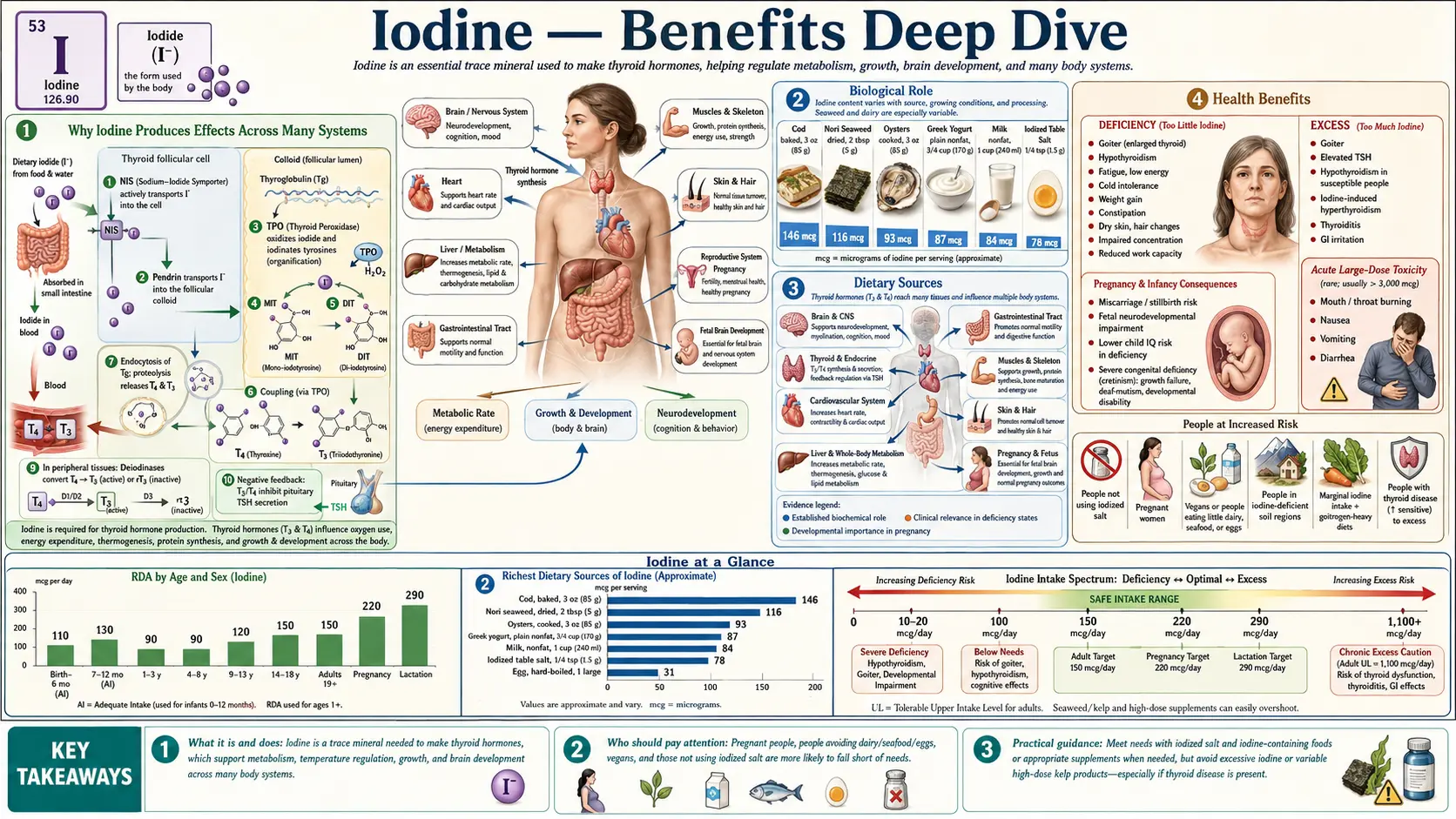
Iodine is an essential mineral: the thyroid gland needs it to build T4 (four iodine atoms) and T3 (three iodine atoms), the hormones that regulate metabolism in nearly every tissue. Delange described iodine deficiency as the world's greatest single cause of preventable brain damage, with a loss of 10–15 IQ points at the population level (Delange 2001). In the United States, median urinary iodine in national surveys fell by more than 50% between 1971–1974 and 1988–1994, while still indicating adequate intake for the population as a whole (Hollowell 1998); the decline has since stabilized (Leung 2012). Changes discussed in the research include the processed foods that supply most U.S. salt intake, which are made mainly with non-iodized salt, and iodate dough conditioners, which now add iodine to U.S. bread only occasionally (Leung 2012). Proponents of high-dose iodine add that commercial bakers replaced iodate with bromate, and that bromide competes with iodine in the body; these are their own claims, and no primary source documenting the bakers' switch or its effect on iodine status was found for this page. The four benefit pages below cover thyroid hormone synthesis, fetal and childhood brain development, breast tissue (fibrocystic breast disease and the breast cancer research), and thyroid hormone's role in metabolic rate, body temperature and body weight.
Deep-Dive Articles
Thyroid Function
How T4 (four iodine atoms) and T3 (three iodine atoms) are built by thyroid peroxidase (TPO) on tyrosine residues in thyroglobulin, the sodium-iodide symporter (NIS) that moves iodide into the thyroid against its concentration gradient, the Wolff-Chaikoff effect — a transient fall in hormone synthesis after a large iodide dose, from which the gland normally escapes within about two days (Eng 1999; Leung and Braverman 2014) — and who fails to escape, iodine-deficiency goiter and hypothyroidism, the high-dose iodine protocol described by the physician Guy Abraham and David Brownstein set beside that research, Lugol's solution, iodide-vs-molecular-iodine pharmacology, and the history of U.S. salt iodization (Marine and Kimball, Akron 1917).
Read the deep dive →Brain Development
Iodine deficiency as what Delange called the world's greatest single cause of preventable brain damage (Delange 2001), cretinism in its myxedematous and neurological forms, the fetus's reliance on maternal thyroxine early in pregnancy (de Escobar 2004), the iodide the lactating breast moves into milk for the nursing infant (Dohán 2003), the WHO and Iodine Global Network universal salt iodization (USI) programs, and the cognitive findings: a 12.45 IQ-point deficit in children in severely iodine-deficient areas of China (Qian 2005 meta-analysis), and, in the UK ALSPAC cohort, children of mothers with low first-trimester iodine status more often scoring in the lowest quarter for verbal IQ and reading (Bath 2013).
Read the deep dive →Breast Health
The lactating breast concentrates iodide into milk through NIS and the pendrin transporter, while NIS was found in breast cancer samples but in none of the normal non-lactating samples studied (Tazebay 2000); Eskin's animal data linking iodine deficiency to mammary dysplasia; the Ghent and colleagues 1993 Canadian Journal of Surgery review of three studies of iodine for fibrocystic breast disease, one of them a small double-blind controlled study of molecular iodine; the Kessler 2004 trial in cyclic breast pain; the hypothesis linking Japan's low breast cancer rate to seaweed iodine, set beside the thyroid harms reported with high intake there (Leung and Braverman 2014); and the ongoing controversy over therapeutic dosing.
Read the deep dive →Metabolism & Energy
Thyroid hormone as a determinant of energy expenditure and the basal metabolic rate (BMR) — which T3-responsive processes matter most is still unclear (Kim 2008) — mitochondrial uncoupling proteins, brown-adipose-tissue thermogenesis and body temperature, the deiodinase enzymes that convert T4 to active T3 (Bianco 2002), the cold intolerance and fatigue of hypothyroidism, and what the research reports about thyroid status and body weight.
Read the deep dive →Table of Contents
- Deep-Dive Articles
- Why Iodine Produces Effects Across Many Systems
- Research Papers: Thyroid Function
- Research Papers: Brain Development & IQ
- Research Papers: Breast Health
- Research Papers: Metabolism & Energy
- Research Papers: Cross-Cutting (Mechanism, Status, Safety)
- External Authoritative Resources
- Connections
- Featured Videos
Why Iodine Produces Effects Across Many Systems
Most minerals act through a small number of enzyme cofactor roles (zinc in carbonic anhydrase, magnesium as an ATP counter-ion, selenium in glutathione peroxidase). Iodine is unusual because its established role is a single one — it is a component of the thyroid hormones, which act on nearly every tissue in the body — while a separate research literature, much of it from cell and animal studies, describes actions in other tissues that take up iodine (Aceves 2013).
- Thyroid hormone synthesis (the established mechanism) — iodide is concentrated by the NIS into thyroid follicular cells, oxidized by thyroid peroxidase (TPO), and covalently bound to tyrosine residues on thyroglobulin to form mono- and di-iodotyrosines that couple into T4 (four iodine atoms) and T3 (three iodine atoms). The resulting thyroid hormones bind nuclear thyroid hormone receptors (TRα and TRβ) in essentially every tissue, affecting the basal metabolic rate, body temperature, neuronal development in the fetus, cardiac output, and many other gene-regulatory effects. This mechanism underlies the thyroid effects, the brain-development effects, and the metabolism / energy / weight effects covered in the four deep-dive pages.
- NIS outside the thyroid — the sodium-iodide symporter also mediates active iodide transport in other tissues, including the salivary glands, the gastric mucosa and the lactating mammary gland, where it moves iodide into milk for the nursing newborn (Dohán 2003). In the breast, NIS-mediated iodide transport was found in the healthy lactating gland but not in the non-lactating gland; NIS was detected in more than 80% of the breast cancer samples analyzed and in none of the normal non-lactating samples (Tazebay 2000). Molecular iodine (I₂) enters breast cancer cells by a route independent of NIS (Arroyo-Helguera 2006). The human trials of iodine in breast tissue are small studies in fibrocystic breast disease and cyclic breast pain (Ghent 1993; Kessler 2004).
- Proposed actions of molecular iodine — a research group at the National Autonomous University of Mexico (Aceves and colleagues) reviews evidence that iodine can act as an antioxidant and as an antiproliferative and differentiation agent: oxidized iodine is described as triggering mitochondria-mediated apoptosis, and iodolipids such as 6-iodolactone, formed from arachidonic acid, as activating PPAR-γ (Aceves 2013; Nuñez-Anita 2009). In animal and human studies they review, molecular iodine supplementation suppressed the development and size of benign and cancerous growths (Aceves 2013); most of the mechanistic evidence comes from cell and animal studies.
The doses discussed for iodine span a wide range. The U.S. Recommended Dietary Allowance (RDA) for adults is 150 µg/day (Leung 2012), and the adult Tolerable Upper Intake Level (UL) is 1,100 µg/day (Leung and Braverman 2014). The high-dose protocol described by the physician Guy Abraham and David Brownstein uses 12.5-50 mg/day, far above the UL. Its proponents argue that these doses saturate the iodine-concentrating tissues outside the thyroid and displace stored bromide and fluoride; these are their own claims, resting largely on their own urine-excretion reports, and no large randomized trials of the protocol were found for this page. They also describe selenium as a companion nutrient, because thyroid peroxidase uses hydrogen peroxide that selenium-dependent glutathione peroxidases help neutralize; in a placebo-controlled trial in 70 women with autoimmune thyroiditis, selenium lowered TPO antibody concentrations (Gärtner 2002). The endocrinology literature reports that intakes above 150 µg/day are generally well tolerated, but that in susceptible people — those with pre-existing thyroid disease, the elderly, fetuses and newborns — excess iodine can cause hypothyroidism or hyperthyroidism (Leung and Braverman 2014); in a five-year Chinese cohort, more-than-adequate or excessive iodine intake was associated with more hypothyroidism and autoimmune thyroiditis (Teng 2006). Both positions are set out on the Thyroid Function page.
Research Papers: Thyroid Function
- Marine D, Kimball OP (1920). Prevention of simple goiter in man. Archives of Internal Medicine 25:661 — doi:10.1001/archinte.1920.00090350088005
- Dai G, Levy O, Carrasco N (1996). Cloning and characterization of the thyroid iodide transporter. Nature 379(6564):458-460 — PubMed PMID: 8559252
- Dohán O, De la Vieja A, Paroder V, Riedel C, et al. (2003). The sodium/iodide symporter (NIS): characterization, regulation, and medical significance. Endocrine Reviews 24(1):48-77 — PubMed PMID: 12588808
- Wolff J, Chaikoff IL (1948). Plasma inorganic iodide as a homeostatic regulator of thyroid function. Journal of Biological Chemistry 174:555-564 — PubMed PMID: 18865621
- Eng PH, Cardona GR, Fang SL, Previti M, Alex S, Carrasco N, Chin WW, Braverman LE (1999). Escape from the acute Wolff-Chaikoff effect is associated with a decrease in thyroid sodium/iodide symporter messenger ribonucleic acid and protein. Endocrinology 140(8):3404-3410 — PubMed PMID: 10433193
- Leung AM, Braverman LE, Pearce EN (2012). History of U.S. iodine fortification and supplementation. Nutrients 4(11):1740-1746 — PubMed PMID: 23201844
- Hollowell JG, Staehling NW, Hannon WH, Flanders DW, et al. (1998). Iodine nutrition in the United States. Trends and public health implications: iodine excretion data from National Health and Nutrition Examination Surveys I and III (1971-1974 and 1988-1994). Journal of Clinical Endocrinology & Metabolism 83(10):3401-3408 — PubMed PMID: 9768638
- Pearce EN, Pino S, He X, Bazrafshan HR, Lee SL, Braverman LE (2004). Sources of dietary iodine: bread, cows' milk, and infant formula in the Boston area. Journal of Clinical Endocrinology & Metabolism 89(7):3421-3424 — PubMed PMID: 15240625
- Abraham GE (2005). The historical background of the iodine project. The Original Internist. The author's own account of the high-dose iodine project; not indexed in PubMed or Crossref.
- Brownstein D. Iodine: Why You Need It, Why You Can't Live Without It (book). The author's own descriptions of clinical experience with high-dose iodine; not indexed in PubMed.
PubMed Topic Searches
- Thyroid peroxidase (TPO) structure and iodination mechanism — PubMed: TPO mechanism
- WHO global iodine status monitoring and urinary iodine medians — PubMed: WHO iodine status
- Brownstein D, high-dose iodine clinical observations — PubMed: Brownstein iodine
- Abraham GE, iodine project and orthoiodosupplementation — PubMed: Abraham iodine project
- Selenium and thyroid peroxidase H2O2 / glutathione peroxidase coupling — PubMed: Selenium and TPO
Research Papers: Brain Development & IQ
- Delange F (2001). Iodine deficiency as a cause of brain damage. Postgraduate Medical Journal 77(906):217-220 — PubMed PMID: 11264481
- Qian M, Wang D, Watkins WE, Gebski V, et al. (2005). The effects of iodine on intelligence in children: a meta-analysis of studies conducted in China. Asia Pacific Journal of Clinical Nutrition 14(1):32-42 — PubMed PMID: 15734706
- Bath SC, Steer CD, Golding J, Emmett P, Rayman MP (2013). Effect of inadequate iodine status in UK pregnant women on cognitive outcomes in their children: results from the Avon Longitudinal Study of Parents and Children (ALSPAC). The Lancet 382(9889):331-337 — PubMed PMID: 23706508
- de Escobar GM, Obregón MJ, del Rey FE (2004). Maternal thyroid hormones early in pregnancy and fetal brain development. Best Practice & Research Clinical Endocrinology & Metabolism 18(2):225-248 — PubMed PMID: 15157838
- Hetzel BS (1983). Iodine deficiency disorders (IDD) and their eradication. The Lancet 2(8359):1126-1129 — PubMed PMID: 6138653
- Zimmermann MB (2009). Iodine deficiency in pregnancy and the effects of maternal iodine supplementation on the offspring: a review. American Journal of Clinical Nutrition 89(2):668S-672S — PubMed PMID: 19088150
PubMed Topic Searches
- Cretinism (myxedematous and neurological forms) — PubMed: Cretinism forms
- Breast milk iodine content and infant iodine sufficiency — PubMed: Breast milk iodine
- Universal salt iodization (USI) and the Iodine Global Network — PubMed: USI program
- Pearce EN, iodine status of US pregnant women — PubMed: US pregnancy iodine
Research Papers: Breast Health
- Eskin BA, Bartuska DG, Dunn MR, Jacob G, Dratman MB (1967). Mammary gland dysplasia in iodine deficiency. Studies in rats. JAMA 200(8):691-695 — PubMed PMID: 6071498
- Ghent WR, Eskin BA, Low DA, Hill LP (1993). Iodine replacement in fibrocystic disease of the breast. Canadian Journal of Surgery 36(5):453-460 — PubMed PMID: 8221402
- Kessler JH (2004). The effect of supraphysiologic levels of iodine on patients with cyclic mastalgia. Breast Journal 10(4):328-336 — PubMed PMID: 15239792
- Aceves C, Anguiano B, Delgado G (2005). Is iodine a gatekeeper of the integrity of the mammary gland? Journal of Mammary Gland Biology and Neoplasia 10(2):189-196 — PubMed PMID: 16025225
- Nuñez-Anita RE, Arroyo-Helguera O, Cajero-Juárez M, López-Bojorquez L, Aceves C (2009). A complex between 6-iodolactone and the peroxisome proliferator-activated receptor type gamma may mediate the antineoplastic effect of iodine in mammary cancer. Prostaglandins & Other Lipid Mediators 89(1-2):34-42 — PubMed PMID: 19443248
- Rillema JA, Hill MA (2003). Prolactin regulation of the pendrin-iodide transporter in the mammary gland. American Journal of Physiology. Endocrinology and Metabolism 284(1):E25-E28 — PubMed PMID: 12388138
- Tazebay UH, Wapnir IL, Levy O, Dohan O, et al. (2000). The mammary gland iodide transporter is expressed during lactation and in breast cancer. Nature Medicine 6(8):871-878 — PubMed PMID: 10932223
- Arroyo-Helguera O, Anguiano B, Delgado G, Aceves C (2006). Uptake and antiproliferative effect of molecular iodine in the MCF-7 breast cancer cell line. Endocrine-Related Cancer 13(4):1147-1158 — PubMed PMID: 17158760
- Stoddard FR 2nd, Brooks AD, Eskin BA, Johannes GJ (2008). Iodine alters gene expression in the MCF7 breast cancer cell line: evidence for an anti-estrogen effect of iodine. International Journal of Medical Sciences 5(4):189-196 — PubMed PMID: 18645607
- Zava TT, Zava DT (2011). Assessment of Japanese iodine intake based on seaweed consumption in Japan: a literature-based analysis. Thyroid Research 4:14 — PubMed PMID: 21975053
- Smyth PP (2003). The thyroid, iodine and breast cancer. Breast Cancer Research 5(5):235-238 — PubMed PMID: 12927031
- Aceves C, Anguiano B, Delgado G (2013). The extrathyronine actions of iodine as antioxidant, apoptotic, and differentiation factor in various tissues. Thyroid 23(8):938-946 — PubMed PMID: 23607319
PubMed Topic Searches
- Japan dietary iodine intake and breast cancer epidemiology — PubMed: Japan breast cancer hypothesis
Research Papers: Metabolism & Energy
- Kim B (2008). Thyroid hormone as a determinant of energy expenditure and the basal metabolic rate. Thyroid 18(2):141-144 — PubMed PMID: 18279014
- Bianco AC, Salvatore D, Gereben B, Berry MJ, Larsen PR (2002). Biochemistry, cellular and molecular biology, and physiological roles of the iodothyronine selenodeiodinases. Endocrine Reviews 23(1):38-89 — PubMed PMID: 11844744
PubMed Topic Searches
- Mitochondrial uncoupling proteins (UCP1, UCP3) and thyroid hormone — PubMed: UCP and T3
- Brown adipose tissue thermogenesis regulation by T3 — PubMed: BAT and T3
- Subclinical hypothyroidism and weight gain — PubMed: Subclinical hypothyroidism weight
- Cold intolerance and hypothyroidism — PubMed: Cold intolerance
- Thyroid hormone resistance and tissue T3 sensitivity — PubMed: T3 resistance
- Reverse T3 (rT3) and the low-T3 syndrome — PubMed: Reverse T3
- Metabolic rate and resting energy expenditure measurement — PubMed: REE and thyroid
- Iodine supplementation in subclinical hypothyroidism — PubMed: Iodine subclinical hypothyroidism
Research Papers: Cross-Cutting (Mechanism, Status, Safety)
- Tonacchera M, Pinchera A, Dimida A, Ferrarini E, Agretti P, Vitti P, Santini F, Crump K, Gibbs J (2004). Relative potencies and additivity of perchlorate, thiocyanate, nitrate, and iodide on the inhibition of radioactive iodide uptake by the human sodium iodide symporter. Thyroid 14(12):1012-1019 — PubMed PMID: 15650353
- Teng W, Shan Z, Teng X, Guan H, et al. (2006). Effect of iodine intake on thyroid diseases in China. New England Journal of Medicine 354(26):2783-2793 — PubMed PMID: 16807415
- Zimmermann MB (2009). Iodine deficiency. Endocrine Reviews 30(4):376-408 — PubMed PMID: 19460960
- Calissendorff J, Falhammar H (2017). Lugol's solution and other iodide preparations: perspectives and research directions in Graves' disease. Endocrine 58(3):467-473 — PubMed PMID: 29075974
- Leung AM, Braverman LE (2014). Consequences of excess iodine. Nature Reviews Endocrinology 10(3):136-142 — PubMed PMID: 24342882
- Gärtner R, Gasnier BC, Dietrich JW, Krebs B, Angstwurm MW (2002). Selenium supplementation in patients with autoimmune thyroiditis decreases thyroid peroxidase antibodies concentrations. Journal of Clinical Endocrinology & Metabolism 87(4):1687-1691 — PubMed PMID: 11932302
PubMed Topic Searches
- Bromide and iodine competition for NIS uptake — PubMed: Bromide vs iodide competition
- Fluoride and thyroid function — PubMed: Fluoride and thyroid
- Iodine loading test (24-hour urinary iodine after 50 mg load) — PubMed: Iodine loading test
- Iodine and selenium interaction in thyroid health — PubMed: Iodine x selenium
- Linus Pauling Institute iodine micronutrient review — PubMed: LPI iodine review
External Authoritative Resources
- WHO — Iodine Deficiency — global data on iodine status, urinary iodine medians, and the Universal Salt Iodization (USI) program
- Iodine Global Network (IGN) — the organization that monitors national iodine status and supports USI implementation
- NIH Office of Dietary Supplements — Iodine Fact Sheet (Health Professionals)
- Linus Pauling Institute — Iodine Micronutrient Information Center
- WHO — Iodine deficiency (Nutrition Landscape Information System)
- PubMed — All research on iodine and thyroid
Connections
- All Minerals
- Iodine (Main Page)
- Iodine for Thyroid Function
- Iodine for Brain Development
- Iodine for Breast Health
- Iodine for Metabolism & Energy
- Selenium (TPO cofactor)
- Zinc
- Magnesium
- Tyrosine (thyroid hormone backbone)
- Hashimoto's Thyroiditis
- Thyroid Disorders
- Thyroid Cancer
- Infertility
- Brain Fog
- Fatigue
- Fluoride (halide competitor)
- Deficiency
- Toxicity
- History