Iodine Excess (Too Much Iodine): Symptoms, Causes, and Risks
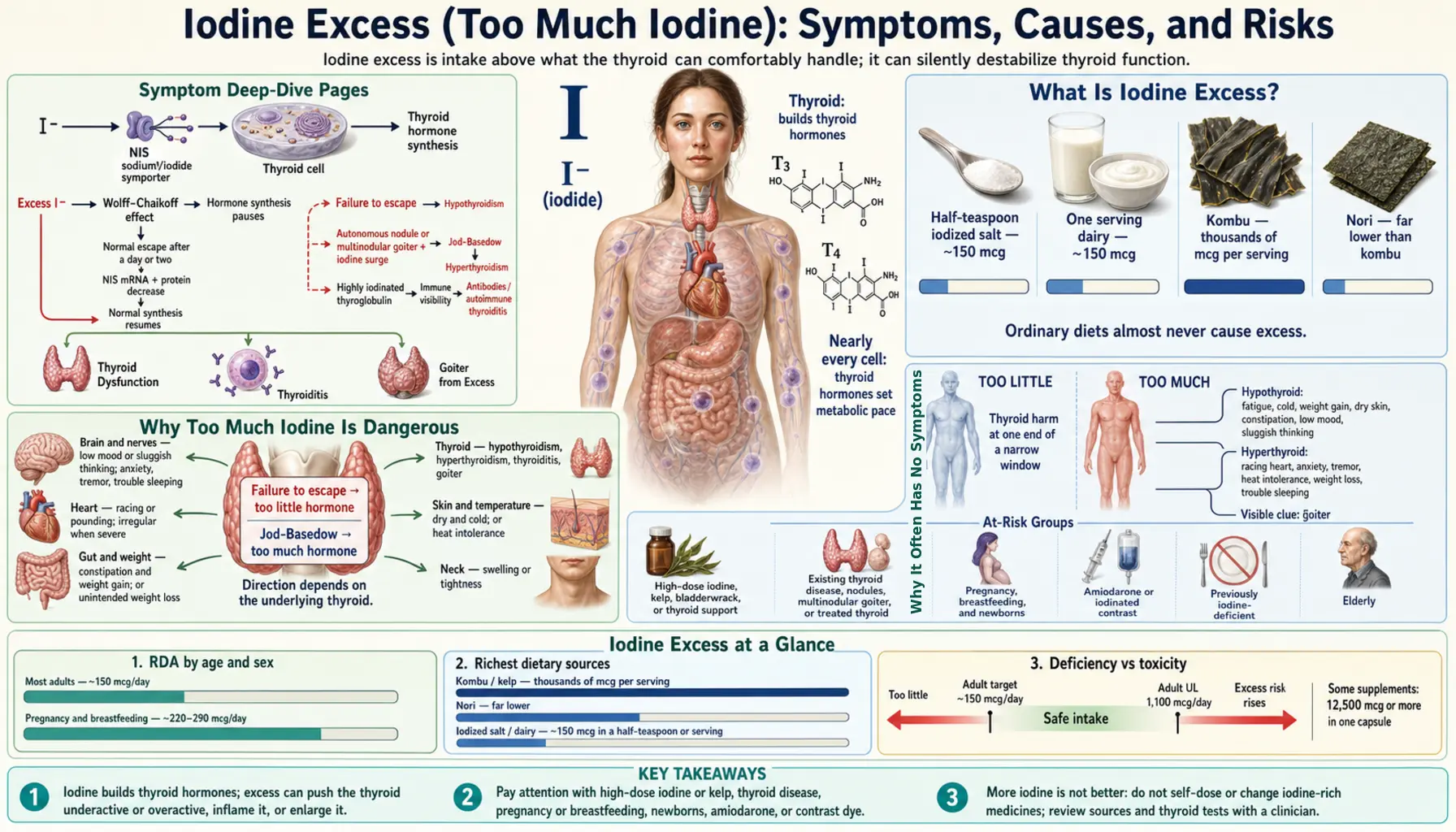
Iodine is needed to make thyroid hormones, and either low or high iodine intake may lead to thyroid disease (Teng 2006). Iodine excess means an intake well above what the body needs. Leung and Braverman (2014) describe medicines, supplements and the iodinated contrast agents used for imaging as containing up to several thousand-fold the recommended daily amount, and seaweed is a food source whose iodine content varies widely (Teas 2004). A healthy thyroid adapts to a sudden iodine load by briefly cutting hormone production (the Wolff–Chaikoff effect) and then “escaping” from it, and intakes above the recommended amount are generally well tolerated. In susceptible people — those with pre-existing thyroid disease, the elderly, fetuses and newborns — excess iodine can cause an underactive or an overactive thyroid, which may be subclinical (an abnormal TSH with thyroid hormone levels still in range) or overt, and the source of the excess may not be readily apparent (Leung and Braverman 2014). Excess intake has also been linked to goiter and thyroid autoimmunity (Farebrother 2019). This hub covers what counts as too much iodine, why excess affects the thyroid, why it is usually found on a blood test rather than felt, the main sources, and how iodine-induced thyroid problems are diagnosed and managed — with deep-dive pages on thyroid dysfunction, thyroiditis, and iodine-induced goiter. From a five-year study of three Chinese regions, Teng and colleagues concluded that more than adequate or excessive iodine intake may lead to hypothyroidism and autoimmune thyroiditis.
Symptom Deep-Dive Pages
Thyroid Dysfunction
How too much iodine can push the thyroid in either direction — into an underactive (hypothyroid) state by failing to escape the Wolff–Chaikoff effect, or into an overactive (hyperthyroid) state through the Jod-Basedow phenomenon — and who is most at risk of each.
Read the deep dive →Thyroiditis
Why a sustained iodine excess can inflame the thyroid gland and, in susceptible people, trigger or worsen autoimmune thyroiditis such as Hashimoto's — how the inflammation works, and what antibody tests have shown.
Read the deep dive →Goiter from Excess
The paradox that the same swollen thyroid (goiter) caused by iodine deficiency can also be caused by iodine excess — how a flood of iodine can enlarge the gland, who is vulnerable, and why the cause matters for treatment.
Read the deep dive →Table of Contents
What Is Iodine Excess?
Iodine is an essential trace mineral that the thyroid gland needs to make thyroid hormones (Leung and Braverman 2014). Iodine excess means an iodine intake well above what the thyroid needs. Teng and colleagues opened their 2006 study by noting that either low or high iodine intake may lead to thyroid disease, which is why excess is studied as a real problem rather than a theoretical one.
The official numbers anchor the discussion. For adults who are not pregnant or breastfeeding, the U.S. Institute of Medicine recommends 150 micrograms (mcg) of iodine a day and states a Tolerable Upper Intake Level (UL) of 1,100 mcg (1.1 mg) per day — the approximate threshold below which notable adverse effects are unlikely to occur in the healthy population (Leung and Braverman 2014). The Institute of Medicine recommends 220 mcg a day in pregnancy and 290 mcg a day during breastfeeding (Leung 2012). For scale, the USDA, FDA and NIH Office of Dietary Supplements iodine database (Release 4, 2024) lists ¼ teaspoon (1.5 g) of iodized table salt at an average of 78 mcg (26 samples, range 51–134 mcg), and a 2001–2002 Boston survey found 88–168 mcg of iodine per 250 mL of cows’ milk (Pearce 2004). Leung and Braverman list far larger amounts in medical sources: up to 13,500 mcg of free iodine in the contrast dose for one CT scan, 75,000 mcg in one 200 mg amiodarone tablet, and 50,000 mcg in one drop of a saturated solution of potassium iodide. They also report that the American Thyroid Association recommends against a daily iodine or kelp supplement containing more than 500 mcg of iodine for all individuals, except for certain medical indications.
Reviews describe iodine exposure by its source and its duration rather than by a single dramatic dose:
- A single large dose — for example, the iodinated contrast given for a CT scan. In most individuals the fall in thyroid hormone production after an iodine load is only transient, but in certain circumstances iodine excess can cause adverse thyroid effects after only a single exposure (Leung and Braverman 2014). After contrast, the body’s iodine stores stay raised: in one small US study of healthy adults, urinary iodine did not return to baseline until a median of 43 days after exposure (as reported by Leung and Braverman 2014).
- Sustained high intake — a high-dose iodine or kelp product taken daily, a long-term iodine-containing medicine, or iodine-rich water or salt. Katagiri and colleagues concluded that chronic exposure to excess iodine from water or poorly monitored salt is a risk factor for hypothyroidism in free-living populations (Katagiri 2017).
- Excess reaching an already-vulnerable thyroid — people with pre-existing thyroid disease or past iodine deficiency may be susceptible to thyroid disorders at intakes only slightly above physiological needs (Farebrother 2019). The dose that matters is partly about the person, not just the micrograms.
Two findings run through this page. First, Leung and Braverman write that salt is not generally considered a source of excess iodine; at the population level, excess intakes have been traced to over-iodized salt, drinking water, iodine-rich animal milk, certain seaweeds, iodine-containing dietary supplements, or a combination of these (Farebrother 2019). Second, thyroid dysfunction caused by excess iodine is usually mild and transient and may be subclinical — detected on a blood test rather than felt — although iodine-induced hyperthyroidism can be life-threatening in some individuals (Farebrother 2019).
Why Too Much Iodine Is Dangerous
Bürgi (2010) describes several mechanisms that keep thyroid hormone secretion normal even when iodine intake exceeds physiologic needs by a factor of 100. When those defenses fail, the gland can be pushed in either direction — toward too little hormone or too much — and which one happens depends largely on the underlying thyroid.
The first defense is a brief shutdown. In 1948 Wolff and Chaikoff reported that the organic binding of iodide in the thyroid fell when plasma iodide levels were raised — the acute Wolff–Chaikoff effect — and that the gland adapted, or “escaped”, in about 2 days despite continuing high plasma iodide (as summarised by Eng and colleagues, 1999). Markou and colleagues (2001) describe the effect as a means of rejecting large quantities of iodide so that the thyroid does not make large quantities of hormone. In rats, Eng and colleagues found that the escape is associated with a fall in the messenger RNA and protein of the sodium/iodide symporter (NIS), the pump that carries iodide into thyroid cells — less iodide gets in, and hormone-making can resume. The danger lies in the two ways this can go wrong:
- Failure to escape → underactive thyroid (hypothyroidism). Markou and colleagues list the people in whom the escape is not achieved and clinical or subclinical hypothyroidism follows: a few apparently normal individuals, newborns and fetuses, some patients with chronic systemic diseases, euthyroid patients with autoimmune thyroiditis such as Hashimoto’s, and people with Graves’ disease previously treated with radioiodine, surgery or antithyroid drugs, as well as people with a history of postpartum or subacute thyroiditis or treated with interferon-alpha (Markou 2001). Bürgi describes the same failure: in susceptible people the symporter fails to shut down, iodide inside the cells stays high, and chronic hypothyroidism ensues.
- Extra substrate → overactive thyroid (hyperthyroidism). Iodine-induced hyperthyroidism, the Jod-Basedow phenomenon, was first described in the early 1800s, when thyrotoxicosis was observed to be more common among patients with endemic goiter treated with iodine; it can be transient or permanent, and risk factors include nontoxic or diffuse nodular goiter, latent Graves’ disease and long-standing iodine deficiency (Leung and Braverman 2014). Roti and Uberti (2001) describe it as frequently observed in people with iodine-deficient goiter who are suddenly exposed to excess iodine, and Bürgi explains it by autonomous nodules in such goiters that overproduce hormone once they are given enough iodine.
Beyond pushing hormone levels up or down, sustained excess is linked with a third, slower effect: thyroid autoimmunity. Bürgi notes that more recent studies suggest chronic high iodine intake furthers classical thyroid autoimmunity, and Leung and Braverman write that high iodine intake seems to increase the prevalence of autoimmune thyroiditis in a rat model and in humans. In a five-year study of 3,018 people in three Chinese regions with mildly deficient (median urinary iodine 84 mcg/L), more-than-adequate (243 mcg/L) and excessive (651 mcg/L) iodine intake, Teng and colleagues (2006, New England Journal of Medicine) found a cumulative incidence of subclinical hypothyroidism of 0.2%, 2.6% and 2.9%, and of autoimmune thyroiditis of 0.2%, 1.0% and 1.3%, respectively; they concluded that more than adequate or excessive iodine intake may lead to hypothyroidism and autoimmune thyroiditis. A 2017 systematic review and meta-analysis (Katagiri and colleagues; 50 articles, of which three cross-sectional studies in adults were pooled) found odds ratios of 2.78 for overt and 2.03 for subclinical hypothyroidism in populations with excess versus adequate iodine, mainly from iodized salt or water; the authors note the low quality and limited number of the included studies. A review by Sun and colleagues (2014) states that iodine excess can lead to hypothyroidism and autoimmune thyroiditis, especially in susceptible people with recurring thyroid disease, the elderly, fetuses and neonates.
The deeper mechanics of each outcome live on the deep-dive pages: how excess swings the gland either way on Thyroid Dysfunction, the inflammatory and autoimmune side on Thyroiditis, and gland enlargement on Goiter from Excess. The thread through this hub is that iodine excess is not a single illness but a destabilized thyroid, and the direction it tips depends largely on the gland it lands on.
Why It Often Has No Symptoms
Iodine excess has no distinct sensation of its own. Leung and Braverman (2014) write that excess iodine exposure generally does not result in any apparent clinical consequences; when a high intake does disturb the thyroid, what a person may notice are the symptoms of an underactive or overactive thyroid — and those are nonspecific.
For hypothyroidism, a 2025 review by Chaker and Papaleontiou lists nonspecific symptoms due to metabolic slowing, including fatigue (68%–83%), weight gain (24%–59%), cognitive issues such as memory loss and difficulty concentrating (45%–48%), and menstrual irregularities (about 23%). In a Danish population study of 140 people with newly diagnosed overt autoimmune hypothyroidism and 560 matched controls, the most common symptoms were tiredness (81%), dry skin (63%) and shortness of breath (51%), but none of the individual symptoms reliably separated patients from controls (Carlé 2014). For hyperthyroidism, Lee and Pearce (2023) list anxiety, insomnia, palpitations, unintentional weight loss, diarrhea and heat intolerance as common symptoms. The onset of hypothyroidism is insidious in most cases, and symptoms may appear relatively late in the disease (Chaker 2022).
Part of the reason iodine excess is so quiet is the thyroid’s own buffering — the escape from the Wolff–Chaikoff effect. Part is that many of the changes are subclinical: subclinical hypothyroidism is an elevated TSH with free T4 still within the reference range (Chaker 2022). In the Teng study, the regions with more-than-adequate and excessive intake had a five-year incidence of subclinical hypothyroidism of 2.6% and 2.9%, against 0.5% and 0.3% for overt hypothyroidism.
For these reasons the research leans on intake histories and blood tests rather than symptoms. Because no single symptom was reliable, Carlé and colleagues concluded that even minor suspicion should lead to a blood test. The groups the research identifies as more susceptible to iodine-induced thyroid dysfunction include:
- People taking high-dose iodine or kelp products — in a case series of four patients, Hoang and colleagues (2013) described an acute worsening of thyrotoxicosis in a woman taking an over-the-counter iodine product while on methimazole, and severe, symptomatic hypothyroidism in two people with Hashimoto’s disease after a high-dose over-the-counter iodine product.
- People with existing thyroid disease — autoimmune thyroiditis (such as Hashimoto's), nodular goiter, latent Graves’ disease, or a thyroid previously treated with surgery, radioiodine or antithyroid drugs (Leung and Braverman 2014; Markou 2001).
- The elderly, fetuses and newborns (Leung and Braverman 2014). Cases of congenital hypothyroidism have been reported after mothers took excess iodine tablets during pregnancy, and hypothyroidism in newborns whose mothers ate large amounts of seaweed or seaweed soup during pregnancy or breastfeeding (as reported by Leung and Braverman 2014).
- People taking iodine-rich medicines such as amiodarone, or receiving iodinated contrast for imaging; Leung and Braverman describe thyroid dysfunction after contrast as a potential consequence in patients with nodular goiters and in elderly patients.
- People with past iodine deficiency, who may be affected at intakes only slightly above physiological needs (Farebrother 2019) and in whom long-standing deficiency is a risk factor for iodine-induced hyperthyroidism (Leung and Braverman 2014).
Feeling well on a high-dose iodine product therefore says little about its effect on the thyroid: the findings above come from thyroid blood tests and intake histories, not from how people felt.
Common Causes of Iodine Excess
Leung and Braverman (2014) list medicines, supplements and iodinated contrast agents as sources with iodine concentrations up to several thousand-fold higher than the recommended intake, and Farebrother and colleagues (2019) add over-iodized salt, drinking water, iodine-rich animal milk and certain seaweeds at the population level. The main sources described in the research:
- High-dose iodine and kelp supplements. Potassium iodide solutions are among the most concentrated: Leung and Braverman list 50,000 mcg of iodine in one drop of a saturated solution of potassium iodide. Supplement contents may not match their labels: in a 2009 US study reported by Leung and Braverman, 25 prenatal multivitamin products whose iodine came from kelp measured 33–610 mcg per daily dose against labelled values of 75–300 mcg, and 13 of them differed from the label by more than 50%. The American Thyroid Association recommends against daily iodine or kelp supplements containing more than 500 mcg of iodine, except for certain medical indications (as reported by Leung and Braverman 2014). Hoang and colleagues, reporting four patients with significant thyroid dysfunction after over-the-counter products containing large amounts of iodine, concluded that there is no valid reason for taking high-dose over-the-counter iodine supplements, which they describe as shown to cause harm with no known benefit (Hoang 2013).
- Seaweed. Teas and colleagues (2004) measured 12 species of edible seaweed sold in the United States or supplied by harvesters and found iodine ranging from 16 mcg per gram in nori to over 8,165 mcg per gram in one sample of processed kelp granules sold as a salt substitute; in two Namibian kelps it ranged from 514 to 6,571 mcg per gram depending on the condition of the blade. The authors noted that some Asian seaweed dishes may exceed the 1,100 mcg upper level, and that iodine is water-soluble in cooking, so the iodine content of prepared foods is difficult to estimate. In a 7-week randomized crossover trial in 25 postmenopausal women, seaweed capsules providing 475 mcg of iodine a day produced a small but statistically significant rise in TSH (Teas 2007). Leung and Braverman describe cases of kelp-induced thyrotoxicosis as widely reported; in one, a 39-year-old woman with multinodular goiter developed hyperthyroidism after drinking a kelp-containing herbal tea for 4 weeks (Müssig 2006).
- Iodine-containing medicines. Several drugs are rich in iodine:
- Amiodarone — a heart-rhythm medicine that is 37% iodine by weight; one 200 mg tablet contains 75,000 mcg of iodine, several hundred-fold the 150 mcg recommendation, and Leung and Braverman describe it as probably the most important and common source of medication-induced thyroid dysfunction. Overt thyroid dysfunction — amiodarone-induced thyrotoxicosis or hypothyroidism — occurs in 14–18% of treated patients (Martino 2001); Leung and Braverman report thyrotoxicosis in 9.6% of patients with low ambient iodine intake and hypothyroidism in 22.0% of patients with normal ambient iodine intake. See Arrhythmia for the rhythm conditions it treats.
- Iodinated contrast — used for CT scans and cardiac catheterization. In a nested case-control study of patients without pre-existing hyperthyroidism or hypothyroidism, contrast exposure was associated with incident hyperthyroidism (odds ratio 1.98) and with incident overt hypothyroidism (odds ratio 3.05), while the association with hypothyroidism overall was not statistically significant (Rhee 2012). Case reports describe thyroid storm after iodinated contrast, including a woman with a mildly enlarged thyroid whose thyroid storm after a contrast CT scan of the chest presented as cardiopulmonary arrest; she had a good outcome with treatment (Alkhuja 2013).
- Topical iodine antiseptics (povidone-iodine) and other products — in an Israeli study, preterm newborns cleansed with iodine antiseptics had higher TSH levels than those cleansed with alcohol-based products (15.4 versus 7.8 mIU/L), and iodine-induced thyrotoxicosis was described in a woman who had applied povidone-iodine several times daily for many years before urinary self-catheterization. Expectorants, food preservatives, parenteral nutrition preparations, mouthwashes and vaginal douches are listed as further sources (Leung and Braverman 2014).
- Excess on a vulnerable thyroid. Strictly this is a susceptibility rather than a source, but it belongs on the list. The same intake that most people tolerate can destabilize a thyroid with autoimmune disease, nodules, a nodular goiter, or a history of treatment (Leung and Braverman 2014; Markou 2001). In people with iodine-deficient goiter, a sudden increase is a frequently observed setting for iodine-induced hyperthyroidism, the Jod-Basedow phenomenon (Roti 2001).
- Population iodine programmes and water. Leung and Braverman report that thyrotoxicosis became more common after periods of mandatory salt iodization in Spain and Zimbabwe; that a 2012 study found a median urinary iodine of 730 mcg/L, in the excessive range, in two Somali refugee camps in Kenya receiving iodine supplementation; and that reversible rises in TSH were seen in US astronauts drinking iodinated water and, in the 1990s, in American Peace Corps workers in Niger whose faulty iodine-based water filtration system was the source. In the United States, an outbreak of thyrotoxicosis was described in 1926 in adults in the Great Lakes goiter belt who took iodized salt, shortly after it reached grocery shelves in 1924 (Leung 2012). Potassium iodide is also given deliberately after a nuclear accident to block uptake of radioactive iodine, as in Poland after Chernobyl (Leung and Braverman 2014).
Sources can add up: Farebrother and colleagues note that excess intake can arise from a combination of sources, and Leung and Braverman point out that the source of the excess iodine might not be readily apparent. A careful inventory of everything that could be adding iodine is the starting point in the case reports above.
How Iodine Excess Is Diagnosed
Because iodine excess shows itself as a thyroid disturbance rather than a distinct illness, it is uncovered the same way other thyroid problems are: with blood tests of thyroid function together with a history of iodine exposure. There is no single “iodine toxicity” test: Leung and Braverman (2014) write that overall iodine levels cannot be reliably measured in individuals, given the considerable day-to-day variation in iodine intake.
The cornerstone is the thyroid panel — thyroid-stimulating hormone (TSH, also called thyrotropin) with free T4, and sometimes T3. Overt primary hypothyroidism is defined as an elevated TSH with free T4 below the reference range, and subclinical hypothyroidism as an elevated TSH with free T4 within it (Chaker 2022); overt hyperthyroidism is a suppressed TSH with high T3 and/or free T4, and subclinical hyperthyroidism a low TSH with normal T3 and free T4 (Lee and Pearce 2023). Because much of the early effect of excess is subclinical, the panel can show a change before symptoms do. (For what each value means and how the hormones relate, see the Thyroid Panel page.) Other tests described in the research:
- Thyroid antibodies — in the Teng study, among people with normal thyroid function and antithyroid antibodies at baseline, the five-year incidence of an elevated TSH was greater in the regions with more-than-adequate or excessive iodine intake than in the mildly deficient region (see Hashimoto's Thyroiditis).
- Urinary iodine — the median urinary iodine concentration is used as a biomarker of a population’s iodine intake, with levels above 300 mcg/L considered excessive in children and adults and above 500 mcg/L in pregnant women (Leung and Braverman 2014). For one person, a single sample is a weak guide: in a 15-month study of 22 Swiss women, 10 repeat spot or 24-hour urine samples were needed to estimate individual iodine status with 20% precision (König 2011).
- A medication and supplement history — iodine and kelp supplements, amiodarone, recent contrast imaging and seaweed intake. Leung and Braverman note that the source of the excess iodine might not be readily apparent, and that supplements’ actual contents might not match their labels.
- Imaging — Lee and Pearce describe thyroid scintigraphy as recommended when thyroid nodules are present or the cause of hyperthyroidism is unclear. Radioiodine uptake and colour-flow Doppler ultrasound have been proposed to tell the two types of amiodarone-induced thyrotoxicosis apart (Leung and Braverman 2014). Leung and Braverman also note that uptake of radioactive iodine is inversely proportional to ambient iodine intake, and in amiodarone-treated patients thyroidal radioiodine uptake is low (Martino 2001).
Leung and Braverman conclude that, because iodine-induced hypothyroidism or hyperthyroidism may be subclinical or overt, excess iodine exposure should be suspected when the cause of thyroid dysfunction is not discernible — which is why the history matters as much as the laboratory results.
How Iodine Excess Is Managed
The management described in the research starts with the source of the iodine and then follows what the excess has done to the thyroid. Where the source is a needed medicine, the decision is made with the prescribing doctor: Leung and Braverman (2014) describe stopping amiodarone as something that might be considered if the patient tolerates it, in collaborative discussion with the patient’s cardiologist.
- Withdrawal of the source. Markou and colleagues (2001) describe iodine-induced hypothyroidism as transient, with thyroid function returning to normal 2 to 3 weeks after iodide withdrawal, though some patients need temporary T4 replacement. In the Hoang case series, thyroid dysfunction resolved in all four patients with appropriate management and discontinuation of the over-the-counter products (Hoang 2013).
- Iodine-induced hypothyroidism. Markou and colleagues add that people who develop transient iodine-induced hypothyroidism need long-term follow-up, because many will go on to develop permanent primary hypothyroidism. Levothyroxine is the first-line treatment for hypothyroidism (Chaker and Papaleontiou 2025; see Hypothyroidism). For amiodarone-induced hypothyroidism, Martino and colleagues describe levothyroxine replacement while amiodarone is continued or, if feasible, stopping amiodarone (Martino 2001).
- Iodine-induced hyperthyroidism (Jod-Basedow). Lee and Pearce (2023) list antithyroid drugs, radioactive iodine and surgery as treatment options for overt hyperthyroidism from autonomous thyroid nodules or Graves’ disease, and observation or supportive care for thyrotoxicosis from thyroiditis (see Hyperthyroidism). For amiodarone-induced thyrotoxicosis, Leung and Braverman describe type 1 (increased hormone synthesis, a form of the Jod-Basedow phenomenon) as treated with thionamides, beta-blockers and, if available, perchlorate, and type 2 (destructive thyroiditis) as usually managed with corticosteroids; thyroidectomy might be required in severe cases (Leung and Braverman 2014; Martino 2001).
- Inflammation and autoimmunity. The link between excess iodine and autoimmune thyroiditis, and what antibody tests have shown, is covered on the Thyroiditis deep-dive page.
- Goiter from excess. The mechanism of an enlarged gland linked to iodine excess, and how it is approached, is covered on Goiter from Excess.
- Follow-up testing. The hypothyroidism review by Chaker and Papaleontiou describes TSH monitoring 6 to 8 weeks after starting or changing levothyroxine. After iodinated contrast, the Contrast Media Safety Committee of the European Society of Urogenital Radiology advocates monitoring high-risk patients for thyroid dysfunction; Leung and Braverman noted that no US guideline for screening or follow-up of at-risk patients receiving contrast was available.
Taken together, the research describes supplement- and drug-driven iodine excess as identifiable from history and blood tests and, in many cases, transient once the source is removed — with the caveats that some people need temporary or permanent thyroid hormone, and that iodine-induced hyperthyroidism can be life-threatening (Farebrother 2019). The contrast with the Deficiency side shows why the same nutrient can call for more in one person and much less in another; decisions about iodine supplements, iodine-containing medicines and thyroid testing belong with a clinician.
Warning Signs Described in the Research
Because iodine excess is usually silent and slow, much of what the research describes is a situation rather than a symptom: a high-dose iodine, kelp or seaweed intake, an iodine-rich medicine, or recent contrast imaging in a person with a susceptible thyroid. The symptoms that the reviews above associate with a thyroid pushed out of balance include:
- Signs of an overactive thyroid — anxiety, insomnia, palpitations, unintentional weight loss, diarrhea and heat intolerance (Lee and Pearce 2023).
- Signs of an underactive thyroid — fatigue, weight gain, memory loss or difficulty concentrating, and menstrual irregularities (Chaker and Papaleontiou 2025); in the Danish study, tiredness, hair loss and dry skin were the symptoms most strongly associated with overt hypothyroidism (Carlé 2014).
- Neck symptoms — Lee and Pearce describe toxic thyroid nodules causing symptoms from local compression of structures in the neck, such as difficulty swallowing (dysphagia), orthopnea or voice changes.
- A clearly excessive intake — for example, a daily milligram-dose iodine or kelp product, well above the 500 mcg level the American Thyroid Association statement refers to.
Iodine-induced hyperthyroidism can be life-threatening in some individuals (Farebrother 2019), and case reports describe thyroid storm after iodinated contrast, in one case presenting as cardiopulmonary arrest (Alkhuja 2013). Untreated hypothyroidism may progress to myxedema coma, which is associated with hypothermia, low blood pressure and altered mental status, requires intensive care, and has a mortality rate of up to 30% (Chaker and Papaleontiou 2025). The groups the research places at higher risk — people with existing thyroid disease (autoimmune thyroiditis, nodules or goiter), people on amiodarone, the elderly, and fetuses and newborns — are the same groups listed above. For related conditions, see Thyroid Disorders, Graves' Disease, and the irregular-heartbeat overview at Arrhythmia. Questions about symptoms like these, and about thyroid testing, are for a clinician.
Key Research Papers
- Leung AM, Braverman LE (2014). Consequences of excess iodine. Nature Reviews Endocrinology;10(3):136-142. — DOI: 10.1038/nrendo.2013.251. — doi:10.1038/nrendo.2013.251
- Bürgi H (2010). Iodine excess. Best Practice & Research Clinical Endocrinology & Metabolism;24(1):107-115. — DOI: 10.1016/j.beem.2009.08.010. — doi:10.1016/j.beem.2009.08.010
- Teng W, Shan Z, Teng X, et al. (2006). Effect of Iodine Intake on Thyroid Diseases in China. New England Journal of Medicine;354(26):2783-2793. — DOI: 10.1056/NEJMoa054022. — doi:10.1056/NEJMoa054022
- Markou K, Georgopoulos N, Kyriazopoulou V, Vagenakis AG (2001). Iodine-Induced Hypothyroidism. Thyroid;11(5):501-510. — DOI: 10.1089/105072501300176462. — doi:10.1089/105072501300176462
- Roti E, Uberti ED (2001). Iodine Excess and Hyperthyroidism. Thyroid;11(5):493-500. — DOI: 10.1089/105072501300176453. — doi:10.1089/105072501300176453
- Katagiri R, Yuan X, Kobayashi S, Sasaki S (2017). Effect of excess iodine intake on thyroid diseases in different populations: A systematic review and meta-analyses. PLOS ONE;12(3):e0173722. — DOI: 10.1371/journal.pone.0173722. — doi:10.1371/journal.pone.0173722
- Eng PH, Cardona GR, Fang SL, et al. (1999). Escape from the Acute Wolff-Chaikoff Effect Is Associated with a Decrease in Thyroid Sodium/Iodide Symporter Messenger RNA and Protein. Endocrinology;140(8):3404-3410. — DOI: 10.1210/endo.140.8.6893. — doi:10.1210/endo.140.8.6893
- Sun X, Shan Z, Teng W (2014). Effects of Increased Iodine Intake on Thyroid Disorders. Endocrinology and Metabolism;29(3):240-247. — DOI: 10.3803/EnM.2014.29.3.240. — doi:10.3803/EnM.2014.29.3.240
- Martino E, Bartalena L, Bogazzi F, Braverman LE (2001). The Effects of Amiodarone on the Thyroid. Endocrine Reviews;22(2):240-254. — DOI: 10.1210/edrv.22.2.0427. — doi:10.1210/edrv.22.2.0427
- Rhee CM, Bhan I, Alexander EK, Brunelli SM (2012). Association Between Iodinated Contrast Media Exposure and Incident Hyperthyroidism and Hypothyroidism. Archives of Internal Medicine;172(2):153-159. — DOI: 10.1001/archinternmed.2011.677. — doi:10.1001/archinternmed.2011.677
- Pearce EN, Pino S, He X, et al. (2004). Sources of Dietary Iodine: Bread, Cows' Milk, and Infant Formula in the Boston Area. Journal of Clinical Endocrinology & Metabolism;89(7):3421-3424. — DOI: 10.1210/jc.2003-032002. — doi:10.1210/jc.2003-032002
- Leung AM, Braverman LE, Pearce EN (2012). History of U.S. iodine fortification and supplementation. Nutrients;4(11):1740-1746. — PubMed PMID: 23201844
- Farebrother J, Zimmermann MB, Andersson M (2019). Excess iodine intake: sources, assessment, and effects on thyroid function. Annals of the New York Academy of Sciences;1446(1):44-65. — PubMed PMID: 30891786
- Hoang TD, Mai VQ, Clyde PW, Shakir MK (2013). Over-the-counter-drug-induced thyroid disorders. Endocrine Practice;19(2):268-274. — PubMed PMID: 23529350
- Teas J, Pino S, Critchley A, Braverman LE (2004). Variability of iodine content in common commercially available edible seaweeds. Thyroid;14(10):836-841. — PubMed PMID: 15588380
- Teas J, Braverman LE, Kurzer MS, Pino S, Hurley TG, Hebert JR (2007). Seaweed and soy: companion foods in Asian cuisine and their effects on thyroid function in American women. Journal of Medicinal Food;10(1):90-100. — PubMed PMID: 17472472
- Müssig K, Thamer C, Bares R, Lipp HP, Häring HU, Gallwitz B (2006). Iodine-induced thyrotoxicosis after ingestion of kelp-containing tea. Journal of General Internal Medicine;21(6):C11-C14. — PubMed PMID: 16808731
- König F, Andersson M, Hotz K, Aeberli I, Zimmermann MB (2011). Ten repeat collections for urinary iodine from spot samples or 24-hour samples are needed to reliably estimate individual iodine status in women. Journal of Nutrition;141(11):2049-2054. — PubMed PMID: 21918061
- Chaker L, Razvi S, Bensenor IM, Azizi F, Pearce EN, Peeters RP (2022). Hypothyroidism. Nature Reviews Disease Primers;8(1):30. — PubMed PMID: 35589725
- Chaker L, Papaleontiou M (2025). Hypothyroidism: a review. JAMA;334(19):1750-1760. — PubMed PMID: 40900603
- Lee SY, Pearce EN (2023). Hyperthyroidism: a review. JAMA;330(15):1472-1483. — PubMed PMID: 37847271
- Carlé A, Pedersen IB, Knudsen N, Perrild H, Ovesen L, Laurberg P (2014). Hypothyroid symptoms and the likelihood of overt thyroid failure: a population-based case-control study. European Journal of Endocrinology;171(5):593-602. — PubMed PMID: 25305308
- Alkhuja S, Pyram R, Odeyemi O (2013). In the eye of the storm: iodinated contrast medium induced thyroid storm presenting as cardiopulmonary arrest. Heart & Lung;42(4):267-269. — PubMed PMID: 23711892
- U.S. Department of Agriculture, Agricultural Research Service; U.S. Food and Drug Administration; NIH Office of Dietary Supplements (2024). USDA, FDA and ODS-NIH Database for the Iodine Content of Common Foods per Serving, Release 4 (iodized table salt, ¼ tsp: 78 mcg). — USDA ARS iodine database, Release 4 (PDF)
PubMed Topic Searches
Connections
- All Minerals
- Iodine Excess: Thyroid Dysfunction
- Iodine Excess: Thyroiditis
- Iodine Excess: Goiter from Excess
- Iodine Overview
- Iodine Deficiency Hub
- Iodine Benefits Hub
- Iodine and Thyroid Function
- Thyroid Panel
- Thyroid Disorders
- Hypothyroidism
- Hyperthyroidism
- Hashimoto's Thyroiditis
- Graves' Disease
- Selenium