Iodine: History and Discovery
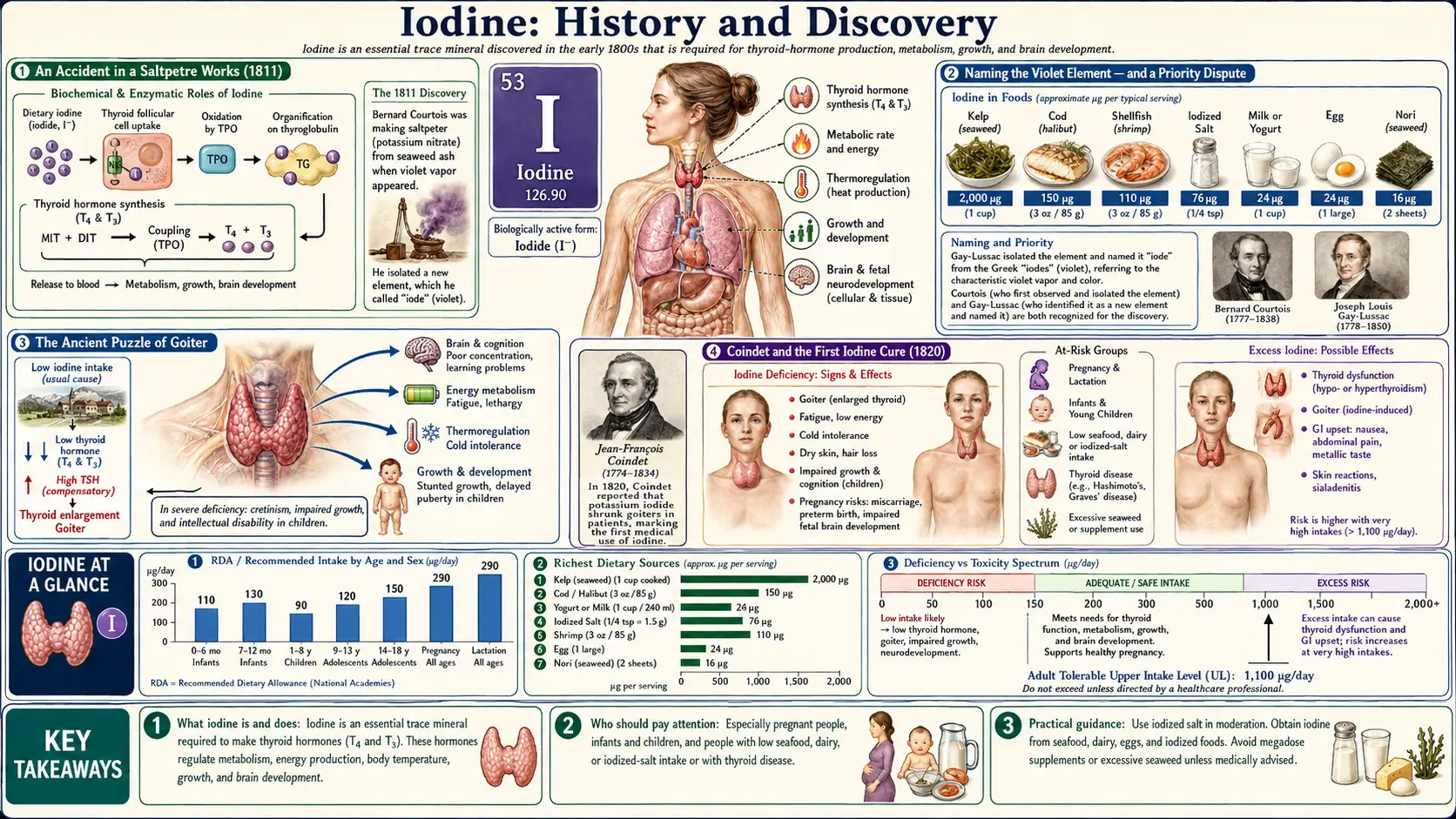
Iodine has one of the more memorable origin stories in all of chemistry: it was found by accident, in 1811, when the French chemist Bernard Courtois, extracting salts for gunpowder from seaweed ash, treated the ash with sulphuric acid and saw an unusual purple vapour rise from it. The colour of that vapour gave the element its name. But the discovery of iodine the element is only half the story. The other half — arguably the more important half for human health — is the slow, century-long discovery of why our bodies cannot do without it: the link between iodine and the thyroid gland, the recognition that iodine-poor soils breed the neck-swelling disease called goiter, and the public-health effort of iodized salt. This article tells both stories, naming the people and dates the published histories give for each step, and marking the places where those histories disagree.
Table of Contents
- An Accident in a Saltpetre Works (1811)
- Naming the Violet Element and Its First Studies
- The Ancient Puzzle of Goiter
- Coindet and the First Iodine Cure (1820)
- Boussingault, Chatin and the Deficiency Idea (1851)
- Iodine Found Inside the Thyroid (1895–96)
- Isolating and Building the Thyroid Hormone
- The Akron Trial and the Coming of Iodized Salt
- A Solved Problem That Never Quite Stays Solved
- Key Research Papers
- Connections
- Featured Videos
An Accident in a Saltpetre Works (1811)
The story begins in a factory rather than a laboratory. Bernard Courtois, a French chemist, was extracting the sodium salts needed for the manufacture of gunpowder from the ash of seaweed (Leung 2012).
In 1811, while treating this seaweed ash with sulphuric acid, Courtois observed an unusual purple vapour rising from it (Leung 2012; Zimmermann 2008; Connelly 2022). Studies of the previously unrecognised substance were continued by Joseph Louis Gay-Lussac, André Ampère, Sir Humphry Davy and others (Leung 2012), and Zimmermann's history credits Gay-Lussac with identifying the vapour as iodine, a new element (Zimmermann 2008).
Each of the published histories used for this page names Courtois as the discoverer. The first paper presenting the new element, by Gay-Lussac, was read in 1813 (Leung 2012).
Naming the Violet Element and Its First Studies
The name points straight back to that first purple vapour. Gay-Lussac's 1813 paper named the new element after the Greek word ioeides, translated as "violet-coloured" (Leung 2012). In England, Humphry Davy published his own work as "Some experiments and observations on a new substance which becomes a violet coloured gas by heat" in the Philosophical Transactions of the Royal Society of London in 1814 (Davy 1814).
Several chemists in France and England were therefore working on the substance at almost the same time (Leung 2012). The histories used for this page credit Courtois with the discovery and Gay-Lussac with identifying the new element (Zimmermann 2008); they do not settle how much of that second step belongs to each of the chemists who studied it, and this page does not try to.
The Ancient Puzzle of Goiter
To understand why iodine matters to medicine, we have to back up to a disease far older than the element's discovery: goiter, the visible swelling of the thyroid gland at the front of the neck. Goiter was particularly well known in many areas of Switzerland, although its cause was obscure (Sawin). In severe iodine deficiency, hypothyroidism results in cretinism (Leung 2012). Early Chinese medical writings, which Leung and colleagues date to approximately 3600 B.C., were the first to record that goiters shrank when people ate seaweed and burnt sea sponge, and the use of these remedies continued, as documented by Hippocrates, Galen and later writers (Leung 2012). Seaweed is among the most common dietary sources of iodine (Leung 2012), and when Coindet later had a sample of sea sponge tested, it contained iodine (Sawin) — so these old remedies were, in effect, iodine therapy long before iodine was known.
Once pure iodine was available after 1811, it was a physician in Geneva who connected the new element to the old burnt-sponge cure, and his work opens the second chapter of the iodine story: not the discovery of the element, but the discovery of what it does inside the human body.
Coindet and the First Iodine Cure (1820)
The Swiss physician Jean-François Coindet (1774–1834) was a native of Geneva who took his medical degree in Edinburgh and returned to Geneva in 1799 to practise (Sawin). Coindet suspected that iodine itself might be the active ingredient in burnt sponge; he had a sample of sea sponge tested to be sure it contained iodine, and then gave iodine directly instead of the natural products (Sawin). Zimmermann dates his hypothesis to 1813 (Zimmermann 2008), and Leung and colleagues describe him giving iodine as grains in distilled alcohol (Leung 2012). In his own hands the treatment worked in most, though not all, patients: the goiters usually either disappeared or became a great deal smaller (Sawin).
Coindet's lecture was published in 1820 and was picked up across Europe, including in an English translation in a London medical journal (Sawin). It is described as the first realisation that iodine could treat goiter (Sawin). But because iodine could be bought without a prescription, some Genevans took far more than Coindet directed, and some of them lost weight and developed palpitations, tremor and a sustained increase in appetite (Sawin). Coindet reported these outcomes the next year, 1821, and the use of iodine as a goiter treatment dropped off markedly (Sawin). Sawin identifies what Coindet saw as iodine-induced hyperthyroidism (Sawin) — the first sign in this history that iodine has a too-much as well as a too-little, a theme that runs through the rest of iodine's medical history.
Boussingault, Chatin and the Deficiency Idea (1851)
Coindet had shown that iodine could treat goiter, but not why some places suffered from it so badly. About two decades later, the French chemist Jean Baptiste Boussingault, working in the Andes Mountains, was the first to advocate prophylaxis with iodine-rich salt to prevent goiter (Zimmermann 2008); Leung and colleagues date his observations to the 1830s and describe him noting that goiter was more common where naturally iodized salt was seldom eaten (Leung 2012).
The French chemist Adolphe Chatin was the first to publish, in 1851, the hypothesis that iodine deficiency was the cause of goiter (Zimmermann 2008). Leung and colleagues cite his 1852 paper in the Comptes rendus of the Paris Academy of Sciences on iodine in fresh waters and in land plants and animals, and describe him as the first to publish the hypothesis of population iodine deficiency associated with endemic goiter (Leung 2012).
Prevention lagged far behind the idea. Attempts at iodine prophylaxis in the U.S., Switzerland, France and elsewhere were not widely adopted for many decades, because of the expense and because of iodine-induced hyperthyroidism (the Jod-Basedow phenomenon), especially in people with an underlying nodular goiter living in iodine-deficient areas (Leung 2012). Kimball's 1953 history describes Geneva physicians using iodized salt (potassium iodide, 1 mg to 10 g of salt) to treat goiter from 1842 to 1858, when the treatment was severely criticised by Rilliet and given up (Kimball 1953).
Iodine Found Inside the Thyroid (1895–96)
For most of the nineteenth century the link between iodine and goiter was clinical and circumstantial — iodine shrank the swelling, and iodine-poor regions had more of it — but nobody had shown iodine inside the thyroid gland itself. That step was taken by the German chemist Eugen Baumann, who found that iodine is a normal constituent of thyroid tissue. The histories date it differently: one to 1895 (Vanderpas 2017), others to 1896, crediting Baumann and Roos (Zimmermann 2008; Leung 2012).
In Zimmermann's account, this finding established the link between goiter, myxoedema and iodine, after Semon had suggested in 1883 that myxoedema was due to thyroid insufficiency (Zimmermann 2008); Leung and colleagues describe it as confirming Chatin's hypothesis (Leung 2012). With iodine shown to be part of the gland itself, the next question followed: what exactly is the iodine-containing substance the thyroid makes, and can it be isolated in pure form?
Isolating and Building the Thyroid Hormone
The first breakthrough belongs to Edward Calvin Kendall (1886–1972) (Raju 1999). Kendall moved to the Mayo Foundation in Rochester, Minnesota, in 1914, and by December 1914 had isolated thyroxine in crystalline form (Kaouache 2024); one history dates the discovery to Christmas Day 1914 (Connelly 2022). His report appeared in JAMA on 19 June 1915 (Kendall 1915). In it he described a pure crystalline compound containing 60 per cent iodine which, given to dogs and to people, produced a rapid increase in pulse rate, metabolism and nervous irritability, and which was toxic in excess; he took it to be di-iodo-di-hydroxy-indol (Kendall 1915). (Kendall's later share of the 1950 Nobel Prize in Physiology or Medicine, with Philip Hench and Tadeus Reichstein, was for work on the hormones of the adrenal cortex, not for thyroxine (Burns 2016; Kaouache 2024).)
The constitution of the molecule was worked out next, in Britain. Charles Robert Harington (1897–1972) (Neuberger 1972), at University College Hospital Medical School in London, published in 1926 an isolation of thyroxine from the thyroid gland and the constitution and synthesis of desiodo-thyroxine (Harington 1926a; Harington 1926b). In 1927, with George Barger, he published the constitution and synthesis of thyroxine itself (Harington and Barger 1927).
By the late 1920s, then, the chain was complete: iodine is an element (Courtois, 1811); iodine shrinks goiter (Coindet, published 1820); goiter is caused by iodine deficiency (Chatin, 1851); iodine is a normal part of the thyroid (Baumann, 1895–96); the thyroid's iodine compound can be isolated in crystalline form (Kendall, 1914); and its constitution was established by synthesis (Harington and Barger, 1927). What remained was to turn this knowledge into something that could protect whole populations.
The Akron Trial and the Coming of Iodized Salt
The leap from understanding iodine to preventing iodine deficiency on a population scale was made in Switzerland and the United States in the early 1920s (Leung 2012). Before then, endemic iodine deficiency was prevalent in the Great Lakes, Appalachian and Northwestern regions of the U.S., an area known as the "goiter belt", where 26%–70% of children had clinically apparent goiter (Leung 2012). During the World War I draft, the Michigan physician Simon Levin found thyromegaly in 30.3% of 583 registrants, and later surveys found goiter in as many as 64.4% of people in some parts of Michigan (Leung 2012). David Marine, a physician in Ohio (Leung 2012), had been teaching as early as 1915 that "endemic goitre is the easiest known disease to prevent", on the basis of ten years of experimental study of the thyroid (Kimball 1953).
Marine and Oliver P. Kimball began an iodine prophylaxis program among schoolgirls in Akron, Ohio. Their October 1917 paper in the Journal of Laboratory and Clinical Medicine surveyed thyroid enlargement in the Akron schoolgirls from the 5th to the 12th grades and set out the plan of prevention (Marine and Kimball 1917). The published sources give different figures for the program's size. Leung and colleagues' 2012 history states that the program began in 1917 in more than 2,100 schoolgirls, and that the papers that followed reported goiter in 0.2% of children treated with iodine, against more than 25% of children who did not receive it (Leung 2012). Kimball's own 1953 account describes the experiment as planned late in 1916 and carried out over four years (1916–20), with approximately 5,000 girls aged 11 to 18 taking 3 grains of sodium iodide daily in their drinking water for ten days each spring and autumn, and an equal number who preferred not to be treated serving as controls; of the treated girls whose thyroids were normal at the first examination, not one developed goiter, while half of the controls classed as normal developed thyroid enlargement (Kimball 1953). The original 1917–1920 reports were not available in full text for this page, so the exact enrolment is not settled here.
Kimball wrote that the experiment was quickly taken up in other countries, with Switzerland starting similar prophylaxis in several cantons (Kimball 1953). Iodized salt was introduced in Switzerland in 1922 (Kimball 1953), and Switzerland's iodized salt program has operated without interruption since then (Zimmermann 2008).
In the U.S., the campaign centred on Michigan. In 1922 David Cowie, chairman of the Pediatrics Department at the University of Michigan, proposed at a Michigan State Medical Society thyroid symposium that the U.S. adopt salt iodization to eliminate simple goiter, and his work with the Society's Iodized Salt Committee over the next few years was instrumental (Leung 2012). Iodized salt first went on sale in Michigan on 1 May 1924, initially fortified at 100 mg of iodine per kg of salt (Leung 2012). Kimball describes the program as a co-operation of the salt producers, the wholesale grocers and the State Department of Health, with no law or mandate (Kimball 1953). In the four Michigan counties used as the index of goiter in the state, goiter among schoolchildren was 38.6% in 1924, 8.2% in 1936 and 1.4% in 1951, when more than 50,000 schoolchildren were examined (Kimball 1953). The double edge Coindet saw reappeared: in 1926 Hartsock described an outbreak of thyrotoxicosis in adults in the Great Lakes region who took iodized salt (Leung 2012). U.S. salt iodization has stayed voluntary; a 1948 bill to make iodized salt mandatory in all states was defeated (Leung 2012). Zimmermann's 2009 review describes carefully monitored universal salt iodization as one of the most cost-effective ways to contribute to economic and social development (Zimmermann 2009).
A Solved Problem That Never Quite Stays Solved
It would be satisfying to end the history in 1924, with the problem solved. The reality is more complicated. In 1990 the United Nations World Summit for Children set the goal of eliminating iodine deficiency worldwide (Leung 2012; WHO 2014); the World Health Assembly adopted the goal of eliminating it as a public-health problem in 1991, and in 1993 WHO and UNICEF recommended universal salt iodization as the main strategy (WHO 2014). The 2014 WHO guideline reports that salt iodization had been implemented in more than 120 countries and that 71% of households worldwide were estimated to have access to adequately iodized salt, while iodine deficiency disorders remained a public-health problem where programs were weakly implemented (WHO 2014). The guideline describes iodine deficiency disorders as usually the most common cause of preventable impaired cognitive development (WHO 2014).
The link between iodine and the developing brain was tested directly in the 1970s: a randomized trial in New Guinea showed that correcting severe iodine deficiency early in pregnancy prevents endemic neurological cretinism, and a randomized trial in Congo (DR) showed that correcting it during pregnancy prevents myxoedematous cretinism (Vanderpas 2017). A 2005 meta-analysis of 37 Chinese studies with 12,291 children found that children living in severely iodine-deficient areas without supplementation scored 12.45 IQ points lower than children in iodine-sufficient communities (Qian 2005).
Even in countries that adopted iodized salt long ago, iodine status is not fixed. In the U.S., most salt is thought to be eaten in processed foods, which are made mainly with non-iodized salt, and median urinary iodine fell by about 50% between the early 1970s and the early 1990s before stabilizing, although the population overall remained iodine sufficient (Leung 2012). This is why public-health bodies continue to monitor iodine status rather than treating the problem as settled. The detailed physiology, the modern dietary sources, the safety considerations, and the role of cofactors such as selenium are taken up in depth on the main Iodine page and in the companion Iodine Benefits articles.
The arc of this history is a long one. A purple vapour over seaweed ash in 1811 had nothing obvious to do with the swollen necks of Swiss villagers or the cretinism of children in iodine-deficient regions. It took more than a hundred years, and a chain of named people — Courtois, Gay-Lussac and Davy, Coindet, Boussingault, Chatin, Baumann, Kendall, Harington and Barger, Marine and Kimball, Cowie — to connect that vapour to the fortified salt now used in households around the world: the chemistry that found the element, and the medicine that found its purpose.
Key Research Papers
The list below combines peer-reviewed historical reviews of iodine and iodine-deficiency research with curated PubMed topic-search links. Where an original report is indexed (Davy 1814, Marine and Kimball 1917, Kendall 1915, Harington 1926 and 1927), it is listed; Courtois's and Gay-Lussac's papers, Coindet's 1820 lecture, Chatin's reports and Baumann's paper are described in the text through the reviews that discuss them. Author names, titles, and journals below are given as plain text; only the stable DOI, PMID, or archive link is hyperlinked, and each opens in a new tab.
- Zimmermann MB. Research on iodine deficiency and goiter in the 19th and early 20th centuries. The Journal of Nutrition. 2008;138(11):2060-2063. — doi:10.1093/jn/138.11.2060 · PubMed PMID: 18936198
- Zimmermann MB. Iodine deficiency. Endocrine Reviews. 2009;30(4):376-408. — doi:10.1210/er.2009-0011 · PubMed PMID: 19460960
- Leung AM, Braverman LE, Pearce EN. History of U.S. iodine fortification and supplementation. Nutrients. 2012;4(11):1740-1746. — doi:10.3390/nu4111740 · PubMed PMID: 23201844
- Harington CR, Barger G. Chemistry of thyroxine: constitution and synthesis of thyroxine. Biochemical Journal. 1927;21(1):169-183. — doi:10.1042/bj0210169 · PubMed PMID: 16743801. Reprinted as a Nutrition classics article in Nutrition Reviews. 1986;44(8):274-276. — PubMed PMID: 3528945
- Sawin CT. Discoverers of Thyroid Landmarks: Jean-François Coindet (1774-1834) and the treatment of goiter with iodine. American Thyroid Association historical archive. — ATA: Coindet and iodine treatment of goiter (PDF)
- Kimball OP. History of the prevention of endemic goitre. Bulletin of the World Health Organization. 1953;9(2):241-248. — PubMed PMID: 13094512
- Marine D, Kimball OP. The prevention of simple goiter in man. A survey of the incidence and types of thyroid enlargements in the schoolgirls of Akron (Ohio), from the 5th to the 12th grades, inclusive — the plan of prevention proposed. Journal of Laboratory and Clinical Medicine. 1917;3(1):40-49; reprinted in Journal of Laboratory and Clinical Medicine. 1990;115(1):128-136. — PubMed PMID: 2405081
- Davy H. Some experiments and observations on a new substance which becomes a violet coloured gas by heat. Philosophical Transactions of the Royal Society of London. 1814:74-93. — doi:10.1098/rstl.1814.0007
- Kendall EC. The isolation in crystalline form of the compound containing iodin, which occurs in the thyroid. Its chemical nature and physiologic activity. JAMA. 1915 (reprinted as a Landmark article, JAMA. 1983;250(15):2045-2046). — PubMed PMID: 6352971
- Harington CR. Chemistry of thyroxine: isolation of thyroxine from the thyroid gland. Biochemical Journal. 1926;20(2):293-299. — doi:10.1042/bj0200293 · PubMed PMID: 16743658
- Harington CR. Chemistry of thyroxine: constitution and synthesis of desiodo-thyroxine. Biochemical Journal. 1926;20(2):300-313. — doi:10.1042/bj0200300 · PubMed PMID: 16743659
- Vanderpas JB, Moreno-Reyes R. Historical aspects of iodine deficiency control. Minerva Medica. 2017;108(2):124-135. — doi:10.23736/S0026-4806.17.04884-4 · PubMed PMID: 28079353
- Connelly KJ, Park JJ, LaFranchi SH. History of the thyroid. Hormone Research in Paediatrics. 2022;95(6):546-556. — doi:10.1159/000526621 · PubMed PMID: 36446327
- Kaouache N, Nouri N. Edward Calvin Kendall: a pioneer in biochemistry and endocrinology. Cureus. 2024;16(9):e69420. — doi:10.7759/cureus.69420 · PubMed PMID: 39403659
- Raju TN. The Nobel chronicles. 1950: Edward Calvin Kendall (1886-1972); Philip Showalter Hench (1896-1965); and Tadeus Reichstein (1897-1996). The Lancet. 1999;353(9161):1370. — doi:10.1016/s0140-6736(05)74374-9 · PubMed PMID: 10218568
- Burns CM. The history of cortisone discovery and development. Rheumatic Disease Clinics of North America. 2016;42(1):1-14. — doi:10.1016/j.rdc.2015.08.001 · PubMed PMID: 26611547
- Neuberger A. Sir Charles Harington (1897-1972). Biochemical Journal. 1972;129(4):801-804. — doi:10.1042/bj1290801 · PubMed PMID: 4570567
- Qian M, Wang D, Watkins WE, Gebski V, Yan YQ, Li M, Chen ZP. The effects of iodine on intelligence in children: a meta-analysis of studies conducted in China. Asia Pacific Journal of Clinical Nutrition. 2005;14(1):32-42. — PubMed PMID: 15734706
- World Health Organization. Guideline: fortification of food-grade salt with iodine for the prevention and control of iodine deficiency disorders. Geneva: WHO; 2014. — WHO IRIS 10665/136908
PubMed Topic Searches
- Iodine deficiency — history of discovery and prevention PubMed: iodine deficiency, goiter, and iodized-salt history
- Discovery of iodine and the thyroid hormones PubMed: history of iodine and thyroxine discovery