Molybdenum: History and Discovery
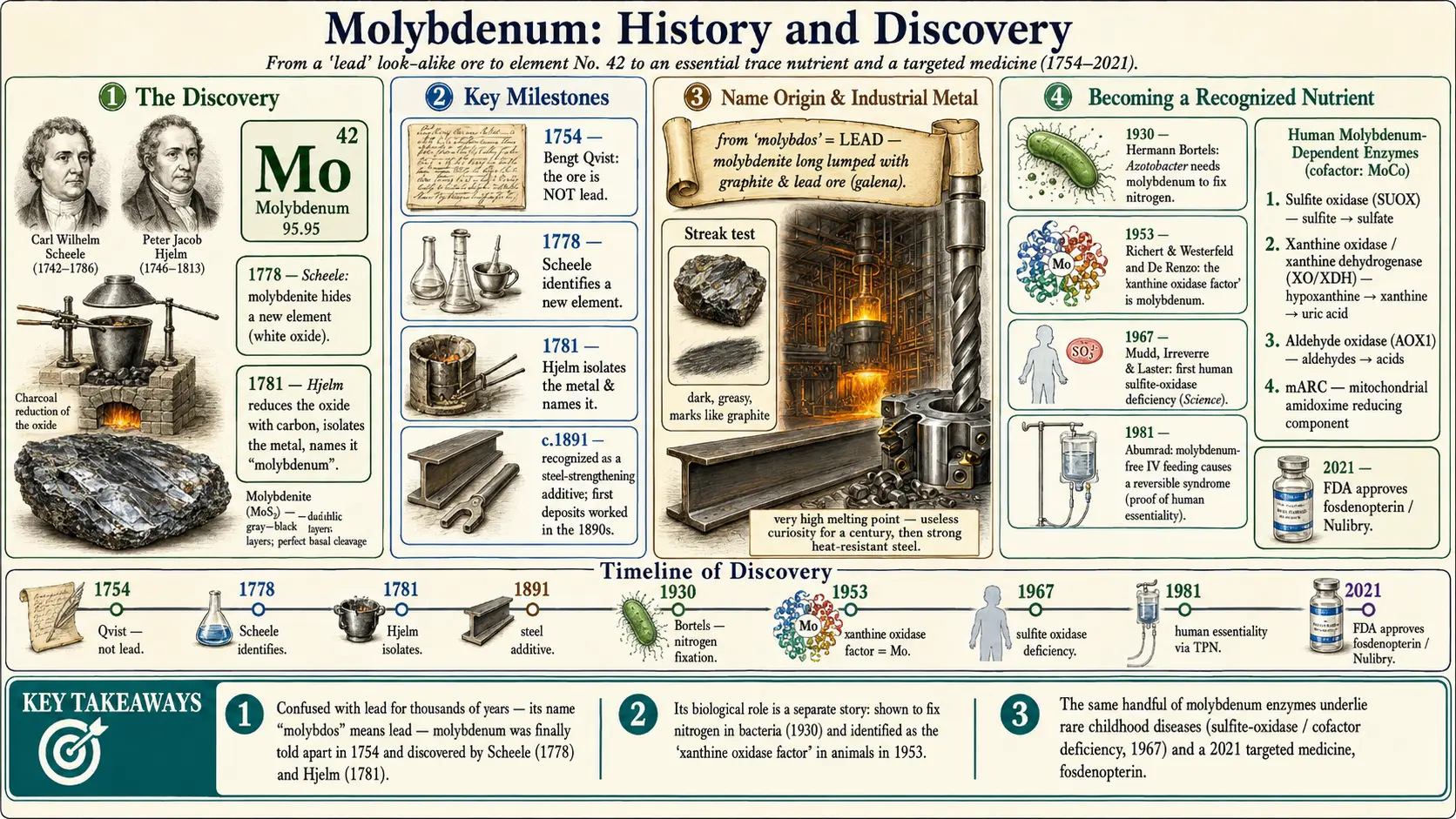
Molybdenum has one of the more confusing origin stories of any element, because for centuries nobody knew it existed. Its main ore is a soft, dark, greasy mineral that looks so much like graphite and like lead ore that the ancient Greeks lumped all three together under one word — molybdos, meaning “lead.” That mix-up is literally baked into the metal's name. This article traces what the historical record actually supports: how the ore was finally told apart from lead, the well-documented two-step discovery of the element by the Swedish chemists Carl Wilhelm Scheele (1778) and Peter Jacob Hjelm (1781), and then a second, completely separate discovery story — the slow realization, beginning in the 1930s and proven in 1953, that this obscure industrial metal is also an essential nutrient that our own enzymes cannot work without. Where the record is firm we say so; where a date is approximate or a claim is debated, we mark it as such.
Table of Contents
- A Name Borrowed from Lead
- Telling the Ore Apart from Lead (1754)
- Discovery of the Element: Scheele and Hjelm (1778–1781)
- From Curiosity to Industrial Metal
- A Second Discovery: Molybdenum as a Nutrient
- The Xanthine Oxidase Factor (1953)
- The Molybdenum Cofactor and Human Disease
- Proving It Matters in People
- Research Papers and References
- Connections
- Featured Videos
A Name Borrowed from Lead
The word molybdenum comes from the Ancient Greek molybdos (μόλυβδος), which simply means “lead.” That sounds strange for a metal that has nothing chemically to do with lead, and the explanation is a case of mistaken identity that lasted thousands of years. The Greeks used molybdos — and the related word molybdaina — loosely, for lead itself, for lead ore (galena), and for any soft, dark, heavy mineral that left a grey mark and could plausibly be lumped in with them.
Two minerals in particular got swept into this group. One was graphite (the “lead” in a pencil, which also contains no lead). The other was the mineral we now call molybdenite — molybdenum disulfide. Molybdenite is dark, metallic, and greasy to the touch, and it streaks like graphite, so for centuries it was treated as interchangeable with both graphite and lead ore. When the element was finally pulled out of that mineral, it inherited the old name. So the metal is called “lead-like” not because of what it is, but because of the rock it came hidden inside.
Telling the Ore Apart from Lead (1754)
The first crack in the centuries-old confusion is usually credited to the Swedish chemist Bengt Andersson Qvist, who in 1754 examined molybdenite and concluded that, whatever it was, it did not contain lead. This was an important negative result: it separated molybdenite from galena (lead ore) and showed that the dark mineral was its own distinct substance rather than just another form of the lead family.
What Qvist could not yet do was say what molybdenite actually was. Distinguishing it from lead is not the same as identifying the new element locked inside it, and the mineral was still widely confused with graphite. So 1754 marks the moment the question came into focus — “if it is not lead, then what is it?” — rather than the moment it was answered. That answer came a generation later, from one of the most productive chemists of the age.
Discovery of the Element: Scheele and Hjelm (1778–1781)
The discovery of molybdenum is one of the well-documented two-person stories in the history of chemistry. In 1778, the Swedish-German pharmacist and chemist Carl Wilhelm Scheele — the same prolific experimenter associated with the discovery of several elements and compounds — studied molybdenite carefully. By treating it with hot nitric acid, he showed two things at once: the mineral was not lead, and it was not graphite either. Instead, he reasoned, it contained a previously unknown element, which he obtained as a white oxide (molybdenum trioxide). Scheele had identified the new element, but he could not isolate the metal itself, in part because molybdenum has an extremely high melting point and resists ordinary smelting.
Scheele passed the problem — and a sample of the oxide — to his colleague Peter Jacob Hjelm. In 1781, Hjelm succeeded in reducing the oxide using carbon, producing an impure sample of the metal for the first time. It is Hjelm who is generally credited with giving the element its enduring name, molybdenum, after molybdenite, the ore it came from. The division of credit is usually stated plainly: Scheele recognized that a new element was present, and Hjelm first isolated it in metallic form. Both men are named in the standard accounts, and the 1778 and 1781 dates are well established.
It is worth being honest about what “isolated” meant in 1781. Hjelm's metal was impure by modern standards, and producing pure molybdenum metal in quantity remained difficult for more than a century afterward because of its very high melting point. But the essential chemical discovery — that molybdenite hides a genuine, distinct chemical element — belongs firmly to Scheele and Hjelm and to those few years at the end of the 1770s.
From Curiosity to Industrial Metal
For more than a hundred years after its discovery, molybdenum was a laboratory curiosity with no practical use — partly because it was so hard to refine and partly because no one had found a job for it. That changed near the end of the nineteenth century, when metallurgists discovered that adding small amounts of molybdenum to steel produced an alloy that was unusually strong and tough, and that held its strength at high temperatures. Sources commonly date the recognition of molybdenum as a steel-strengthening additive to around 1891, with the first commercial deposits being worked in the 1890s.
This industrial chapter matters to the health story for one quiet reason: it is why molybdenum became plentiful, mined, studied, and available in the laboratory at all. The same metal that strengthens armor plate and high-speed cutting tools is also, in vanishingly small amounts, a nutrient. The transition from “useless curiosity” to “essential trace element” is one of the more surprising turns in the element's history — and that turn happened almost entirely in the twentieth century, which is where the rest of this article lives.
A Second Discovery: Molybdenum as a Nutrient
The discovery that molybdenum is biologically essential is a separate story from the discovery of the element, and it began not in human medicine but in the soil. In 1930, the German microbiologist Hermann Bortels reported that the bacterium Azotobacter needs molybdenum in order to fix atmospheric nitrogen — that is, to pull nitrogen out of the air and turn it into a form living things can use. This was the first time anyone had shown that molybdenum played any biological role at all, and it established the metal as essential for that bacterial chemistry. (It later turned out that molybdenum sits at the heart of the nitrogenase enzyme that performs this reaction, which is why molybdenum is important to plant and crop nutrition as well.)
Bortels' finding planted an obvious question: if bacteria need molybdenum, do animals? For roughly two decades the answer was unclear. The metal was present in animal tissues, but presence is not the same as necessity, and it was not obvious what, if anything, molybdenum was doing inside a mammal. The breakthrough on that front came in 1953, and it linked molybdenum to a single enzyme that was already well known to biochemists.
The Xanthine Oxidase Factor (1953)
By the late 1940s, researchers studying the enzyme xanthine oxidase — the enzyme that helps the body break down purines into uric acid — knew that full activity required some additional ingredient beyond the parts they had already identified. Dan A. Richert and W. W. Westerfeld had been chasing this mysterious component, at first calling it the “liver residue factor” and then the “xanthine oxidase factor,” without yet knowing what it was.
In 1953 the mystery was solved, and notably it was solved twice, independently, in the same year. Richert and Westerfeld reported the “isolation and identification of the xanthine oxidase factor as molybdenum” in the Journal of Biological Chemistry. In the same year, Edward C. De Renzo and colleagues independently identified the same factor as molybdenum, reporting it in the Journal of the American Chemical Society and following up with confirmatory work the next year. Together these reports established, for the first time, that molybdenum has a direct role in the metabolism of animals — it is the metal that makes xanthine oxidase work.
This is the pivotal moment in molybdenum's nutritional history, and it deserves to be stated as plainly as the Scheele–Hjelm discovery. Where 1778–1781 answered “what is this element?”, 1953 answered “what does this element do inside us?” The answer — that molybdenum is a working part of a human enzyme — is the foundation on which everything about molybdenum-as-a-nutrient is built. The next two sections describe how that single insight expanded into a whole family of enzymes and, eventually, into the clinic.
The Molybdenum Cofactor and Human Disease
Once molybdenum was tied to xanthine oxidase, biochemists found it in other enzymes as well — including sulfite oxidase, the enzyme that converts toxic sulfite into harmless sulfate, and aldehyde oxidase. A crucial later insight was that molybdenum does not act inside these enzymes as a bare metal atom. It must first be wrapped inside a special organic carrier molecule, now called the molybdenum cofactor (often abbreviated Moco). Without that cofactor, the metal cannot do its job, and all of the molybdenum-dependent enzymes fall silent at once.
The human cost of this became clear in 1967, when S. Harvey Mudd, F. Irreverre, and L. Laster described the first known human case of sulfite oxidase deficiency in the journal Science. They reported an infant with severe neurological damage and dislocated lenses whose tissues lacked sulfite oxidase activity and whose urine carried the chemical fingerprints of un-detoxified sulfite. This was the first documented inborn error of metabolism in this pathway, and it showed, tragically, exactly what is at stake when molybdenum chemistry fails in a person. Later work distinguished isolated sulfite oxidase deficiency from the broader molybdenum cofactor deficiency, in which the cofactor itself cannot be made and several enzymes fail together.
The historical arc here is striking: a metal once confused with lead turned out to sit at the center of a cluster of rare, devastating childhood diseases. Understanding the molybdenum cofactor is what eventually made it possible to even attempt a treatment — the subject the final section returns to.
Proving It Matters in People
Showing that molybdenum runs human enzymes is not quite the same as showing that a person can become deficient in it from diet. Because the body needs so little molybdenum, and because it is so widespread in ordinary food, true dietary deficiency essentially never happens in healthy people eating normally. The clearest demonstration that molybdenum is genuinely required by humans came from an unusual clinical situation. In 1981, Naji N. Abumrad and colleagues reported, in the American Journal of Clinical Nutrition, the case of a patient kept alive for many months on intravenous feeding (total parenteral nutrition) that happened to lack molybdenum. The patient developed a syndrome of intolerance to amino acids — with a rapid heart rate, rapid breathing, headache, night blindness, and worsening mental state — together with telltale biochemical signs: disordered sulfur handling and abnormally low uric acid. Adding molybdate to the feeding reversed the problem. This case is widely cited as the practical proof that molybdenum is an essential nutrient for humans, not merely for bacteria and laboratory enzymes.
The most recent chapter is therapeutic. Because molybdenum cofactor deficiency type A is caused by an inability to make an early building block of the cofactor called cyclic pyranopterin monophosphate (cPMP), researchers reasoned that supplying that missing building block might help. In 2021, the U.S. Food and Drug Administration approved fosdenopterin (brand name Nulibry), a manufactured form of cPMP, as the first treatment shown to reduce the risk of death in molybdenum cofactor deficiency type A. It is a remarkable place for the story to arrive: from a mineral mistaken for lead, to an essential trace element, to a rare inherited disease, to a targeted medicine — all turning on the same handful of molybdenum-dependent enzymes first glimpsed in 1953. The detailed biochemistry, dosing, food sources, and clinical cautions are covered on the main Molybdenum page and in the Molybdenum Benefits articles; this history is concerned only with how molybdenum came to be known and understood.
Research Papers and References
The list below combines the primary papers that mark molybdenum's discovery as an essential nutrient with curated PubMed topic-search links into the historical and biochemical literature. The eighteenth-century discovery of the element by Carl Wilhelm Scheele (1778) and Peter Jacob Hjelm (1781) is documented in the historical and mineralogical sources listed under External Resources rather than in modern journal citations. Author names, titles, and journals are given as plain text; only the stable DOI, PMID, or archive link is hyperlinked, and each opens in a new tab.
- Richert DA, Westerfeld WW. Isolation and identification of the xanthine oxidase factor as molybdenum. Journal of Biological Chemistry. 1953;203(2):915-923. — doi:10.1016/S0021-9258(19)52361-4 · PMID: 13084661 (Primary identification of molybdenum as the “xanthine oxidase factor” in animal metabolism; see the De Renzo references below for the concurrent, independently published confirmation.)
- De Renzo EC, Kaleita E, Heytler PG, Oleson JJ, Hutchings BL, Williams JH. The nature of the xanthine oxidase factor. Journal of the American Chemical Society. 1953;75(3):753. — doi:10.1021/ja01099a515
- De Renzo EC, Heytler PG, Kaleita E. Further evidence that molybdenum is a cofactor of xanthine oxidase. Archives of Biochemistry and Biophysics. 1954;49(1):242-244. — PMID: 13139688
- Mudd SH, Irreverre F, Laster L. Sulfite oxidase deficiency in man: demonstration of the enzymatic defect. Science. 1967;156(3782):1599-1602. — doi:10.1126/science.156.3782.1599 · PMID: 6025118
- Abumrad NN, Schneider AJ, Steel D, Rogers LS. Amino acid intolerance during prolonged total parenteral nutrition reversed by molybdate therapy. American Journal of Clinical Nutrition. 1981;34(11):2551-2559. — doi:10.1093/ajcn/34.11.2551
- Farrell S, Karp J, Hager R, et al. Regulatory news: Nulibry (fosdenopterin) approved to reduce the risk of mortality in patients with molybdenum cofactor deficiency type A — FDA approval summary. Journal of Inherited Metabolic Disease. 2021;44(5):1085-1087. — doi:10.1002/jimd.12421 · PMID: 34337775
- Molybdenum — discovery, history, and the molybdenum cofactor — PubMed: molybdenum cofactor history and discovery
- Molybdenum essentiality and human deficiency — PubMed: molybdenum as an essential trace element in humans
External Authoritative Resources
- International Molybdenum Association — History of Molybdenum (Scheele 1778, Hjelm 1781)
- NIH Office of Dietary Supplements — Molybdenum (Health Professional Fact Sheet)
- Linus Pauling Institute — Molybdenum
- PubMed — molybdenum enzyme research