Magnesium Glycinate: History and Discovery
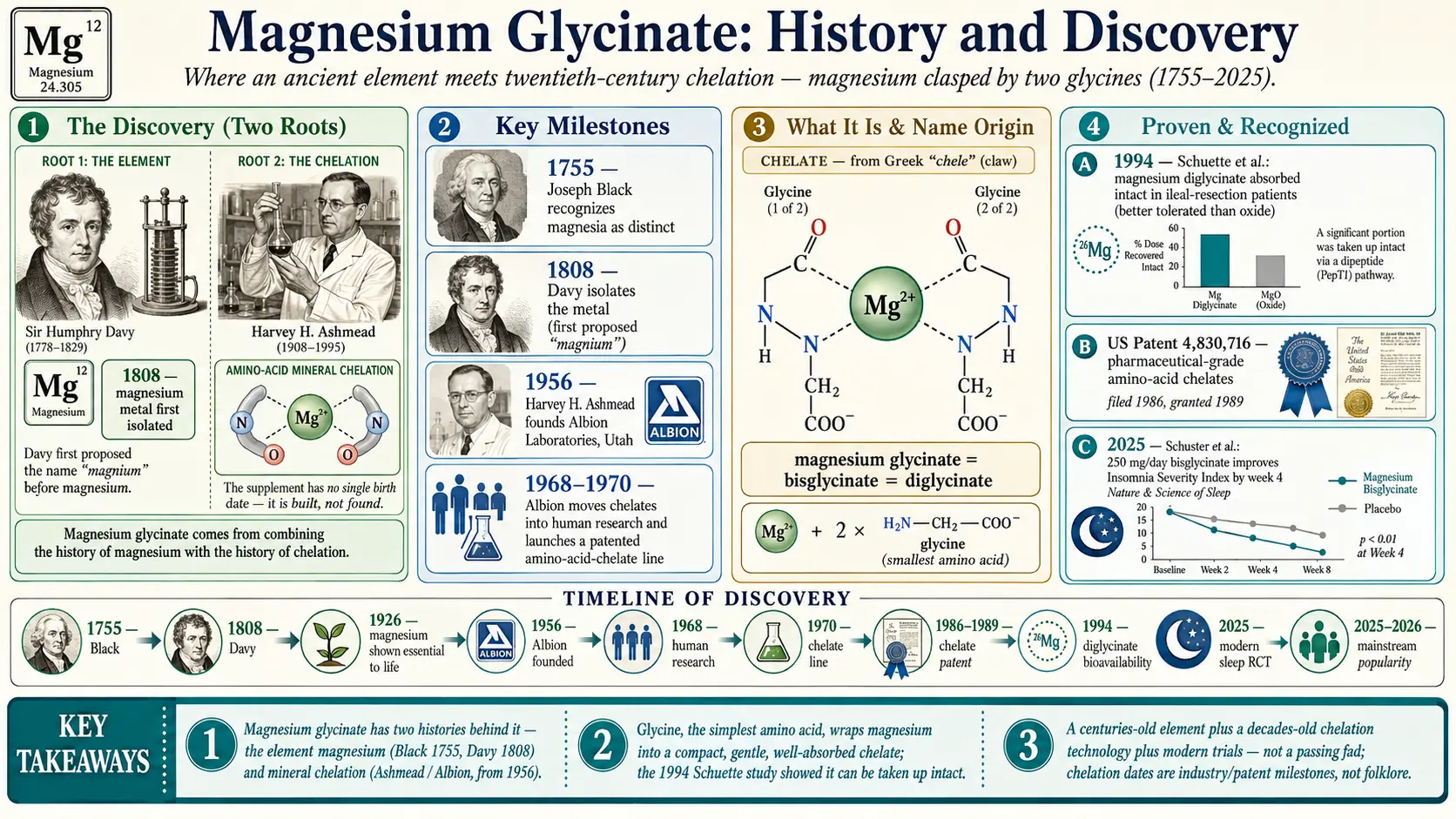
Magnesium glycinate is not a substance that was dug from the ground or found in nature; it is a deliberately built molecule with two quite separate histories behind it. One is the story of the element magnesium itself — a metal first recognised as distinct by the Scottish chemist Joseph Black in 1755, first isolated as a pure metal by Sir Humphry Davy in 1808, and only shown to be essential to life much later. The other is the story of chelation: the mid-twentieth-century idea of binding a mineral to an amino acid so the body could absorb it more easily, a line of work led above all by the American researcher Harvey H. Ashmead and his company Albion Laboratories. Magnesium glycinate — magnesium clasped by two molecules of the amino acid glycine — sits exactly where those two histories meet. This article tells both, names the people the record actually credits, gives their dates, and is careful to mark where a claim is firmly documented and where it is approximate or still a matter of commercial rather than scientific record.
Interactive Visualization Magnesium — the mineral that makes ATP work Bare ATP is useless and enzymes reject it. Watch magnesium clamp the phosphates and switch it on, plug the NMDA channel, and let a cramping muscle finally let go. Launch →
Table of Contents
- What Magnesium Glycinate Actually Is
- Magnesia: A Name From Ancient Greece
- Joseph Black and the Recognition of Magnesia (1755)
- Humphry Davy Isolates the Metal (1808)
- Discovering That Magnesium Is Essential to Life
- The Birth of Mineral Chelation
- How Magnesium Glycinate Came to Be
- From Niche Chelate to Best-Selling Supplement
- Research Papers and References
- Connections
- Featured Videos
What Magnesium Glycinate Actually Is
Before tracing the history it is worth being clear about what magnesium glycinate is, because that shapes the whole story. It is a chelate: a single atom of the metal magnesium held in the grip of two molecules of the amino acid glycine. The word "chelate" comes from the Greek chele, meaning the claw of a crab or lobster — an apt image for the way the two glycine molecules close around the central magnesium ion like a pair of pincers. Because it is built from two glycines, the compound is also called magnesium bisglycinate or magnesium diglycinate; the three names refer to the same kind of molecule.
This matters for the history because it means magnesium glycinate has no single moment of "discovery" in the way an element or a wild plant does. Instead it is the product of two long developments that had to happen first. Someone had to discover the element magnesium and learn that the body needs it — that is a chemistry-and-nutrition story stretching from the eighteenth century into the twentieth. And someone had to invent the idea of feeding a mineral to the body bound to an amino acid — that is a twentieth-century story. The fuller account of how the body uses the finished supplement, and why the glycine carrier makes it so gentle, lives on the main Magnesium Glycinate page and in the Bioavailability article; here we are concerned only with where it all came from.
Magnesia: A Name From Ancient Greece
The name "magnesium" is far older than the metal itself. It descends from Magnesia, a district in the region of Thessaly in ancient Greece. In antiquity, several different minerals dug from the ground near Magnesia were lumped together under names like magnesia, which over the centuries became attached to more than one substance — a tangle that explains why the closely related words magnesium, manganese, and even the mineral magnetite all trace back to the same Greek place-name. By the time chemistry became a precise science, "magnesia" in particular had come to mean a soft white earth we now call magnesium oxide, and a related white powder called magnesia alba ("white magnesia"), which is magnesium carbonate.
Long before anyone understood its chemistry, one magnesium compound was already famous for its effect on the body. In the early seventeenth century a bitter-tasting spring water at Epsom, in England, gained a wide reputation as a purgative and healing water; the salt later crystallised from it — magnesium sulfate, still sold as Epsom salt — carries that town's name to this day. So even at the start of the story, magnesium enters human use not as a metal but as a healing earth and a medicinal salt, known by what it did rather than by what it was.
Joseph Black and the Recognition of Magnesia (1755)
The first real step toward magnesium as we know it was taken by the Scottish physician and chemist Joseph Black (1728–1799). For a long time chemists had confused magnesia alba (magnesium carbonate) with ordinary lime (calcium compounds), assuming the two white earths were much the same thing. In 1755, in a celebrated study he presented to the Philosophical Society of Edinburgh under the title Experiments upon Magnesia Alba, Quicklime, and Some Other Alcaline Substances, Black showed by careful weighing that magnesia alba was a genuinely distinct substance with its own chemistry, separate from lime.
Black's experiments are landmarks of early chemistry for more than one reason. In the course of them he also discovered that heating magnesia alba drove off a gas — what he called "fixed air," and what we now know as carbon dioxide — one of the first clear demonstrations that an ordinary air could be chemically bound inside a solid. For the history of magnesium, the key point is simpler: 1755 is the year the magnesium-bearing earth was first scientifically recognised as something in its own right. Black did not isolate the metal — that was still half a century away — but he established that there was a particular "something" in magnesia waiting to be isolated.
Humphry Davy Isolates the Metal (1808)
The metal itself was first obtained by the English chemist Sir Humphry Davy (1778–1829) in 1808, at the Royal Institution in London. Davy was then in the middle of an extraordinary run of discoveries made possible by a brand-new tool: the electric battery, or voltaic pile. By passing a strong electric current through molten or moistened compounds — a technique now called electrolysis — he was able to tear apart substances that had resisted every earlier chemist. In 1807 he had used this method to isolate potassium and sodium; in 1808 he turned it on the alkaline earths and, in a single remarkable season of work, produced the metals we now call barium, calcium, strontium, and magnesium.
The exact method for magnesium is well documented. Davy worked with magnesia (magnesium oxide), making a moist paste of it together with mercuric oxide, and passed a current through it using mercury as one electrode. The reaction produced an amalgam — an alloy of magnesium dissolved in mercury — and gently heating that amalgam to boil off the mercury left the new metal behind. Davy reported the work to the Royal Society and published it in 1808 in the Philosophical Transactions in his paper "Electro-Chemical Researches, on the Decomposition of the Earths." He first proposed calling the metal magnium, partly to avoid confusion with manganese, but the name magnesium — built from the old word magnesia — is the one that stuck.
It is worth pausing on how strange pure magnesium would have looked to him: a light, silvery-white metal so reactive that it burns in air with a blinding white flame, a property later put to use in photographic flash powder and fireworks. Nothing about that metal hints at the quiet role it plays inside living cells. That second discovery — that this fierce little metal is also a nutrient the body cannot do without — belonged to a later generation entirely.
Discovering That Magnesium Is Essential to Life
Knowing what magnesium is as a metal told scientists nothing about why a human being needs it. Establishing that magnesium is an essential nutrient — a substance life cannot manufacture and must obtain from food — was a separate discovery, and it came more than a century after Davy. The widely cited modern review of magnesium physiology by Jeroen de Baaij, Joost Hoenderop, and René Bindels dates this turning point to 1926, when the French researcher Jehan Leroy showed that mice deprived of magnesium could not survive and thrive — the first clear demonstration that magnesium is required for life in an animal.
From that starting point the picture filled in steadily. The characteristic signs of severe magnesium deficiency were worked out in laboratory animals through the late 1920s and 1930s, and clinical magnesium deficiency in human patients was described in the following decades, with sustained medical interest building through the 1950s. Researchers gradually learned that magnesium is not a minor player but one of the busiest ions in the body: the same de Baaij review notes that magnesium is the second most abundant positively charged ion inside our cells and is needed for the activity of well over 600 enzymes — the molecular machines that run energy production, build proteins and DNA, and keep nerves and muscles working. (Older sources often quote "more than 300 enzymes," a figure that was simply revised upward as more were identified; both numbers describe the same basic truth, that magnesium is everywhere in our biochemistry.)
This is the discovery that turned magnesium from a chemical curiosity into a matter of public health. Once it was clear that the body genuinely depends on a steady supply of magnesium, and that modern diets often fall short, the practical question followed naturally: what is the best way to actually get magnesium into the body? That question is what eventually led to magnesium glycinate, and answering it required the second great development in this story — chelation.
The Birth of Mineral Chelation
The idea behind magnesium glycinate is that a mineral may be absorbed more easily and gently if it is bound — chelated — to an amino acid, the same kind of small building-block molecule the gut is already expert at taking up from digested protein. Rather than presenting magnesium as a bare mineral salt, which the digestive tract handles clumsily, a chelate disguises it, in effect, as a tiny piece of protein. The principal figure in turning this concept into a practical nutritional technology was the American researcher Harvey H. Ashmead, who founded Albion Laboratories in Utah in 1956 and spent his career developing and patenting amino acid mineral chelates.
According to the company's own published history, Ashmead's work moved from extensive animal studies into human research in 1968, and in 1970 Albion introduced a line of patented amino acid chelates intended for human nutrition. Over the following decades Ashmead and Albion were granted a long series of patents covering ways to manufacture clean, well-defined mineral chelates — among them U.S. Patent 4,830,716, "Preparation of pharmaceutical grade amino acid chelates," filed in 1986 and granted in 1989, which describes reacting amino acids with metals such as magnesium, calcium, iron, copper, and zinc to make chelates free of unwanted leftover ions. This body of patents is why so many magnesium glycinate products on the market today are made with, or branded around, Albion's chelated minerals.
Two honest cautions belong here. First, much of the detail of this chelation history comes from company records and the patent literature rather than from independent historical scholarship, so the precise years are best read as well-documented industry milestones rather than settled academic history. Second, "chelate" is a general chemical idea far older and broader than any one company — chemists had understood metal–ligand complexes long before anyone sold them as supplements. What Ashmead and Albion are genuinely credited with is the specific, patented application of that idea to nutritional mineral supplements, and the sustained effort to prove such chelates are real, stable, and better absorbed.
How Magnesium Glycinate Came to Be
Magnesium glycinate is the meeting point of the two histories told above: the essential metal magnesium, and the chelation technology built to deliver minerals gently. Of all the amino acids that can be used to chelate a mineral, glycine is in many ways the obvious choice. It is the smallest and simplest amino acid of all, which lets it wrap neatly around a magnesium ion to form a compact, stable, electrically neutral molecule. Because glycine is so small, a magnesium glycinate molecule carries very little excess baggage, and the resulting chelate is unusually well-behaved in the gut.
The most influential scientific support for magnesium glycinate specifically — as opposed to chelates in general — came from a study by Schuette and colleagues, published in 1994 in the Journal of Parenteral and Enteral Nutrition. Using magnesium tagged with a heavy isotope so they could track exactly where it went, the researchers compared magnesium diglycinate with magnesium oxide in patients who had had part of the small intestine surgically removed and so absorbed magnesium poorly. They found evidence that a portion of the magnesium diglycinate was taken up intact — absorbed as a whole little dipeptide-like unit through the gut's protein-absorbing machinery, rather than having to compete as a bare mineral — and that in the most impaired patients the chelate was absorbed substantially better than the oxide. This was an early, concrete demonstration of the very mechanism the chelation idea had predicted, and it is still one of the most cited pieces of evidence for why the glycinate form is worth the extra cost.
So magnesium glycinate has no lone inventor and no single birth date. It emerged in the late twentieth century as chelation chemistry, a growing scientific appreciation of magnesium deficiency, and consumer demand for a magnesium supplement that did not upset the stomach all converged on the same answer: pair the essential mineral with the simplest amino acid and let the body absorb the pair together. Tradition supplied neither the metal nor the molecule; this is, start to finish, a product of modern chemistry and modern nutrition science.
From Niche Chelate to Best-Selling Supplement
For years magnesium glycinate was a relatively specialist product, known mainly to nutritionists, integrative-medicine practitioners, and people whose sensitive stomachs ruled out the cheaper, laxative magnesium salts. Its rise to mainstream fame is recent and rapid. Driven by widespread concern about poor sleep, chronic stress, and anxiety — and amplified enormously by social media in the 2020s — magnesium glycinate became one of the most talked-about supplements of 2025 and 2026, prized for combining good absorption with a gentleness on the gut that the older magnesium salts could never offer.
What gives this modern popularity its credibility is that the underlying science kept pace. A growing run of clinical trials has tested magnesium against exactly the problems people reach for it to solve. A representative recent example is a 2025 randomized, placebo-controlled trial by Julius Schuster and colleagues, published in Nature and Science of Sleep, which gave healthy adults reporting poor sleep 250 milligrams of elemental magnesium as bisglycinate daily and found a modest but statistically significant improvement in Insomnia Severity Index scores by week four — with the largest benefit in those who started with the lowest dietary magnesium intake. Results like this, honestly reported with their limits, are what separate magnesium glycinate from a passing wellness fad: a centuries-old element, a decades-old chelation technology, and a modern body of trials all pointing the same way.
The thread running through this whole history is unbroken. A bitter healing water at Epsom; a Scottish chemist weighing a white powder in 1755; Davy's blinding silvery metal in 1808; a French researcher's magnesium-starved mice in 1926; an American chemist clasping minerals in amino-acid claws in the mid-twentieth century — every one of those steps was needed before a capsule of magnesium glycinate could sit on a shelf today. The detailed evidence, dosing, and cautions for using it are covered in the companion Magnesium Glycinate Benefits articles and on the main Magnesium Glycinate page; this history is simply the record of how it came to exist at all.
Research Papers and References
The list below combines key peer-reviewed and primary sources behind the two histories told here — the discovery of the element magnesium and its essential role, and the development of mineral chelation — with curated PubMed topic-search links. Historical primary documents (Joseph Black's 1755 Experiments upon Magnesia Alba and the 1926 work of Jehan Leroy) are named in the article as historical sources; the 1926 essentiality finding is documented in the de Baaij review cited below. Author names, titles, and journals are given as plain text; only the stable DOI, PMID, patent, or archive link is hyperlinked, and each opens in a new tab.
- Davy H. Electro-Chemical Researches, on the Decomposition of the Earths; with Observations on the Metals Obtained from the Alkaline Earths, and on the Amalgam Procured from Ammonia. Philosophical Transactions of the Royal Society of London. 1808;98:333-370. — doi:10.1098/rstl.1808.0023
- de Baaij JHF, Hoenderop JGJ, Bindels RJM. Magnesium in man: implications for health and disease. Physiological Reviews. 2015;95(1):1-46. — PMID: 25540137
- Schuette SA, Lashner BA, Janghorbani M. Bioavailability of magnesium diglycinate vs magnesium oxide in patients with ileal resection. Journal of Parenteral and Enteral Nutrition. 1994;18(5):430-435. — PMID: 7815675
- Schuster J, Cycelskij I, Lopresti A, Hahn A. Magnesium bisglycinate supplementation in healthy adults reporting poor sleep: a randomized, placebo-controlled trial. Nature and Science of Sleep. 2025;17:2027-2040. — doi:10.2147/NSS.S524348 (PMID: 40918053)
- Ashmead HH (inventor); Albion International, Inc. (assignee). Preparation of pharmaceutical grade amino acid chelates. U.S. Patent 4,830,716. Filed July 3, 1986; granted May 16, 1989. — Google Patents: US4830716A
- Magnesium history, discovery, and essentiality — PubMed: magnesium history and essentiality
- Magnesium amino acid chelate / bisglycinate bioavailability — PubMed: magnesium bisglycinate bioavailability
External Authoritative Resources
- NIH Office of Dietary Supplements — Magnesium Fact Sheet
- The Royal Society — Davy's 1808 paper on the alkaline-earth metals
- PubMed — All research on magnesium supplementation
Connections
- All Minerals
- Magnesium: The Mineral That Makes ATP Work — interactive animation
- Magnesium Glycinate
- Magnesium Glycinate Benefits
- Magnesium
- Glycine
- Calcium
- Potassium
- Zinc