Chromium Toxicity: Symptoms, Causes, and Risks
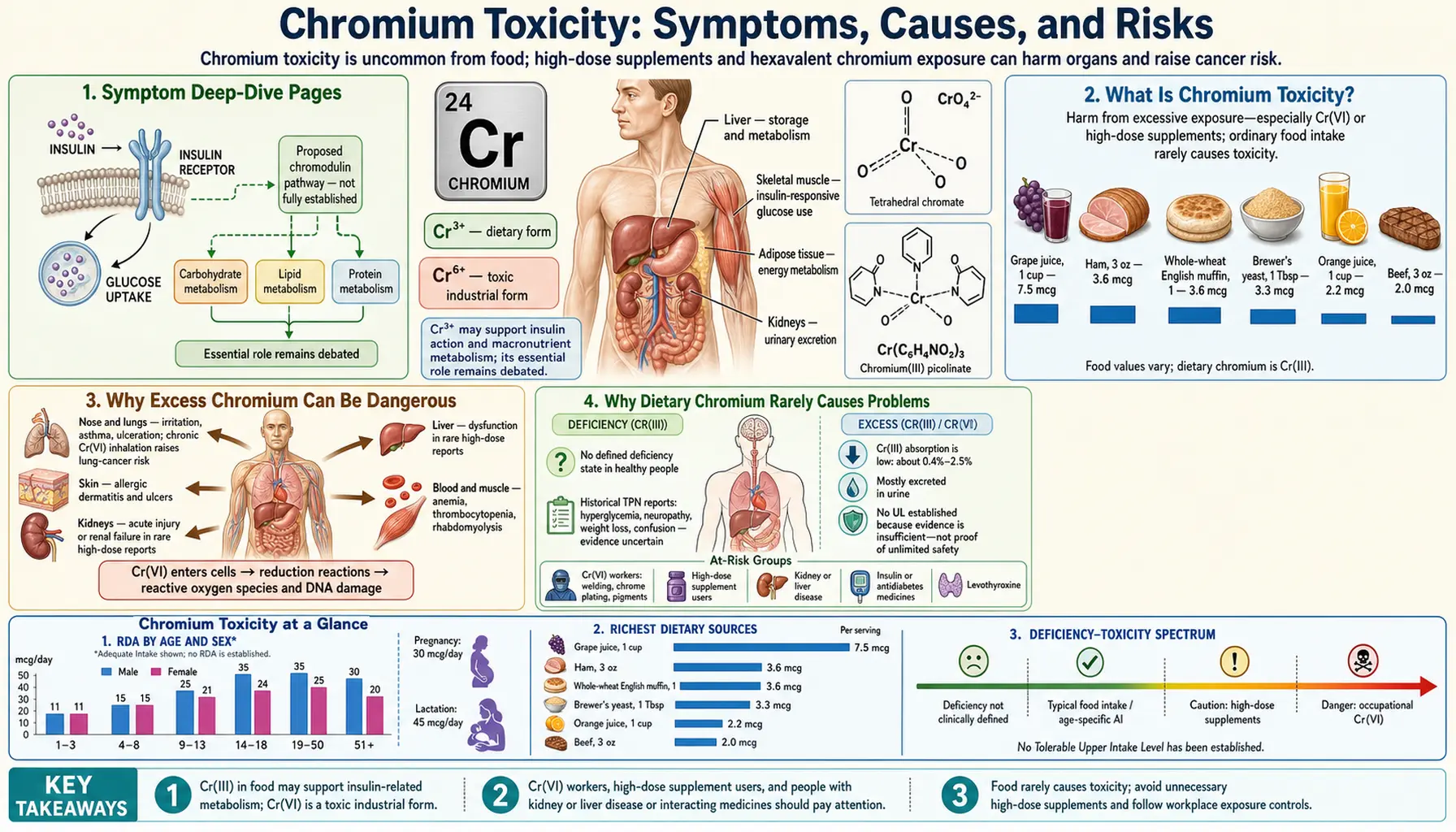
“Chromium toxicity” is really two very different stories, and confusing them is the single biggest source of needless worry. The chromium in food and in ordinary supplements — trivalent chromium, Cr(III) — is so poorly absorbed and so quickly excreted that there is no recognized poisoning syndrome from eating it, and health agencies have not even set an upper safe limit for it because real harm is so hard to demonstrate. The dangerous form is hexavalent chromium, Cr(VI) — an industrial chemical from chrome plating, stainless-steel welding, pigments, and tannery and cooling-tower water. Cr(VI) is a recognized human carcinogen (the “Erin Brockovich” contaminant): breathing it raises the risk of lung cancer, and high exposures damage the nose, skin, kidneys, and liver. So if your concern is a chromium picolinate bottle from the pharmacy, the honest answer is that serious toxicity is rare and mostly tied to very high doses or pre-existing kidney problems; if your concern is occupational or contaminated-water exposure to Cr(VI), that is a genuine and well-documented hazard. This hub explains both, why the form matters so much, how excess is diagnosed and managed, and when to seek care. Suspected hexavalent-chromium exposure — or any large overdose — is medical territory, not something to manage alone.
Symptom Deep-Dive Pages
Hexavalent vs Dietary Chromium
The most important distinction in the whole topic: why industrial hexavalent chromium, Cr(VI), is a recognized carcinogen while the trivalent Cr(III) in food and supplements is essentially harmless. How the same element can be both, and what that means for your real risk.
Table of Contents
- Symptom Deep-Dive Pages
- What Is Chromium Toxicity?
- Why Excess Chromium Can Be Dangerous
- Why Dietary Chromium Rarely Causes Problems
- Common Causes of Chromium Overexposure
- How Chromium Toxicity Is Diagnosed
- How Chromium Toxicity Is Managed
- When to Seek Care / Red Flags
- Key Research Papers
- Connections
- Featured Videos
What Is Chromium Toxicity?
Chromium is a metallic element, and like several metals it can exist in more than one chemical “form” depending on how many electrons it has given up. Two forms matter for human health, and they behave so differently that they almost deserve different names:
- Trivalent chromium — Cr(III), or chromium-3. This is the form found in food (broccoli, whole grains, meat, brewer's yeast) and in nearly every over-the-counter supplement, usually as chromium picolinate or chromium chloride. It has long been studied as a possible nutrient that helps the body respond to insulin, although even that role is now debated. The key fact for this page is that Cr(III) is very poorly absorbed (only about 0.4–2.5% of what you swallow), and what little gets in is excreted in the urine. Its toxicity is low.
- Hexavalent chromium — Cr(VI), or chromium-6. This is an industrial form created by high-temperature and electrochemical processes — chrome plating, stainless-steel welding, chromate pigments, leather tanning, wood preservatives, and anti-corrosion treatments. It does not occur meaningfully in food. Cr(VI) is a powerful oxidizer that crosses cell membranes easily, and it is a recognized human carcinogen. This is the chromium that causes serious toxicity.
So when people say “chromium toxicity,” they almost always mean one of two scenarios. The first is a question about supplements — “is the chromium picolinate I take dangerous?” The honest, evidence-based answer is that meaningful toxicity from dietary Cr(III) is genuinely rare, and the U.S. National Academy of Medicine has not set a Tolerable Upper Intake Level for chromium precisely because there was not enough evidence of harm to base one on. The second scenario is industrial or environmental exposure to Cr(VI) — breathing chrome-plating mist, welding fumes, or drinking water contaminated with chromate — and that is a real, well-documented hazard with consequences ranging from a perforated nasal septum to lung cancer.
This distinction is not a technicality; it is the whole story. The deep-dive page on Hexavalent vs Dietary Chromium walks through exactly why the same element can be nearly harmless in one form and carcinogenic in another. The rest of this hub keeps the two forms clearly separated, because the symptoms, causes, diagnosis, and treatment are different for each.
Why Excess Chromium Can Be Dangerous
The danger of chromium depends almost entirely on the form, so it helps to take them one at a time.
Hexavalent chromium, Cr(VI) — the form that causes serious harm. Cr(VI) is dangerous because of a chemical trap inside the cell. The chromate ion sneaks into cells by hitching a ride on the same transport channels the body uses for sulfate and phosphate, so the cell essentially lets it in by mistake. Once inside, it is rapidly reduced — stepping down through unstable intermediates such as Cr(V) and Cr(IV) on the way to stable Cr(III) — and that reduction generates a burst of reactive oxygen species (highly reactive, damaging molecules) and reactive chromium species that attack DNA. The result is DNA strand breaks, chromium-DNA bonds, and chromosome damage. This is the mechanistic reason Cr(VI) is classified by the International Agency for Research on Cancer as a Group 1 human carcinogen — the highest certainty category. The best-established consequence is lung cancer from inhaling Cr(VI) dust or fumes over time, demonstrated in chrome-platers, chromate-production workers, and welders. Laboratory and worker studies have repeatedly shown that even soluble and particulate Cr(VI) damages human lung-cell DNA, and that chronically exposed electroplating workers carry measurably more DNA damage than unexposed people. Beyond cancer, high Cr(VI) exposure can corrode and perforate the nasal septum, cause nosebleeds and chronic sinus problems, trigger asthma, produce deep, slow-healing “chrome ulcers” on the skin, provoke severe allergic contact dermatitis, and — in large acute poisonings — damage the kidneys and liver. For the dedicated page on the industrial contaminant, see Hexavalent Chromium (Chromium-6) Toxicity; the cancer link is covered on Lung Cancer.
Trivalent chromium, Cr(III) — why the worry is usually overblown. The dietary and supplement form is a poor oxidizer and is largely shut out of cells, so it does not readily produce the DNA-attacking chemistry that makes Cr(VI) carcinogenic. Decades of human use of chromium picolinate — one of the most popular weight-loss and blood-sugar supplements ever sold — have not produced a clear pattern of serious harm in the general population. That said, “low toxicity” is not the same as “impossible to harm.” There are two honest caveats. First, a handful of case reports describe kidney damage (acute tubular necrosis, interstitial nephritis) and, rarely, liver injury in people who took very large doses of chromium picolinate over weeks to months, sometimes with pre-existing kidney problems. Second, laboratory studies — most famously the 1995 Stearns experiments — showed that the picolinate form specifically can cause chromosome damage in cultured animal cells at high concentrations, raising a theoretical concern that has been debated ever since. Importantly, this cell-culture finding has not translated into a demonstrated cancer risk in people taking the supplement, and reviews of the actual human evidence have generally concluded that ordinary supplemental doses are safe. The practical takeaway: Cr(III) toxicity is uncommon and dose-related, not a routine danger of a daily multivitamin.
Why Dietary Chromium Rarely Causes Problems
One of the most reassuring facts about chromium is also the most counter-intuitive: the body has a very effective set of defenses against the everyday (Cr(III)) form, which is why dietary and supplemental chromium so seldom causes any symptom at all. Understanding why helps put a supplement bottle in perspective.
- It barely gets in. Only a small percentage of swallowed Cr(III) is absorbed from the gut — on the order of 0.4–2.5%. The overwhelming majority simply passes through and leaves in the stool. Compared with metals that the body absorbs efficiently (like iron), chromium is almost actively excluded.
- What gets in, gets out. Absorbed Cr(III) is carried in the blood and filtered into the urine fairly quickly. The body does not accumulate it in the way it accumulates lead or mercury, so a steady intake does not build to a toxic burden in most people.
- The chemistry is gentle. Cr(III) is a poor oxidizer and is not readily taken up inside cells, so it does not generate the cascade of reactive, DNA-damaging species that the hexavalent form does. The very property that makes Cr(VI) dangerous — easy entry into cells followed by violent reduction — is largely absent for Cr(III).
This is why regulators have taken an unusual stance. The U.S. Institute of Medicine (now the National Academy of Medicine) set an Adequate Intake for chromium but explicitly declined to set a Tolerable Upper Intake Level, stating that the available data did not establish a level of dietary or supplemental chromium that causes harm. Few nutrients carry that kind of “we could not find a clear toxic dose” footnote. The European Food Safety Authority likewise reviewed chromium picolinate and concluded that, while the picolinic-acid part deserved some scrutiny, ordinary supplemental use was not a safety concern at the doses studied.
None of this means supplements are useful — that is a separate question, and the evidence that chromium meaningfully improves blood sugar or causes weight loss is weak and inconsistent (see the Chromium Benefits hub for the honest version). It only means they are unlikely to poison you at normal doses. The exceptions worth respecting are very high self-dosing (well beyond label directions) and pre-existing kidney disease, where the body's clearance route is impaired — the same situations that turn up in the rare case reports of harm.
Common Causes of Chromium Overexposure
Meaningful chromium overexposure comes overwhelmingly from industrial and environmental Cr(VI), with supplements a distant and minor contributor. Here are the routes worth knowing, grouped by how the chromium gets into the body.
- Inhaling hexavalent chromium at work — the most important cause of serious harm. Breathing Cr(VI) mist, dust, or fume is the route most strongly tied to lung cancer and nasal damage. Classic high-risk jobs include:
- Chrome electroplating — the bath releases a fine chromic-acid mist.
- Stainless-steel and high-chromium welding — the heat converts chromium in the metal into Cr(VI) fume.
- Chromate and pigment manufacturing — making the bright yellow/orange chromate paints and dyes.
- Leather tanning, wood preservation, and refractory-brick work — older or poorly controlled processes.
- Drinking Cr(VI)-contaminated water. Hexavalent chromium can leach into groundwater from industrial discharge, cooling-tower additives, and improper waste disposal — the situation made famous by the Hinkley, California case. Ingested Cr(VI) is partly converted to harmless Cr(III) by stomach acid before it is absorbed, which lowers the risk somewhat, but high or prolonged contamination is still a recognized concern. For the broader picture of metals in water and the body, see Toxic Minerals & Heavy Metals and Heavy Metals.
- Skin contact with Cr(VI). Wet cement, chromate-treated leather, and plating solutions can cause allergic contact dermatitis (chromium is a leading cause of metal allergy) and, with heavy exposure, the deep “chrome holes” or ulcers seen on the hands of platers and tanners.
- Very high-dose Cr(III) supplements — the uncommon supplement scenario. The rare reports of supplement-related harm involve people taking chromium picolinate well above label directions, often for months, and sometimes with reduced kidney function. The damage described is mainly to the kidneys (and occasionally the liver), not cancer. This is a dose-and-clearance problem, not a property of taking a sensible amount.
- Metal-on-metal hip implants — a niche but real source. Certain older metal-on-metal artificial hip joints can wear and release chromium and cobalt ions into the blood and surrounding tissue. This is monitored with blood metal levels and is a recognized reason for elevated chromium that has nothing to do with diet or supplements. (Cobalt is usually the bigger concern in these cases; see Cobalt.)
The pattern is clear: if the question is “how might someone actually get too much chromium,” the answer is almost always an industrial or environmental Cr(VI) route, or — far less often — a worn metal implant or an extreme self-dosing habit. A normal diet and a labeled supplement are not on this list for a reason.
How Chromium Toxicity Is Diagnosed
There is no single “chromium poisoning” test that fits every situation, because the diagnosis hinges on what kind of exposure is suspected. Doctors start with the story — the job, the water supply, the supplement history, any implants — and then choose tests to match.
- Blood and urine chromium levels. Chromium can be measured in blood and urine, and these are the main tools for confirming and tracking overexposure. Urine chromium reflects recent exposure and is commonly used to monitor workers; blood chromium is used especially to watch for ion release from metal-on-metal implants. An important caveat: because everyday Cr(III) is cleared so efficiently, a person's levels are interpreted against reference ranges for their exposure setting, and a mildly elevated value is not automatically dangerous. Sample collection matters too, since environmental and equipment contamination can falsely raise a result.
- Tests aimed at the affected organ. Rather than chasing the chromium number alone, clinicians usually test the part of the body the exposure threatens:
- Lungs — for inhaled Cr(VI), chest imaging and, when cancer is a concern, the standard work-up for lung cancer and a nasal exam for septal damage.
- Kidneys and liver — for high-dose supplement exposure or acute poisoning, a Comprehensive Metabolic Panel checks kidney markers (creatinine) and liver enzymes; urine tests can detect kidney tubule injury.
- Skin — patch testing can confirm chromium contact allergy when dermatitis is the problem.
- Occupational and environmental investigation. For workplace exposure, the real “diagnosis” often happens at the source: air sampling, surface wipes, and reviewing the safety controls. For suspected water contamination, the water itself is tested for Cr(VI). Catching the exposure is more protective than any individual blood draw.
For a supplement user with no symptoms who simply wants reassurance, the practical answer is usually that no special testing is needed — the relevant question is the dose and whether the kidneys are healthy, both of which a clinician can address without an exotic panel. Routine chromium-level screening is not recommended for the general public.
How Chromium Toxicity Is Managed
Management, like diagnosis, follows the form and the route of exposure. The single most important step in every scenario is the same: stop the exposure.
For hexavalent-chromium (Cr(VI)) exposure:
- Remove the source. The cornerstone is ending or controlling the exposure — improving workplace ventilation, using proper respirators and protective clothing, treating contaminated water, and following occupational exposure limits. No medical treatment substitutes for stopping the inhalation or contact.
- Treat the injury, organ by organ. There is no routine antidote for chronic Cr(VI) exposure. Care is directed at what was harmed: skin ulcers and dermatitis are treated by dermatology and by removing contact; nasal damage by ENT; an established lung cancer through standard oncologic care. In an acute high-dose poisoning (a rare event, usually a swallowed industrial chromate), hospital treatment is supportive and intensive — protecting the kidneys and liver, managing fluids, and, in severe cases, dialysis. Reducing agents such as ascorbic acid (vitamin C) have been used in some acute poisonings to help convert Cr(VI) to the less harmful Cr(III), but this is specialist, in-hospital territory, not a home remedy.
- Surveillance. Exposed workers are monitored with periodic exams and biological testing so problems are caught early.
For trivalent-chromium (Cr(III)) supplement situations:
- Simply stop the supplement. In the rare cases of suspected harm (usually kidney injury at very high doses), the first and often sufficient step is to discontinue the chromium product. Because the body clears Cr(III) efficiently, levels fall once intake stops.
- Support the affected organ. If kidney or liver injury occurred, care is supportive and focused on recovery, with kidney function monitored. Most case reports describe improvement after the supplement is stopped.
- Reassurance and a dose check for the worried-but-well. For someone taking a normal labeled dose with healthy kidneys, the honest guidance is that no treatment is needed — and that if blood-sugar or weight benefit is the goal, the evidence is weak enough that the supplement may simply not be worth continuing. (See the Chromium Benefits hub and the Chromium Deficiency hub for the full, balanced picture.)
The reassuring bottom line is that genuine dietary-chromium toxicity is uncommon and usually reversible once exposure ends, while the serious hazard — industrial Cr(VI) — is best handled by prevention and by addressing each organ effect under medical supervision.
When to Seek Care / Red Flags
Because everyday chromium is so low-risk, the warning signs that matter are tied to hexavalent exposure or to large overdoses. Seek prompt medical care if you have any of the following:
- Work with chrome plating, stainless-steel welding, chromate pigments, or tanning and develop frequent nosebleeds, a crusted or painful nose, a sore that will not heal inside the nose, or a new cough, wheeze, or shortness of breath. Persistent respiratory or nasal symptoms in these jobs deserve evaluation, not waiting.
- Slow-healing skin ulcers (“chrome holes”) or a stubborn, spreading rash after contact with wet cement, plating solutions, or chromate-treated materials.
- You learn your drinking water may be contaminated with chromium-6 — report it to your water authority and ask a clinician about monitoring; do not rely on symptoms, which may be absent.
- You have a metal-on-metal hip implant and develop new hip pain, swelling, or unexplained symptoms — ask about blood metal-ion testing.
- You took a large amount of a chromium supplement (well above label directions) and notice reduced urination, dark urine, swelling, yellowing of the skin or eyes, or severe abdominal pain — these can signal kidney or liver injury and warrant urgent assessment.
- Any deliberate or accidental swallowing of an industrial chromate product — treat as a poisoning emergency. In the United States, call Poison Control at 1-800-222-1222 or seek emergency care immediately.
For the everyday situation — a healthy person taking a normal dose of chromium picolinate — there is no red flag to watch for, because meaningful toxicity at that dose is not expected. The honest message is to match your level of concern to your level of exposure: ordinary diet and supplements, very low worry; industrial Cr(VI) or contaminated water, genuine and worth acting on. For related metal-exposure topics see Hexavalent Chromium and Heavy Metals.
Key Research Papers
- Costa M, Klein CB (2006). Toxicity and Carcinogenicity of Chromium Compounds in Humans. Critical Reviews in Toxicology;36(2):155-163. — DOI: 10.1080/10408440500534032
- Cefalu WT, Hu FB (2004). Role of Chromium in Human Health and in Diabetes. Diabetes Care;27(11):2741-2751. — DOI: 10.2337/diacare.27.11.2741
- Levina A, Lay PA (2008). Chemical Properties and Toxicity of Chromium(III) Nutritional Supplements. Chemical Research in Toxicology;21(3):563-571. — DOI: 10.1021/tx700385t
- Vincent JB (2003). The Potential Value and Toxicity of Chromium Picolinate as a Nutritional Supplement, Weight Loss Agent and Muscle Development Agent. Sports Medicine;33(3):213-230. — DOI: 10.2165/00007256-200333030-00004
- Stearns DM, Wise JP Sr, Patierno SR, Wetterhahn KE (1995). Chromium(III) picolinate produces chromosome damage in Chinese hamster ovary cells. The FASEB Journal;9(15):1643-1648. — DOI: 10.1096/fasebj.9.15.8529845
- Hepburn DDD, Vincent JB (2002). In Vivo Distribution of Chromium from Chromium Picolinate in Rats and Implications for the Safety of the Dietary Supplement. Chemical Research in Toxicology;15(2):93-100. — DOI: 10.1021/tx010091t
- Cerulli J, Grabe DW, Gauthier I, Malone M, McGoldrick MD (1998). Chromium Picolinate Toxicity. Annals of Pharmacotherapy;32(4):428-431. — DOI: 10.1345/aph.17327
- Pittler MH, Stevinson C, Ernst E (2003). Chromium picolinate for reducing body weight: meta-analysis of randomized trials. International Journal of Obesity;27(4):522-529. — DOI: 10.1038/sj.ijo.0802262
- Suksomboon N, Poolsup N, Yuwanakorn A (2014). Systematic review and meta-analysis of the efficacy and safety of chromium supplementation in diabetes. Journal of Clinical Pharmacy and Therapeutics;39(3):292-306. — DOI: 10.1111/jcpt.12147
- Wise JP Sr, Wise SS, Little JE (2002). The cytotoxicity and genotoxicity of particulate and soluble hexavalent chromium in human lung cells. Mutation Research;517(1-2):221-229. — DOI: 10.1016/S1383-5718(02)00071-2
- Zhang X, Zhang X, Wang X, et al. (2011). Chronic occupational exposure to hexavalent chromium causes DNA damage in electroplating workers. BMC Public Health;11:224. — DOI: 10.1186/1471-2458-11-224
- EFSA Panel on Food Additives (2009). Chromium picolinate, zinc picolinate and zinc picolinate dihydrate added for nutritional purposes in food supplements. EFSA Journal;7(6):1113. — DOI: 10.2903/j.efsa.2009.1113
PubMed Topic Searches
- PubMed — Hexavalent chromium, carcinogenicity, and lung cancer
- PubMed — Chromium picolinate toxicity, safety, and kidney
- PubMed — Trivalent chromium absorption and supplementation in humans
- PubMed — Occupational chromium exposure, DNA damage, and welders
- PubMed — Hexavalent chromium in drinking water and health effects
Connections
- All Minerals
- Chromium Toxicity: Hexavalent vs Dietary Chromium
- Chromium Overview
- Chromium Deficiency Hub
- Chromium Benefits Hub
- Hexavalent Chromium (Chromium-6) Toxicity
- Toxic Minerals & Heavy Metals
- Heavy Metals
- Lung Cancer
- Comprehensive Metabolic Panel
- Diabetes
- Cobalt
- Zinc
- Iron