Calcium: Food Sources & Daily Intake
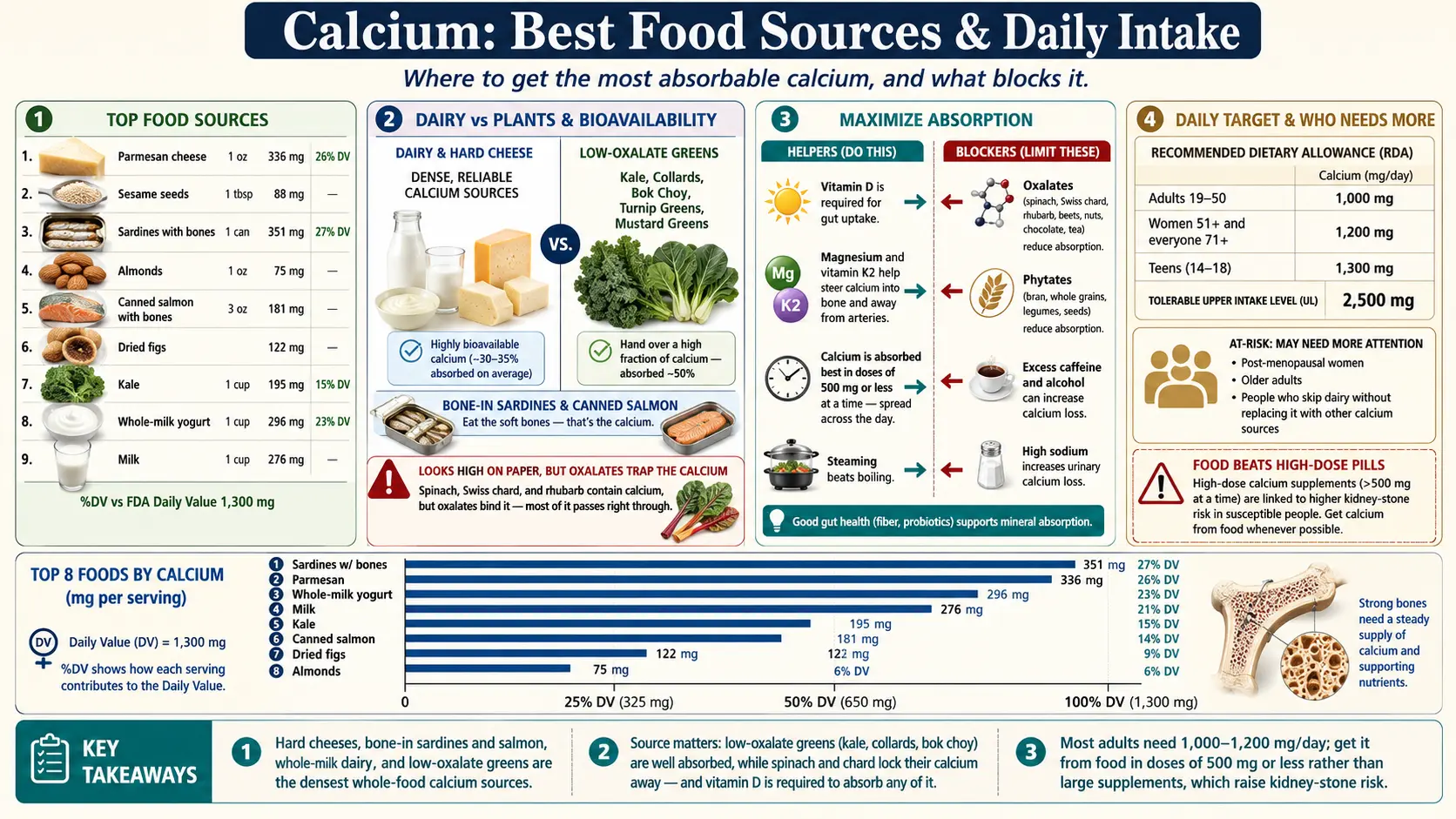
Calcium is the most abundant mineral in the body, and about 99% of it sits in the bones and teeth, where it doubles as a structural material and a reserve the body can draw on. The rest does quiet but essential work — muscle contraction, nerve signaling, blood clotting and a steady heartbeat. Dairy dominates the whole-food sources (whole milk, whole-milk yogurt and hard cheeses), with small fish eaten with their bones, dark leafy greens, almonds and sesame rounding out the list. Where the calcium comes from matters as much as how much there is, because some plant foods lock it up (see below).
| Calcium: Food Sources & Daily Intake | ||||||
|---|---|---|---|---|---|---|
| Rank | Food (serving) | Per 100 g | %DV / 100g | Glucose | Fructose | Notes |
| 1 | Parmesan Cheese 1 oz / 28 g | 1,180 mg | 🟢 91% | — | — | Hard aged cheeses are the most concentrated whole-food source. |
| 2 | Sesame Seeds (Whole) 1 tbsp / 9 g | 975 mg | 🟢 75% | — | — | Whole seeds keep the calcium-rich hull; hulled seeds have far less. |
| 3 | Cheddar Cheese 1 oz / 28 g | 562 mg | 🟡 43% | — | — | |
| 4 | Sardines (With Bones) 1 can / 92 g | 382 mg | 🟡 29% | 0 | 0 | The soft, edible bones are where the calcium is. |
| 5 | Almonds 1 oz / 28 g | 269 mg | 🟡 21% | 0.2 | 0.1 | About 23 nuts. |
| 6 | Canned Salmon (With Bones) 3 oz / 85 g | 213 mg | 🟡 16% | — | — | Mash the soft bones in — that is the calcium. |
| 7 | Figs (Dried) About 5 figs / 75 g | 162 mg | 🟡 12% | 24.8 | 22.9 | |
| 8 | Kale 1 cup / 130 g | 150 mg | 🟡 12% | 0.5 | 0.4 | Low in oxalates, so absorption is high. |
| 9 | Tahini (Sesame Paste) 2 tbsp / 30 g | 141 mg | 🟡 11% | — | — | |
| 10 | Collard Greens 1 cup / 190 g | 141 mg | 🟡 11% | — | — | A low-oxalate green, so the calcium is well absorbed. |
| 11 | Turnip Greens 1 cup / 144 g | 137 mg | 🟡 11% | — | — | |
| 12 | Plain Yogurt (Whole Milk) 1 cup / 245 g | 121 mg | ⚪ 9% | — | — | |
| 13 | Mustard Greens 1 cup / 140 g | 118 mg | ⚪ 9% | — | — | |
| 14 | Milk (Whole) 1 cup / 244 g | 113 mg | ⚪ 9% | 0 | 0 | |
| 15 | Bok Choy 1 cup / 170 g | 93 mg | ⚪ 7% | — | — | A low-oxalate Asian green; calcium is highly absorbable. |
| 16 | Broccoli 1 cup / 156 g | 40 mg | ⚪ 3% | 0.5 | 0.7 | |
| 17 | Brown Rice 1 cup / 195 g | 3.0 mg | ⚪ 0% | 0 | 0 | Common staple. |
| 18 | Beef Organ Meats 3 oz / 85 g | 19 mg | ⚪ 1% | 0 | 0 | Nutrient-dense organ meat. |
| 19 | Pork Organ Meats 3 oz / 85 g | 13 mg | ⚪ 1% | — | — | Nutrient-dense organ meat. |
| 20 | Chicken Organ Meats 3 oz / 85 g | 13 mg | ⚪ 1% | — | — | Nutrient-dense organ meat (giblets). |
Table of Contents
- How to Read These Tables
- Recommended Intakes & Upper Limits
- Bioavailability & Absorption
- Cooking & Storage
- Vegetarian & Vegan Sources
- Who Needs to Pay Attention
- Data Sources & References
- Connections
- Featured Videos
How to Read These Tables
- Total amount vs. how much you absorb. A food can be high in calcium yet hand over only a little of it. Low-oxalate greens like kale, collards and bok choy give up roughly half their calcium, while spinach — despite a big number on paper — releases only a fraction. The amount column tells you what is in the food; the body decides how much it keeps.
- %DV vs. your personal target. The %DV column compares a serving against the FDA Daily Value of 1,300 mg. Your own goal (the RDA) is 1,000 mg for most adults, rising to 1,200 mg for women over 50 and everyone over 70, and 1,300 mg for teens — see the second table.
- Per 100 g vs. per serving. Per-100 g lets you compare foods head to head; the serving size shown beside each food is what you actually eat. A cup of milk or yogurt, an ounce of hard cheese, or a can of sardines each delivers a large slice of the day in one go, while greens add up over several servings.
Recommended Intakes & Upper Limits
Your personal target depends on age, sex and pregnancy. The Daily Value used for the %DV column above is a single label figure; the table below is the age-specific guidance.
| Life stage | RDA / AI (mg/day) | Upper limit (mg/day) |
|---|---|---|
| Infants 0–6 mo | 200* (AI) | 1,000 |
| Infants 7–12 mo | 260* (AI) | 1,500 |
| Children 1–3 y | 700 | 2,500 |
| Children 4–8 y | 1,000 | 2,500 |
| Children 9–13 y | 1,300 | 3,000 |
| Teens 14–18 y | 1,300 | 3,000 |
| Adults 19–50 y | 1,000 | 2,500 |
| Men 51–70 y | 1,000 | 2,000 |
| Women 51–70 y | 1,200 | 2,000 |
| Adults 71+ y | 1,200 | 2,000 |
| Pregnancy / Lactation 14–18 y | 1,300 | 3,000 |
| Pregnancy / Lactation 19–50 y | 1,000 | 2,500 |
Bioavailability & Absorption
Two things shape how much calcium you actually keep. The first is vitamin D: without enough of it the gut absorbs only a small share of dietary calcium, which is why the two nutrients are almost always discussed together. The second is what else is in the food. Oxalates bind calcium tightly and carry it out unabsorbed — this is why spinach, Swiss chard and rhubarb make poor calcium sources despite high numbers, while low-oxalate greens (kale, collards, bok choy, turnip and mustard greens) are excellent. Phytates in some seeds and grains have a milder version of the same effect. Calcium also works as part of a team: magnesium and vitamin K2 help put it to use — K2 in particular helps steer calcium into bone and away from arteries — so a varied whole-food diet beats relying on calcium alone. One practical note: the body absorbs calcium best in amounts of about 500 mg or less at a time, so spreading intake across the day works better than one big hit.
Cooking & Storage
Calcium is a stable mineral — it does not break down with heat or light the way fragile vitamins do. Boiling can leach a little into the cooking water, so steaming or eating the cooking liquid (as in soups and braised greens) keeps slightly more. Cooking greens has a hidden upside: it shrinks the volume so you can eat far more in one sitting, and it can lower the oxalate content a touch, nudging absorption up. With canned sardines and salmon, the key is to eat the soft bones rather than pick them out — that is where most of the calcium lives.
Vegetarian & Vegan Sources
Calcium is one of the nutrients plant-based eaters have to plan for, because so much of the everyday supply comes from dairy. The good news is that low-oxalate greens — kale, collard greens, bok choy, turnip and mustard greens — are not only rich in calcium but hand over a high fraction of it, often better than dairy gram for gram. Almonds, sesame seeds and tahini, and dried figs add more, and oranges and broccoli chip in. (Avoid leaning on spinach for calcium: its oxalates lock most of it away.) Anyone who does eat fish should know that canned sardines and salmon with the bones are among the densest sources of all. Whatever the mix, pairing it with enough vitamin D is what makes the calcium count.
Who Needs to Pay Attention
Too little calcium over years is largely silent until it shows up as weak, thinning bones — osteopenia and, eventually, osteoporosis and fractures. The body keeps blood calcium tightly controlled by pulling from the skeleton when the diet falls short, so a normal blood test does not mean intake is adequate. Groups that most often fall short include girls and women, especially after menopause when bone loss speeds up, older adults, and people who avoid dairy without replacing it. Absorption itself drops with age and with low vitamin D. At the other end, the concern is overdoing supplements: intakes above the UL have been linked to kidney stones and may cause constipation, and very high doses can interfere with the absorption of iron and zinc. Getting calcium from food rather than large pills is the safest approach for most people.
Data Sources & References
- NIH Office of Dietary Supplements — Calcium Fact Sheet for Health Professionals (DV, RDA, AI, UL)
- Linus Pauling Institute — Calcium, Micronutrient Information Center
- PubMed — calcium absorption, bioavailability and oxalate
- PubMed — dietary calcium intake and bone health
Connections
- All Minerals
- Calcium (Main Page)
- Calcium Benefits
- Calcium History
- Vitamin D3 (drives calcium absorption)
- Vitamin K (directs calcium to bone)
- Magnesium (calcium’s partner mineral)
- Phosphorus (the other half of bone mineral)