Soursop Leaf for Sleep and Digestive Comfort
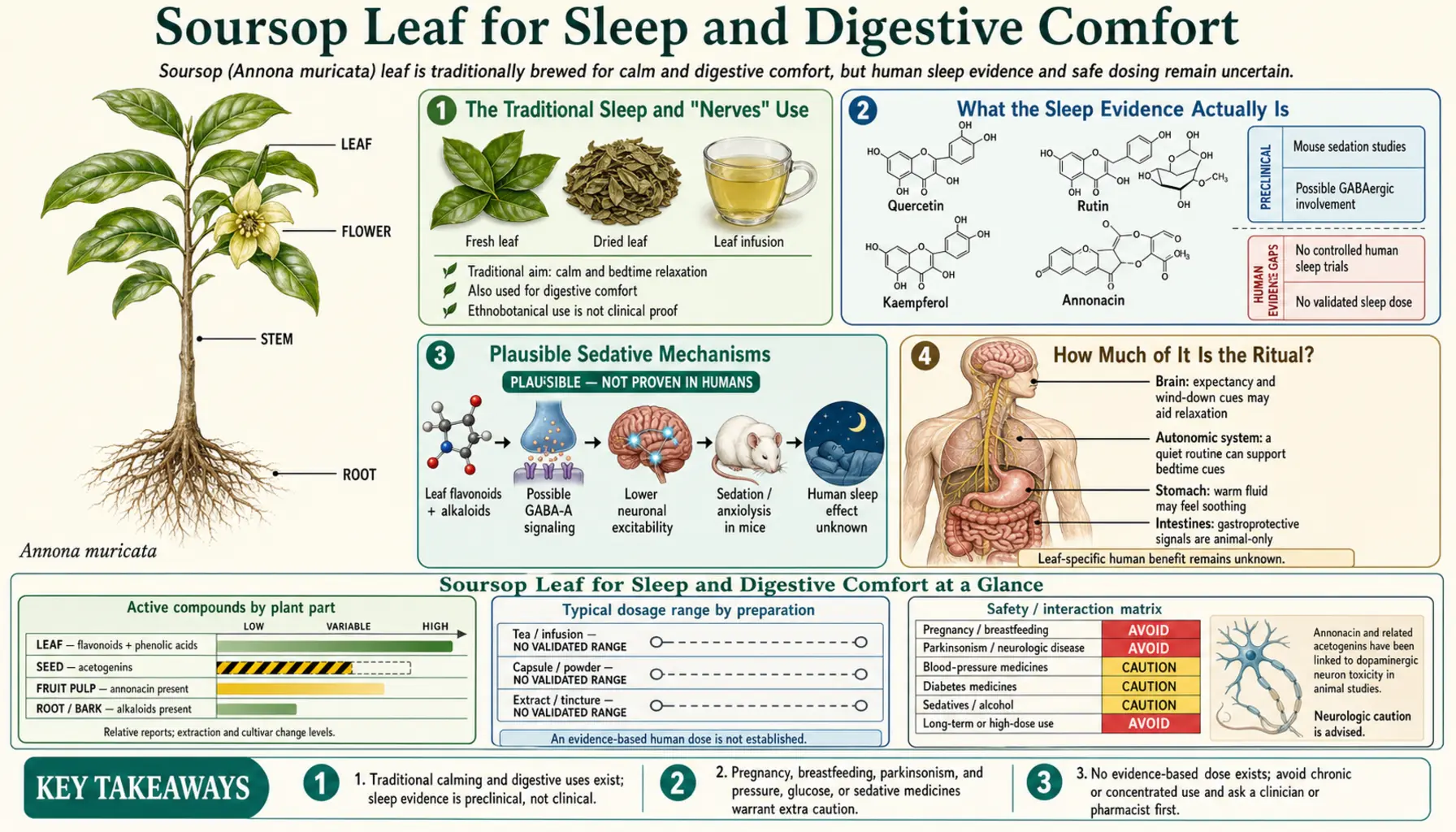
Evidence tier: traditional use only, with supportive rodent behavioural and gastroprotective studies. There are no randomised controlled trials of soursop leaf for insomnia, anxiety, indigestion or any digestive condition in humans.
This is the plant's oldest and most geographically consistent use, and the one where traditional practice deserves the most respect. From the Caribbean to West Africa to Java to the Philippines, soursop leaf is brewed in the evening for sleep, for "nerves", and for an unsettled stomach — and it arrived at that reputation independently in places that had no contact with each other for most of history. That convergence is meaningful. It usually means people were noticing something.
It also, unfortunately, describes the exact usage pattern that this hub's safety article is about. A bedtime tea is a nightly tea. A nightly tea taken for a chronic sleep problem is a habit measured in years. That is precisely the exposure implicated in the Guadeloupe findings, and it is why this article ends up recommending other bedtime teas rather than this one — not because the traditional use is nonsense, but because the same mild sedative effect is available from plants with no comparable hazard.
Table of Contents
- The Traditional Sleep and "Nerves" Use
- What the Sleep Evidence Actually Is
- Plausible Sedative Mechanisms
- How Much of It Is the Ritual?
- The Traditional Digestive Uses
- What the Digestive Evidence Actually Is
- The Nausea Paradox
- Gout, Joint Pain and the Anti-inflammatory Claim
- How It Is Traditionally Prepared
- Why a Bedtime Tea Is the Wrong Habit for This Plant
- Bedtime Teas With Better Evidence and No Hazard
- What Actually Fixes Sleep
- Key Research Papers
- Connections
The Traditional Sleep and "Nerves" Use
The ethnobotanical record for soursop leaf as an evening sedative is unusually consistent. A partial survey:
- Caribbean. Corossol or guanábana leaf tea drunk in the evening for sleeplessness and for "nerves" — a folk category covering anxiety, agitation and stress. In Jamaica, Trinidad, Cuba, Puerto Rico, Haiti and the French Antilles this is a household preparation, not a specialist remedy.
- West Africa. In Nigeria, Ghana and Cameroon, leaf decoctions appear in ethnobotanical surveys for insomnia and nervousness alongside the fever, hypertension and diabetes indications.
- Indonesia and Malaysia. Daun sirsak is brewed in Jamu practice for restlessness, back pain and general unease as well as for the better-known uses.
- Philippines. Guyabano leaf tea for sleep and for cough is a common household remedy.
- Vietnam and Thailand. Leaf preparations for calming and digestive complaints.
- Brazil. Graviola leaf tea for nervousness and insomnia.
Two observations about the pattern. First, it is remarkably specific about timing — this is an evening tea nearly everywhere it appears, not a morning tonic. Traditions that independently converge on a time of day are usually responding to a real perceived effect. Second, the "nerves" indication travels with the sleep indication, which is the signature of a mild sedative rather than a hypnotic: something that takes the edge off rather than something that knocks you out.
Evidence tier: traditional use only. Ethnobotanical documentation records that people use a plant and what they use it for. It records nothing about efficacy, and nothing about long-term safety — a distinction that matters more here than usual.
What the Sleep Evidence Actually Is
Human trials: none. There is no randomised controlled trial of soursop leaf for insomnia, sleep quality, sleep latency or anxiety. No sleep-diary study, no actigraphy study, no polysomnography study. Nothing that would let anyone say how well it works or in whom.
Animal behavioural work: some, and worth knowing about. Rodent studies of Annona muricata and related Annona species have reported sedative-type and anxiolytic-type behaviour in the standard test batteries — reduced spontaneous locomotor activity, increased time in the open arms of an elevated maze, prolonged sleeping time in barbiturate-induced sleep tests. An older report by N'gouemo and colleagues in Phytotherapy Research in the 1990s examined the effect of an ethanol extract of Annona muricata on chemically induced convulsive seizures in mice, which sits in the same broad central-depressant category.
How to read that. Rodent sedation assays are genuinely useful for detecting that a plant has central nervous system activity. They are much weaker at predicting whether a person will sleep better: they measure movement and anxiety-like behaviour in a nocturnal animal, at doses often far above human intake, over hours rather than weeks. Many plants that sedate a mouse do nothing useful for human insomnia.
What can honestly be said: soursop leaf almost certainly has some central activity — the alkaloid content and the animal data both point that way, and four continents of traditional use point the same way. Whether that activity amounts to a clinically useful sleep effect in humans is unknown, and there is no dose at which anyone can say it has been shown to. Evidence tier: traditional use, with preliminary animal support.
Plausible Sedative Mechanisms
The leaf contains several classes of compound that could plausibly contribute:
- Isoquinoline alkaloids — reticuline, coreximine, anonaine, asimilobine. These are the most likely candidates for a genuine central effect. Related alkaloids in other plants have documented actions on dopaminergic and serotonergic systems. Note, though, that this cuts both ways: some of these alkaloids have been examined in laboratory systems for effects on dopaminergic signalling, and they are a second, less-discussed candidate contributor to the plant's neurological signal.
- GABAergic modulation — frequently proposed for Annona extracts, on the basis of behavioural profiles resembling those of GABA-A modulators. Proposed, not firmly demonstrated for this species.
- Flavonoids — quercetin and kaempferol glycosides. Certain flavonoids have measurable affinity for benzodiazepine binding sites in laboratory assays, which is the standard mechanistic story for mildly sedative herbal teas generally. The concentrations reached from a cup of tea are usually far below what those assays use.
- Essential-oil constituents — β-caryophyllene and sesquiterpenes give the crushed leaf its aroma, and aroma has real if modest effects on subjective relaxation.
- The acetogenins are not the sedative. Worth stating clearly. Complex I inhibition is not a sedative mechanism; it is a metabolic-poisoning mechanism. Whatever calming effect the tea has, it is not the acetogenins doing it — which means the desirable effect and the hazardous constituent are separable in principle, and that is exactly why choosing a different plant is a reasonable response rather than a loss.
How Much of It Is the Ritual?
This is not a dismissal. It is a real and underrated mechanism, and taking it seriously is what makes the alternatives at the end of this page a genuine substitute rather than a consolation prize.
A bedtime tea does several things that have nothing to do with pharmacology and quite a lot to do with sleep:
- It is a consistent pre-sleep cue. Sleep is strongly conditioned by routine. A repeated wind-down ritual becomes a signal, and the signal itself does work.
- It replaces the evening with something calmer. Twenty minutes making and drinking tea is twenty minutes not spent on a screen or on email — two of the better-documented contributors to poor sleep onset.
- Warm fluid and a slight drop in core temperature afterwards track the physiological changes that accompany sleep onset.
- It is an act of self-care with an expectation attached. Expectation effects on subjective sleep quality are substantial and measurable, and they are not fake — the sleep is real sleep.
The practical implication is straightforward and cheering: if a large part of the benefit is the ritual, then the ritual transfers. A cup of chamomile or lemon balm at the same time each night does the same conditioning work with no neurological question attached.
The Traditional Digestive Uses
The digestive indications are almost as widespread as the sedative one, and they cluster into recognisable groups:
- General indigestion and "heaviness" after eating — leaf infusion after meals, across the Caribbean and Southeast Asia.
- Diarrhoea and dysentery — unripe fruit and leaf preparations, particularly in India and parts of West Africa. Astringency from tannins and other polyphenols is the usual explanation for this class of remedy, and it is a reasonable one.
- Intestinal worms — leaf and especially seed preparations. This use is mechanistically explicable and mechanistically alarming for the same reason: acetogenins are toxic to organisms dependent on mitochondrial respiration, which includes helminths and also includes you.
- Stomach ulcers and gastric pain — leaf decoctions in West African and Southeast Asian practice.
- Nausea — recorded in some traditions, which sits awkwardly beside the fact that nausea is the most commonly reported adverse effect of the tea. See below.
- Loss of appetite and "cleansing" — a vague indication common to bitter plant infusions generally; bitterness stimulates salivary and gastric secretion, which is a real if modest effect.
What the Digestive Evidence Actually Is
Human trials: none. No controlled trial of soursop leaf for dyspepsia, gastritis, ulcers, irritable bowel syndrome, functional dyspepsia, reflux or diarrhoea.
Animal gastroprotection work: yes, and it is the most interesting part of this literature. Studies have examined Annona muricata leaf extract in the standard rodent gastric-injury models — ethanol-induced and indomethacin-induced gastric lesions — and reported reduced lesion area with pre-treatment. Moghadamtousi and colleagues published work on gastroprotective activity of Annona muricata leaves against ethanol-induced gastric injury in rats in Drug Design, Development and Therapy in 2014, reporting involvement of heat-shock protein and apoptosis-regulating pathways in the protective effect.
What that model does and does not tell you. The ethanol-lesion model detects mucosal protection, and plants that raise mucus production, improve mucosal blood flow or supply antioxidants routinely perform well in it. It is a reasonable screening assay. It is not a model of human dyspepsia, which is largely a disorder of gut–brain signalling and motility rather than of mucosal erosion, and it is not a model of ulcer disease, which in humans is mostly Helicobacter pylori and NSAID-driven and is treated by eradicating the organism or removing the drug.
Anti-inflammatory and analgesic animal work: yes. Leaf extracts reduce paw oedema in the carrageenan model and reduce pain behaviour in the acetic-acid writhing and hot-plate tests. De Sousa and colleagues reported antinociceptive and anti-inflammatory activity of an ethanol extract of Annona muricata leaves in animal models in the International Journal of Molecular Sciences around 2010.
Antimicrobial and antiparasitic activity: in vitro. Leaf and seed extracts show activity against a range of bacteria, protozoa and helminths in culture. This is unsurprising for a metabolic poison and should not be read as a treatment.
Evidence tier for the whole digestive group: traditional use only, with preliminary animal support.
The Nausea Paradox
Worth its own short section because it is genuinely confusing to readers.
Some traditions use soursop leaf tea for nausea. Meanwhile nausea and vomiting are the most commonly reported adverse effects of soursop leaf tea, especially taken on an empty stomach, and especially at higher strength.
Both can be true. Bitter plant infusions frequently sit on both sides of this line, dose-dependently: a small amount of bitterness stimulates digestive secretion and can genuinely settle a queasy stomach, while a stronger dose of the same bitter irritates the gastric mucosa and produces the symptom it was supposed to relieve. Concentrated capsules skip the low end of that curve entirely.
Practically: if soursop leaf tea makes you feel sick, that is a common and expected response, not an idiosyncratic reaction. It is also a reason to stop rather than a hurdle to push through. Nausea from an unquantified mitochondrial toxin is not a detox sign, and it should never be reframed as one.
Gout, Joint Pain and the Anti-inflammatory Claim
Included here because in Indonesian Jamu practice, daun sirsak for gout and "high uric acid" is among the most prominent uses of all, alongside back pain and arthritis.
The mechanistic story has two parts. First, generic anti-inflammatory activity from the flavonoid and alkaloid fractions, which is what the rodent oedema models detect. Second, and more specifically, some in-vitro work reports inhibition of xanthine oxidase — the enzyme that produces uric acid, and the target of allopurinol. If that held up in humans it would be a coherent explanation for the traditional gout use.
The problem is that gout is a condition where getting it wrong has permanent consequences. Untreated or under-treated gout does not merely hurt in flares; persistently high urate deposits crystals in joints and soft tissue, causing erosive joint damage and tophi that do not resolve. Urate-lowering therapy has decades of outcome data and clear targets. An in-vitro enzyme-inhibition finding is not in the same category and should not be treated as an alternative.
Evidence tier: traditional use, with in-vitro and animal support. No human trials.
How It Is Traditionally Prepared
Described rather than recommended, and with the exposure implications noted, because how you prepare it changes what you get.
- Fresh leaf infusion. Three to five leaves, torn, steeped in 200–250 ml of just-boiled water for five to fifteen minutes. Bitter, grassy, faintly aromatic. Lowest-exposure leaf preparation, especially at the shorter end of the steep.
- Decoction. Leaves simmered in water for ten to twenty minutes, sometimes longer, which is the common preparation in Caribbean, West African and Indonesian practice. Extracts substantially more than a brief steep — including more acetogenin.
- Dried leaf, loose or in bags. Widely sold; content varies enormously between products and is essentially never stated on the label.
- Leaf powder capsules. Concentrated relative to tea, because nothing is discarded with the spent leaves. Higher exposure.
- Tinctures and alcohol extracts. Ethanol efficiently extracts lipophilic compounds, so these are relatively enriched in exactly the fraction of concern. Highest exposure among the liquid forms.
- Standardised acetogenin extracts. Sold with a percentage on the label. The one form with no defensible use at all.
- Seeds — never internally. Highest acetogenin content in the plant; traditional use is as an insecticide, a lice treatment and a fish poison.
Taste notes, for anyone who has been given a bag of leaves and does not know what to expect: the infusion is pale green-brown, distinctly bitter with a green tea-like astringency and a faint sweetness in the aroma. It is usually drunk plain or with a little honey. If a preparation tastes intensely bitter, that is a strong brew, not a good one.
Why a Bedtime Tea Is the Wrong Habit for This Plant
Everything above is the fair case for the traditional uses. This section is why the page still lands where it lands.
The exposure implicated in the Guadeloupe findings was not an occasional cup. It was heavy, daily, long-term consumption of Annona fruit and leaf infusions — the plant used as a routine beverage or as a chronic remedy over years and decades. Look at what a sleep indication does to usage:
- Insomnia is chronic. Nobody has insomnia for four days. A person who finds a bedtime tea that helps drinks it nightly, for years, and has every reason to.
- The dose gets a nudge upward, not downward. If a cup stops working — and tolerance to mild sedatives is common — the natural response is a stronger brew, more leaves, a longer simmer, or capsules.
- There is no feedback signal to stop. Neuronal loss is silent until functional reserve is exhausted. Nothing about the experience of drinking the tea tells you anything about cumulative exposure.
- The desirable effect is not the hazardous constituent. Whatever mild calming the tea provides comes from alkaloids, flavonoids and the ritual — not from the acetogenins. So the acetogenin exposure is a pure cost with no corresponding benefit; you are paying it for nothing.
- The alternatives are genuinely good. This is what settles it. If the only mild sedative tea in the world were soursop, the trade-off would be worth arguing about. It is not.
So the honest conclusion: an occasional cup of soursop leaf tea is a small thing, and this page is not going to pretend that one cup is dangerous. But making it your nightly tea is the single most common way readers of this site could end up in the exposure pattern of concern — and it is entirely avoidable.
Bedtime Teas With Better Evidence and No Hazard
All of these have at least some human trial data — more than soursop leaf has — and none carries a neurodegeneration signal. None is a treatment for a serious sleep disorder, and none should be combined with prescribed sedatives without asking.
- Chamomile — the classic bedtime infusion, with small human trials in sleep quality and generalised anxiety. Mild, pleasant, and about as well tolerated as any herb gets. Avoid if you have a severe ragweed or aster-family allergy.
- Valerian — the most-studied herbal hypnotic, with a mixed but real human trial literature. Stronger-acting than chamomile; the smell is off-putting to many people; do not combine with prescribed sedatives without asking.
- Passionflower — small human trials in sleep quality and anxiety; often blended with the two above.
- Lemon Balm — pleasant, mild, with small human studies on mood and calm. An easy direct swap for an evening ritual.
- L-Theanine — not a tea to brew but the relaxing constituent of green tea, with human data on subjective calm and some on sleep quality. Non-sedating.
- Magnesium — relevant if intake is low; some trial evidence for sleep quality in older adults and in people with low intake, and easily obtained from food.
- For digestive comfort specifically — peppermint has genuine human trial evidence in irritable bowel syndrome and is a well-established after-dinner infusion, and ginger has among the best human evidence of any herb for nausea. Both are better-supported than soursop leaf for the uses in question and neither carries the hazard.
What Actually Fixes Sleep
Since the most common reason a reader reaches this page is trouble sleeping, it would be a poor page that offered only a list of teas. The interventions with the strongest human evidence for chronic insomnia are not pharmacological at all:
- Cognitive behavioural therapy for insomnia (CBT-I) is the first-line treatment for chronic insomnia in essentially every clinical guideline, with better long-term outcomes than sleeping tablets and no dependence risk. It is available as structured programmes, books and apps as well as in person.
- A consistent wake time, seven days a week, does more than a consistent bedtime. Anchoring the morning stabilises the whole circadian system.
- Morning daylight — substantial outdoor light exposure early in the day is one of the strongest available signals for circadian timing.
- Get out of bed if you are awake. Lying awake trains your brain to associate the bed with wakefulness. Stimulus-control instructions are the most powerful single component of CBT-I.
- Caffeine has a long tail. Its half-life is around five to six hours in most adults, so an afternoon coffee is still measurably present at bedtime.
- Alcohol is a sleep destroyer disguised as a sleep aid. It shortens sleep latency and then fragments the second half of the night.
- Rule out the treatable causes. Sleep apnoea, restless legs, an overactive thyroid, chronic pain, depression, anxiety, nocturia and medication timing all cause insomnia that no tea will touch. If sleep has been bad for months, this deserves a proper assessment rather than another herb.
Key Research Papers
Per this site's citation policy, each reference links to a PubMed topic search rather than a numeric identifier, so a transcription error cannot silently point at the wrong paper. Titles, journals and years are given where they are known with confidence; otherwise the finding is described and a topic search is provided.
- Moghadamtousi and colleagues on the gastroprotective activity of Annona muricata leaves against ethanol-induced gastric injury in rats, Drug Design, Development and Therapy, 2014. Animal. PubMed topic search
- De Sousa and colleagues on antinociceptive and anti-inflammatory activities of the ethanol extract of Annona muricata leaves in animal models, published around 2010. Animal. PubMed topic search
- N'gouemo and colleagues on the effects of an ethanol extract of Annona muricata on chemically induced convulsive seizures in mice, Phytotherapy Research, 1990s. Animal. PubMed topic search
- Rodent behavioural studies of sedative and anxiolytic-type activity in Annona species extracts. Animal. PubMed topic search
- Isoquinoline alkaloids of Annona muricata — reticuline, coreximine, anonaine, asimilobine — and their reported effects in neuronal systems. In vitro. PubMed topic search
- In-vitro reports of xanthine oxidase inhibition by Annona muricata, the mechanistic basis of the traditional gout use. In vitro. PubMed topic search
- Ethnobotanical surveys documenting soursop leaf for insomnia, nervousness and digestive complaints across the Caribbean, West Africa and Southeast Asia. Traditional use documentation. PubMed topic search
- The clinical-trials gap: searching for human trials of Annona muricata in insomnia, anxiety or dyspepsia returns no adequately designed study. PubMed topic search
- Moghadamtousi, Fadaeinasab, Nikzad and colleagues, Annona muricata (Annonaceae): a review of its traditional uses, isolated acetogenins and biological activities, International Journal of Molecular Sciences, 2015 — the standard reference for the traditional-use catalogue. PubMed topic search
- Champy and colleagues, Quantification of acetogenins in Annona muricata linked to atypical parkinsonism in Guadeloupe, Movement Disorders, 2005 — what a habitual infusion habit represents in exposure terms. PubMed topic search
- The chamomile, valerian, passionflower and lemon balm human trial literature — the comparison set that makes soursop leaf an unnecessary choice for a bedtime tea. PubMed topic search
- Cognitive behavioural therapy for insomnia as first-line treatment, versus hypnotic medication, in guideline and meta-analytic literature. PubMed topic search
Live PubMed Searches
- Annona muricata and sedation
- Annona muricata and gastric protection
- Annona muricata anti-inflammatory activity
- Annona muricata antiparasitic activity
- Herbal teas and gastric irritation
- Bitters and digestive secretion
- Peppermint and irritable bowel syndrome
- Ginger for nausea
- Morning light and circadian timing
Connections
- All Herbs
- Soursop Leaf Benefits Hub
- Soursop Safety: Annonacin, Neurotoxicity and Dose Limits
- Soursop and Cancer: The Claim Examined
- Soursop Leaf for Blood Sugar and Blood Pressure
- Soursop Leaf (Annona muricata)
- Insomnia
- Anxiety
- Psychiatry
- Circadian Rhythm Sleep-Wake Disorders
- Functional Dyspepsia
- Irritable Bowel Syndrome
- GERD
- Gastroenterology
- Chamomile
- Valerian
- Passionflower
- Lemon Balm
- Peppermint
- Ginger
- L-Theanine
- Magnesium
Safety and disclaimer. This page is health information, not medical advice. Soursop leaf for sleep, anxiety and digestive complaints is traditional use only — there are no human trials, and no dose has been shown to work. More importantly, a bedtime tea taken nightly for a chronic problem is exactly the long-term daily exposure pattern associated with the plant's documented neurological hazard, and the calming effect does not come from the hazardous constituent, so the risk buys nothing. Prefer chamomile, lemon balm, valerian or passionflower for an evening ritual, and peppermint or ginger for digestive comfort. Avoid soursop leaf entirely in pregnancy, breastfeeding, childhood, any parkinsonian or movement disorder, a family history of neurodegenerative disease, and any known mitochondrial condition; never consume the seeds. Do not combine with prescribed sedatives, and if sleep has been poor for months, ask for a proper assessment rather than trying another herb. See the safety article.