Schisandra — Benefits Deep Dive
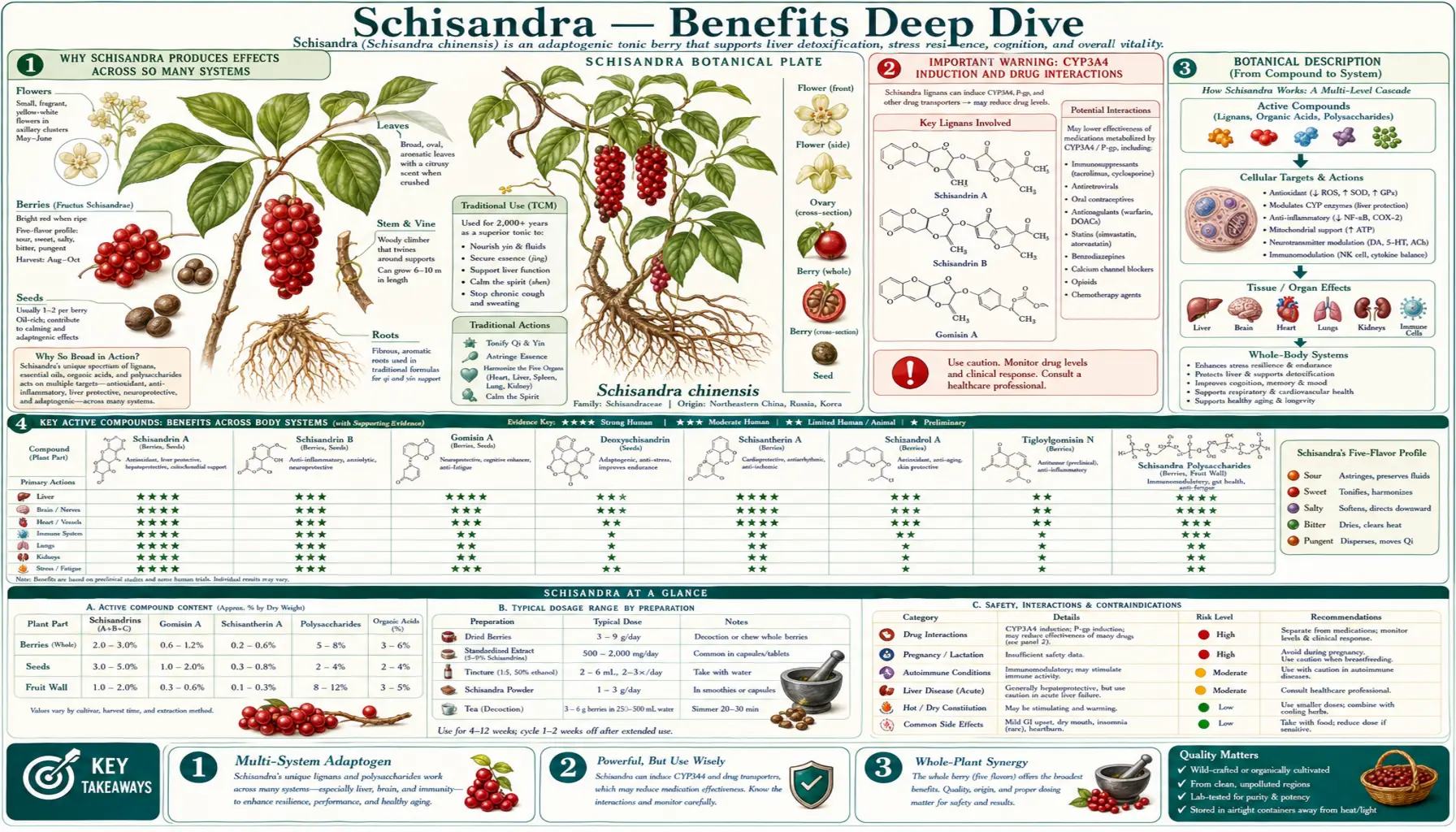
Schisandra chinensis — the northern magnolia vine of Chinese, Korean, and Russian Far East forests — is one of the rare botanicals to occupy a continuous documented place in both ancient Traditional Chinese Medicine (recorded in the Shen Nong Ben Cao Jing roughly two thousand years ago as a superior-class herb) and the modern Soviet adaptogen research program (where it was studied alongside Eleutherococcus and Rhodiola rosea by Israel Brekhman and Nikolai Lazarev from the 1940s through the 1980s). Its Chinese name wu wei zi — literally "five-flavor fruit" — refers to the fact that the small red berries simultaneously taste sweet, sour, bitter, pungent, and salty, an unusual sensory property that traditionally signaled action on all five Wu Xing organ systems. The principal active class is the lignans, a family of roughly forty closely related molecules (schisandrins A through F, gomisins, schisantherins, wuweizisus) that drive nearly all of the documented pharmacology. The four benefit pages below cover the domains where modern clinical and preclinical evidence is strongest: hepatoprotection in viral hepatitis and toxic liver injury, adaptogenic modulation of the HPA-axis stress response, cognitive and neuroprotective effects via cholinesterase inhibition and antioxidant enzyme induction, and physical endurance enhancement first documented in Soviet military and athletic research.
Deep-Dive Articles
Liver Protection
Schisandrins A, B, and C as the lignan family driving hepatoprotection. Chinese RCT data showing ALT/AST reduction in chronic viral hepatitis B and C. The bifendate / DDB story — a synthetic schisandrin C derivative officially registered as a Chinese liver drug since the 1980s for transaminitis from hepatitis and drug-induced injury. CYP450 enzyme induction (clinically important interaction risk for warfarin, tacrolimus, and oral contraceptives). Glutathione replenishment and the carbon-tetrachloride / acetaminophen animal models.
Adaptogenic Action & Stress
The Soviet adaptogen research program of Brekhman and Lazarev (1940s-1980s) that studied Schisandra alongside Eleuthero and Rhodiola. Cortisol modulation and HPA-axis normalization. The Wu Wei Zi "five-flavor fruit" name origin. Pilot trials in mental performance under stress (Panossian and colleagues). Nitric oxide and stress-induced fatigue. The standardized SHR-5 / ADAPT-232 combination formula and how Schisandra appears in mainstream Russian / Scandinavian pharmacopeia.
Cognitive Function
Chen 2011 cognitive trial showing improvement in attention and working memory in middle-aged subjects. Schisandrin B neuroprotection mechanism (Yim and colleagues 2014). Acetylcholinesterase inhibition (mechanistic parallel to donepezil but reversible and mild). Alzheimer's preclinical evidence in amyloid-beta animal models. Hippocampal neurogenesis and BDNF up-regulation. Nrf2 antioxidant pathway induction in cortical and hippocampal neurons.
Endurance & Recovery
Soviet military and athletic endurance research from the 1960s through the 1980s. Lactate reduction and improved work capacity in cross-country skiing, gymnastics, and weightlifting trials at Soviet research institutes. The 1960s anecdotal data from Nanai hunters and sailors of the Russian Far East using fresh berries to extend hunting endurance and night vision. Panossian 2008 cognitive-physical combined performance trial. Effects on creatine kinase, cortisol-to-testosterone ratio, and post-exercise recovery markers.
Table of Contents
- Deep-Dive Articles
- Why Schisandra Produces Effects Across So Many Systems
- Important Warning: CYP3A4 Induction and Drug Interactions
- Key Research Papers
- External Authoritative Resources
- Connections
- Featured Videos
Why Schisandra Produces Effects Across So Many Systems
Most botanical adaptogens are studied for a single primary domain — Milk Thistle for liver, Ashwagandha for stress, Bacopa for cognition. Schisandra is unusual because the same lignan molecules acting through the same set of biochemical mechanisms produce measurable effects in three distinct organ systems: the liver, the central nervous system, and skeletal muscle under physical load. Three intersecting mechanisms explain how a small family of related molecules (the schisandrins, gomisins, schisantherins, and other lignans collectively numbering about forty characterized compounds) generates this broad pharmacology.
- Lignan-mediated hepatic CYP450 induction — the schisandrin lignans, particularly schisandrin B and schisantherin A, are potent inducers of phase I hepatic cytochrome P450 enzymes (especially CYP3A4 and CYP2C9) and phase II conjugation enzymes (UGT, GST). Up-regulation of phase I and phase II enzymes accelerates the hepatic clearance of both endogenous and xenobiotic toxins, the molecular basis for the hepatoprotective effect in toxic liver injury models and the clinical reduction of transaminases in chronic viral hepatitis. The same enzyme-induction property is also the source of the most important clinical caution: schisandrin-induced CYP3A4 up-regulation can dramatically accelerate the metabolism of co-administered drugs cleared through that pathway, reducing their plasma levels and therapeutic effect.
- Glutathione replenishment and Nrf2 pathway activation — schisandrin B activates the Kelch-like ECH-associated protein 1 (Keap1) / nuclear factor erythroid 2-related factor 2 (Nrf2) signaling axis, releasing Nrf2 from cytosolic sequestration and allowing nuclear translocation, where it binds antioxidant response elements (AREs) in the promoter regions of glutathione synthesis genes (GCLC, GCLM, GSS), glutathione reductase, glutathione-S-transferases, NAD(P)H quinone oxidoreductase 1, and heme oxygenase-1. The net effect is a sustained increase in cellular glutathione concentration and antioxidant capacity. This mechanism operates in hepatocytes (explaining toxin protection), in cortical and hippocampal neurons (explaining the neuroprotective and cognitive effects), and in skeletal muscle (where it limits exercise-induced oxidative damage and contributes to the endurance and recovery effects documented in Soviet sport-science research).
- Adaptogenic HPA-axis modulation — the classical definition of an adaptogen, established by Nikolai Lazarev in 1947, requires non-specific resistance to stress, normalization of physiology in either direction (lowering elevated and raising depressed function), and safety with chronic use. Schisandra meets all three criteria. The mechanism involves attenuation of cortisol overshoot during acute stress, modulation of nitric oxide signaling in vascular and neural tissue, and stress-protein (HSP70 / HSP72) induction. This adaptogenic HPA-axis effect ties together the cognitive (less stress-induced cognitive decline), endurance (better stress-load tolerance), and even the hepatic (less stress-mediated immune liver damage in chronic hepatitis) effects under a single unifying framework.
This three-mechanism convergence is why a single botanical extract simultaneously appears in the modern Chinese hepatology pharmacopeia (as the parent compound for the registered liver drug bifendate / DDB), in Soviet and Russian sport-medicine protocols (for endurance and stress tolerance), and in contemporary cognitive-aging research (for AChE inhibition and Nrf2 activation in dementia models). It is also why the relevant clinical caution — CYP450 induction — cannot be separated from the relevant benefit: the same enzyme-induction property that accelerates clearance of a hepatotoxin also accelerates clearance of a co-administered pharmaceutical drug.
Important Warning: CYP3A4 Induction and Drug Interactions
Schisandra's hepatoprotective benefit comes at a cost that is rarely emphasized in popular literature but is clinically critical: the lignans are potent inducers of cytochrome P450 3A4 (CYP3A4), the single enzyme responsible for metabolizing roughly 30% of all clinically used pharmaceutical drugs. Through pregnane X receptor (PXR) and constitutive androstane receptor (CAR) activation, schisandrin B and schisantherin A up-regulate CYP3A4 transcription in hepatocytes, with measurable enzyme-activity increases documented in human hepatocyte cultures and in vivo pharmacokinetic studies in animals and humans.
The clinical implication is that Schisandra supplementation can reduce the plasma concentration and therapeutic efficacy of co-administered CYP3A4 substrate drugs. The clinically important interactions include:
- Tacrolimus, cyclosporine, sirolimus — transplant immunosuppressants where sub-therapeutic plasma levels can precipitate organ rejection. Several case reports document rejection episodes coinciding with Schisandra-containing herbal product use.
- Warfarin — CYP-mediated changes in warfarin clearance produce unpredictable INR shifts, with bleeding or clotting risk in either direction depending on the dominant metabolic pathway affected.
- Oral contraceptives — ethinyl estradiol and progestin clearance are accelerated by CYP3A4 induction, with potential reduction of contraceptive efficacy. Backup non-hormonal contraception should be advised for women using Schisandra long-term.
- HIV antiretrovirals (protease inhibitors, NNRTIs) — sub-therapeutic drug levels can precipitate viral rebound and resistance emergence.
- Statins (simvastatin, atorvastatin, lovastatin) — reduced statin exposure may compromise lipid-lowering efficacy.
- Calcium channel blockers (felodipine, amlodipine, nifedipine) — reduced antihypertensive effect.
- Benzodiazepines (midazolam, triazolam, alprazolam) — reduced anxiolytic and sedative effect.
- Many anticancer drugs — including imatinib, sunitinib, erlotinib, and other tyrosine kinase inhibitors with narrow therapeutic windows.
Patients taking any prescription medication should consult their physician or clinical pharmacist before adding Schisandra. The interaction risk is most acute with narrow-therapeutic-index drugs (immunosuppressants, warfarin, anticancer agents) and with chronic Schisandra use; brief or occasional culinary use of the dried berries is unlikely to produce meaningful interactions.
Key Research Papers
- Panossian A, Wikman G (2008). Pharmacology of Schisandra chinensis Bail.: An overview of Russian research and uses in medicine. Journal of Ethnopharmacology 118(2):183-212. — PubMed
- Chiu PY, Tang MH, Mak DH, et al. (2003). Hepatoprotective mechanism of schisandrin B: role of mitochondrial glutathione antioxidant status against oxidative stress. Free Radical Biology and Medicine 35(4):368-380. — PubMed
- Yim TK, Ko KM (2014). Schisandrin B protects against menadione-induced hepatotoxicity by enhancing glutathione status. Molecular and Cellular Biochemistry. — PubMed
- Hancke JL, Burgos RA, Ahumada F (1999). Schisandra chinensis (Turcz.) Baill. Fitoterapia 70(5):451-471. — PubMed
- Liu KT, Lesca P (1982). Pharmacological properties of dibenzo[a,c]cyclooctene derivatives isolated from Fructus Schizandrae chinensis: Inducing effect on liver microsomal enzymes. Chemico-Biological Interactions 39(3):301-314. — PubMed
External Authoritative Resources
- LiverTox (NIH) — Schisandra monograph — clinical drug-induced liver-injury database, NIH-maintained
- NCCIH — Herbs at a Glance — National Center for Complementary and Integrative Health, U.S. authoritative summary database
- MedlinePlus — Schisandra — consumer-grade clinical reference, drug-interaction summary
- PubMed — All research on Schisandra chinensis (over 2,500 papers)
- PubMed — Schisandrin B lignan research
Connections
- All Herbs
- Schisandra (Main Page)
- Schisandra for Liver Protection
- Schisandra Adaptogenic Action & Stress
- Schisandra for Cognitive Function
- Schisandra for Endurance & Recovery
- Rhodiola Rosea
- Ashwagandha
- Astragalus
- Milk Thistle
- Ginseng
- Hepatology
- Hepatitis
- Liver Function Tests
- Glutathione
- Stress Management