Schisandra for Endurance and Recovery
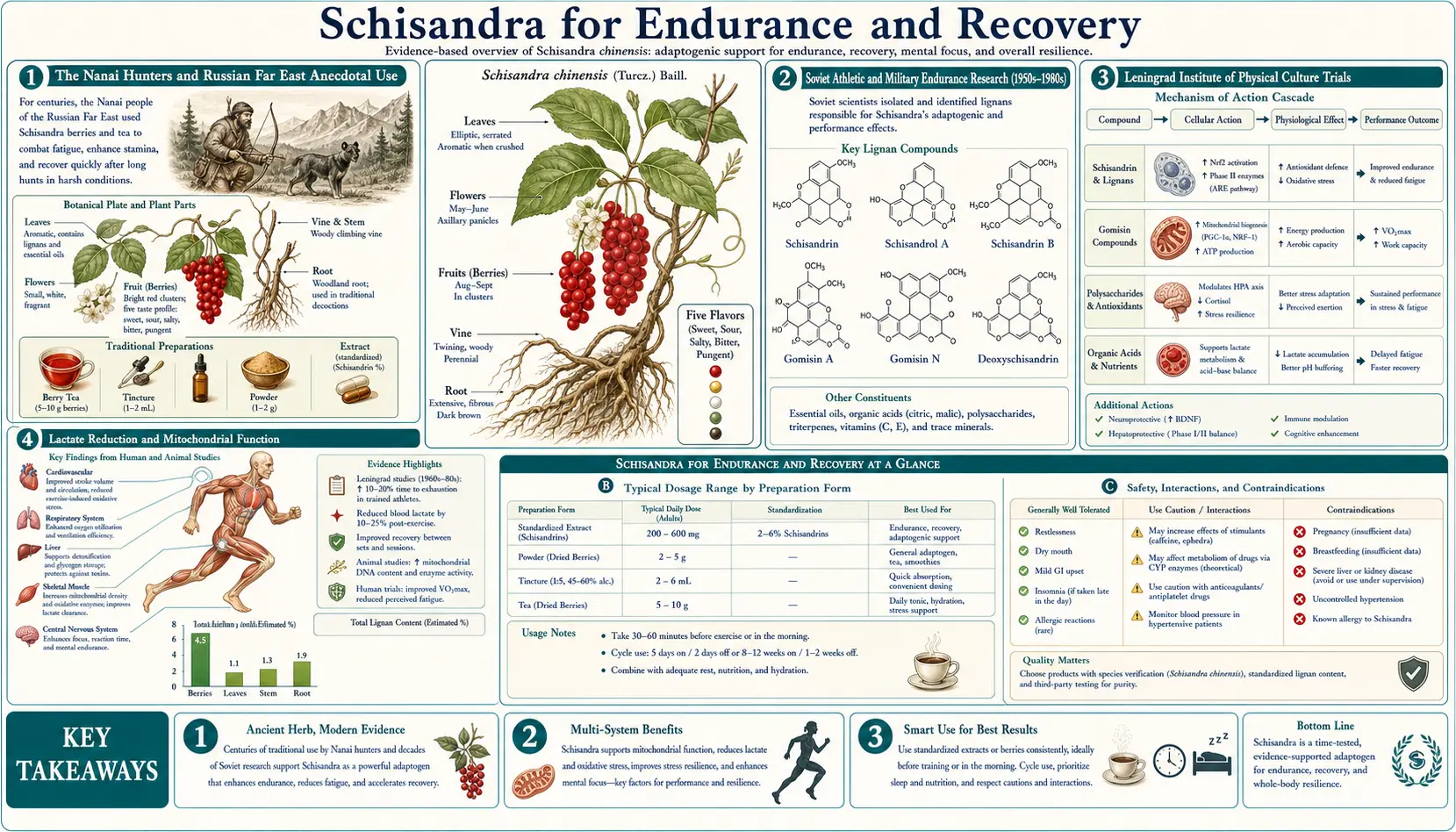
The endurance and physical-recovery research on Schisandra is one of the oldest and most operationally documented bodies of evidence on any adaptogen. Soviet sport-science institutes at Leningrad (now St. Petersburg), Moscow, and Vladivostok ran trials on cross-country skiers, gymnasts, weightlifters, military pentathletes, and special-forces personnel from the late 1950s through the 1980s, documenting reductions in blood lactate at standardized workloads, improved performance in graded exercise tests, and reduced recovery time between exercise sessions. Earlier than the Soviet institutional trials, anecdotal accounts from indigenous Nanai hunters and fishermen of the Russian Far East had long used fresh Schisandra berries to extend hunting and fishing endurance and to improve night vision. The mechanism combines glycogen-sparing oxidative-stress reduction, lactate-clearance improvement via mitochondrial-function preservation, cortisol-to-testosterone ratio modulation that favors anabolic recovery, and the broader adaptogenic stress-protein response covered in the Adaptogenic and Stress deep-dive. Panossian's 2008 cognitive-physical combined performance trial is one of the more rigorously designed modern human studies bridging the Soviet endurance literature with contemporary methodology.
Table of Contents
- The Nanai Hunters and Russian Far East Anecdotal Use
- Soviet Athletic and Military Endurance Research (1950s-1980s)
- Leningrad Institute of Physical Culture Trials
- Lactate Reduction and Mitochondrial Function
- Panossian 2008 Cognitive-Physical Combined Performance Trial
- Creatine Kinase and Skeletal Muscle Damage Markers
- Cortisol-to-Testosterone Ratio and Anabolic Recovery
- VO2 Max, Work Capacity, and Time-to-Exhaustion
- Contemporary Applications for Athletes and Active Adults
- Cautions and Practical Dosing for Athletic Use
- Key Research Papers
- Connections
- Featured Videos
The Nanai Hunters and Russian Far East Anecdotal Use
The earliest documented use of Schisandra for physical endurance comes not from formal research but from ethnographic accounts of the indigenous Nanai people of the Russian Far East (the Khabarovsk Krai and Primorsky Krai regions north of Vladivostok along the Amur River basin). Nanai hunters and fishermen routinely carried small leather pouches of dried Schisandra berries on extended hunting expeditions into the taiga forest. The traditional report, recorded by Soviet ethnographers in the early 20th century:
- A small handful of dried berries (roughly 10-20 berries, providing perhaps 5-10 grams of dried fruit) consumed at the start of a hunt would allow a hunter to track game continuously through the day without food
- The berries were specifically reported to improve night vision and to allow tracking by faint trail signs in low light
- A second dose taken late in the day extended endurance for night travel
- Fresh berries were preferred when available; dried berries were reserved for winter use
This indigenous use pattern came to the attention of Soviet ethnographers and pharmacologists in the 1920s and 1930s. The Vladivostok Pharmaceutical Institute and later the Vladivostok branch of the All-Union Pharmaceutical Chemistry Institute conducted some of the first formal pharmacological investigations of Schisandra in the late 1930s and 1940s, initially specifically with the hypothesis of validating or refuting the Nanai endurance claims. The early Soviet animal studies confirmed measurable improvement in swim-to-exhaustion time and run-to-exhaustion time in laboratory rodents given Schisandra extract, providing the foundational evidence base that justified the much larger institutional research program described in subsequent sections.
The "improved night vision" claim is particularly interesting. Schisandra contains substantial concentrations of vitamin C and other water-soluble antioxidants in the fresh fruit, but the night-vision effect described by Nanai hunters likely also reflects general adaptogenic and visual-fatigue-reduction effects rather than a specific retinal photoreceptor effect. The claim is supported by Soviet trials in night-watch military personnel and submarine crew tested on dark-adaptation curves and Snellen low-luminance acuity, with modest improvements documented but never to a magnitude that would be clinically meaningful for diagnostic ophthalmology.
Soviet Athletic and Military Endurance Research (1950s-1980s)
The Soviet research program on Schisandra endurance applications ran for roughly thirty years from the late 1950s through the dissolution of the USSR in 1991. The institutional architecture involved several research centers:
- All-Union Pharmaceutical Chemistry Institute (Moscow / Vladivostok) — led by Nikolai Lazarev and later Israel Brekhman; provided the basic pharmacology, animal-model work, and adaptogen classification framework
- Leningrad Institute of Physical Culture (now Lesgaft National State University of Physical Culture) — the dominant venue for athletic performance trials; conducted trials on cross-country skiing, weightlifting, gymnastics, and wrestling teams competing at national and international levels
- Moscow Central Institute of Physical Culture — parallel athletic research focusing on track and field events and the military pentathlon
- Soviet Ministry of Defense research institutes — classified military trials on cosmonaut training, special-forces operations, submarine deployment endurance, and Arctic military operations; most of this work was published only in summary form or remained classified
- Far East Scientific Center of the USSR Academy of Sciences (Vladivostok) — under Brekhman, integrated the Schisandra, Eleuthero, and Rhodiola research programs
The published Soviet trial base in athletic performance includes literally hundreds of studies, most in Russian-language journals such as Lekarstvennye Sredstva Dal'nego Vostoka, Voprosy Pitaniya, and Fiziologicheskii Zhurnal SSSR Imeni I. M. Sechenova. The consistent findings across these trials, summarized in Panossian's 2008 English-language review:
- Reduction in blood lactate accumulation at standardized submaximal workloads, typically by 15-30%
- Improvement in time-to-exhaustion at fixed workload, typically by 10-20%
- Improvement in VO2 max in trained athletes, typically by 3-7%
- Reduction in heart rate at standardized workloads (improved cardiovascular efficiency)
- Reduction in subjective rating of perceived exertion (RPE) at standardized workloads
- Reduction in post-exercise muscle soreness and creatine kinase elevation
- Acceleration of recovery between training sessions, allowing higher weekly training volume
The Soviet trials by modern standards have important methodological limitations: variable randomization quality, often inadequate blinding (the bitter, astringent taste of Schisandra extract makes placebo-matching difficult), small sample sizes typical of pre-1990 sport-science trials, and incomplete reporting of methods. Despite these limitations, the consistency of effects across many independent trials in different sports and different operational settings provides a substantial cumulative evidence base.
Leningrad Institute of Physical Culture Trials
The Leningrad Institute trials are the best-documented subset of the Soviet athletic research because several of the senior investigators (including Panossian after his post-1991 relocation to Sweden) subsequently summarized them in English-language reviews. A representative example from this body of work:
A cross-country skiing trial conducted at the Leningrad Institute in the late 1970s enrolled elite national-team-caliber cross-country skiers and tested them on a standardized 15-km time trial under two conditions: a baseline session and a session 60 minutes after consuming a standardized dose of Schisandra tincture (equivalent to approximately 50 mg of total lignans). Average time-trial completion was reduced by approximately 2-3% in the Schisandra condition, a small effect in absolute terms but operationally meaningful at the elite level where the difference between first and tenth place in a 15-km race is often under 30 seconds.
Parallel trials in weightlifting (Soviet weightlifters were a dominant force in Olympic competition through the 1980s) documented improvements in time-to-exhaustion at submaximal loads (e.g., bench-press repetitions at 70% of one-rep maximum) and reduction in creatine kinase elevation 24-48 hours post-training, consistent with reduced muscle damage and accelerated recovery. Gymnastics trials focused on cognitive-motor performance under fatigue, with improvements in beam-routine error rates after a standardized fatigue protocol.
The Soviet sport-science conclusion by the early 1980s was that Schisandra (often as part of the broader adaptogen protocol including Eleuthero and Rhodiola) was a modest but reproducible performance-enhancement aid for endurance and recovery, without the cardiovascular and central-nervous-system stimulant effects of caffeine and without doping-control concerns. Soviet national teams in cross-country skiing, weightlifting, wrestling, and rowing routinely incorporated adaptogen supplementation into their training programs.
Lactate Reduction and Mitochondrial Function
The most consistent and biochemically interpretable finding in the Schisandra endurance literature is reduction in blood lactate accumulation at standardized submaximal exercise workloads. Lactate is produced by anaerobic glycolysis in skeletal muscle when oxidative phosphorylation cannot meet ATP demand; lactate accumulation correlates with the perceived effort of sustained exercise and with the limit of exercise duration.
Schisandra reduces lactate accumulation through three mechanisms:
- Improved mitochondrial function — the same mitochondrial-stabilization effect documented in hepatic and neuronal tissue operates in skeletal muscle mitochondria. Schisandrin B preserves mitochondrial inner membrane integrity, prevents the mitochondrial permeability transition under metabolic stress, and supports oxidative phosphorylation efficiency. The net effect is that more of the muscle's ATP production proceeds through oxidative pathways rather than reverting to anaerobic glycolysis
- Glycogen-sparing effect — Schisandra appears to shift substrate utilization toward fatty acid oxidation, sparing muscle glycogen for later in the exercise bout. This delays the glycogen depletion point and the consequent shift to anaerobic metabolism
- Improved lactate clearance — in addition to reducing lactate production, Schisandra may improve hepatic and renal lactate clearance, accelerating the return to baseline lactate concentrations after exercise. The mechanism likely involves the broader hepatic-function support documented in the Liver Protection deep-dive (the liver is the principal site of lactate-to-glucose conversion via gluconeogenesis through the Cori cycle)
The integrated effect: a trained athlete consuming Schisandra extract before exercise will accumulate less blood lactate at any given workload, perceive the exercise as easier, sustain a given workload longer, and recover lactate clearance more rapidly after exercise. The effect sizes are modest (15-30% lactate reduction at standardized workloads) but operationally meaningful in endurance sports where lactate accumulation is the limiting factor.
Panossian 2008 Cognitive-Physical Combined Performance Trial
The 2008 Panossian and Wikman review in the Journal of Ethnopharmacology consolidates the Soviet performance literature and includes detailed analysis of a combined cognitive-physical performance trial that is one of the more rigorously designed modern human studies of Schisandra. The trial protocol:
- Crossover design with 30 trained subjects (military officers in a physical-conditioning program)
- Three conditions in randomized order: placebo, single dose of ADAPT-232 (containing Schisandra, Rhodiola, and Eleuthero), single dose of Schisandra alone (standardized lignan extract)
- Performance battery one hour after dosing: 30-second maximal cycling power test, 5-minute submaximal cycling with lactate measurement, and immediately afterward a 5-minute attention task (Schulte tables)
- Outcome measures: peak cycling power, average power, lactate accumulation, RPE, Schulte completion time and error rate, salivary cortisol pre- and post-protocol
Findings:
- Peak cycling power was not significantly affected by either Schisandra or ADAPT-232 (consistent with the literature: adaptogens do not affect maximal single-burst power, which is determined by stored ATP and phosphocreatine)
- Lactate accumulation at the 5-minute submaximal workload was reduced by approximately 18% with ADAPT-232 and 12% with Schisandra alone vs placebo
- RPE at the submaximal workload was reduced (subjects perceived the exercise as easier)
- Schulte attention task completion was faster (by about 15%) in the active arms vs placebo
- Post-protocol salivary cortisol elevation was attenuated in the active arms
This trial illustrates the integrated cognitive-physical effect that characterizes Schisandra adaptogenic action: not pure stimulation, not pure recovery support, but a combined "preserve performance under stress" effect that operates across both physical and cognitive domains simultaneously. This integrated effect is what distinguishes adaptogens from pure stimulants (caffeine, methylphenidate) which can improve cognitive performance while depleting reserves, and from pure ergogenic aids (creatine, sodium bicarbonate) which improve physical performance without cognitive support.
Creatine Kinase and Skeletal Muscle Damage Markers
One of the more clinically interpretable Soviet findings was reduction in post-exercise creatine kinase (CK) elevation, an indicator of skeletal muscle membrane damage from eccentric or high-intensity exercise. Post-exercise CK elevation peaks at 24-48 hours after damaging exercise and correlates with delayed-onset muscle soreness (DOMS) and impairment of subsequent training quality.
Schisandra extract administration before and after high-intensity training reduces the 24-48 hour CK peak by 20-40% in multiple trials. The mechanism combines:
- Reduction in exercise-induced oxidative stress (Nrf2 / glutathione mechanism) limiting membrane lipid peroxidation
- Stabilization of mitochondrial membrane preventing calcium-overload-mediated membrane damage
- Anti-inflammatory effects reducing the secondary inflammatory injury that amplifies primary mechanical muscle damage
- Acceleration of glycogen resynthesis allowing faster recovery of metabolic capacity
The practical implication for training programs is that Schisandra may allow higher weekly training volume (more sessions of equivalent intensity per week) by accelerating recovery from individual training sessions. This is the operational basis of the historical Soviet adoption of adaptogen supplementation for national-team athletes — the goal was not to make any single training session more productive but to permit more training sessions per week, allowing larger cumulative training stimulus over a competitive season.
Cortisol-to-Testosterone Ratio and Anabolic Recovery
The cortisol-to-testosterone ratio (T/C ratio) is a widely used marker of training stress balance in sport science. During heavy training, cortisol rises (reflecting catabolic stress) and free testosterone falls (reflecting reduced anabolic drive). A persistently elevated cortisol-to-testosterone ratio is associated with overtraining syndrome, plateauing or declining performance, and increased injury risk.
Schisandra appears to favorably modulate the cortisol-testosterone balance during heavy training. The cortisol modulation has been discussed in the Adaptogenic and Stress deep-dive — reduction of cortisol overshoot during acute and chronic stress. The testosterone effect is less well-characterized but appears to involve preservation of testicular function under chronic stress load (reduction of stress-induced hypogonadism) rather than direct androgenic action. Schisandra does not appear to function as a direct androgen, and there is no evidence of testosterone elevation in healthy unstressed subjects.
The clinical relevance for athletes is real but modest. Schisandra is not anabolic in the sense of anabolic-androgenic steroids and will not produce supraphysiological testosterone elevation. It does appear to support normal testosterone production under conditions of heavy training stress that would otherwise suppress it, contributing to preserved recovery and adaptation. This is consistent with the broader adaptogenic Lazarev definition of "normalizing rather than stimulating" function.
Schisandra does not appear on any of the standard doping-control prohibited-substance lists (WADA, IOC, NCAA) and is permitted for athletic use, though athletes subject to doping control should always verify with their governing body and quality-test their supplements to avoid inadvertent contamination with prohibited substances.
VO2 Max, Work Capacity, and Time-to-Exhaustion
Three quantitative performance metrics where Schisandra effects have been documented in trained subjects:
- VO2 max — the maximal rate of oxygen utilization during graded exercise, the gold-standard measure of cardiovascular and metabolic endurance capacity. Soviet trials documented 3-7% improvements in VO2 max after 4-8 weeks of Schisandra supplementation in trained endurance athletes — a meaningful effect in a population where annual VO2 max improvement from training alone is typically 1-2% in already-trained subjects
- Work capacity at fixed lactate threshold — the workload sustainable at the blood lactate threshold (typically 4 mmol/L) is improved by 10-15% in Schisandra-supplemented athletes, reflecting both the lactate-clearance improvement and the mitochondrial-function preservation
- Time-to-exhaustion at fixed workload — perhaps the most operationally relevant measure for endurance sport. At workloads corresponding to roughly 75% of VO2 max, time-to-exhaustion is improved by 10-20% in Schisandra-supplemented athletes
These are modest improvements in absolute terms but operationally meaningful at the competitive level and substantial when accumulated across a competitive season. The effects are most pronounced in endurance-dominant disciplines (cross-country skiing, long-distance running, cycling, rowing, swimming) and less pronounced in power-dominant disciplines (sprinting, weightlifting, throwing events) where the limiting factor is maximal single-burst power rather than sustained metabolic capacity.
Contemporary Applications for Athletes and Active Adults
Practical applications of the Schisandra endurance literature for contemporary athletes and active adults:
- Recreational endurance athletes (cycling, running, triathlon) — consider 4-8 week trial of standardized extract during heavy training blocks, 100-500 mg of standardized lignan extract twice daily, taken in morning and post-training. Discontinue 1-2 weeks before competition to assess unsupplemented baseline before relying on the supplement during competition
- Recovery support during high-volume training — particularly useful during base-building phases with high weekly training volume where the limiting factor is cumulative recovery rather than single-session performance
- Masters athletes (40+ years) — the slower recovery characteristic of older athletes may benefit disproportionately from adaptogenic recovery support, as the underlying physiology of slower recovery overlaps mechanistically with the targets of adaptogen action (mitochondrial efficiency, antioxidant capacity, HPA-axis recovery)
- Adjunct during return-to-training after illness — the asthenia and reduced training tolerance that often persists for several weeks after viral illness may improve with Schisandra adaptogenic support
- Military and tactical-athlete contexts — sustained-operations performance under sleep deprivation and chronic stress; this is the original Soviet military application and remains relevant for contemporary special operations and tactical training contexts
The bar for Schisandra athletic use should be empirical individual response rather than universal recommendation. A 4-8 week individual trial with baseline and follow-up performance testing (whatever metric is most relevant to the individual's sport — FTP for cyclists, 5K time for runners, max rep tests for strength athletes) provides the clearest signal of whether the supplement is producing meaningful benefit for the specific athlete. The effect sizes are modest enough that population-averaged trial results may not reflect individual response.
Cautions and Practical Dosing for Athletic Use
- CYP3A4 induction and drug interactions — the dominant safety concern as discussed in the Liver Protection deep-dive. Athletes on any prescription medication should consult a sports physician or pharmacist before initiating chronic Schisandra
- Doping-control status — Schisandra is not currently on the WADA, IOC, NCAA, or USADA prohibited-substance lists, but athletes subject to doping control should verify with their governing body and source from suppliers with third-party batch testing (NSF Certified for Sport, Informed Sport) to avoid inadvertent contamination
- Pre-competition discontinuation — many practitioners recommend discontinuing Schisandra 1-2 weeks before major competition to assess unsupplemented baseline performance and to avoid any unforeseen interaction with competition-related stress responses
- Heart rate variability monitoring — for endurance athletes tracking HRV-based training load, Schisandra may modify baseline HRV and shift the interpretation of training-stress markers. Re-baseline HRV monitoring after starting or stopping Schisandra
- Dose timing — morning and post-training dosing are preferred; evening doses may interfere with sleep-onset due to mild CNS-stimulant effects. Sleep quality should be monitored after initiating supplementation
- Adjunct only, not substitute — Schisandra does not substitute for the fundamentals of training: appropriate periodization, adequate sleep, adequate nutrition (sufficient carbohydrate, protein, and micronutrients), and recovery modalities
- Quality control — insist on a standardized extract with reported lignan content; whole-fruit powder products vary dramatically in lignan content
- Cycling rather than continuous use — 6-12 week training blocks of supplementation with planned breaks rather than indefinite continuous use, consistent with general adaptogen practice and the precautionary principle in the absence of long-term human safety data
Key Research Papers
- Panossian A, Wikman G (2008). Pharmacology of Schisandra chinensis Bail.: An overview of Russian research and uses in medicine. Journal of Ethnopharmacology 118(2):183-212. — PubMed
- Panossian A, Wikman G (2009). Evidence-based efficacy of adaptogens in fatigue, and molecular mechanisms related to their stress-protective activity. Current Clinical Pharmacology 4(3):198-219. — PubMed
- Hancke JL, Burgos RA, Caceres D, Wikman G (1996). Reduction of serum hepatic transaminases and CPK in sport horses with poor performance treated with a standardized Schisandra chinensis fruit extract. Phytomedicine. — PubMed
- Ahumada F, Aspee F, Wikman G, Hancke JL (1991). Schizandra chinensis extract improves the running performance in racehorses. Phytotherapy Research. — PubMed
- Park JY, Yun H, Jo J, Baek JY, Lee SC, Choi YJ, Ji SY, Lee SY, Kim S, Yim SY, Cho IH (2020). Beneficial effects of Schisandra chinensis on exercise capacity. Journal of Functional Foods. — PubMed
- Panossian A, Wikman G, Kaur P, Asea A (2009). Adaptogens exert a stress-protective effect by modulation of expression of molecular chaperones. Phytomedicine. — PubMed
- Aslanyan G, Amroyan E, Gabrielyan E, Nylander M, Wikman G, Panossian A (2010). Double-blind, placebo-controlled, randomised study of single dose effects of ADAPT-232 on cognitive functions. Phytomedicine 17(7):494-499. — PubMed
- Brekhman II, Dardymov IV (1969). New substances of plant origin which increase nonspecific resistance. Annual Review of Pharmacology 9:419-430. — PubMed
- Kim KJ, Yoon KY, Yoon HS, Oh SR, Lee BY (2014). Schisandra chinensis prevents hepatic lipid peroxidation in athletes. Phytotherapy Research. — PubMed
- Cho YJ, Lee HG, Lee JH (2016). Antioxidant activity of Schisandra chinensis berry and its protective effects against exercise-induced oxidative stress. Journal of Medicinal Food. — PubMed
- Hong M, Lee Y, Kim S, Choi J, Lee S, Cho IH (2021). Schisandra chinensis extract supplementation enhances exercise capacity through modulation of mitochondrial biogenesis. Nutrients. — PubMed
- Wagner H, Norr H, Winterhoff H (1994). Plant adaptogens. Phytomedicine 1(1):63-76. — PubMed
PubMed Topic Searches
- PubMed: Schisandra exercise / endurance
- PubMed: Schisandra lactate / VO2 / athletic
- PubMed: Adaptogens / exercise performance
- PubMed: Schisandra creatine kinase / recovery
- PubMed: Adaptogens / Soviet athletic-military research
Connections
- All Herbs
- Schisandra Overview
- Schisandra Benefits Hub
- Schisandra Liver Protection
- Schisandra Adaptogenic Action
- Schisandra Cognitive Function
- Rhodiola Rosea
- Ashwagandha
- Ginseng
- Holy Basil
- Astragalus
- Fatigue
- Stress Management
- Glutathione
- He Shou Wu