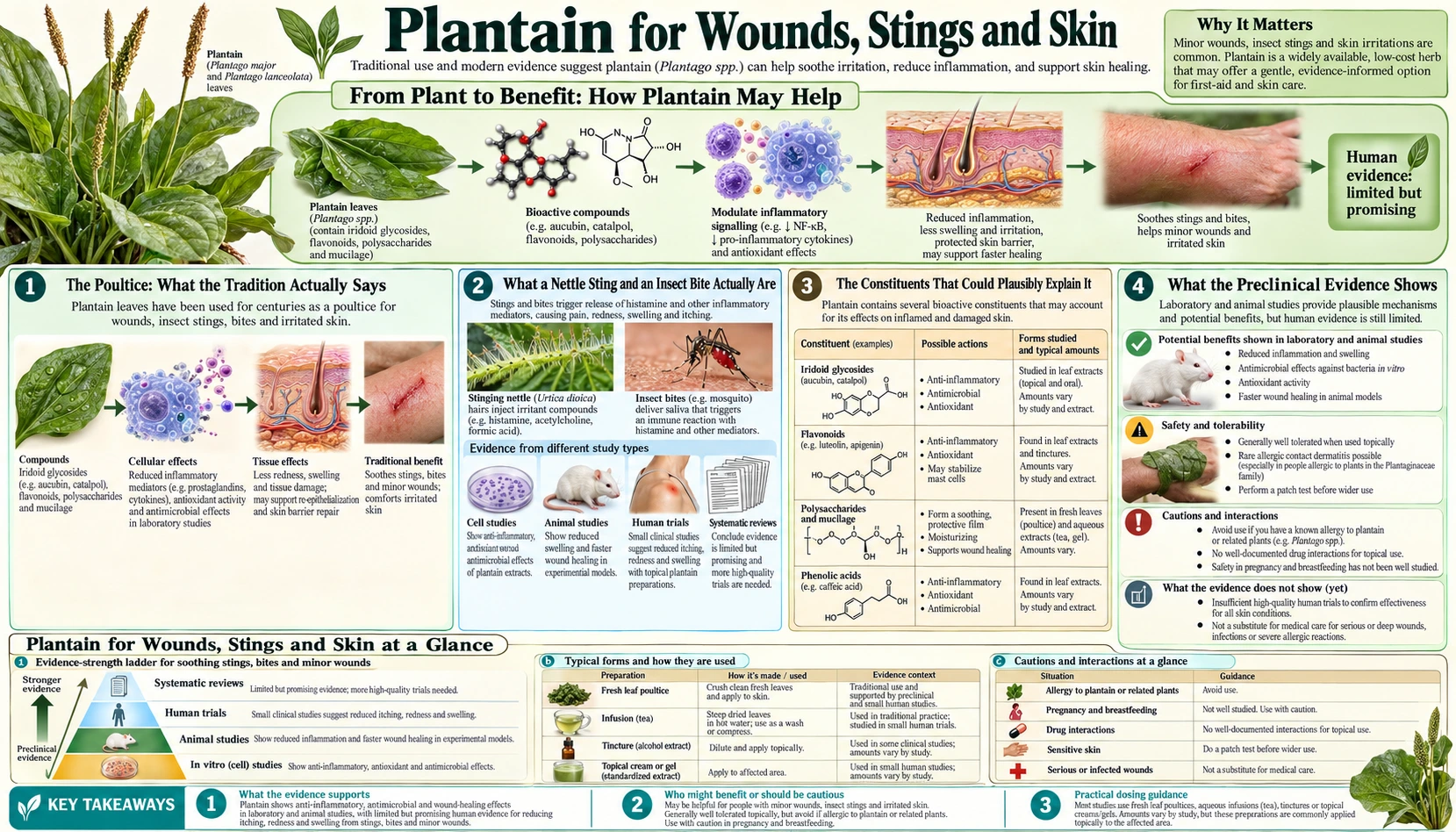
Plantain for Wounds, Stings and Skin
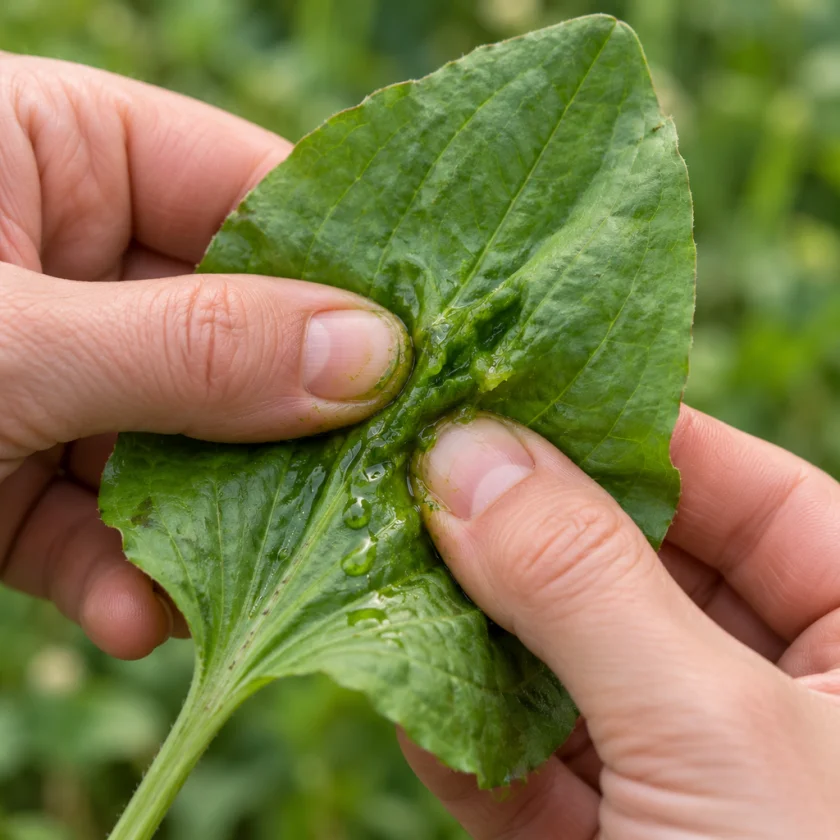
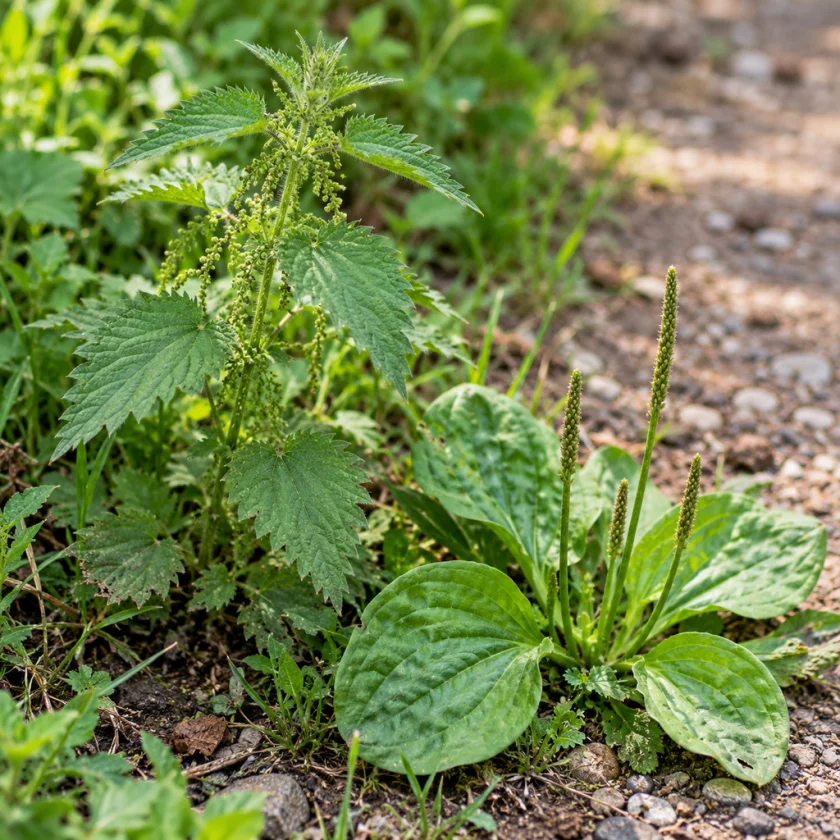
People crush a plantain leaf and press it onto a nettle sting. That single gesture is probably the most widely transmitted plant remedy in the temperate world — taught by grandparents, scout leaders, hill walkers and gardeners across Europe, North America, Russia, Australia and New Zealand, usually without either party knowing the plant's Latin name. It is free, it is immediate, the plant grows within arm's reach of wherever you were stung, and it is essentially risk-free on intact-enough skin. That combination is why it survived.
This page does two jobs. First, it reports what is actually known, which is a real body of laboratory and animal work, a plausible set of constituents, a few small human trials of plantain creams and gels on chronic ulcers, and no controlled trial in humans of the leaf for stings, bites or minor wounds. Second — and this is the more useful half — it is practical. People have long put a poultice on a sting or a scratch; no harm from it is reported, and whether it helps beyond cooling and moisture is untested. An expanding reaction, a breathing problem, a spreading red edge or a deep dirty wound is not a poultice situation, and knowing which is which matters more than any amount of phytochemistry.
Table of Contents
- The Poultice: What the Tradition Actually Says
- What a Nettle Sting and an Insect Bite Actually Are
- The Constituents That Could Plausibly Explain It
- What the Preclinical Evidence Shows
- The Human Evidence Is Absent, Not Negative
- How a Trial Would Actually Measure This
- Comparators That Do Have Human Trials
- Why Topical Use Escapes the Usual Dose Objection
- How the Traditional Poultice Is Made and Applied
- When It Is Not a Poultice Situation
- Beyond First Aid: Salves, Washes and Itchy Skin
- The "Drawing Out" Claim, Examined
- The Honest Ledger
- Key Research Papers
- Connections
- Featured Videos
The Poultice: What the Tradition Actually Says
The tradition is unusually specific and unusually consistent, which is itself worth noting. Across scattered sources and centuries, the instructions barely vary:
- Pick, crush, apply. Take a clean leaf, bruise it — chewing, rolling between the palms, pounding with a stone, or rubbing it hard — until it is wet and green, then press it onto the spot and hold it there.
- The target complaints are nettle stings, insect bites, bee and wasp stings, minor cuts and grazes, splinters, blisters and small burns.
- Repeat with a fresh leaf when the first goes dry or warm.
- Bruising the leaf is treated as essential, not incidental. A whole leaf laid flat is not the remedy; the juice is.
The plant carried names that record the use: waybread, "soldier's herb", "healing blade", "nature's bandage". Written records go back through medieval European herbals to Dioscorides and Pliny in antiquity, and the same use appears independently in Persian medicine, in Russian folk practice, and in numerous North American Indigenous pharmacopoeias after the plant's introduction. The reference review of the ethnobotany is Samuelsen's "The traditional uses, chemical constituents and biological activities of Plantago major L. A review", Journal of Ethnopharmacology, 2000, which assembles the folk record from primary sources. PubMed PMID: 10904143.
A caution about what convergent tradition proves. Widespread independent use is meaningful evidence that a remedy is tolerable, available and perceived to help. It is weak evidence of pharmacological effect, because the complaints in question — a sting, a graze, an itch — nearly all resolve on their own within minutes to days, which is the ideal condition for any remedy to acquire an undeserved reputation. That is not a reason to dismiss the practice. It is a reason not to over-read it.
What a Nettle Sting and an Insect Bite Actually Are
To judge whether a crushed leaf could plausibly help, it helps to know what it is being applied to. The three common cases are mechanically different.
- Nettle sting. Stinging nettle leaves and stems carry brittle silica-tipped hairs that snap on contact and act as tiny hypodermics, injecting a mix that includes histamine, acetylcholine, serotonin, formic acid and oxalic and tartaric acids. The result is immediate burning, a nettle rash of raised pale weals, and itching that can persist for hours. Crucially, the hair tips can remain in the skin. Which of these causes the lasting pain is less settled than the usual "formic acid" explanation suggests: a 2006 study of the stinging hairs of Urtica thunbergiana, a close relative of stinging nettle, found histamine, oxalic acid and tartaric acid were the main contents, while formic acid and serotonin were present only at low levels. In rats, oxalic and tartaric acid caused long-lasting pain, while formic acid and serotonin caused only moderate pain in the first 10 minutes.
- Mosquito and midge bite. The reaction is largely an immune one to injected salivary proteins — a local immunoglobulin E- and mast-cell-driven wheal with itch mediated by histamine and other pruritogens. The sensitisation is why bites get itchier with repeated exposure over a season and why children often react more strongly than adults.
- Bee or wasp sting. Genuine venom, injected in quantity, containing melittin and phospholipase A2 in the honeybee's case. Pain is immediate and intense, and a honeybee leaves its barbed sting and venom sac in the skin, continuing to pump. Here the single most effective intervention is getting the sting out quickly, by scraping sideways with a fingernail or card edge. Nothing applied to the skin matters as much as the seconds saved.
Notice what this implies for the poultice. For a nettle sting or a mosquito bite, the plausible targets are itch, burning, weal and inflammation — all subjective or short-lived, all things a cool wet application could affect by physical means alone. For a bee sting, mechanical removal outranks everything. And for a graze, the plausible targets are bleeding, contamination and rate of closure. These are three different claims and they deserve three different verdicts, not one.
The Constituents That Could Plausibly Explain It
Plantain leaf is not inert green matter. Several classes of compound in it have documented activity relevant to skin, and they map onto the tradition reasonably well.
- Iridoid glycosides — aucubin and catalpol. Aucubin is plantain's most-studied single molecule, with anti-inflammatory, antioxidant and tissue-protective activity across many laboratory models. The reference synthesis is Zeng, Guo and Ouyang's "A review of the pharmacology and toxicology of aucubin", Fitoterapia, 2020. PubMed PMID: 31790767. Catalpol, the related iridoid, is also present in Plantago and carries its own anti-inflammatory literature. Topic search.
- Phenylethanoid glycosides — plantamajoside and acteoside (verbascoside). Caffeic-acid esters with antioxidant and antibacterial activity. Plantamajoside was structurally characterised and its antibacterial action documented in Ravn and Brimer, "Structure and antibacterial activity of plantamajoside, a caffeic acid sugar ester from Plantago major subsp. major", Phytochemistry, 1988. doi:10.1016/0031-9422(88)80744-1.
- Mucilage. Water-holding polysaccharides that form a cool, slippery film. On skin this is a physical effect — occlusion, moisture, reduced friction — rather than a pharmacological one. It is the same mechanism family exploited by marshmallow root and slippery elm.
- Tannins. Astringent polyphenols that precipitate surface proteins, tighten tissue and reduce weeping. This is the plausible basis for the traditional claim about minor bleeding and for the "dries up a weepy patch" observation.
- Allantoin. Widely listed as a plantain constituent and long used in dermatology as a keratolytic and skin-conditioning agent. Two honesty notes. First, allantoin's dermatological pedigree comes mainly from comfrey and from synthetic allantoin in cosmetic formulations, not from plantain trials. Second, we decline to state how much allantoin a plantain leaf contains: published figures are sparse, vary with species, season and assay, and a confident milligram-per-gram number here would be a guess dressed as data. Topic search on allantoin and skin.
- Flavonoids — including apigenin and luteolin derivatives, contributing antioxidant and anti-inflammatory activity documented at the cell level.
Two things follow. The constituent list is a genuine mechanistic plausibility argument — there is something in the leaf that could do something. It is not an efficacy argument, and the gap between the two is where most herbal writing about plantain goes wrong.
What the Preclinical Evidence Shows
Wound healing is, of all plantain's uses, the one with the most modern experimental support. It is also, almost entirely, support from cells and rodents.
Cell-layer closure
Zubair and colleagues, "Effects of Plantago major L. leaf extracts on oral epithelial cells in a scratch assay", Journal of Ethnopharmacology, 2012, found that leaf extract accelerated closure of a deliberate scratch across a monolayer of oral epithelial cells. PubMed PMID: 22465512. A scratch assay measures cell migration and proliferation in a dish. It is a legitimate, standard first-pass model. It is not a wound: there is no blood clot, no immune infiltrate, no bacteria, no dressing, no dermis and no patient.
The preclinical systematic review
Cardoso and colleagues, "The effect of Plantago major on wound healing in preclinical studies: a systematic review", Wound Management & Prevention, 2021, searched seven databases for controlled animal studies published from 2006 to March 2020. Of 176 publications identified, only four small animal studies (20 to 100 animals each) qualified. They tested varying concentrations of the plant, and the best wound-contraction results came at 10%, 20% and 50% concentrations compared with controls, measured 17 to 21 days after wounding. But all four studies had a high risk of bias and a lack of methodological rigour, and the authors concluded that the review did not find evidence of the plant's effectiveness for wound healing in living animals. PubMed PMID: 33448940. The review was scoped to animal work by choice; it does not show that human studies were absent (see the next section). A systematic review of four weak animal studies is a summary of weak animal evidence and nothing more.
Aucubin in impaired healing
Kartini and colleagues reported wound-healing activity of aucubin in hyperglycaemic rats in the Journal of Young Pharmacists, 2018 — interesting because diabetic animals heal badly, so an effect there is harder to produce than in a healthy animal. doi:10.5530/jyp.2018.2s.28. Note the substitution to be careful about: this is isolated aucubin, not plantain leaf, and not a crushed leaf pressed on skin. A purified compound at a chosen dose is a different intervention from a poultice.
Anti-inflammatory and organ-protective work
Türel and colleagues reported hepatoprotective and anti-inflammatory activities of Plantago major L. in the Indian Journal of Pharmacology, 2009, in rats. PubMed PMID: 20442819. Relevant as supporting evidence that the plant has genuine anti-inflammatory activity in a living animal; not relevant to a poultice, since the route is systemic.
Summed up: the preclinical picture points the same way as the tradition, which is more than many herbs can say, though the animal studies are few and all at high risk of bias. Every element of it is one or more translational steps away from a person with a sting.
The Human Evidence Is Absent, Not Negative
This distinction is not pedantry, and getting it wrong is unfair in both directions. Two very different situations get described with the same casual phrase "no good evidence":
- Negative evidence — adequate trials were run and the treatment did not work.
- Absent evidence — no adequate trial was ever run, so nothing is known either way.
Plantain's topical use sits firmly in the second category. There is no randomised, controlled, adequately powered trial of plantain leaf — poultice, juice, ointment or salve — against a credible control for insect bites, nettle stings, minor wounds or itch. Searches turn up small, mixed-herb and unblinded studies, work in which plantain is one of several components of a proprietary formulation, and preparations that differ so much from a crushed leaf that they answer a different question. None of that constitutes a test of the folk remedy. Run the trial search on PubMed yourself.
Small human trials on chronic wounds do exist. They tested prepared plantain creams and gels on long-lasting sores, not a fresh-leaf poultice and not stings or bites:
- Pressure sores. In a triple-blind randomised trial of 130 patients with early (stage 1) pressure ulcers, a standardised topical plantain preparation gave a significantly better resolution of the damage than the control over 14 days, and no side effects of the preparation were found (Ghiasian and colleagues, Complementary Therapies in Clinical Practice, 2021). PubMed PMID: 33548748.
- Diabetic foot and pressure ulcers. In an open-label randomised trial, a 10% plantain leaf-extract gel applied once a day with routine wound care for two weeks healed the wound completely in 32 of 50 patients (64%), against 9 of 44 (20.45%) given a modern dressing with routine care (Ghanadian and colleagues, The International Journal of Lower Extremity Wounds, published online 2022). PubMed PMID: 35044254.
Because plantain is often sold or discussed inside multi-herb creams, the formula-substitution trap is worth stating explicitly: a result for a cream containing plantain plus calendula plus chamomile plus a base is a result for that cream. It cannot be assigned to plantain, and where a blend's stated selling point is synergy, single-component attribution is unsound twice over.
A published example: a 2019 double-blind trial in 40 people with diabetic foot ulcers tested a gel of aloe vera plus plantain, applied twice a day for 4 weeks alongside routine care, against a placebo gel. The gel group had a significantly better total ulcer score and a smaller ulcer surface, with no difference in ulcer depth and no side effects seen (Najafian and colleagues, Current Drug Discovery Technologies, 2019). Because the gel held two plants, the result cannot be credited to plantain alone. PubMed PMID: 29336265.
Here is the missing evidence written as findings rather than as a gap:
- No randomised controlled trial of plantain poultice or ointment for insect bites or stings.
- No controlled trial for acute minor wounds, grazes or lacerations.
- No dose-finding work of any kind — nobody has established how much leaf, how often, for how long.
- No standardisation: commercial extracts are not reliably standardised to aucubin, plantamajoside or mucilage content, so two products are not the same intervention.
- No human pharmacokinetics for topical application — whether aucubin or plantamajoside penetrate intact or broken skin at meaningful concentrations is unknown.
- No comparative trial against the cheap standards a clinician would reach for: cool water, a cold pack, topical antihistamine, low-potency topical corticosteroid, or simple occlusion.
How a Trial Would Actually Measure This
The commonest defence of a traditional remedy is that it cannot be trialled — too variable, too personal, endpoints too soft. For plantain's topical uses that defence is simply false, and the fastest way to show it is to list the validated instruments that already exist and are used routinely in dermatology and wound care. None has been pointed at this plant.
For itch and sting relief:
- Visual analogue and numerical rating scales for itch intensity — the standard primary endpoint in pruritus trials, sensitive to change within minutes.
- The 5-D Itch Scale and similar validated multidimensional itch questionnaires for duration, disability and distribution.
- Wheal-and-flare planimetry — the diameter or traced area of the raised weal and surrounding redness, measured with calipers or digital photograph analysis. This is exactly how antihistamines are tested against a histamine skin-prick challenge.
- Erythema quantified by colorimetry or spectrophotometry — an objective redness index, no observer judgement required.
- Scratching counts by actigraphy — wrist-worn accelerometers count nocturnal scratching, turning a subjective symptom into a number.
- A standardised challenge model — histamine iontophoresis, cowhage spicules or a controlled mosquito-bite model, which removes the enormous variability of who happened to get bitten by what.
For wound healing:
- Time to complete epithelialisation — the accepted primary endpoint for acute wounds.
- Serial planimetric wound-area measurement from calibrated digital photographs, giving a healing-rate curve rather than a single yes/no.
- Validated wound scores — the Bates-Jensen Wound Assessment Tool, the Pressure Ulcer Scale for Healing (PUSH), and scar scales such as the Patient and Observer Scar Assessment Scale (POSAS) or the Vancouver Scar Scale for the cosmetic outcome that patients actually care about.
- Quantitative bacterial bioburden from swab or tissue culture, if the antimicrobial claim is being tested.
- Transepidermal water loss as an objective measure of barrier restoration.
- Pain scores and analgesic use as secondary endpoints.
And the design is not difficult either: a split-body or contralateral-lesion design, an identical-looking green vehicle as placebo — which is the one genuinely hard part, since crushed leaf is hard to blind — randomised allocation, and blinded outcome assessment from photographs. Studies of exactly this shape are run constantly on topical agents. The tools exist; the trial has not been done.
Comparators That Do Have Human Trials
Naming the alternatives that have been tested does two useful things: it gives a reader a better option when one exists, and it removes any suggestion that traditional topical remedies as a class are ignored by researchers.
- Calendula — the wound and skin herb with the most human data, including trials in radiation dermatitis and venous leg ulcers. Still imperfect, but a genuinely higher evidence tier than plantain. Topic search
- Medical-grade honey — has been through Cochrane review as a topical wound treatment, with a nuanced and partly disappointing result, which is what an actually-tested intervention looks like. Topic search
- Comfrey ointment — several randomised trials for sprains, bruising and osteoarthritic pain, and a hazard profile plantain does not share. Topic search
- Aloe vera — trialled for burns and wounds with mixed results, again a tested rather than untested position.
- Conventional first-line options for bites and stings — cool water or a cold pack, topical antihistamine, and short-course low-potency topical corticosteroid for a strong local reaction. Cheap, available, and studied.
Plantain's honest position among these is: pleasant, free, immediately available, low-risk, plausible, and untested. People reach for it on a hillside because it is there; the options above are the ones that have been tested in people.
Why Topical Use Escapes the Usual Dose Objection
Most herbal claims fall apart on arithmetic. A laboratory antibacterial result at a given concentration in a dish usually implies a swallowed dose far beyond anything a tea or capsule delivers, once dilution into body water, protein binding and first-pass metabolism are accounted for. That objection is decisive against many oral claims and it is worth being explicit that it does not apply in the same way here.
A crushed leaf pressed against skin delivers leaf juice essentially undiluted to a patch of tissue a couple of centimetres across. There is no dilution into 40-odd litres of body water and no hepatic first pass. Concentration at the site is as high as the plant can make it. So of all plantain's uses, the topical one is the least vulnerable to the dilution argument, and that is a genuine point in its favour.
The counter-point, in the same breath, so this is not a one-sided argument: we cannot state whether that concentration reaches the levels at which plantamajoside or aucubin were active in vitro, because the amount of each compound in fresh leaf juice of a given species, season and site is not reliably published, and inhibitory concentrations vary by organism and assay. Anyone who prints such a comparison is inventing at least one of the two numbers. What can be said is that the topical route is the one where the numbers could plausibly line up — a much weaker and much more honest claim than the one usually made.
How the Traditional Poultice Is Made and Applied
For a minor complaint and a correctly identified plant, this is the traditional practice, with the parts that matter flagged.
- The site matters before the leaf. Leaves from road verges, sprayed lawns, dog-walking routes, farm gateways and railway edges carry contamination. This is the single most important point and it is covered fully on the safety page. A leaf from a mown, sprayed municipal verge is a worse idea than doing nothing.
- Rinsing. A rinse with water from a bottle is enough. On a genuinely clean site, the traditional chewed leaf is what people have always used; chewing introduces mouth bacteria to the application, which is a real if small consideration for broken skin.
- Bruising. The traditional method rolls, pounds or chops the leaf until it is wet and dark green. Unbruised leaf does very little; the juice is the point.
- Applying and holding. The leaf is pressed onto the sting or graze and held, or secured with a plaster or a strip of cloth. Ten to twenty minutes is a typical folk application, with a fresh leaf when the first dries.
- For a bee sting, the sting comes out first. Scraping sideways with a fingernail or card edge removes it; the seconds this saves matter more than any leaf.
- Cool water and a cold pack are legitimate co-treatments and probably account for part of what a fresh wet leaf does anyway. Using both is not cheating.
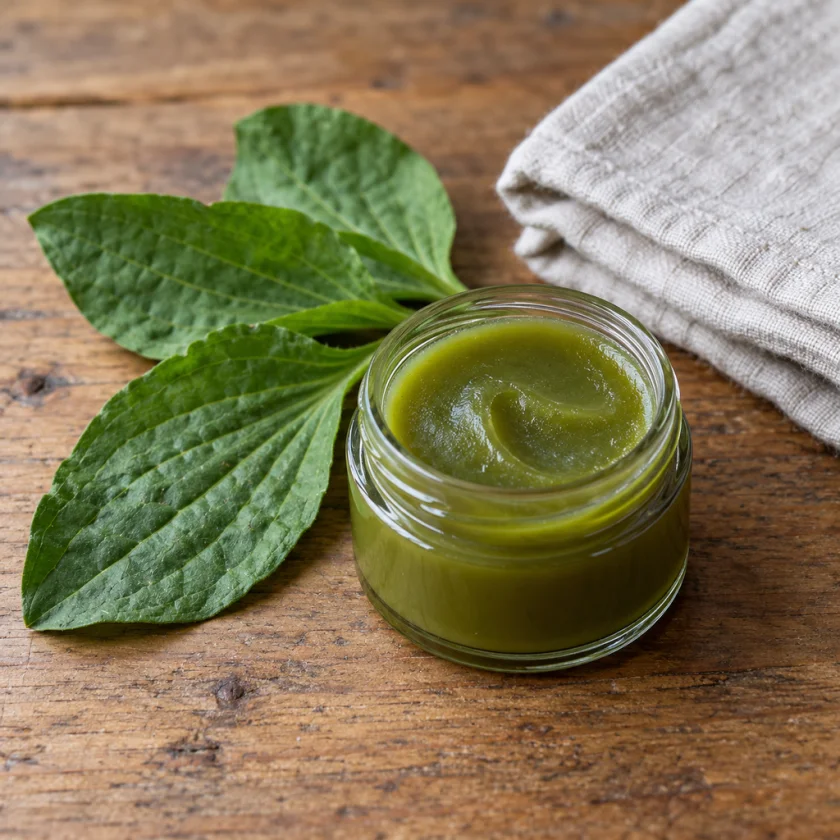
Other traditional forms, with the honest note that none has been trialled: an infused oil or beeswax salve for chapping, itchy patches and grazes, which keeps in a first-aid kit and is the form most people can actually store; a cooled infusion as a skin wash or compress for larger irritated areas; and a fresh juice pressed from leaves, which does not keep. There is no established dose because there is no dose-finding work.
When It Is Not a Poultice Situation
This is the most useful section on the page. A poultice is for the trivial end of a spectrum, and the whole value of knowing the remedy is undermined if it delays real care. These are situations where care beyond a poultice is needed:
- Any sign of a systemic allergic reaction — difficulty breathing, wheeze, throat or tongue swelling, widespread hives, faintness, vomiting, or a feeling of impending collapse after a sting. This is a medical emergency, treated with adrenaline and emergency care straight away. No plant is relevant.
- A reaction that keeps expanding. A large local reaction spreading over hours, or redness with a advancing edge, warmth and increasing pain, may be cellulitis, which needs antibiotics.
- Stings inside the mouth or throat, or multiple stings, or a sting near the eye.
- Deep, gaping, or dirty wounds, anything that may need closure, anything with embedded material, animal and human bites, and puncture wounds. These need cleaning and assessment, and often antibiotics or a tetanus review.
- Any wound in someone with diabetes, peripheral neuropathy, poor circulation, or on immunosuppressive treatment. The threshold for professional care is much lower, and a foot wound in particular is never a home-remedy matter.
- A wound that is not healing over the expected timescale, or an ulcer.
- A tick. Tick-bite first aid centres on prompt, proper removal with fine-tipped tweezers or a tick tool — see tick-bite first aid. Putting something on a tick to make it detach is not part of that method.
- Fever, red streaking up a limb, pus, or spreading pain. Signs of infection outrank tradition every time.
None of this is hedging for its own sake. Plantain is safe; the risk in this whole area is not the plant, it is the ten or twenty minutes spent looking for a leaf when the situation had already changed.
Beyond First Aid: Salves, Washes and Itchy Skin
Traditionally, plantain moves from acute injury to general skin soothing: rashes, chapped hands, minor burns, nappy rash, sunburn, haemorrhoids and slow-healing patches. The rationale is the combination the plant is unusual for — soothing mucilage plus astringent tannin, which calms and gently tightens at the same time.
The evidence tier for all of this is traditional use plus mechanistic plausibility, and no more than that. Two specific honesty notes:
- Eczema and other chronic inflammatory skin disease are not a plantain indication. These conditions are relapsing, immunologically driven, and well served by treatments with real trial evidence. People use soothing herbal washes alongside their treatment; no trial has tested a plantain wash for eczema, while topical corticosteroids and calcineurin inhibitors have trial evidence for flares.
- Haemorrhoids appear repeatedly in the folk record for plantain washes and ointments. The mechanism — astringent plus demulcent on inflamed mucosa — is plausible, and the untested status is the same as everywhere else on this page.
Where plantain does earn a place is as a gentle, cheap, low-risk soother for minor, self-limiting skin irritation, in the same category as an oat bath or a cool compress. That is a real if modest role, and describing it accurately serves a reader better than promoting it.
The "Drawing Out" Claim, Examined
A specific and very persistent folk claim deserves its own scrutiny: that a plantain poultice draws out splinters, thorns, stingers, and even venom or infection.
What is plausible: a moist occlusive dressing softens and macerates skin over hours, which genuinely makes a shallow splinter easier to grip and can allow a superficial foreign body to work its way out. That is an effect of moisture and occlusion, and any moist dressing would do it. Nettle hair fragments are extremely fine and may well be shed with the skin surface regardless.
What is not supported: any active "drawing" force. There is no mechanism by which leaf juice creates suction, and no evidence that plantain removes venom already injected into tissue or reverses an established infection. A honeybee's sting apparatus comes out only by mechanical removal, and poulticing it in place leaves the venom sac pumping, as described above. Where the claim shades into "draws out infection", it is not only unsupported but potentially harmful, because an infection that needs antibiotics is being managed with a leaf.
The reasonable summary: the moisture story is real and small, the drawing story is not, and the distinction matters most in exactly the cases where the claim is most enthusiastically made.
The Honest Ledger
Set the claims out by tier, with the strongest evidence first rather than the most famous claim first.
- Best established: safety on intact and minor-broken skin. Long food and topical use, no notable toxicity signal, no meaningful case-report literature of harm from the leaf. This is the firmest fact on the page and it is a safety fact, not a benefit.
- Well supported: mechanistic plausibility. Real anti-inflammatory, antioxidant and antibacterial activity for named constituents in laboratory systems — aucubin, plantamajoside, catalpol, tannins, mucilage.
- Wound closure: small human trials for chronic ulcers, animal and cell work for the rest. Two small randomised trials of plantain cream or gel on pressure sores and diabetic foot ulcers reported better healing than the control, and a third tested an aloe-plus-plantain gel. The animal studies point the same way but are few, and the 2021 systematic review that gathered them found all at high risk of bias and did not find evidence of effectiveness. Acute minor wounds remain untested.
- Traditional use only, and near-universal: soothing of stings, bites and grazes. Strong ethnographic record, no controlled trial, and a complaint type that resolves by itself — the conditions under which a reputation can be built without an effect.
- Traditional but weak and partly wrong: "drawing out" splinters, venom or infection. The moisture component is plausible; the active drawing component is not, and the infection version is potentially harmful.
- Not supported at any tier: treating cellulitis, abscesses, deep or dirty wounds, or a systemic allergic reaction. (For chronic ulcers, see the small trials in item 3, which used prepared gels and creams alongside routine wound care, not a leaf on its own.)
If a reader takes away one thing, it is the shape of that list: the science is real but mostly preclinical, with a few small human trials on chronic ulcers; the tradition is real but untested, and the safest and most confident statements about plantain are about how unlikely it is to hurt you.
Key Research Papers
Each paper ends with its PubMed or DOI link; the entries marked "Topic search" are PubMed searches rather than single papers.
- Samuelsen. The traditional uses, chemical constituents and biological activities of Plantago major L. A review. Journal of Ethnopharmacology, 2000. PubMed PMID: 10904143
- Zubair and colleagues. Effects of Plantago major L. leaf extracts on oral epithelial cells in a scratch assay. Journal of Ethnopharmacology, 2012. PubMed PMID: 22465512
- Cardoso and colleagues. The effect of Plantago major on wound healing in preclinical studies: a systematic review. Wound Management & Prevention, 2021. Four animal studies, all at high risk of bias; no evidence of effectiveness found. PubMed PMID: 33448940
- Kartini K, Islamie R, Handojo CS. Wound healing activity of aucubin on hyperglycemic rat. Journal of Young Pharmacists, 2018;10(2s):S136-S139. Isolated compound, not leaf. doi:10.5530/jyp.2018.2s.28
- Zeng, Guo & Ouyang. A review of the pharmacology and toxicology of aucubin. Fitoterapia, 2020. PubMed PMID: 31790767
- Ravn H, Brimer L. Structure and antibacterial activity of plantamajoside, a caffeic acid sugar ester from Plantago major subsp. major. Phytochemistry, 1988;27(11):3433-3437. doi:10.1016/0031-9422(88)80744-1
- Türel I, Ozbek H, Erten R, Oner AC, Cengiz N, Yilmaz O. Hepatoprotective and anti-inflammatory activities of Plantago major L. Indian Journal of Pharmacology, 2009;41(3):120-124. PubMed PMID: 20442819
- Ghiasian M, Niroomandi Z, Dastan D, Poorolajal J, Zare F, Ataei S. Clinical and phytochemical studies of Plantago major in pressure ulcer treatment: a randomized controlled trial. Complementary Therapies in Clinical Practice, 2021;43:101325. PubMed PMID: 33548748
- Ghanadian M, Soltani R, Homayouni A, Khorvash F, Jouabadi SM, Abdollahzadeh M. The effect of Plantago major hydroalcoholic extract on the healing of diabetic foot and pressure ulcers: a randomized open-label controlled clinical trial. The International Journal of Lower Extremity Wounds, 2024;23(3):475-481 (online 2022). PubMed PMID: 35044254
- Najafian Y, Khorasani ZM, Najafi MN, Hamedi SS, Mahjour M, Feyzabadi Z. Efficacy of aloe vera/Plantago major gel in diabetic foot ulcer: a randomized double-blind clinical trial. Current Drug Discovery Technologies, 2019;16(2):223-231. PubMed PMID: 29336265
- Fu HY, Chen SJ, Chen RF, Ding WH, Kuo-Huang LL, Huang RN. Identification of oxalic acid and tartaric acid as major persistent pain-inducing toxins in the stinging hairs of the nettle, Urtica thunbergiana. Annals of Botany, 2006;98(1):57-65. PubMed PMID: 16675601
- Topic search: Plantago major topical randomised controlled trials. Run this to see what has and has not been tested. PubMed
- Topic search: validated wound-healing endpoints and planimetry. The measurement tools that exist and were never applied here. PubMed
- Topic search: itch measurement, visual analogue scale and 5-D Itch Scale validation. PubMed
- Topic search: mosquito bite reaction, wheal and flare, topical antihistamine trials. The comparators. PubMed
- Topic search: Urtica dioica sting, histamine and trichome contents. What the poultice is being applied to. PubMed
- Topic search: honey as a topical wound treatment, systematic review. A tested traditional topical, for contrast. PubMed
External Resources
Connections
- All Herbs
- Plantain (Herb) — the main topic page
- Plantain Benefits Deep Dive — hub for this leg
- Not the Banana, and Which Species — why species matters for every study above
- Psyllium Relatives, Safety and Evidence — harvest contamination and allergy in detail
- Calendula for Skin and Wound Healing — the wound herb with human trials
- Comfrey, Wound Healing and Allantoin — the other allantoin herb
- Comfrey: Never Take It Internally — a hazard plantain does not share
- Yarrow for Wound Care and Bleeding — the classic styptic herb
- Marshmallow Root for Skin and Wound Care — the same mucilage logic
- Slippery Elm, Topical Use — a third demulcent applied to skin
- Mullein for Skin, Wounds and Inflammation — often gathered alongside plantain
- Aloe Vera — the trialled soothing gel
- Lavender for Skin Healing and Burns — minor burns and grazes
- Stinging Nettle — the sting itself, and what is in it
- Dermatology — skin conditions and care
- Cellulitis — the spreading infection that is not a poultice situation
- Anaphylaxis — the emergency after a sting
- Tick-Bite First Aid — remove the tick, do not poultice it
- Antibacterial Herbs — herbs with documented antimicrobial activity
Featured Videos