Calendula for Skin and Wound Healing
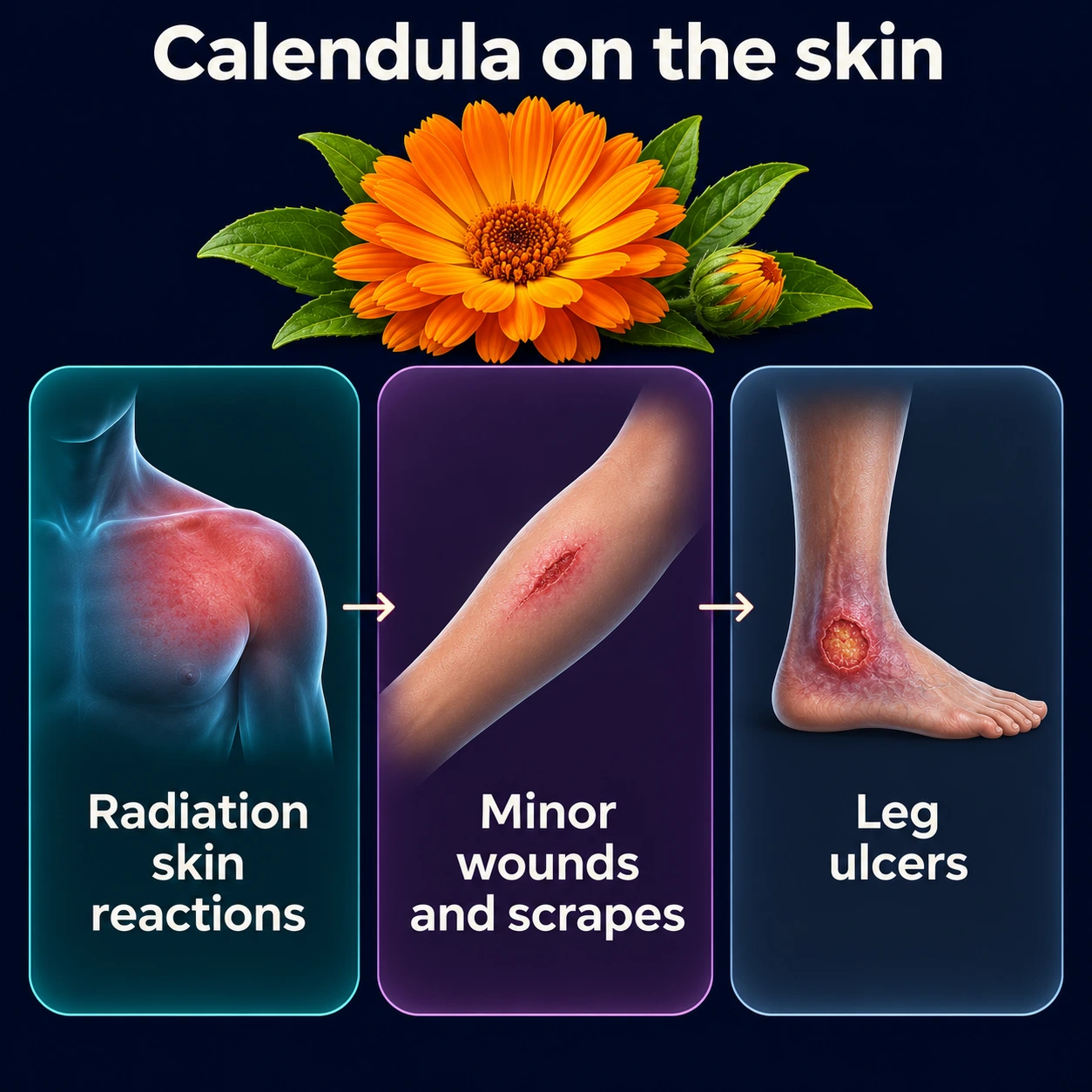
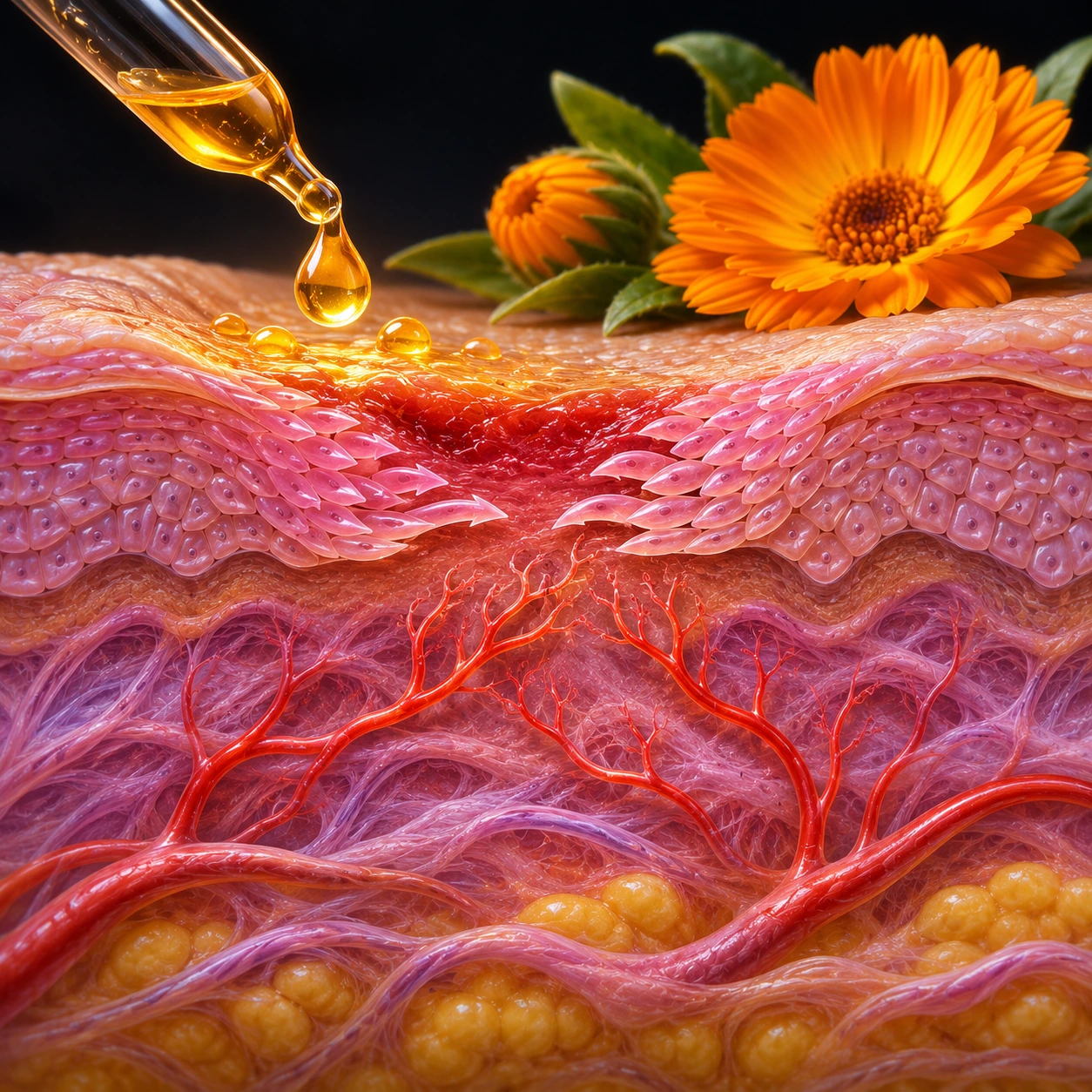
Skin is where calendula earns its reputation. Applied as a cream, ointment, salve, or infused oil, Calendula officinalis (pot marigold) is a gentle, low-risk soother for minor wounds, scrapes, irritated skin, and mild dermatitis — and it holds the strongest single piece of clinical evidence any topical herb has for a specific problem: easing the radiation dermatitis that develops during breast-cancer radiotherapy. This page walks through that landmark trial, the more cautious verdict of the larger reviews that followed, the everyday-irritation and diaper-rash evidence, the chronic leg-ulcer and diabetic-foot studies, and the biology that may explain why calendula seems to help the earliest phase of healing. The honest theme throughout: real but modest support for a comforting, well-tolerated skin herb — never a replacement for proper care of serious wounds, burns, or infections.
Table of Contents
- Skin Is Calendula's Home Turf
- Radiation Dermatitis: The Best Evidence
- What the Larger Reviews Actually Say
- Minor Wounds, Scrapes & Everyday Irritation
- Diaper Rash & Very Sensitive Skin
- Chronic Wounds: Venous Leg & Diabetic Foot Ulcers
- How Calendula May Support Healing
- How to Use It on the Skin
- Safety & Warning Signs
- Key Research Papers
- External Resources
- Connections
- Featured Videos
Skin Is Calendula's Home Turf
Nearly all of calendula's useful evidence sits in one place: topical use on the skin. Traditional European herbalism reached for calendula salve for centuries to calm minor wounds, grazes, rashes, and inflamed patches, and modern laboratory and animal studies broadly support the idea that flower extracts can nudge the early phase of wound healing along and quiet local inflammation.
It helps to be clear about what "calendula" means here. The medicinal plant is Calendula officinalis — pot marigold — not the ornamental bedding "marigolds" (Tagetes species) sold at most garden centers. They share a common name and a family resemblance, but the herb studied for skin is specifically Calendula officinalis, and the part used is the flower: the petals and whole flower heads, dried and worked into creams, ointments, salves, infused oils, or (for mouth and throat use) teas.
The realistic promise is comfort, not cure. Calendula's evidence and safety record are strongest for minor skin problems in people who are not allergic to the daisy family. It is not a wound-closing drug, an antibiotic, or a substitute for medical care of anything serious.
Radiation Dermatitis: The Best Evidence
The single best-known piece of clinical evidence for calendula is for a very specific problem: radiation dermatitis — the red, sore, sometimes peeling skin reaction that many people develop in the treated area during radiotherapy.
In a well-known French phase III randomized trial (Pommier and colleagues, 2004), 254 women receiving radiation after surgery for breast cancer were randomly assigned to apply either a calendula ointment or a standard trolamine cream to the treated skin. The women using calendula had noticeably less severe skin reactions: roughly 41% developed a grade 2 or worse (moderate-or-worse) reaction with calendula, compared with about 63% with the standard cream. The calendula group also reported less radiation-related pain and had fewer interruptions to their radiotherapy schedule. Interestingly, patients found the calendula ointment somewhat harder to apply, yet still preferred the outcome.
That is a genuinely encouraging result. But it deserves honest context on its own terms:
- Calendula was compared with another cream (trolamine), not with doing nothing. So the trial suggests calendula was at least as good as, and probably better than, a common standard option — not that it produces a dramatic effect versus no treatment.
- It is essentially one notable trial. A single positive study, however well run, is a starting point rather than a settled conclusion.
What the Larger Reviews Actually Say
When the wider evidence on creams for radiation dermatitis is gathered, the enthusiasm cools. A systematic review and meta-analysis of topical management of acute radiation dermatitis in breast-cancer patients (Haruna and colleagues, 2017) looked only at topical steroid (corticosteroid) creams: across 10 randomised trials with 919 participants, steroid creams lowered the chance of wet, peeling skin (wet desquamation; odds ratio 0.29) and lowered the average dermatitis score. That review did not assess calendula.
The most direct test of calendula since the French trial is a blinded Swedish trial (Sharp and colleagues, 2013) that randomised 420 women having radiotherapy after breast-cancer surgery to a calendula cream or an ordinary aqueous cream. Severe skin reactions occurred in 23% with calendula and 19% with the aqueous cream; the trial found no difference between the creams at any assessment, and no significant difference in the skin symptoms the women reported.
A 2025 network meta-analysis (Li and colleagues) compared plant-based products across 18 randomised trials with 2,177 breast-cancer patients. Silymarin, from milk thistle, ranked best and chicory root extract next for preventing radiation dermatitis; silymarin outperformed standard care for preventing grade 2 or worse dermatitis, but no product beat standard care for grade 3 or worse.
A dedicated systematic review of Calendula officinalis for wound healing (Givol and colleagues, 2019) pooled 14 studies spanning laboratory, animal, and human work. Its verdict is a fair summary of the whole field: there is some evidence consistent with a wound-healing benefit, but the trials are relatively few, varied in quality, and not yet strong enough to call calendula a proven wound treatment. The authors called for larger, better-designed studies.
So the honest picture is a tension: one prominent positive trial against trolamine, one large blinded trial that found no difference from an ordinary aqueous cream, and broader reviews that are cautious. The research leaves open whether calendula eases radiation skin reactions; it is generally well tolerated on the skin. Radiotherapy units set their own rules about what may be applied to the treated area and when.
Minor Wounds, Scrapes & Everyday Irritation
For the everyday reasons people reach for calendula — a graze, a patch of dry, inflamed skin, a mild rash — the evidence is thinner than for radiation dermatitis but still reasonable for a low-risk soother.
Most of the support comes from animal and laboratory wound models. In controlled excision- and incision-wound studies in rodents, calendula flower extract has been reported to speed the rate of wound contraction, increase the amount of new connective tissue (granulation tissue), and raise markers of tissue repair compared with untreated controls (Preethi and Kuttan, 2009; Parente and colleagues, 2012). These studies also document the anti-inflammatory side of the effect — less swelling and lower inflammatory signaling in treated wounds.
Animal results do not automatically transfer to people, and the human trials for general minor wounds are sparse. But the combination of a plausible mechanism, a long traditional record, and an excellent safety profile is the basis for calendula's use for minor, everyday skin irritation — used on intact or barely broken skin, with realistic expectations. For inflamed-skin conditions where you might consider it, see our pages on eczema, contact dermatitis, and psoriasis — calendula is a comfort measure alongside, not a replacement for, the primary treatment of these conditions.
Diaper Rash & Very Sensitive Skin
One of the more concrete human results outside radiotherapy is for diaper dermatitis (diaper rash). A small randomized, double-blind trial in 66 infants under 3 years old (Panahi and colleagues, 2012) compared a calendula ointment with an aloe vera cream, applied three times a day for 10 days. Rash severity improved in both groups, the calendula group ended up with significantly fewer rash sites, and importantly no side effects were reported in either group.
This is a single small study, so it is promising rather than definitive — but it fits the overall pattern: calendula is gentle enough to consider even on the delicate skin of infants, and its main practical value is soothing rather than curing. Babies' skin is highly sensitive and calendula carries a daisy-family allergy risk; a small-area test shows whether the skin reacts before wider use. A diaper rash that is severe, weeping, spreading, or not improving can be a sign of a yeast or bacterial infection.
Chronic Wounds: Venous Leg & Diabetic Foot Ulcers
Calendula has also been studied in harder, slower-healing wounds — the kind managed by clinicians rather than at home.
- Venous leg ulcers. A clinical study of a marigold (calendula) ointment applied to chronic venous leg ulcers (Duran and colleagues, 2005) in 34 patients reported that the total ulcer area fell by 41.7% over 3 weeks with twice-daily calendula ointment, against 14.5% with saline dressings (p < 0.05); 7 patients in the calendula group and 4 in the saline group healed completely. It is a small study, but it points in the same direction as the animal wound work.
- Diabetic foot ulcers. A prospective study of a Calendula officinalis hydroglycolic extract used topically on diabetic foot ulcers (Buzzi and colleagues, 2016) had no comparison group, and 43 of the 84 patients enrolled dropped out. Among the 41 who finished, 54%, 68% and 78% had fully closed wounds after 11, 20 and 30 weeks, with no side effects observed; the extract was sprayed on twice daily under saline-moistened dressings, with protective footwear to take pressure off the foot. The Givol review (2019) also describes a randomized trial in diabetic leg ulcers in which calendula gave no improvement.
- Modern wound dressings. Reflecting continued interest, researchers are now incorporating calendula extract into engineered wound dressings — for example, a bilayer polyurethane dressing combining snail mucin, calendula extract and zinc-doped carbon dots (2025) — though these are early laboratory-stage products, not proven clinical treatments.
The essential caveat: chronic ulcers are serious wounds kept open by an underlying cause (venous insufficiency, diabetes, pressure, infection). Calendula in these studies was an adjunct to standard wound care, not a stand-alone remedy. A wound that will not heal is a sign that one of those underlying causes is still active.
How Calendula May Support Healing
Why might calendula help a wound along? The laboratory picture points to several overlapping actions of the flower's compounds:
- Quieting inflammation. The triterpenoid fraction (faradiol esters and related compounds) is widely regarded as calendula's main anti-inflammatory and anti-swelling constituent. Less excess inflammation in the wound bed can translate to a smoother early healing phase. This mechanism is covered in depth on the anti-inflammatory and antimicrobial page.
- Encouraging new tissue (granulation and angiogenesis). Animal wound studies report more granulation tissue and better formation of new small blood vessels in calendula-treated wounds — both are needed to fill and resurface a wound.
- Supporting collagen and epithelial repair. Some studies note higher hydroxyproline (a marker of collagen deposition) and faster re-covering of the wound surface (epithelialization) with treatment.
- Antioxidant protection. Flavonoids and other polyphenols reduce oxidative damage; calendula extract has been shown to protect skin from ultraviolet B-induced oxidative stress in laboratory models (Fonseca and colleagues, 2010), which may help stressed or irritated skin recover.
These are mechanisms observed largely in the lab and in animals. They make calendula's traditional use biologically plausible, but plausibility is not the same as proof of a large clinical effect — a distinction the human evidence keeps reminding us of.
How to Use It on the Skin
Calendula is a topical herb — something you put on the skin, not generally something to take as a daily internal supplement.
- Creams, ointments, and salves. The most common form. Usually applied as a thin layer to a minor irritation, rash, or dry, inflamed patch on intact (unbroken) skin, typically a few times a day. Products vary widely in calendula strength and in their other ingredients, and each label gives that product's directions.
- Infused (macerated) oil. Petals steeped in a carrier oil make a simple soothing oil and a base for homemade balms. The sources and preparations page explains how to make and store it.
- Patch test. A patch test means applying a small amount to a small area (for example, the inner forearm) and waiting 24–48 hours to check for redness or itching before wider use; it is most useful for sensitive skin.
- During radiotherapy. Radiotherapy units set their own rules about which products may go on the treated skin and at what times around treatment sessions.
Safety & Warning Signs
Used on the skin, calendula is generally considered very safe and well tolerated; the trials above reported few or no side effects. A few cautions are recorded:
- Daisy-family (Asteraceae) allergy. This is the main concern. Calendula is related to ragweed, chamomile, echinacea, daisies, and ornamental marigolds. People sensitive to those plants can develop an allergic contact rash, and people who already react to this family are the group most likely to react to calendula.
- Pregnancy. Traditional herbal sources caution against concentrated internal calendula (strong extracts, tinctures, large amounts of tea) in pregnancy, and there is no pregnancy safety data for these forms. Occasional use of a topical skin cream is considered lower risk.
- Serious wounds. Deep cuts, burns, wounds that will not heal, and signs of infection (spreading redness, warmth, pus, fever) are problems that clinics and hospitals treat as needing professional wound care; an herbal salve does not treat their cause.
See the sources and preparations page for a fuller discussion of the allergy caution and how to patch-test.
Key Research Papers
All references below are real, peer-reviewed studies, each linked to its PubMed record. Note the overall balance: a prominent positive breast-cancer trial and supportive animal work, set against a large blinded trial that found no difference and reviews that stress how limited and mixed the human evidence still is.
- Pommier P, Gomez F, Sunyach MP, et al. Phase III randomized trial of Calendula officinalis compared with trolamine for the prevention of acute dermatitis during irradiation for breast cancer. J Clin Oncol. 2004. — PubMed PMID: 15084618
- Haruna F, Lipsett A, Marignol L. Topical management of acute radiation dermatitis in breast cancer patients: a systematic review and meta-analysis. Anticancer Res. 2017. (A review of topical corticosteroids.) — PubMed PMID: 28982842
- Sharp L, Finnilä K, Johansson H, Abrahamsson M, Hatschek T, Bergenmar M. No differences between Calendula cream and aqueous cream in the prevention of acute radiation skin reactions — results from a randomised blinded trial. Eur J Oncol Nurs. 2013;17(4):429-35. — PubMed PMID: 23245940
- Li M, Hao J, Song G, Zhang M, Zhang B, Hao Y, Zhao L. Efficacy of various plant-derived interventions in the prevention of radiation dermatitis in breast cancer patients: a systematic review and network meta-analysis of randomised controlled trials. Front Oncol. 2025;15:1657588. — PubMed PMID: 41199840
- Givol O, Kornhaber R, Visentin D, et al. A systematic review of Calendula officinalis extract for wound healing. Wound Repair Regen. 2019. — PubMed PMID: 31145533
- Preethi KC, Kuttan R. Wound healing activity of flower extract of Calendula officinalis. J Basic Clin Physiol Pharmacol. 2009. — PubMed PMID: 19601397
- Parente LM, Lino Junior RS, Tresvenzol LM, et al. Wound healing and anti-inflammatory effect in animal models of Calendula officinalis L. growing in Brazil. Evid Based Complement Alternat Med. 2012. — PubMed PMID: 22315631
- Panahi Y, Sharif MR, Sharif A, et al. A randomized comparative trial on the therapeutic efficacy of topical aloe vera and Calendula officinalis on diaper dermatitis in children. ScientificWorldJournal. 2012. — PubMed PMID: 22606064
- Duran V, Matic M, Jovanovć M, et al. Results of the clinical examination of an ointment with marigold (Calendula officinalis) extract in the treatment of venous leg ulcers. Int J Tissue React. 2005. — PubMed PMID: 16372475
- Buzzi M, de Freitas F, Winter M. A prospective, descriptive study to assess the clinical benefits of using Calendula officinalis hydroglycolic extract for the topical treatment of diabetic foot ulcers. Ostomy Wound Manage. 2016;62(3):8-24. — PubMed PMID: 26978856
- Fonseca YM, Catini CD, Vicentini FT, et al. Protective effect of Calendula officinalis extract against UVB-induced oxidative stress in skin. J Ethnopharmacol. 2010. — PubMed PMID: 20026397
- Amirsoleimani A, Bahrami Z, Abdoos H, Kafshdouzan K. Polyurethane-based bilayer wound dressing with snail mucin, Calendula extract, and zinc-doped carbon dots for enhanced therapeutic and antibacterial performance. Int J Biol Macromol. 2025;330(Pt 4):148314. — PubMed PMID: 41101409