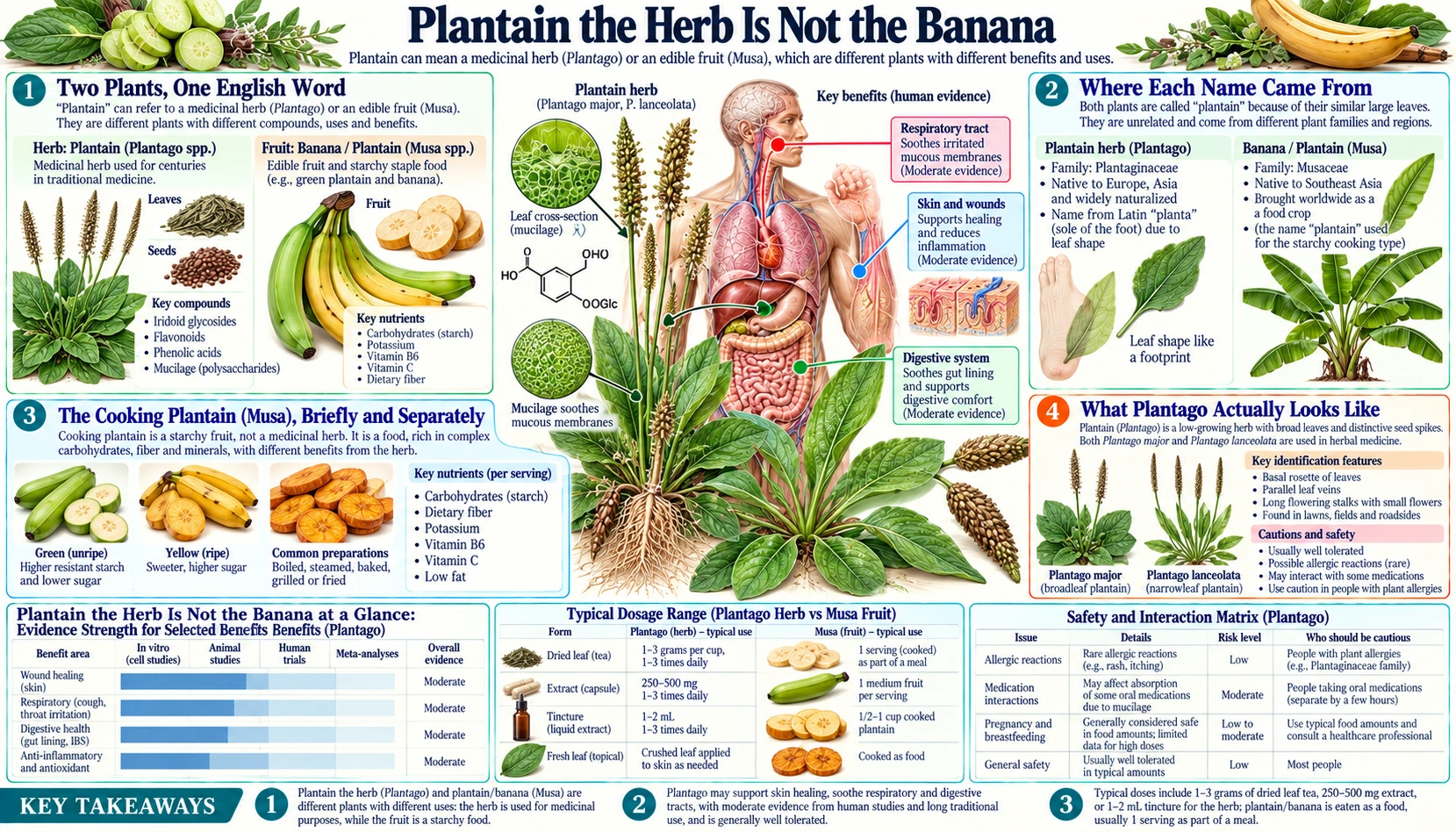
Plantain the Herb Is Not the Banana
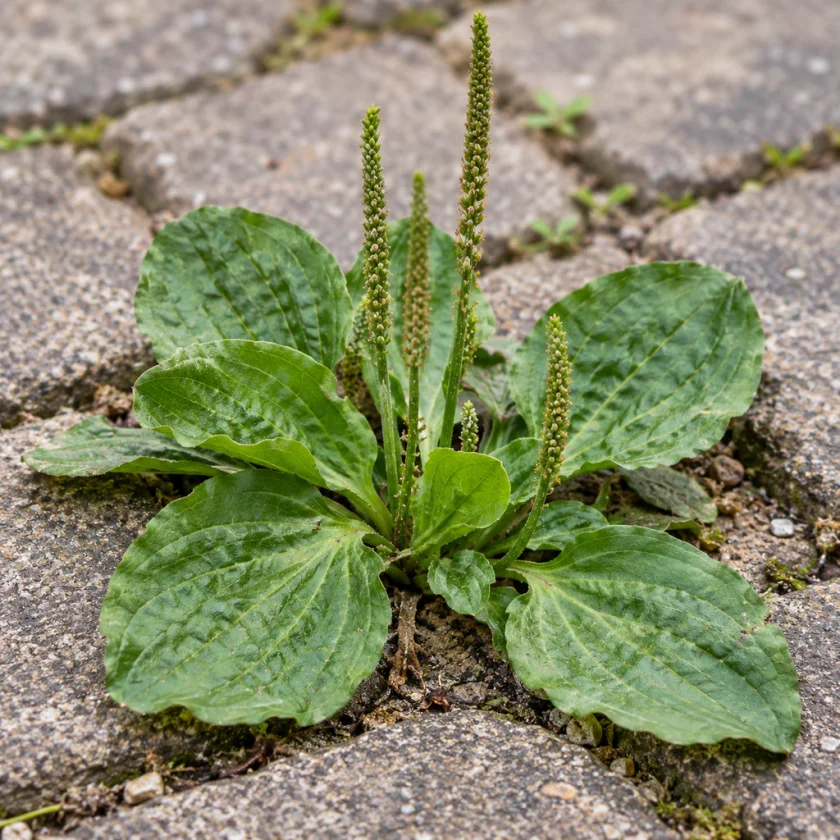
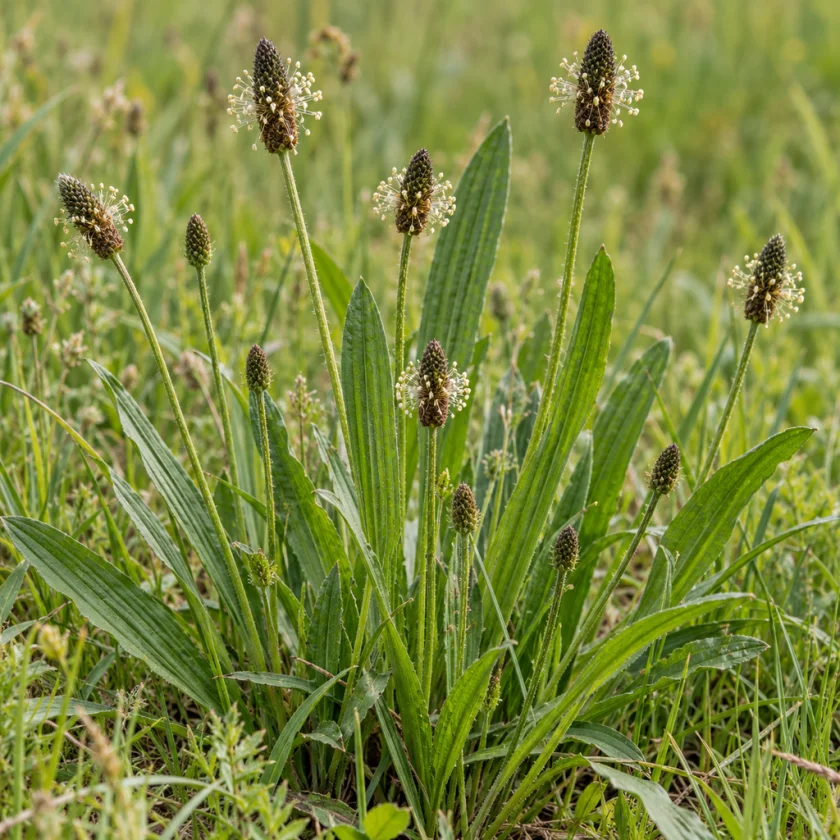
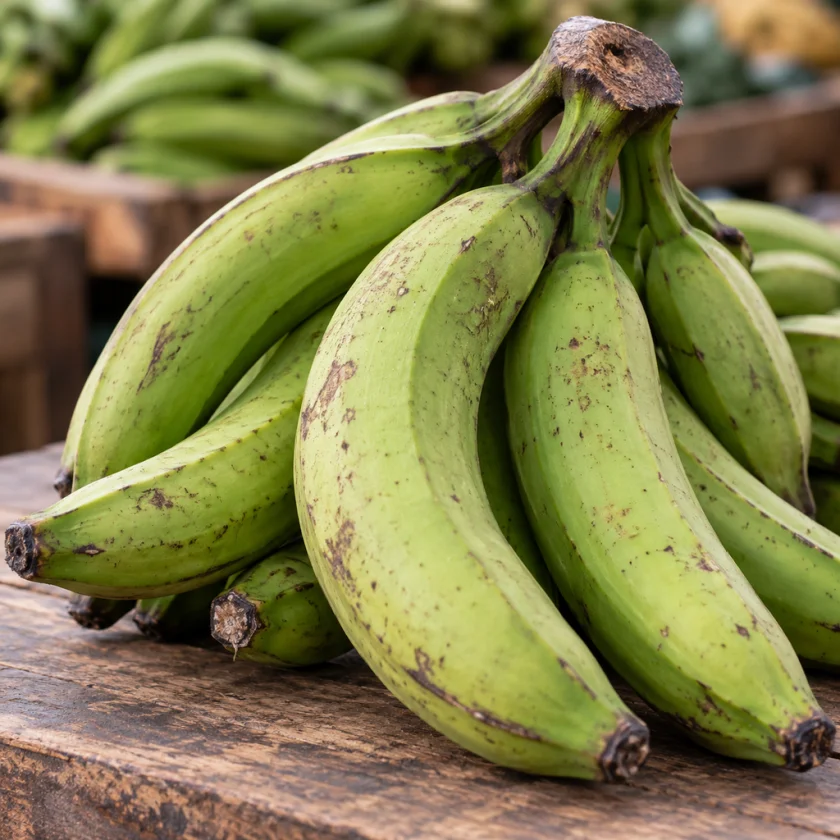
Plantain the herb has nothing whatsoever to do with the cooking banana. The herb is Plantago — a low, flat rosette of ribbed leaves that grows in lawns, gravel paths, playing fields and the seams of pavement almost everywhere humans walk. The cooking plantain is Musa, a large starchy tropical fruit in the banana family, fried or boiled and eaten as a staple across West Africa, the Caribbean, Central America and Southeast Asia. The two plants are not relatives. They are not in the same family, the same order, or even the same broad lineage of flowering plants. They share one thing: an English word, acquired by two separate historical accidents that happened to collide. Everything else on this page follows from getting that straight first.
Once past that, there is a second naming problem, smaller but more consequential for reading the research: Plantago is a genus of roughly 200 species, and the two used as the wound-and-cough herb are broadleaf plantain (Plantago major) and ribwort or narrowleaf plantain (Plantago lanceolata). They are used somewhat differently, they hold different proportions of the same compounds, and only one of them carries a European regulatory registration for cough. A third group of species in the same genus — Plantago ovata and Plantago psyllium — is the source of psyllium husk, which has a clinical evidence base the leaf does not remotely approach. This page sorts all of that out.
Table of Contents
- Two Plants, One English Word
- Where Each Name Came From
- The Cooking Plantain (Musa), Briefly and Separately
- What Plantago Actually Looks Like
- Broadleaf Plantain (Plantago major)
- Ribwort Plantain (Plantago lanceolata)
- Which Species Each Study Used
- The Rest of the Genus, Including Psyllium
- Identifying It, and Three Things It Is Not
- How the Name Bears on Safety: A Check That Comes Back Clear
- Why the Confusion Actually Matters
- Key Research Papers
- Connections
- Featured Videos
Two Plants, One English Word
Here are the two plants side by side, because seeing them stated flatly is the fastest cure for the confusion.
- Plantain the herb — genus Plantago, family Plantaginaceae, the same family as foxglove, snapdragon and speedwell. A herbaceous perennial weed, usually ankle-high, forming a ground-hugging rosette of oval or lance-shaped leaves with strong parallel veins, sending up slim flower spikes. Temperate and near-cosmopolitan. Used as a poultice on stings and grazes, as a tea for dry cough, and eaten as a wild green.
- Plantain the food — genus Musa, family Musaceae, in the same group of plants as gingers and bird-of-paradise. A giant herb with a false trunk of rolled leaf bases, growing several metres tall, bearing bunches of long starchy fruit. Tropical. It is a cooking banana: starchier, lower in sugar and firmer than a dessert banana, and generally cooked rather than eaten raw.
These are not "related plants with a shared common name" in the way that, say, sweet basil and holy basil are. They are as distantly related as a dandelion and a palm tree. Nothing known about one transfers to the other — not a nutrient, not a compound, not a caution, not a benefit. If a page, a video or a product label slides between them, that is not a simplification; it is an error.
Where Each Name Came From
The collision is worth understanding, because it explains why nobody is going to fix it.
The herb takes its name from Latin planta, the sole of the foot. Two readings circulate: that the broad flat leaf resembles a footprint pressed into the ground, and that the plant follows the tread of feet along paths. Both fit the plant's behaviour, and both are old. Its Old English name was wegbræde — "waybread", the bread of the road, the plant of the path. Numerous North American Indigenous names translate as "White Man's Footprint" or "Englishman's Foot", recording with real precision that the plant appeared where European settlers had walked; it travels with disturbed soil and compacted ground, so the observation is botanically exact as well as pointed.
The fruit arrived in English by a different route entirely. The usual account traces it through Spanish plátano in the Caribbean, itself likely a reshaping of an earlier borrowed word, which English speakers heard and mapped onto the familiar herb name "plantain" that they already knew. The result is that one English word now denotes both a lawn weed and a tropical staple crop, with no etymological relationship between them at all.
The practical consequence: search engines, supermarket labels, recipe sites and nutrition databases overwhelmingly mean Musa, while herbals, foraging guides and pharmacopoeias overwhelmingly mean Plantago. A reader who types "plantain benefits" into a search box gets potassium, resistant starch and fried side dishes. A reader who types "plantain poultice" gets the weed. Neither result is wrong; they are answers to different questions that look identical.
The Cooking Plantain (Musa), Briefly and Separately
For completeness, and then we set it aside for good. Cooking plantains are a starchy staple: green plantains are firm and largely resistant starch, and as they ripen that starch converts to sugar, which is why the same fruit can be a savoury chip when green and a caramelised sweet when black. They carry potassium, vitamin B6, vitamin C and provitamin A carotenoids, and they are food rather than medicine. That subject belongs in the Food section, not the herb library.
Nothing in the remaining pages of this Benefits leg — not the poultice, not the cough tea, not the psyllium comparison, not one safety note — has any application to Musa. From here on, "plantain" means the weed.
What Plantago Actually Looks Like
The herb is easier to recognise than most medicinal plants, which is part of why it became a universal folk remedy: it is where you are, it is unmistakable once seen, and it is in leaf for most of the growing season.
- Habit — a basal rosette. Leaves radiate from a single central point at ground level, pressed flat or angled upward, with no upright leafy stem.
- Venation — the diagnostic feature. Several strong veins run the length of the leaf, roughly parallel, converging at the tip and at the base. Tear a leaf slowly and those veins pull free as tough strings, like celery fibres. Almost no other lawn plant does this.
- Petiole — the leaf stalk is channelled and often flushed pink or purple where it meets the crown.
- Flower spike — leafless stalks rise from the centre carrying a dense green spike of tiny wind-pollinated flowers with protruding stamens. Depending on species the spike is long and slender or short and bullet-shaped.
- Habitat — compacted, trodden, disturbed ground. Lawns, verges, footpaths, gravel, sports pitches, farm gateways, pavement cracks. It tolerates trampling better than nearly anything it competes with, which is precisely why it wins in those places.
Wind pollination matters later, on the safety page: a plant that broadcasts pollen on the breeze is a plant whose pollen ends up in noses, and Plantago pollen is a recognised hay-fever allergen.
Broadleaf Plantain (Plantago major)
Broad, oval to elliptical leaves, blunt-tipped, on a distinct stalk, with five to nine strong parallel veins. The flower spike is long, slender and green, often as long as the rest of the stalk again — the "rat-tail" look. This is the classic waybread of European folklore and the species most often named in the wound-poultice tradition.
P. major is also the species with the largest modern phytochemical literature. The reference review remains Samuelsen's "The traditional uses, chemical constituents and biological activities of Plantago major L. A review", published in the Journal of Ethnopharmacology in 2000, which assembled the folk record and the chemistry in one place and is still the paper most subsequent work cites. PubMed PMID: 10904143.
Because its leaves are broad, soft and easy to bruise, P. major is the species most people actually pick for a poultice — a practical rather than pharmacological reason for its prominence, and worth naming as such.
Ribwort Plantain (Plantago lanceolata)
Narrow, lance-shaped leaves, sharply pointed, with three to five deeply impressed ribs — hence "ribwort". The flower head is short, dense and bullet-shaped on a long grooved stalk, ringed by a halo of pale protruding stamens when in bloom. It is often taller and more upright than broadleaf plantain and is abundant in meadows and grassland as well as paths.
This is the species with the regulatory paperwork. The European Medicines Agency's herbal medicines committee has adopted a European Union herbal monograph on Plantago lanceolata L., folium covering traditional use for the relief of dry, irritating cough and associated hoarseness of the throat. Germany's Commission E likewise issued a monograph for Plantaginis lanceolatae folium. What those instruments do and do not certify is the entire subject of the cough page — the short version is that a traditional-use registration attests to documented long use plus plausible pharmacology and explicitly does not require efficacy trials. It is not a clinical endorsement, and reading it as one is the single commonest mistake made about plantain. In practice, a 2022 study of these products describes ribwort leaf as the active ingredient in "traditional herbal medicinal products" sold in pharmacies as a demulcent (a soothing, coating agent) for the symptomatic treatment of mouth or throat irritation and the dry cough that goes with it.
Ribwort is also the species behind the most-cited European respiratory review, Wegener and Kraft's German-language paper on plantain (Plantago lanceolata) and anti-inflammatory action in upper respiratory tract infections, in Wiener Medizinische Wochenschrift, 1999. PubMed PMID: 10483683.
Which Species Each Study Used
This is the section that changes how you read everything else, and it is the reason this page exists rather than being a paragraph on the hub. Herbal writing about plantain habitually treats P. major and P. lanceolata as one plant. Sometimes that is defensible — they overlap heavily in constituents and both are used as demulcents. Often it is not, and the substitution runs in whichever direction flatters the claim being made.
So here is an honest species ledger for the evidence discussed across this Benefits leg:
- Wound-healing cell and animal work: mostly P. major. The oral-cell scratch assay — Zubair and colleagues, "Effects of Plantago major L. leaf extracts on oral epithelial cells in a scratch assay", Journal of Ethnopharmacology, 2012 — used P. major. PubMed PMID: 22465512. So did the preclinical synthesis, Cardoso and colleagues, "The effect of Plantago major on wound healing in preclinical studies: a systematic review", Wound Management & Prevention, 2021. PubMed PMID: 33448940.
- The cough registration: P. lanceolata only. The European Medicines Agency (EMA) monograph is for ribwort leaf. It is not a monograph on broadleaf plantain, and citing it for P. major is a species substitution.
- The one recent controlled cough trial: P. major. A 2024 double-blind randomized trial in Iran (Naderi and colleagues, Caspian Journal of Internal Medicine) gave 80 adults with acute bronchitis a broadleaf-plantain syrup, 30 ml a day, or placebo for 10 days. Bronchitis severity scores, cough frequency, sputum and chest-wall pain were all significantly lower with the syrup than with placebo, quality-of-life scores improved, and no notable side effects were reported in either group. So the cough evidence is not ribwort-only: the European registration covers P. lanceolata, while this trial tested P. major. PubMed PMID: 39359439.
- Antioxidant and anti-inflammatory phenolic profiling: species-specific and comparative. Beara and colleagues compared "two closely-related plantain species: Plantago altissima L. and Plantago lanceolata L." in LWT – Food Science and Technology, 2012, which is exactly the kind of paper that shows why the distinction is not pedantry — closely related Plantago species do not have identical phenolic profiles. doi:10.1016/j.lwt.2012.01.001.
- Antiviral cell-culture work: P. major and P. asiatica. Chiang and colleagues, "In vitro cytotoxic, antiviral and immunomodulatory effects of Plantago major and Plantago asiatica", American Journal of Chinese Medicine, 2003, is frequently cited on pages about ribwort, which is a third species again. PubMed PMID: 12856861.
- Psyllium clinical trials: P. ovata, seed husk. A different species, a different organ of the plant, and a different mechanism. This is the largest and most consequential substitution in the whole subject and it gets its own page.
The principle used across these pages, stated plainly: a result belongs to the species, plant part, preparation and route that produced it. Where the literature does not say which species was used — and for older ethnobotanical sources it frequently does not — the honest reading is that the finding applies to "plantain" loosely and to neither species firmly.
The Rest of the Genus, Including Psyllium
Plantago contains roughly two hundred species worldwide. Four groupings matter for a reader of this site:
- The leaf herbs — P. major, P. lanceolata, and regionally P. media (hoary plantain) and P. asiatica (used in Chinese and Japanese traditions, where the seed, che qian zi, is also a distinct drug from the leaf).
- The psyllium species — P. ovata (blond or Indian psyllium, ispaghula, grown mainly in Gujarat and Rajasthan) and P. psyllium, also catalogued as P. afra (black or French psyllium). The drug is the husk stripped from the seed coat, not the leaf.
- Coastal and saltmarsh species — including sea plantain, P. maritima, eaten as a foraged green in parts of northern Europe. Edible, but a different plant from the lawn weed and not interchangeable in the herbal literature.
- Everything else — the great majority, with essentially no pharmacological literature.
The genus-wide overview most often cited is Gonçalves and Romano, "The medicinal potential of plants from the genus Plantago (Plantaginaceae)", published in Industrial Crops and Products in 2016; note that this is an agricultural and industrial-crops journal rather than a clinical one, which tells you something true about where the field sits. doi:10.1016/j.indcrop.2015.12.038.
The psyllium relationship is genuinely instructive and it cuts both ways, so it is worth previewing here. In one direction it demolishes a common defence of thin herbal evidence: nobody can claim that weedy Plantago species are untrialled because the genus is unfashionable or unpatentable, because a close relative has been through dozens of randomised controlled trials for constipation, irritable bowel syndrome, low-density lipoprotein (LDL) cholesterol and glycaemic control. The genus is demonstrably triallable. In the other direction, it cannot launder the leaf's credibility, because husk fibre and leaf mucilage are not the same intervention in any respect that matters. Both halves of that argument are developed on the psyllium and safety page.
Identifying It, and Three Things It Is Not
Plantain is among the safest plants for a beginner to learn, because its parallel-veined rosette is distinctive and because its common look-alikes are not dangerous. Still, three points are worth making explicit.
- It is not a grass, though it grows among them. The strong ribs and the broad blade give it away; grasses have a single midrib and a sheathing base.
- Rosette-forming lawn plants that could be confused with it are mostly harmless — young dandelion, cat's ear, hawkweed, dock. None of these has plantain's tough pull-apart parallel veins. Dock leaves are much larger with a single midrib and net veins; dandelion leaves are toothed and exude white latex when broken. Plantain has no milky latex.
- The real identification risk is not the plant, it is the ground. Plantain's preferred habitat is exactly where herbicide is sprayed, where dogs are walked and where vehicle exhaust settles. That is a contamination problem, not a botany problem, and it is the single most important practical caution attached to this herb. It is covered in detail on the safety page.
How the Name Bears on Safety: A Check That Comes Back Clear
Some herb names smuggle in an assumption. "Motherwort" invites a reader to assume pregnancy safety when the etymology means the opposite. So it is worth running the check on plantain and reporting the answer, including when the answer is reassuring.
Plantain's names — plantago from the sole of the foot, "waybread", "White Man's Footprint", "ribwort", "greater plantain" — all describe the leaf shape, the venation or the habitat. None makes a therapeutic or a safety claim. The one name that does carry an implication is the accidental banana overlap, and it implies "ordinary food". In this unusual case the implication happens to be broadly correct: the leaf genuinely is eaten as a wild green, it has a long dietary record, and it has no notable toxicity signal. So the misleading name misleads in a harmless direction.
The two places where the food framing could still cause trouble are worth naming, and both are about context rather than the plant: a food-safe leaf harvested from a sprayed verge is not food-safe, and no data exist on concentrated tincture doses during pregnancy, whatever the leaf's record as a salad green. Neither is a hazard of the plant itself. A checked-and-clear finding is still a finding, and this one is clear.
Why the Confusion Actually Matters
It would be easy to treat all this as trivia. It is not, for four concrete reasons.
- Nutrition data get transplanted. Potassium, resistant starch and carbohydrate figures for cooking plantain circulate attached to articles about the herb. They are figures for a different plant. Where a page quotes a nutrient number for "plantain", the genus behind the figure decides whether it applies at all.
- Cautions get transplanted the other way. Notes about wild-harvest contamination, pollen allergy or vitamin K and warfarin belong to the leaf herb. Applied to a supermarket cooking plantain they are nonsense, and pages that mix them lose the reader's trust on the points that are real.
- Species substitution inflates the evidence base. Add up "plantain research" without separating major from lanceolata from ovata from asiatica and you produce an impressive-looking literature that no single preparation can claim. Separate them and the leaf's human clinical evidence is thin, the leaf's preclinical evidence is real, and psyllium husk's clinical evidence is excellent — three different verdicts that only look like one.
- Product labels are unreliable here. A bottle marked "plantain extract" may contain either leaf species, a blend, or occasionally something else entirely; a bottle marked "plantain fibre" almost certainly means psyllium husk. Where you cannot tell which plant and which part you have bought, you cannot apply any of the evidence on these pages with confidence.
Contamination worries also attach to specific products. After public concern about cadmium in ribwort products, a Polish study (Jurowski and colleagues, Biological Trace Element Research, 2022) tested the traditional herbal medicinal products containing ribwort leaf sold in Polish pharmacies. All of them contained cadmium, but at very low levels (0.73 to 20.6 micrograms per litre), and even the worst-case estimated daily intake stayed below the oral limit for cadmium of 5.0 micrograms a day set by the International Council for Harmonisation's Q3D guideline on elemental impurities. PubMed PMID: 34373979.
The rest of this Benefits leg is written on the assumption that the reader now knows which plant is which. The wound and sting page covers the deep traditional core and what a real trial of it would have to measure. The cough page covers the mucilage mechanism and the regulatory instrument. The psyllium and safety page covers the relative with the real trials, and the genuinely reassuring safety picture along with the few real cautions.
Key Research Papers
Papers indexed in PubMed close with their PubMed PMID; three papers from journals PubMed does not index close with their DOI. The entries marked "Topic search" are PubMed searches, not single papers. Journal, year and title are stated in the text above and repeated here.
- Samuelsen. The traditional uses, chemical constituents and biological activities of Plantago major L. A review. Journal of Ethnopharmacology, 2000. The foundational review of broadleaf plantain. PubMed PMID: 10904143
- Gonçalves & Romano. The medicinal potential of plants from the genus Plantago (Plantaginaceae). Industrial Crops and Products, 2016;83:213-226. Genus-wide survey across species. doi:10.1016/j.indcrop.2015.12.038
- Zubair and colleagues. Effects of Plantago major L. leaf extracts on oral epithelial cells in a scratch assay. Journal of Ethnopharmacology, 2012. Species explicitly P. major; a cell-layer model, not a wound in a person. PubMed PMID: 22465512
- Cardoso and colleagues. The effect of Plantago major on wound healing in preclinical studies: a systematic review. Wound Management & Prevention, 2021. Note the title's own scope limit: preclinical. PubMed PMID: 33448940
- Beara and colleagues. Comparative analysis of phenolic profile, antioxidant, anti-inflammatory and cytotoxic activity of two closely-related plantain species: Plantago altissima L. and Plantago lanceolata L. LWT – Food Science and Technology, 2012;47:64-70. Direct evidence that close Plantago relatives differ chemically. doi:10.1016/j.lwt.2012.01.001
- Chiang and colleagues. In vitro cytotoxic, antiviral and immunomodulatory effects of Plantago major and Plantago asiatica. American Journal of Chinese Medicine, 2003. Two species, cell culture only. PubMed PMID: 12856861
- Wegener & Kraft. Plantain (Plantago lanceolata L.): anti-inflammatory action in upper respiratory tract infections. Wiener Medizinische Wochenschrift, 1999. Ribwort specifically; a review of rationale rather than a trial. PubMed PMID: 10483683
- Ravn & Brimer. Structure and antibacterial activity of plantamajoside, a caffeic acid sugar ester from Plantago major subsp. major. Phytochemistry, 1988;27:3433-3437. The paper that named the compound and its subspecies source — unusually precise about provenance for its era. doi:10.1016/0031-9422(88)80744-1
- Naderi A, Mozaffarpur SA, Shirafkan H, Bayani M, Memariani Z. Effect of Plantago major on cough severity in acute bronchitis: A double-blind randomized clinical trial. Caspian J Intern Med, 2024;15(4):651-658. Broadleaf plantain syrup, 80 adults, 10 days. PubMed PMID: 39359439
- Jurowski K, Fołta M, Tatar B, Krośniak M. The Level of Cadmium Impurities in Traditional Herbal Medicinal Products with Plantago lanceolata L., folium (Ribwort Plantain Leaves) Available in Polish Pharmacies — Comprehensive Toxicological Risk Assessment Including Regulatory Point of View and ICH Q3D Elemental Impurities Guideline. Biol Trace Elem Res, 2022;200(6):2963-2969. Ribwort leaf products; cadmium below the ICH Q3D limit. PubMed PMID: 34373979
- Topic search: Plantago taxonomy and species delimitation. Useful for seeing how unstable some species boundaries in the genus have been, which is part of why older literature is vague. PubMed
- Topic search: Plantago species authentication and adulteration by DNA barcoding. Directly relevant to "which plant is in the bottle". PubMed
- Topic search: Musa cooking plantain composition and resistant starch. Included only so the two literatures can be told apart at a glance. PubMed
- Topic search: Plantago lanceolata pollen allergen Pla l 1. The wind-pollination consequence, developed on the safety page. PubMed
External Resources
- European Medicines Agency — publishes the herbal monographs, including the one on Plantago lanceolata leaf.
- NCCIH (US National Center for Complementary and Integrative Health) — plain-language herb summaries and evidence ratings.
- World Flora Online — authoritative accepted names and synonymy for Plantago species.
- PubMed — the search interface behind every citation above.
Connections
- All Herbs
- Plantain (Herb) — the main topic page for the plant
- Plantain Benefits Deep Dive — the hub for this four-part leg
- Plantain for Wounds, Stings and Skin — the traditional core use
- Plantain for Cough — mucilage and the European Medicines Agency registration
- Psyllium Relatives, Safety and Evidence — the relative with real trials
- Marshmallow Root — the other classic mucilage demulcent
- Marshmallow Root Benefits — same mechanism family, compared directly
- Slippery Elm — a third mucilage herb, different plant family
- Comfrey — also allantoin-bearing, but with a hazard plantain does not share
- Calendula — the wound herb with more human trial data
- Yarrow — the other great first-aid herb of the Western tradition
- Self-Heal — another trodden-ground herb with a curative name
- Stinging Nettle — the sting that plantain is most famously applied to
- Mullein — demulcent for airways, often gathered alongside plantain
- Food — where the cooking plantain (Musa) belongs
Featured Videos