⚠ Evidence warning: Clinical trials or other evidence do not support the claim that marshmallow flower extract eases pain in laboratory models. This page keeps it as a report of what people, websites or other media say.
Marshmallow Root for Skin and Wound Care
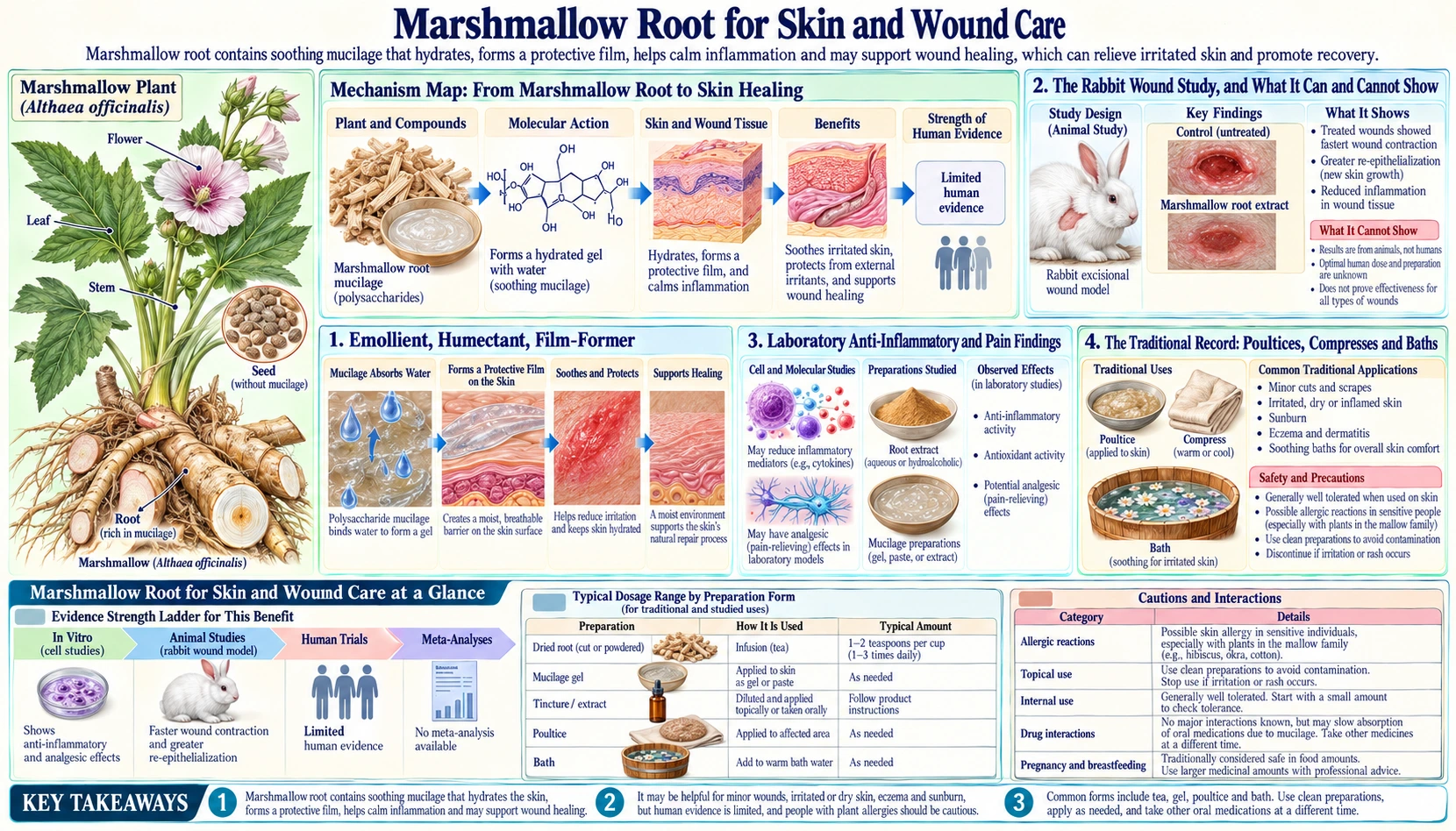
The topical use of marshmallow is the oldest one on record and the least studied. Dioscorides described the root for wounds and inflammations; medieval herbals list it in poultices for burns, stings, boils and chapped skin; and the plant still appears in creams, lip balms and after-sun products today. What has never happened is a controlled clinical trial of marshmallow on human skin. The whole modern evidence base is two animal wound-healing studies, a small set of laboratory anti-inflammatory findings, and the general dermatological principle that a hydrated film over dry skin helps.
That last principle is not a small thing, though, and it is the reason this page is worth reading rather than dismissing. The mechanism on skin is the same as everywhere else marshmallow works — physical, not pharmacological. Hydrated mucilage is simultaneously an emollient (it smooths and softens), a humectant (it binds water and holds it against the surface) and a film-former (it slows evaporation and shields against friction and irritants). Those are exactly the three properties that make any moisturiser work, and they are the properties dermatology has best characterised. Marshmallow is not doing something exotic; it is doing something ordinary, from a plant.
Table of Contents
- Emollient, Humectant, Film-Former
- The Rabbit Wound Study, and What It Can and Cannot Show
- Laboratory Anti-Inflammatory Findings
- The Traditional Record: Poultices, Compresses and Baths
- Dry, Itchy Skin and Eczema
- Mouth, Gums and Dry Mouth
- Why It Turns Up in Lip Balm
- Traditional Skin Preparations
- Where the Research and Tradition Do Not Support Topical Marshmallow
- Marshmallow, Calendula, Aloe and Comfrey
- Key Research Papers
- Connections
- Featured Videos
Emollient, Humectant, Film-Former
Three words describe everything marshmallow does to skin, and keeping them separate makes the claims easy to evaluate.
An emollient fills the gaps between loose corneocytes in a dry, flaking surface, making it feel smooth. A humectant attracts and binds water molecules — glycerin and hyaluronic acid are the familiar examples, and both are hydrophilic molecules with many hydroxyl groups, which is precisely what a branched polysaccharide is. A film-former leaves a continuous layer on the surface after the water carrier evaporates, reducing further water loss and putting a physical barrier between the skin and friction, wind or an irritant.
Marshmallow mucilage does all three at once, and the chemistry explains why. The mucilage is 5–11 percent of the dried root and consists of large branched polysaccharides — rhamnogalacturonans, arabinogalactans, arabinans and glucans. (This structural work is often credited to Tomoda and colleagues in the early 1980s, but the specific Althaea paper could not be confirmed in PubMed.) In water these swell into a shear-thinning gel: thick at rest, thinner while you spread it, thick again once still. That rheology is why a mucilage feels pleasant rather than gluey, and it is also why cosmetic chemists like plant mucilages as natural texture agents.
The critical consequence is the same as on every other page in this section: nothing is absorbed and nothing needs to be. These polysaccharides are far too large to cross the stratum corneum. Any claim that marshmallow "penetrates to rebuild collagen" or "works at the cellular level" from a cream is not describing this plant. The benefit is at the surface, which is where dryness, itch and friction actually happen.
Dry, itchy skin is largely a barrier problem: water is lost faster than it is replaced, the corneocyte layer cracks, irritants reach nerve endings more easily, and the itch-scratch cycle begins — structurally the same self-sustaining loop as the cough-irritation cycle in the throat. A humectant film interrupts it at the same point, by holding water and blocking contact. Tier: this general principle is supported by strong randomized-trial evidence for emollients as a class; it has not been tested for marshmallow specifically.
The Rabbit Wound Study, and What It Can and Cannot Show
The single most-cited piece of evidence for topical marshmallow is a study by Valizadeh and colleagues, published in 2015 in the Asian Pacific Journal of Tropical Biomedicine, examining the wound-healing potential of Althaea officinalis flower mucilage in rabbit full-thickness wounds. Treated wounds closed faster than untreated controls. Tier: preliminary (animal).
It is worth being precise about what that supports, because the study is routinely over-cited.
- It used flower mucilage, not root. The flowers and leaves of Althaea officinalis are also mucilaginous and share the same broad polysaccharide chemistry, but they are not the same material as the root, and the root is what almost everyone buys. Extrapolating from one plant part to another is reasonable but not free.
- Rabbit skin is not human skin. It is thinner, it heals faster, and — importantly for wound research — rabbit and rodent wounds close substantially by contraction of the surrounding skin, a mechanism far less available in humans. Animal wound models are notorious for producing effects that do not translate.
- A full-thickness surgical wound is not a scrape. The model is a standardised excision, not the graze, chap or insect bite for which people actually reach for a herbal compress.
- The comparison was against untreated wounds in the usual design of such studies, which cannot separate a specific herbal effect from the general benefit of keeping a wound moist. Moist wound healing is one of the better-established principles in wound care: occlusive and semi-occlusive dressings improve healing compared with letting a wound dry and scab. A wet polysaccharide gel is, functionally, a moist dressing. That may be the whole effect — which would still be a real benefit, just not a botanical one.
So the fair reading is: consistent with the tradition, encouraging, and not evidence that marshmallow heals human wounds. No study has compared a marshmallow poultice with standard wound care in people.
A second animal study points the same way. Rezaei and colleagues (Avicenna Journal of Phytomedicine, 2015) applied a water-and-alcohol extract of marshmallow leaf to excision wounds in rats: the treated wounds healed by a significantly higher percentage than untreated controls. In test tubes the same extract acted against gram-positive bacteria (such as Staphylococcus aureus) but not against gram-negative bacteria (such as Escherichia coli and Pseudomonas aeruginosa). This again is a leaf extract, in rats and in the laboratory, not a human result. Tier: preliminary (animal and in vitro).
Laboratory Anti-Inflammatory Findings
Two strands of in-vitro and animal pharmacology are usually cited alongside the wound study.
Hage-Sleiman, Mroueh and Daher published a pharmacological evaluation of a water extract of Althaea officinalis flower grown in Lebanon in Pharmaceutical Biology in 2011. The rats drank the extract (it was not put on skin); it showed anti-inflammatory activity against both acute and chronic inflammation in standard rat models, protected against alcohol-induced stomach ulcers, raised HDL cholesterol at 50 mg/kg, and in a test tube slowed platelet clumping at 500 micrograms per millilitre. The study did not report a pain-relief result. An aqueous extract of Althaea officinalis flower is also described as having pain-easing (antinociceptive) activity in standard laboratory models. Bonaterra and colleagues, in Frontiers in Pharmacology in 2020, tested marshmallow root extract on human macrophages (immune cells) in culture: it protected the cells against damage from hydrogen peroxide and cut their release of the inflammatory signals tumour necrosis factor-alpha (TNF-alpha) and interleukin-6 (IL-6) after a bacterial-toxin trigger, with the anti-inflammatory drug diclofenac used as the comparison. These are cell-culture results only. Kardošová and Machová had earlier described antioxidant activity among medicinal plant polysaccharides including Althaea's, in Fitoterapia in 2006. Tier for all three: preliminary.
A caution about how much weight this can bear. Demonstrating anti-inflammatory activity in cultured immune cells is one of the easiest results to obtain in natural-product research — a very large fraction of plant extracts show some, often at concentrations that would never be reached in living tissue, and often driven by polyphenols present in trace amounts. Such findings are useful for generating hypotheses and close to useless for predicting clinical effect. They do, however, sit comfortably with the observed behaviour of the herb: something mildly calming applied to something mildly irritated.
The Deters cell-culture work discussed on the other pages of this section is more interesting here than it first appears. It showed marshmallow polysaccharides being taken up by, and stimulating, human epithelial cells. Those were epithelial cells rather than keratinocytes, so it does not transfer directly to skin — but it is the one finding suggesting mucilage interacts with epithelium rather than merely resting on it. The same study also tested human skin fibroblasts (the connective-tissue cells under the skin surface): the polysaccharides formed a sticky (bioadhesive) layer on their surface but were not taken up and did not change their growth or survival.
The Traditional Record: Poultices, Compresses and Baths
The traditional topical uses are worth listing, both because they are the actual reason people try marshmallow on skin and because the pattern in them is informative. Tier: traditional use only, throughout this section.
- Poultices of mashed boiled root or powdered root mixed to a paste, applied to boils, abscesses, splinters and inflamed swellings — often warm. This is the classic use and appears across European, Middle Eastern and North African traditions.
- Compresses of cooled infusion on chapped skin, windburn, sunburn, insect bites and stings.
- Baths and washes with a strained infusion added to bathwater, for widespread dry or itchy skin — the same role oatmeal baths play in modern practice.
- Mouth rinses and gargles for sore gums, mouth ulcers and irritation from dentures or dental work.
- Ointments and creams combining root extract with a fat base, for cracked hands, heels and lips.
The pattern: every one of these targets a surface that is dry, raw, chapped or superficially inflamed. Not one traditional use claims marshmallow as an antiseptic, an antibiotic or a treatment for a deep infection — even the poultice-for-a-boil use is about drawing and softening, not sterilising. Traditional practice was, in effect, applying the mechanism correctly. Modern marketing sometimes is not.
Dry, Itchy Skin and Eczema
In eczema (atopic dermatitis) the skin barrier is genuinely defective — often through filaggrin-related changes — so water escapes, irritants and allergens get in, and inflammation and itch follow. The cornerstone of management, alongside anti-inflammatory treatment during flares, is regular generous emollient use, and that is supported by robust clinical evidence as a class.
A marshmallow-containing cream or a mucilage compress is, in that framework, an emollient with a humectant component. It is a plausible member of a proven class. What it is not is a substitute for the anti-inflammatory part of treatment: mucilage does not suppress the immune activity driving a flare, and moderate or severe eczema left without anti-inflammatory treatment tends to worsen, not settle.
The class evidence itself was summarised in a 2026 meta-analysis of 10 randomized trials in people with atopic dermatitis (Yang and Zhang, Acta Dermatovenerologica Alpina, Pannonica et Adriatica). Emollients lowered water loss through the skin (transepidermal water loss) and raised skin hydration compared with control groups, with significant effects after 2 and 4 weeks of continuous use; they did not change skin acidity (pH), and the benefit of use for 6 weeks or longer remained unproven because of limited evidence. None of the trials tested marshmallow.
Two facts matter for irritable skin. First, simplicity is an advantage: a home-made mucilage compress has the advantage of containing almost nothing — no fragrance, no preservative, no botanical extract cocktail — and fragrance and preservatives are among the commonest causes of contact dermatitis in people who already have compromised skin. Second, a home-made preparation has no preservative, which is a real hygiene issue: an unpreserved water-based plant preparation is a bacterial growth medium, and on broken or weeping skin a contaminated preparation is a genuine infection risk. Traditional practice made it fresh, kept it refrigerated and discarded it within about 24 hours.
For psoriasis, the same logic applies with a further limit: emollients help scaling and comfort but the disease is driven by immune-mediated hyperproliferation, and marshmallow addresses none of that.
Mouth, Gums and Dry Mouth
The mouth is arguably the best topical target for marshmallow, because it is where the throat evidence and the skin tradition converge. The European Medicines Agency's traditional-use indication is for irritation of the mouth and throat, not only the throat — and the mucosal-adhesion work of Deters and colleagues used precisely this type of epithelium.
- Mouth ulcers. A cooled infusion held in the mouth coats the ulcer and reduces contact with food, air and moving tissue. It will not shorten the ulcer's course, but painful contact is the whole complaint. Comfort care only; traditional use only.
- Sore or irritated gums, denture rubbing, orthodontic irritation. Same reasoning: coat the sore spot. Marshmallow is not a treatment for gum disease, which is a bacterial and inflammatory process requiring dental care.
- Dry mouth. Interesting and under-explored. Saliva is itself a mucin-based lubricating gel, and commercial saliva substitutes are built from polysaccharides and mucin analogues for exactly that reason. A mucilage rinse is conceptually a home-made saliva substitute. Plausible; unstudied for marshmallow. Dry mouth raises tooth-decay risk, and a sweetened marshmallow syrup used repeatedly for this purpose adds sugar to a mouth that is already decay-prone — see Tooth Decay.
Why It Turns Up in Lip Balm
Marshmallow root extract appears on cosmetic ingredient lists fairly often, and the reason is straightforwardly technical rather than medicinal. Formulators want natural humectants and texture modifiers, and a shear-thinning polysaccharide with good water-binding delivers both: it thickens without stickiness, improves slip, and adds a genuine hydrating claim. Lips are a natural fit — thin skin, no sebaceous glands, constant water loss, constant mechanical stress — and, pleasingly, this is the same property nineteenth-century confectioners exploited when they whipped root mucilage into pâte de guimauve throat lozenges.
Two consumer-level cautions. Cosmetic ingredient lists are ordered by concentration, and a botanical extract near the end of a long list may be present at a fraction of a percent — enough for the label, not enough to matter. And a cream's performance is usually determined by its base — the oils, waxes and glycerin — far more than by any botanical addition. Marshmallow in a well-formulated cream is a pleasant bonus; marshmallow in a poorly formulated one does not rescue it.
Traditional Skin Preparations
The traditional skin preparations below all use the same cold-water principle as the internal preparations, for the same reason: heat degrades mucilage, so a long cold soak yields a thicker gel than boiling does. They are described here as they are traditionally made; none has been tested in a clinical trial.
- Basic cold infusion (the base for everything else). Traditionally 2–4 tablespoons of dried chopped root are covered with about 500 mL of cool water in a jar and left 4 hours or overnight in the refrigerator, then strained. For skin use it is made stronger than a drinking infusion, so that it is visibly slippery and slightly viscous.
- Compress. A clean cotton cloth is soaked in the cooled infusion, wrung lightly, and held on the area for 10–15 minutes, two or three times a day, with a fresh cloth each time.
- Bath addition. About 500 mL of strained infusion is added to a warm (not hot) bath for a 15–20 minute soak. Moisturiser applied right after, while the skin is still damp, is what keeps water in — that sequence, not the herb, does most of the work.
- Poultice. Powdered root is mixed with just enough cool water to make a soft paste, spread about half a centimetre thick on gauze, and applied for 20–30 minutes. It was traditionally applied warm; a hot poultice can scald the skin.
- Mouth rinse. Traditionally 30–50 mL of cooled infusion is swished for 30 seconds, two to four times daily, and held against the sore area. It can be swallowed.
- Simple gel. A strong infusion can be thickened further by stirring in a little powdered root and letting it hydrate. It is kept refrigerated and discarded within 24 hours.
Hygiene is the main risk. A water-based plant preparation with no preservative is a bacterial growth medium. Traditional practice used clean utensils, kept it cold, made it fresh daily and threw away anything that smelled off; open, weeping or broken skin is where a contaminated preparation can cause infection. Stinging or reddening after a small test patch is the sign of a skin reaction.
Where the Research and Tradition Do Not Support Topical Marshmallow
- Anything infected. Spreading redness, increasing pain, warmth, swelling, pus, or red streaks tracking away from a wound are signs of infection that often needs antibiotics. Marshmallow has no meaningful antibacterial action, and a moist unpreserved dressing on an infected wound can make matters worse.
- Deep, gaping, dirty or bite wounds, wounds that may need stitching or a tetanus booster, and any wound with foreign material in it.
- Burns beyond small superficial ones. Blistering, large or deep burns, and any burn on the face, hands, feet or genitals are the burns hospitals treat as needing medical care.
- Diabetic foot wounds and any ulcer on a leg or foot with poor circulation. These are high-stakes wounds with a real amputation risk.
- Moderate or severe eczema or psoriasis in place of prescribed treatment. The trial evidence is for emollients used with treatment, not instead of it.
- Any skin lesion that is changing, bleeding, growing, or not healing after a few weeks. These are recognised warning signs of skin cancer; a soothing layer does nothing for them.
Marshmallow, Calendula, Aloe and Comfrey
For topical use, marshmallow's realistic competitors are not slippery elm and licorice but the classic skin herbs, and they differ meaningfully.
- Calendula is the traditional first choice for minor wounds and inflamed skin, with a somewhat larger — though still limited — clinical literature, including studies in radiation-induced skin reactions. If wound care is the goal rather than pure hydration, calendula has the better track record.
- Aloe vera is the closest mucilaginous analogue and the best-studied of the group for skin, with human data in burns and wound healing. Product quality varies enormously. See Aloe Vera for Skin and Wound Healing.
- Comfrey is traditionally used for bruises and sprains and has some clinical data for pain, but it contains pyrrolizidine alkaloids that are hepatotoxic if absorbed. That is why its traditional use is limited to unbroken skin for short periods and never internally — a genuinely different risk profile from marshmallow's near-zero one.
- Slippery elm makes a comparable poultice by an identical mechanism. See Slippery Elm for Skin.
- Plain petrolatum, oatmeal baths and glycerin-based emollients deserve honest mention: they are cheap, extensively evidenced, preserved, sterile in the tube, and better documented than any of the herbs above. Marshmallow's advantages are its simplicity and its pleasantness, not superiority.
Key Research Papers
Papers are cited by PubMed identifier (PMID) or DOI where one could be confirmed; the remaining entries are PubMed topic searches, so each link returns the current literature. Evidence tier is labelled for each.
- Valizadeh R, Hemmati AA, Houshmand G, Bayat S, Bahadoram M. "Wound healing potential of Althaea officinalis flower mucilage in rabbit full thickness wounds." Asian Pacific Journal of Tropical Biomedicine 2015;5(11):937–943 — faster closure than untreated controls; the single most-cited topical study (not indexed in PubMed). Preliminary (animal). doi:10.1016/j.apjtb.2015.07.018
- Rezaei M, Dadgar Z, Noori-Zadeh A, Mesbah-Namin SA, Pakzad I, Davodian E. "Evaluation of the antibacterial activity of the Althaea officinalis L. leaf extract and its wound healing potency in the rat model of excision wound creation." Avicenna Journal of Phytomedicine 2015;5(2):105–112 — leaf extract; better wound healing in rats, active against gram-positive but not gram-negative bacteria in vitro. Preliminary (animal and in vitro). PubMed PMID: 25949951
- Hage-Sleiman R, Mroueh M, Daher CF. "Pharmacological evaluation of aqueous extract of Althaea officinalis flower grown in Lebanon." Pharmaceutical Biology 2011;49(3):327–333 — extract given in drinking water to rats: anti-inflammatory, antiulcer and HDL-raising effects, and antiplatelet activity in vitro. Preliminary (animal). PubMed PMID: 21281251
- Bonaterra and colleagues, on anti-inflammatory and anti-oxidative effects of Althaea officinalis root extract on macrophages, Frontiers in Pharmacology, 2020. Preliminary (in vitro). PubMed PMID: 32256361
- Deters A, Zippel J, Hellenbrand N, Pappai D, Possemeyer C, Hensel A. "Aqueous extracts and polysaccharides from Marshmallow roots (Althea officinalis L.): cellular internalisation and stimulation of cell physiology of human epithelial cells in vitro." Journal of Ethnopharmacology 2010;127(1):62–69 — uptake by epithelial cells; a bioadhesive layer, but no uptake or effect, on dermal fibroblasts. Preliminary (cell culture). PubMed PMID: 19799989
- Tomoda and colleagues, "Plant mucilages," Chemical and Pharmaceutical Bulletin, early 1980s — structural characterisation of Althaea mucilage polysaccharides, the basis of the humectant argument. The specific Althaea paper could not be confirmed in PubMed; kept as a topic search. Search: Tomoda plant mucilages Althaea officinalis
- Kardošová and Machová, "Antioxidant activity of medicinal plant polysaccharides," Fitoterapia, 2006 — includes Althaea polysaccharides. Preliminary. Search: antioxidant activity medicinal plant polysaccharides Althaea. — PubMed PMID: 16797146
- Yang Q, Zhang W. "Effect of emollients on skin barrier function in patients with atopic dermatitis: a systematic review and meta-analysis." Acta Dermatovenerologica Alpina, Pannonica et Adriatica 2026;35(3):187–199 — 10 randomized trials; less water loss and more hydration after 2 and 4 weeks, no pH change; the class evidence marshmallow would belong to. Meta-analysis of randomized trials (class, not herb). PubMed PMID: 42809766
- Moist wound healing and occlusive dressings — the alternative explanation for the rabbit result. Search: moist wound healing occlusive dressing epithelialization. — Search PubMed
- Humectants, film-formers and transepidermal water loss — how a hydrophilic polysaccharide layer reduces water loss from skin. Search: humectant film-former transepidermal water loss
- Plant mucilages and polysaccharides as cosmetic and dermatological excipients. Search: plant mucilage polysaccharide cosmetic dermatological excipient. — Search PubMed
- Mucin-based saliva substitutes for dry mouth — the engineered analogue of a mucilage rinse. Search: saliva substitute mucin polysaccharide xerostomia
- Comparative topical herbal literature — calendula and aloe vera in wound healing and irritated skin, the realistic alternatives. Search: calendula aloe vera topical wound healing trial
Connections
- All Herbs
- Marshmallow Root Benefits — the hub, with the full evidence map by tier.
- Marshmallow Root — botany, history and forms.
- Mucilage, Dosing and Safety — why cold water, and how to store a preparation safely.
- Cough and Sore Throat — the mouth-and-throat indication that overlaps this page.
- Calendula — the traditional first choice for minor wounds.
- Aloe Vera for Skin and Wound Healing — the best-studied mucilaginous comparator.
- Comfrey — effective for bruises but with a real toxicity caveat.
- Slippery Elm for Skin — an identical poultice mechanism.
- Chamomile — another gentle herb used on irritated skin.
- Plantain — the classic traditional poultice for stings and bites.
- Eczema — where emollients are proven and anti-inflammatory treatment is still needed.
- Contact Dermatitis — why a simple, fragrance-free preparation has an advantage.
- Psoriasis — scaling and comfort only; the disease needs real treatment.
- Dermatology — the wider skin library.
- Canker Sores — mouth ulcers, a good target for a mucilage rinse.
- Gum Disease — needs dental care, not a soothing rinse.
- Tooth Decay — why a sweetened syrup is the wrong dry-mouth remedy.
Safety and disclaimer. Topical marshmallow is very low-risk, and true allergy is rare; people sensitive to plants in the mallow family are the ones most likely to react. The genuine hazard is not the herb but the preparation: a home-made water-based infusion contains no preservative and is a bacterial growth medium (traditionally it was kept refrigerated and discarded within 24 hours), and open, weeping or broken skin is where a contaminated preparation can cause infection. Marshmallow has no meaningful antibacterial action in people, so it does not treat an infected wound, a deep or dirty wound, a significant burn, or a foot or leg ulcer in someone with diabetes or poor circulation — wounds that carry a real risk of spreading infection or amputation. The trial evidence for emollients in eczema and psoriasis is for use alongside anti-inflammatory treatment, not instead of it. A skin lesion that is changing, bleeding, growing or failing to heal within a few weeks is a recognised warning sign of skin cancer. This page is health information, not medical advice.