Perilla Seed Oil: Plant Omega-3 and What ALA Does
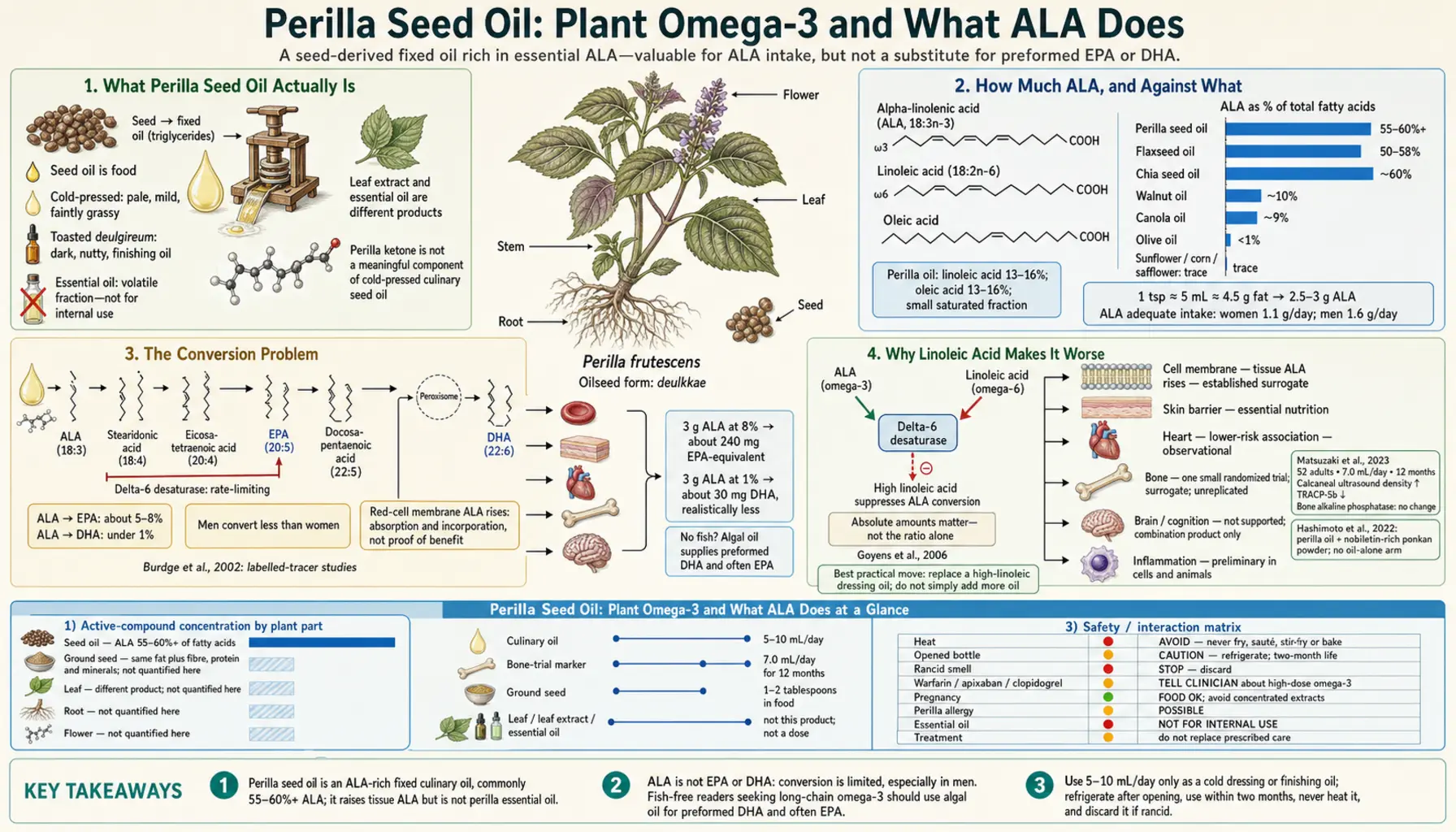
Perilla seed oil is the one thing about this plant that is not in dispute. Pressed from the seed of Perilla frutescens — the Korean oilseed form, deulkkae, grown as var. frutescens rather than the leaf-crop var. crispa — it is among the richest plant sources of alpha-linolenic acid on earth, commonly 55 to 60 per cent or more of its fatty acids. That number is measurable, reproducible, and usually a little higher than flaxseed oil, the plant omega-3 everyone has heard of.
And then there is the correction that almost nobody makes, which is the real reason this page exists. Alpha-linolenic acid is not EPA and it is not DHA. Your body converts it to those long-chain omega-3s at a rate best described as a trickle — a few per cent to EPA, a fraction of one per cent to DHA, worse in men, and suppressed further by the linoleic acid that dominates most modern diets. Perilla oil is an excellent way to raise your ALA. It is a poor way to raise your DHA, and it is not a substitute for marine omega-3. If you take one thing from this page, take that.
Table of Contents
- What Perilla Seed Oil Actually Is
- How Much ALA, and Against What
- The Conversion Problem
- Why Linoleic Acid Makes It Worse
- So Is There Any Point? What ALA Does on Its Own
- The Human Trials on Perilla Seed Oil
- Oxidation: Cold-Pressed, Refrigerated, Never Fried
- Buying, Storing and Cooking With It
- Dosing and How It Compares
- Testing Whether It Worked
- Cautions and Interactions
- Evidence Verdict
- Key Research Papers
- Connections
What Perilla Seed Oil Actually Is
Perilla seed oil is a fixed oil — triglycerides, pressed from seed, like olive or walnut oil. It is not the same product as perilla essential oil, which is the steam-distilled volatile aroma fraction and is where the plant's chemotype and toxicity questions live. Confusing the two is the single most consequential mistake a reader can make about this plant. Seed oil is food. Essential oil is not for internal use. See Perilla: Perilla Ketone, Species and Safety.
Two culinary versions exist, and they are used differently:
- Cold-pressed perilla seed oil — pale, mild, faintly grassy. This is the version used for dressings and sold as a supplement.
- Toasted perilla seed oil — Korean deulgireum, made from roasted seed. Dark, deeply nutty, aromatic. It is a finishing oil, drizzled over vegetables and rice at the end of cooking, in the same role sesame oil plays but with a completely different flavour.
The Korean pantry also uses ground perilla seed itself — deulkkae garu — stirred into pork-bone stew and blanched vegetable side dishes, and made into deulkkae kalguksu, a pale nutty noodle soup that reads as creamy while containing no dairy at all. Whole ground seed carries the same fat plus fibre, protein and minerals, and it goes rancid just as fast.
The chemotype note that matters here: the oilseed and leaf crops are different cultivars of one species, selected for different things. Korean perilla leaf and Japanese shiso are not compositionally interchangeable either, and neither leaf type tells you anything about the seed oil in a bottle. Seed oil is a fatty fraction, and perilla ketone — the compound behind the livestock toxicity — is not a meaningful component of cold-pressed culinary seed oil, whatever chemotype the plant was.
How Much ALA, and Against What
Alpha-linolenic acid (ALA, 18:3n-3) is an eighteen-carbon fatty acid with three double bonds. It is an essential fatty acid: humans cannot synthesise it and must eat it. Perilla seed oil is a concentrated source.
| Oil or food | Approximate ALA, % of total fatty acids |
|---|---|
| Perilla seed oil | 55–60%+ |
| Flaxseed (linseed) oil | 50–58% |
| Chia seed oil | ~60% (whole seed lower by weight) |
| Walnut oil | ~10% |
| Rapeseed / canola oil | ~9% |
| Olive oil | <1% |
| Sunflower, corn, safflower oils | trace |
The rest of perilla oil is roughly 13 to 16 per cent linoleic acid and 13 to 16 per cent oleic acid, with a small saturated fraction. That composition — overwhelmingly polyunsaturated, dominated by a triple-double-bond fatty acid — explains both its value and its fragility.
Put in everyday units: a teaspoon (about 5 mL, roughly 4.5 g of fat) of perilla oil supplies somewhere in the region of 2.5 to 3 grams of ALA. Common dietary guidance for adequate ALA intake sits around 1.1 g/day for women and 1.6 g/day for men. So a single teaspoon comfortably exceeds either figure. ALA sufficiency is easy, and perilla oil makes it trivially easy. That is a real, if unglamorous, benefit — and it is a different claim from the one most people are making when they buy the bottle.
The Conversion Problem
Evidence tier: well-replicated human tracer studies. This is not a controversial area.
Almost all the health research that made omega-3 famous — the cardiovascular work, the triglyceride-lowering, the retinal and brain development work — is about EPA (eicosapentaenoic acid, 20:5n-3) and DHA (docosahexaenoic acid, 22:6n-3), the long-chain omega-3s found in oily fish and algae. ALA is the eighteen-carbon precursor. The body can elongate and desaturate it upward through the pathway:
ALA (18:3) → stearidonic acid (18:4) → eicosatetraenoic acid (20:4) → EPA (20:5) → docosapentaenoic acid (22:5) → → DHA (22:6)
The rate-limiting enzyme early in that chain is delta-6 desaturase, and the final step to DHA requires an extra round trip through the peroxisome. Human studies that fed labelled ALA and measured where the label ended up converge on a discouraging picture:
- ALA to EPA: roughly a few per cent — commonly quoted figures land in the range of about 5 to 8 per cent, with wide variation between individuals.
- ALA to DHA: a fraction of one per cent — often reported as under 1 per cent, and in some tracer studies in men effectively unmeasurable.
- Men convert less than women. This is one of the most consistent findings in the field, and it is attributed largely to oestrogen's effect on the desaturase pathway. Young women in tracer studies produced measurably more DHA from labelled ALA than young men did.
The classic human work here is Burdge and colleagues' pair of tracer studies in British Journal of Nutrition in 2002, one in young women and one in young men, which measured the products of labelled ALA metabolism directly. The male study concluded, in effect, that EPA and docosapentaenoic acid are the principal products of ALA metabolism in young men — with DHA synthesis very limited. Reviews by Brenna and by Gerster reached compatible conclusions.
What this means in practice. Take a generous teaspoon of perilla oil supplying 3 g of ALA. At an 8 per cent conversion you get about 240 mg of EPA-equivalent; at 1 per cent to DHA you get about 30 mg of DHA, and realistically less. A single modest portion of oily fish supplies well over a gram of preformed EPA plus DHA directly. You cannot close that gap with a plant oil at any sane dose. Drinking a quarter-bottle of perilla oil would not do it either, because the pathway saturates and because you would be consuming an absurd amount of highly oxidisable fat.
Therefore:
- If you eat oily fish regularly, perilla oil is a nice cooking-oil upgrade and nothing more.
- If you eat no fish and want EPA and DHA, the direct plant-based source is algal oil, which supplies preformed DHA (and often EPA) with no conversion required. Perilla oil is not a substitute for it, and no plant seed oil is.
- Anyone selling perilla or flax oil as “vegan fish oil” is either mistaken or misleading you.
Why Linoleic Acid Makes It Worse
The same delta-6 desaturase that starts ALA on its way to EPA also handles linoleic acid (18:2n-6), the omega-6 fatty acid that dominates sunflower, corn, safflower and most industrial seed oils. The two fatty acids compete for the enzyme. When linoleic acid intake is high — as it is in most modern diets — ALA conversion is suppressed.
The honest nuance, which the popular version of this story usually flattens: research by Goyens and colleagues, published in the American Journal of Clinical Nutrition in 2006, found that conversion in humans was influenced by the absolute amounts of ALA and linoleic acid in the diet rather than simply by their ratio. In other words “fix your omega-6 to omega-3 ratio” is a slogan that oversimplifies a real effect. Lowering total linoleic acid intake helps; raising ALA helps; the arithmetic ratio on its own is not the mechanism.
The practical upshot is genuinely useful, and it is the strongest real-world case for perilla oil:
- Displacement is the win. Using perilla oil instead of a linoleic-acid-heavy oil in your dressings does two things at once — it raises ALA and lowers the competitor. Adding perilla oil on top of an unchanged high-linoleic diet does only half the job.
- Other things throttle the pathway too. Zinc, magnesium and B6 are cofactors for the desaturase and elongase steps; deficiency, heavy alcohol intake, poorly controlled diabetes and ageing all reduce conversion further. None of these is a reason to take a supplement blindly, but they explain why individual variation is so large.
So Is There Any Point? What ALA Does on Its Own
Yes — but the case has to be made for ALA as ALA, not as a DHA precursor.
- It is an essential nutrient and deficiency is real. Frank ALA deficiency is rare in ordinary diets but has been documented, and adequate intake matters for skin barrier function and for membrane composition. Perilla oil covers the requirement several times over in a teaspoon. Tier: established nutrition.
- It changes your membrane fatty-acid composition, measurably. Feeding studies including the perilla-oil trials below show red-cell membrane ALA rising on supplementation. That is proof of absorption and incorporation, not proof of benefit. Tier: established, but a surrogate.
- Observational evidence associates higher ALA intake with lower cardiovascular risk. The association appears across several large cohort analyses. It is observational — people eating more ALA differ in many other ways — and randomized trials of ALA specifically are far weaker than the trials of EPA and DHA. Tier: observational.
- Small randomized trials of perilla oil itself report effects on bone-turnover markers and, in a combination product, cognitive scores. Details below. Tier: small randomized trials.
- Anti-inflammatory effects attributed to ALA in cell and animal work are real in those systems and unproven as clinical outcomes in people. Tier: preliminary.
A fair summary: perilla oil is a genuinely excellent culinary fat with an unusually good fatty-acid profile, and using it in place of a high-linoleic oil is a small, cheap, defensible improvement to a diet. It is not a therapy, and it is not marine omega-3.
The Human Trials on Perilla Seed Oil
There are two worth reporting accurately, and neither is large.
Bone (randomized clinical trial). Matsuzaki and colleagues published a twelve-month, randomized, double-blind, placebo-controlled trial in Phytotherapy Research in 2023: Perilla seed oil improves bone health by inhibiting bone resorption in healthy Japanese adults. Fifty-two healthy Japanese adults, mean age in the mid-fifties, took either 7.0 mL of perilla seed oil or 7.0 mL of olive oil daily for a year. The perilla group showed an increase in heel-bone (calcaneal) ultrasound density expressed as a percentage of the young-adult mean, and a fall in serum TRACP-5b, a marker of bone resorption. Bone alkaline phosphatase, a marker of bone formation, did not change — so if the effect is real, the mechanism is slowed breakdown, not faster building. Red-cell membrane ALA rose, confirming the oil was absorbed.
What to make of it: fifty-two people, one site, and heel ultrasound is a screening surrogate rather than the DXA hip-and-spine scan that defines osteoporosis or the fracture rate that actually matters. Twelve months is a respectable duration and the biochemical marker moving in the same direction as the imaging is reassuring. Call it a promising signal awaiting a proper trial.
Cognition (randomized, but confounded by design). Hashimoto and colleagues reported in Food & Function in 2022 that perilla seed oil combined with nobiletin-rich ponkan citrus powder improved cognitive scores in healthy elderly Japanese adults. The flaw is structural and unavoidable: it was a combination product with no perilla-oil-alone arm, so nothing in the result can be attributed to the oil. It cannot support a claim that perilla oil improves memory, and any marketing that cites it for that purpose is misrepresenting it.
Beyond these, the literature is composition analyses, animal studies and reviews — useful for describing the oil, not for claiming clinical effects.
Oxidation: Cold-Pressed, Refrigerated, Never Fried
This section is more practically important than any benefit claim on the page, because a mishandled bottle of perilla oil is actively worse for you than no perilla oil at all.
Every double bond in a fatty acid is a site where oxygen can attack. ALA has three. With the great majority of its fatty acids carrying three double bonds, perilla oil is one of the most oxidation-prone edible oils in existence — more fragile than flax, far more fragile than olive. Oxidation produces hydroperoxides, aldehydes and polymers: the rancid smell of old paint or stale fish. Those oxidised lipids are pro-inflammatory and are precisely what you were trying to avoid.
Rules, in order of importance:
- Never fry with it. Not sautéing, not stir-frying, not baking at temperature. Heat accelerates oxidation enormously and perilla oil has no thermal margin at all. Use olive oil, butter or ghee for heat.
- Refrigerate after opening, and treat it as a fresh product with a two-month life once open rather than a pantry staple with a year on it.
- Buy small, dark bottles. Light drives oxidation. A large clear bottle is a bad purchase however good the price.
- Buy cold-pressed and check for a pressing or best-before date. Oil that has sat in a warm warehouse is already partly gone.
- Smell it before every use. Fresh perilla oil is grassy and nutty. If it smells of paint, putty, crayon or old fish, pour it away. This is not a marginal call — rancid oil is not neutral.
- Ground seed goes off just as fast. Buy deulkkae garu in small quantities and keep it in the fridge or freezer.
- Softgel capsules protect the oil from light and air better than a bottle does, which is one honest argument for the supplement form over the culinary one — provided the manufacturer's own handling was sound.
Buying, Storing and Cooking With It
Perilla oil belongs in the same category as good walnut oil or fresh flax oil: a raw, finishing, dressing fat.
- Korean style. Toasted deulgireum drizzled over blanched spinach or bean sprouts, over rice, into vegetable side dishes at the end of cooking. Small quantities, big aroma.
- Dressings. Cold-pressed perilla oil with rice vinegar and a little honey; or half perilla, half olive, if the flavour is too assertive on its own.
- Finishing. A teaspoon stirred into hot soup off the heat, or over grilled vegetables, or into a bowl of brown rice. See Brown Rice.
- Not for: frying, roasting, mayonnaise you intend to keep, or anything that sits at room temperature for days.
On sourcing: perilla oil is a mainstream Korean grocery product, which is generally the best place to buy it — turnover is high, so bottles are fresher than in a supplement shop. Look for a Korean-language label naming deulgireum or deulkkae, a small bottle, and a date.
Dosing and How It Compares
- Culinary: one to two teaspoons (5–10 mL) a day is a sensible everyday amount and supplies far more ALA than any dietary reference intake requires.
- The bone trial used 7.0 mL daily for twelve months — about a heaped teaspoon and a half. That is the only meaningful trial-derived dose for the oil.
- Ground seed: a tablespoon or two stirred into food, Korean-style, is normal food use.
- Not a dose: perilla leaf, perilla leaf extract, or perilla essential oil. None of them is this product. The leaf extract is the allergy preparation — see Perilla for Allergy and Seasonal Rhinitis.
- More is not better. Large doses of any highly unsaturated oil increase your oxidative load and displace other fats you may want. There is no evidence that 30 mL of perilla oil does anything 7 mL does not.
Compared with flaxseed: nutritionally almost interchangeable, with perilla usually a shade higher in ALA and much easier to like as a flavour. Ground flaxseed brings lignans and soluble fibre that perilla oil does not. Compared with walnuts and chia seeds: those are whole foods carrying fibre, protein and minerals along with less concentrated ALA, and a whole food is generally the better default. Compared with salmon or sardines: not comparable, because those supply preformed EPA and DHA and perilla oil does not.
Testing Whether It Worked
There is an actual laboratory answer available here, which is unusual for a supplement question. The Omega-3 Index measures EPA plus DHA as a percentage of red-cell membrane fatty acids — a stable, months-long integrated marker rather than a snapshot.
If you take perilla or flax oil in the belief that it is raising your EPA and DHA, this is the test that will tell you the truth. In most people it will show that it barely moved, which is exactly what the conversion literature predicts. That is a useful, slightly deflating experiment, and it is far better evidence about your own body than any general argument on this page. A fuller discussion of the fatty acids themselves is on Omega-3 Fatty Acids.
Cautions and Interactions
- Anticoagulant and antiplatelet consideration — mild and mostly theoretical. Omega-3 fats have modest antiplatelet effects, and standard advice is to tell a surgeon or a clinician managing warfarin, apixaban or clopidogrel about any high-dose omega-3 supplement. The important honest qualifier: ALA's antiplatelet effect is considerably weaker than that of the EPA and DHA in fish oil, and clinically significant bleeding attributable to culinary perilla oil has not been demonstrated. Mention it; do not panic about a teaspoon on a salad.
- Rancidity is the main real risk. Covered above, and worth repeating because it is the failure mode people actually experience.
- Pregnancy and breastfeeding: perilla seed oil as food is fine and traditional. Concentrated perilla extracts have no pregnancy safety data and should be avoided — that caution is about leaf extracts and essential oil, not about culinary oil, but the distinction is easily lost on a label, so read what you are buying. Note also that pregnancy and infancy are precisely when preformed DHA matters most, and a plant oil does not supply it.
- The ALA and prostate cancer question. Older observational research suggested a weak association between high ALA intake and prostate cancer risk. Later and larger analyses have been inconsistent and the association is not considered established. Worth knowing if you are taking high-dose ALA long term with a strong family history; not a reason to avoid perilla as a food.
- Perilla allergy exists. Reactions to perilla seed as well as leaf have been reported, mostly from countries where it is eaten daily.
- Not a treatment for anything. Do not use perilla oil in place of prescribed treatment for cardiovascular disease, high triglycerides or osteoporosis.
Evidence Verdict
- “Perilla seed oil is among the richest plant ALA sources” — established. Straight composition analysis, repeatedly measured.
- “It covers your essential omega-3 requirement easily” — established. One teaspoon exceeds common adequate-intake figures.
- “It raises your tissue ALA” — established, but a surrogate.
- “It substitutes for fish oil or supplies DHA” — false. The conversion arithmetic rules it out.
- “It improves bone health” — single small randomized trial, surrogate endpoint, unreplicated.
- “It improves cognition” — not supported. The only trial used a combination product.
- “It reduces inflammation” — preliminary in cells and animals; no clinical outcome data.
Key Research Papers
All links are PubMed topic searches rather than fixed records, so they stay current.
- Matsuzaki K, Hossain S, Wakatsuki H, et al. Perilla seed oil improves bone health by inhibiting bone resorption in healthy Japanese adults: a 12-month, randomized, double-blind, placebo-controlled trial. Phytotherapy Research, 2023. 52 adults, 7 mL/day, heel-ultrasound surrogate. Find on PubMed
- Hashimoto M, Matsuzaki K, Maruyama K, et al. Perilla seed oil in combination with nobiletin-rich ponkan powder enhances cognitive function in healthy elderly Japanese individuals. Food & Function, 2022. Combination product — the oil's own contribution cannot be isolated. Find on PubMed
- Burdge GC, Wootton SA. Conversion of alpha-linolenic acid to eicosapentaenoic, docosapentaenoic and docosahexaenoic acids in young women. British Journal of Nutrition, 2002. Labelled-tracer study — one half of the sex-difference pair. Find on PubMed
- Burdge GC, Jones AE, Wootton SA. Eicosapentaenoic and docosapentaenoic acids are the principal products of alpha-linolenic acid metabolism in young men. British Journal of Nutrition, 2002. The companion study showing very limited DHA synthesis in men. Find on PubMed
- Brenna JT. Efficiency of conversion of alpha-linolenic acid to long chain n-3 fatty acids in man. Current Opinion in Clinical Nutrition and Metabolic Care, 2002. The standard review of the conversion problem. Find on PubMed
- Gerster H. Can adults adequately convert alpha-linolenic acid to eicosapentaenoic acid and docosahexaenoic acid? International Journal for Vitamin and Nutrition Research, 1998. The paper that framed the question. Find on PubMed
- Goyens PLL, et al. Conversion of alpha-linolenic acid in humans is influenced by the absolute amounts of alpha-linolenic acid and linoleic acid in the diet and not by their ratio. American Journal of Clinical Nutrition, 2006. The paper that corrects the popular “ratio” story. Find on PubMed
- Guan L, et al. Perilla seed oil and protein: composition, health benefits, and potential applications in functional foods. Molecules, 2024. Current composition review. Find on PubMed
- Oxidative stability studies of perilla and other high-ALA oils — the literature behind the handling rules above. Find on PubMed
- Algal-oil DHA supplementation trials — the actual plant-based route to long-chain omega-3, for comparison. Find on PubMed
- ALA intake and cardiovascular outcomes in cohort studies and meta-analyses — the observational tier. Find on PubMed
- ALA intake and prostate cancer risk — the inconsistent literature behind the caution above. Find on PubMed
External Resources
- USDA FoodData Central — authoritative fatty-acid composition data for oils and seeds.
- NIH Office of Dietary Supplements — fact sheets on omega-3 fatty acids and intake recommendations.
- PubMed — the primary literature.
- National Center for Complementary and Integrative Health — plain-language supplement summaries.
Connections
- All Herbs
- Perilla (Perilla frutescens) — the main topic page.
- Perilla Benefits Hub — all four deep dives.
- Perilla Ketone, Species and Safety — why seed oil and essential oil must never be confused.
- Perilla for Allergy and Rhinitis — the leaf-extract strand.
- Omega-3 Fatty Acids — ALA, EPA and DHA explained in full.
- Omega-3 Index — the blood test that shows whether your EPA and DHA actually moved.
- Flaxseed — the plant omega-3 perilla oil is measured against.
- Chia Seeds — another concentrated plant ALA source, as a whole food.
- Walnuts — the everyday whole-food ALA source.
- Salmon — preformed EPA and DHA, which ALA cannot replace.
- Sardines — the cheapest reliable marine omega-3.
- Olive Oil — the oil to cook with, since perilla oil must never be heated.
- Brown Rice — the Korean pairing for a drizzle of deulgireum.
- Cardiology — where most of the omega-3 outcome research lives.
- All Foods — the complete food index.
Safety and disclaimer. This page is health information, not medical advice. Perilla seed oil is a food; treat it as one. It must never be heated, must be refrigerated after opening, and must be discarded once it smells rancid, because oxidised oil is worse than no oil. It is not a substitute for marine or algal EPA and DHA, and it should not replace prescribed treatment for heart disease, high triglycerides or bone loss. Tell your clinician or surgeon about any high-dose omega-3 supplement if you take an anticoagulant or antiplatelet drug. Concentrated perilla extracts and perilla essential oil are different products with different risks — the essential oil is not for internal use at all.