Myrrh — Benefits Deep Dive
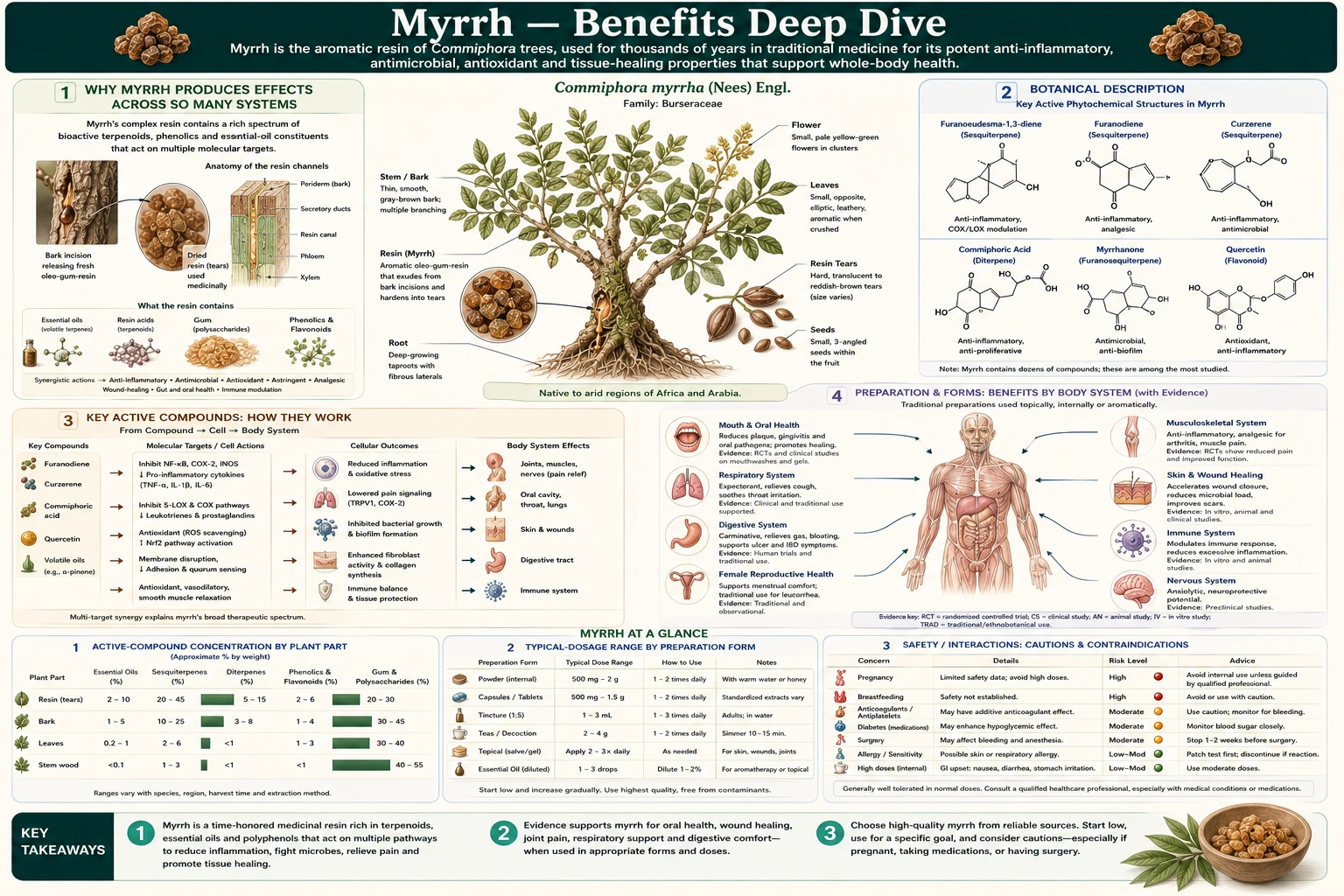
Myrrh is the aromatic oleo-gum resin harvested from small thorny Commiphora myrrha trees native to the arid Horn of Africa (Somalia, Ethiopia, Eritrea, Sudan) and the southern Arabian Peninsula (Yemen, Oman). It is best known to Western readers as one of the three gifts of the Magi to the infant Jesus alongside frankincense and gold, but its medicinal use long predates the Nativity — Egyptian embalmers were packing body cavities with myrrh to prevent putrefaction by 2700 BCE, Roman field surgeons carried it for battlefield wounds, and the Ebers Papyrus (c. 1550 BCE) lists it in dozens of formulations. Modern phytochemistry has identified the primary actives as sesquiterpenes (curzerene, furanoeudesma-1,3-diene, lindestrene) and resinous commiphoric acids that disrupt bacterial membranes, inhibit COX-2, and bind opioid receptors. Most consequentially, an Egyptian pharmaceutical preparation of purified myrrh oleoresin called Mirazid (Commiphora molmol) was approved by the Egyptian Ministry of Health in 2001 for schistosomiasis and fascioliasis — a rare modern instance of a traditional herbal remedy crossing into formal pharmaceutical regulation. Four benefit pages below explore where myrrh produces the largest clinical effect today.
Deep-Dive Articles
Wound Healing
The oldest documented use — Egyptian embalming (2700 BCE onward), Roman legionary field kits, the Ebers Papyrus wound recipes, and Crusader-era European wound salves. Modern topical trials on burn, diabetic, and surgical wounds; the sesquiterpene + commiphoric acid membrane-disruption mechanism; astringent tannin-like protein cross-linking that mechanically seals oozing tissue; and the Mirazid Egyptian pharmaceutical — the rare modern crossover from folk remedy to regulated drug.
Oral Health
The single best-supported clinical application. The German Commission E approval for oral and pharyngeal mucosal inflammation, the Mukherjee 2003 gingivitis trial, modern myrrh-containing commercial mouthwashes (Parodontax, Weleda Ratanhia), traditional miswak/tooth-powder use, and the dual antimicrobial + astringent mechanism against Streptococcus mutans, Porphyromonas gingivalis, and the dental-plaque biofilm.
Anti-Inflammatory
Sesquiterpenes and commiphoric acids inhibit cyclooxygenase-2 (COX-2), 5-lipoxygenase (5-LOX), and the NF-kappa-B transcription pathway, parallel mechanisms to NSAID and corticosteroid drugs but more diffuse. Traditional use in osteoarthritis and rheumatoid arthritis, the comparison to Boswellia (frankincense) as a structurally similar resin with overlapping but distinct anti-inflammatory profile, and the synergy when the two ancient resins are co-administered.
Antimicrobial & Parasitic
Mirazid — the Egyptian Ministry of Health-approved myrrh derivative for schistosomiasis (Sheir 2001, Massoud 2001), the subsequent debate over efficacy, the parallel use in fascioliasis (liver fluke), antibacterial spectrum against S. aureus (including MRSA), Gram-negative rods, and the traditional African and Arabian use as an anthelmintic for intestinal worms.
Table of Contents
- Deep-Dive Articles
- Why Myrrh Produces Effects Across So Many Systems
- Research Papers: Wound Healing
- Research Papers: Oral Health
- Research Papers: Anti-Inflammatory
- Research Papers: Antimicrobial & Parasitic
- Research Papers: Cross-Cutting (Chemistry, Safety, Synergy)
- External Authoritative Resources
- Connections
- Featured Videos
Why Myrrh Produces Effects Across So Many Systems
Most modern pharmaceuticals act on a single molecular target — a receptor, a transporter, an enzyme. Myrrh, like most plant resins, is a chemical orchestra of dozens to hundreds of co-occurring compounds, and its clinical effects emerge from the simultaneous action of four overlapping mechanism classes. Each class maps to a distinct subset of traditional and modern uses.
- Sesquiterpene + commiphoric acid membrane disruption — the lipophilic sesquiterpenes (curzerene, furanoeudesma-1,3-diene, lindestrene, furanodiene) and the resinous commiphoric acids integrate into the phospholipid bilayer of bacterial and fungal cell membranes, increasing permeability and dissipating the proton motive force. This is the unifying mechanism behind the broad antimicrobial activity against Staphylococcus aureus (including MRSA), oral pathogens like Streptococcus mutans and Porphyromonas gingivalis, Helicobacter pylori, and parasitic worms.
- COX-2, 5-LOX, and NF-kappa-B inhibition — the same sesquiterpenes and commiphoric acids inhibit the cyclooxygenase-2 and 5-lipoxygenase enzymes that produce pro-inflammatory prostaglandins and leukotrienes, and they suppress the NF-kappa-B transcription pathway that drives chronic inflammatory gene expression. This is the mechanism behind myrrh's traditional use in osteoarthritis, rheumatoid arthritis, and the gingival-tissue protective effect that complements its antimicrobial action in oral health applications.
- Astringent protein cross-linking — the resinous fraction of myrrh produces a classic astringent effect: it cross-links surface proteins on mucosal and wound tissue, contracting and mechanically sealing tissues that are bleeding, weeping, or inflamed. This is why myrrh has been used continuously since antiquity for battlefield wound treatment and for bleeding gums in gingivitis — the effect is partly antimicrobial and partly mechanical contraction of inflamed mucosa.
- Mu-opioid receptor agonism — uniquely among common herbs, two furanosesquiterpenes isolated from myrrh (furanoeudesma-1,3-diene and curzerene) bind directly to mu-opioid receptors and produce dose-dependent analgesia in animal models. This was demonstrated in a 1996 Nature paper by Dolara and colleagues and explains why myrrh has been used for pain management across virtually every traditional medical system since antiquity — it is, mechanistically, a weak opioid agonist.
The therapeutic complication is that the same orchestra of mechanisms that produces beneficial effects also produces a non-trivial safety profile. Myrrh is a well-documented uterine stimulant and is absolutely contraindicated in pregnancy. It potentiates anticoagulant medications (warfarin, heparin, aspirin, clopidogrel, NOACs) through platelet-inhibitory effects and should be discontinued two weeks before surgery. It can lower blood glucose, potentiating insulin and oral hypoglycemics, and it may suppress thyroid hormone production. None of these effects rule out clinical use — they simply require informed patient selection. The pharmaceutical-grade Mirazid product (Egyptian Ministry of Health-approved 2001) represents the formalization of this risk-benefit framework: a standardized purified myrrh oleoresin extract with defined dosing and monitoring protocols for a specific indication (schistosomiasis), tested in the same regulatory pathway as a conventional drug.
Research Papers: Wound Healing
- Haffor AS (2010). Effect of myrrh on leukocyte levels before and during healing from gastric ulcer or skin injury — PubMed: Haffor 2010 wound healing
- Galehdari H et al. Effect of Commiphora myrrha hydroalcoholic extract on wound healing — PubMed: Myrrh extract wound healing
- Egyptian embalming and antiseptic use of myrrh resin (historical-pharmacological reviews) — PubMed: Egyptian embalming myrrh
- Antibacterial terpenes from Commiphora molmol oleo-resin (Rahman 2008) — PubMed: Rahman antibacterial terpenes
- Astringent and hemostatic action of myrrh resin in topical wound application — PubMed: Astringent wound action
- Anti-inflammatory and analgesic activity of Commiphora myrrha extracts (Su 2011) — PubMed: Su 2011 anti-inflammatory
- Furanoeudesma-1,3-diene and curzerene from myrrh — PubMed: Furanoeudesma sesquiterpenes
- Diabetic ulcer healing and herbal topical agents including myrrh — PubMed: Diabetic ulcer myrrh
- Burn wound treatment with myrrh-based topical preparations — PubMed: Burn wound treatment
- Mirazid (Commiphora molmol) Egyptian pharmaceutical preparation history — PubMed: Mirazid history
Research Papers: Oral Health
- Mukherjee PK et al. (2003). Studies on myrrh in gingivitis and periodontitis treatment — PubMed: Mukherjee 2003 gingivitis
- Tipton DA et al. (2003). In vitro cytotoxic and anti-inflammatory effects of myrrh oil on human gingival fibroblasts — PubMed: Tipton 2003 gingival fibroblasts
- German Commission E monograph: Myrrh tincture for oral and pharyngeal mucosal inflammation — PubMed: Commission E myrrh
- Myrrh-containing commercial mouthwash efficacy in chronic gingivitis — PubMed: Mouthwash gingivitis trial
- Anti-microbial activity of myrrh against Porphyromonas gingivalis and periodontal pathogens — PubMed: P. gingivalis activity
- Myrrh extract inhibition of Streptococcus mutans and dental caries — PubMed: S. mutans inhibition
- Traditional miswak chewing-stick + myrrh dentifrice formulations — PubMed: Miswak + myrrh
- Aphthous ulcer (canker sore) treatment with myrrh tincture — PubMed: Aphthous ulcer treatment
- Myrrh as endodontic intracanal medicament against Enterococcus faecalis — PubMed: Endodontic medicament
- Astringent action of myrrh resin on inflamed gingival mucosa — PubMed: Astringent gingival action
Research Papers: Anti-Inflammatory
- Su S et al. (2011). Anti-inflammatory and analgesic activity of different extracts of Commiphora myrrha. Journal of Ethnopharmacology — PubMed: Su 2011
- Dolara P et al. (1996). Analgesic effects of myrrh. Nature — PubMed: Dolara Nature 1996
- Sesquiterpene inhibition of COX-2 and 5-LOX in myrrh extracts — PubMed: COX-2 / 5-LOX inhibition
- NF-kappa-B pathway suppression by myrrh and frankincense sesquiterpenes — PubMed: NF-kappa-B suppression
- Comparative anti-inflammatory effect of myrrh vs Boswellia — PubMed: Myrrh vs Boswellia
- Myrrh + frankincense combination synergy in inflammation models — PubMed: Myrrh + frankincense synergy
- Osteoarthritis traditional use of myrrh-frankincense compound preparations — PubMed: OA traditional use
- Rheumatoid arthritis and herbal resin therapy — PubMed: RA resin therapy
- Commiphoric acids and their COX-inhibitory action — PubMed: Commiphoric acids COX
- Furanodiene and methoxyfuranoguaia-9-ene-8-one mu-opioid receptor binding — PubMed: Mu-opioid binding
Research Papers: Antimicrobial & Parasitic
- Sheir Z et al. (2001). A safe, effective herbal antischistosomal therapy derived from myrrh. American Journal of Tropical Medicine and Hygiene — PubMed: Sheir 2001 schistosomiasis
- Massoud A et al. (2001). Preliminary study of therapeutic efficacy of a new fasciolicidal drug derived from Commiphora molmol (myrrh) — PubMed: Massoud 2001 fascioliasis
- Mirazid for schistosomiasis — subsequent efficacy debate and meta-review — PubMed: Mirazid efficacy debate
- Antibacterial activity of myrrh against methicillin-resistant Staphylococcus aureus (MRSA) — PubMed: Myrrh against MRSA
- Antibacterial spectrum of myrrh essential oil (de Rapper 2012 frankincense + myrrh synergy) — PubMed: de Rapper synergy
- Traditional Arabian and African anthelmintic use of myrrh — PubMed: Traditional anthelmintic use
- Antifungal activity of Commiphora molmol (Mahboubi 2016 dermatophytes) — PubMed: Mahboubi 2016 dermatophyte
- Anti-Helicobacter pylori activity of myrrh extracts — PubMed: H. pylori activity
- Activity against intestinal protozoa (Giardia, Entamoeba) — PubMed: Anti-protozoal
- Biofilm inhibition by myrrh sesquiterpenes — PubMed: Biofilm inhibition
Research Papers: Cross-Cutting (Chemistry, Safety, Synergy)
- Hanus LO et al. (2005). Myrrh — Commiphora chemistry. Biomedical Papers — PubMed: Hanus chemistry review
- Shen T et al. (2012). The genus Commiphora: traditional uses, phytochemistry, pharmacology. Journal of Ethnopharmacology — PubMed: Shen 2012 Commiphora review
- Nomicos EY (2007). Myrrh: medical marvel or myth of the Magi? Holistic Nursing Practice — PubMed: Nomicos 2007
- Tonkal AM, Morsy TA (2008). Update review on Commiphora molmol. Journal of the Egyptian Society of Parasitology — PubMed: Tonkal 2008 review
- Uterine stimulant action of myrrh and pregnancy contraindication — PubMed: Pregnancy contraindication
- Myrrh and anticoagulant drug interactions (platelet inhibition) — PubMed: Anticoagulant interaction
- Hypoglycemic effect of myrrh and diabetes drug interaction — PubMed: Hypoglycemic effect
- Thyroid hormone suppression by myrrh — PubMed: Thyroid effect
- Allergic contact dermatitis from myrrh essential oil — PubMed: Contact dermatitis
- Standardization and quality control of myrrh oleoresin preparations — PubMed: Standardization
External Authoritative Resources
- European Medicines Agency — Myrrhae tinctura (Myrrh Tincture) Herbal Monograph — the regulatory EU monograph for myrrh tincture, covering accepted indications and dosing
- NCBI Bookshelf — Myrrh entry in herbal medicine references
- WHO Monographs on Selected Medicinal Plants — Volume 4 (includes Myrrh)
- CABI Invasive Species Compendium — Commiphora myrrha botanical profile
- PubMed — All research on Commiphora myrrha / Commiphora molmol (~1,500+ papers)
Connections
- All Herbs
- Myrrh (Main Page)
- Myrrh for Wound Healing
- Myrrh for Oral Health
- Myrrh Anti-Inflammatory
- Myrrh Antimicrobial & Parasitic
- Boswellia (Frankincense, the Sister Resin)
- Goldenseal
- Manuka Honey
- Tea Tree
- Neem
- Echinacea
- Immune Boosting
- Parasites
- Staphylococcus aureus
- Fungal Infections