Muira Puama for Fatigue, Mood and Memory
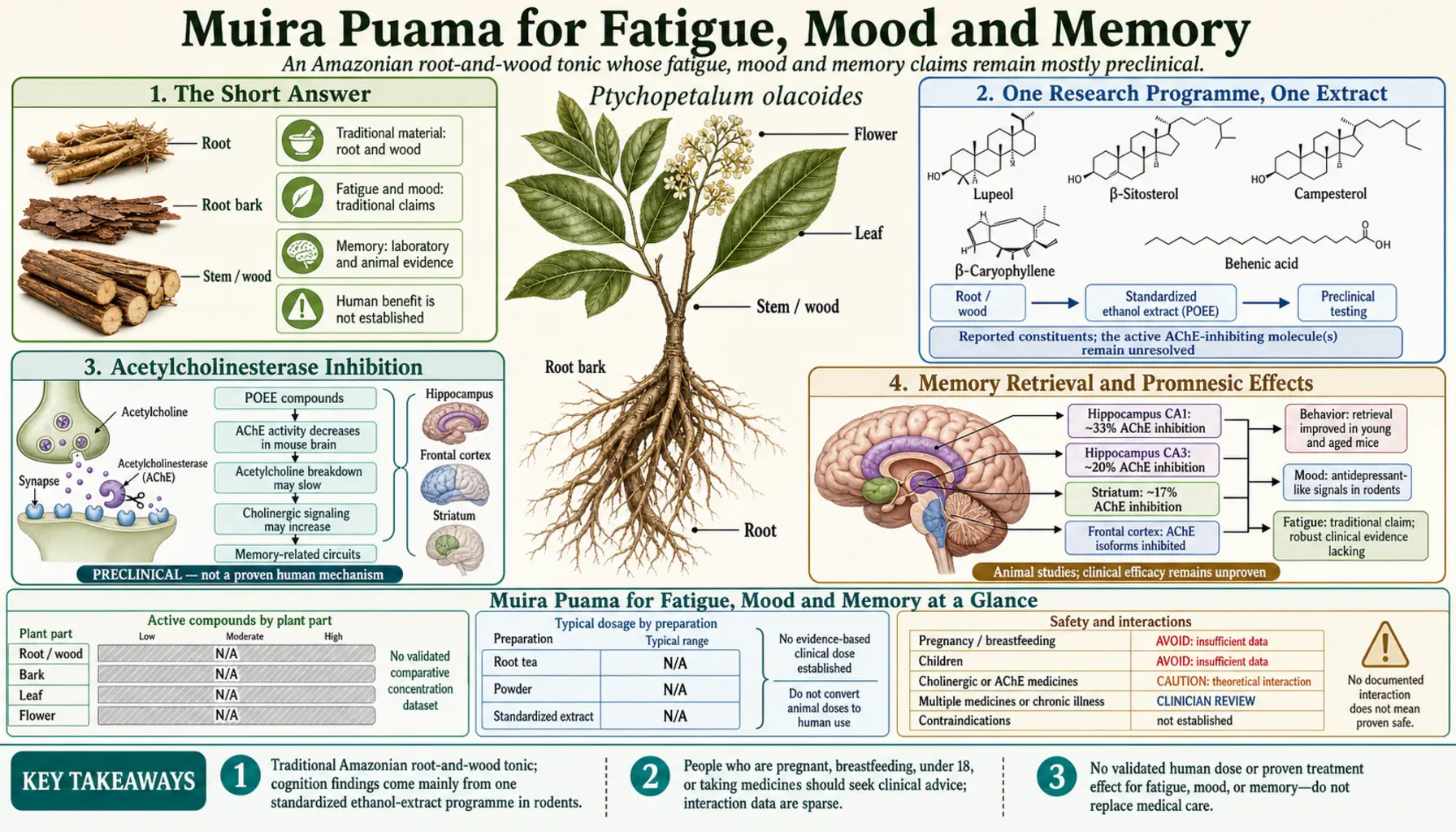
Here is the genuinely surprising thing about muira puama: its best science has nothing to do with the claim it is sold on. The herb is marketed as "potency wood," and the libido evidence is close to non-existent. But there is a real, coherent, multi-year body of laboratory pharmacology on Ptychopetalum olacoides and the brain — on acetylcholinesterase inhibition, memory retrieval, stress responses, depression-like behaviour and protection of brain tissue from injury. Almost all of it comes from one Brazilian research programme, it is careful work on named material, and it maps rather neatly onto the traditional Amazonian description of the plant as a nerve tonic rather than merely an aphrodisiac.
And every single piece of it is preclinical: rodents and isolated brain tissue. Not one human trial of muira puama for fatigue, mood, memory or stress has been published that we can locate. So this page has an unusual job. It has to take the preclinical work seriously enough to describe it properly — because dismissing it with a generic "animal study" caveat would waste real information — while being completely clear that preclinical is the tier, and the tier does not support a claim about people.
Table of Contents
- The Short Answer
- One Research Programme, One Extract
- Acetylcholinesterase Inhibition
- Memory Retrieval and Promnesic Effects
- Neuroprotection in Brain Slices
- Antidepressant-Like and Anti-Stress Effects
- The Alzheimer-Model Study
- Read the Designs Before the Results
- The Contradiction Nobody Mentions
- What "Adaptogen" and "Nerve Tonic" Actually Assert
- Which Compound, and Does It Reach the Brain?
- The Dose Arithmetic, With Assumptions Printed
- What a Human Trial Would Require
- Comparators That Have Been Tested in People
- Evidence Ledger
- Key Research Papers
- External Resources
- Connections
The Short Answer
- There is real preclinical pharmacology here, and it is the strongest thing about this plant. An ethanol extract of P. olacoides inhibits acetylcholinesterase in cognition-relevant brain regions, improves memory retrieval in young and aged mice, protects hippocampal slices from oxygen-and-glucose deprivation, shows antidepressant-like and anti-stress profiles in standard rodent tests, and eased impairment in a mouse model of Alzheimer-type damage.
- There are no human trials. Not for fatigue, not for mood, not for memory, not for stress. The claim is absent rather than refuted.
- The mechanism is unusually plausible for a herbal claim, because acetylcholinesterase inhibition is the actual mechanism of licensed Alzheimer's drugs. Plausibility raises the value of running the trial. It is not a substitute for having run it.
- The active principle is not established. Nobody knows which constituent produces these effects, and several of the named constituents are pan-plant compounds that could not be specific to this species.
- There is an unresolved internal contradiction between the herb being characterised as anxiogenic in one study and anti-stress in others, and between it being sold simultaneously as a stimulant and as a calming nerve tonic.
One Research Programme, One Extract
Something worth stating plainly before any individual result: the modern muira puama neuropharmacology is not a broad international literature. It is substantially the output of one group of Brazilian investigators working over roughly fifteen years, publishing in journals such as Journal of Ethnopharmacology, Phytotherapy Research, Phytomedicine, Life Sciences and Pharmacology, Biochemistry and Behavior, with a recurring set of author names across the papers.
In its favour: a single programme with consistent material and methods produces a coherent, internally comparable body of work rather than a scatter of one-off experiments. The material is identified to species, characterised as an ethanol extract, and reported in the tradition that deposits voucher specimens — a model of specificity next to the anonymous "muira puama extract" of the supplement literature.
Against it: independent replication is the single most important missing ingredient in preclinical pharmacology, and it is largely absent here. Results from one laboratory using one extract in one set of assays are a promising start, not a settled finding; effect sizes routinely shrink or vanish when a second group tries. Hold these findings as "one group found, repeatedly" rather than "science has established."
Note also that an ethanol extract is what was studied, while the folk use includes prolonged boiling in water — and hot water does not extract the same fraction. Species, plant part and plant name can all match while the solvent quietly makes it a different intervention. The preparations page works through what that means for what you can buy.
Acetylcholinesterase Inhibition
This is the mechanistic anchor of the whole programme. Acetylcholinesterase is the enzyme that breaks down acetylcholine, a neurotransmitter central to attention and memory. Inhibit the enzyme and acetylcholine persists longer in the synapse. This is not a speculative herbal mechanism — it is precisely the mechanism of donepezil, rivastigmine and galantamine, the licensed drugs for Alzheimer's disease.
Work published in Pharmacology, Biochemistry and Behavior in 2003 reported that P. olacoides extract possesses anticholinesterase activity, framed explicitly around the plant's traditional reputation as an Amazonian "nerve tonic." A later study in Phytomedicine around 2010 went further and localised the inhibition to cognition-relevant brain areas in treated mice — which is a meaningfully stronger result than an enzyme assay in a test tube, because it demonstrates that something in an orally or systemically administered extract reached brain tissue and acted there.
Three qualifications belong immediately alongside that, not in a footnote:
- Many, many plant extracts inhibit acetylcholinesterase in vitro. It is one of the easiest positive results to obtain in natural-products screening. Demonstrating the effect in brain tissue after administration is a genuinely higher bar, and that is the finding worth taking seriously here — but the enzyme-assay version of the claim, which is what marketing usually quotes, is close to worthless on its own.
- Potency is the unanswered question. Inhibition is not binary. Whether a crude extract achieves clinically meaningful enzyme inhibition at an achievable human dose is exactly the question a human pharmacodynamic study would answer, and none exists.
- Cholinesterase inhibition is also how a class of pesticides and nerve agents works. This is not scaremongering — the doses and potencies are not remotely comparable — but it is a reminder that "inhibits acetylcholinesterase" is a pharmacological action with a dose-response and a toxic ceiling, not a synonym for "good for the brain." The safety page notes the theoretical interaction implications.
Memory Retrieval and Promnesic Effects
Two behavioural papers follow the enzyme work. One, in the Journal of Ethnopharmacology in 2004, reported memory retrieval improvement in young and aging mice. A second, in 2007, reported promnesic (memory-enhancing) effects across aversive and non-aversive learning paradigms.
The design detail that makes these better than average is worth pointing out, because it is the kind of thing marketing flattens away. Testing across both aversive and non-aversive paradigms matters: an aversive task such as step-down inhibitory avoidance can be influenced by an animal's anxiety or pain sensitivity rather than by memory as such, so a compound that merely makes a mouse more fearful can look like a memory enhancer. Showing an effect in a non-aversive task too is a partial control against that confound. Similarly, targeting retrieval rather than acquisition or consolidation is a specific hypothesis rather than a fishing expedition.
What these studies do not establish:
- That rodent task performance predicts human cognition. The translational failure rate from rodent memory models to human cognitive benefit is notoriously high, including for compounds with far more development behind them than this one.
- That "aging mice" model human cognitive ageing. Normal murine ageing is not Alzheimer's disease, and neither is it human age-associated memory complaint.
- That anything happens at a dose a person would take. See the arithmetic section below.
Neuroprotection in Brain Slices
A 2004 study in Life Sciences reported that P. olacoides extract protected rat hippocampal slices from oxygen and glucose deprivation — the standard in-vitro analogue of the metabolic insult in stroke.
The result is real and mechanistically interesting: something in the extract reduces tissue damage in an ischaemia-like model. The gap between that experiment and "muira puama protects the brain" is nonetheless very wide:
- The extract is applied directly to the tissue at a concentration the experimenter chooses. No gut, no liver, no blood-brain barrier, no distribution. Nothing about the effective bath concentration tells you what an oral capsule delivers to a living hippocampus.
- Cytoprotection in this assay is extremely common among plant extracts rich in reducing compounds. It is not a distinguishing finding.
- Protecting a slice from an acute insult is not treating a chronic disease. A very large number of compounds that protect tissue in vitro went on to fail in stroke trials — one of the largest translational graveyards in neurology.
Antidepressant-Like and Anti-Stress Effects
Two further papers extend the programme into mood. One, in Phytotherapy Research around 2009, described an antidepressant profile in mice. Another, in Phytomedicine around 2010, reported anti-stress effects of the "tonic" P. olacoides — the authors' own scare quotes around "tonic" are a nice signal that they knew they were testing a traditional claim rather than assuming it.
The critical translation, and it is one the supplement industry never makes: "antidepressant-like" is a technical term describing behaviour in a specific assay, not a claim about depression. The standard rodent tests — forced swim, tail suspension — measure how long an animal remains immobile in an inescapable situation. Reduced immobility is the read-out that every licensed antidepressant produces, which is why the tests are used. But so do stimulants, so do compounds that simply increase locomotor activity, and so do a number of things nobody would call antidepressants. A test that a stimulant passes cannot distinguish a stimulant from an antidepressant unless locomotor activity is separately controlled.
That is not a hypothetical worry for this plant. The same extract has independently been characterised as centrally stimulating. A stimulant that reduces immobility in a forced-swim test is the textbook false positive for this assay, and it is a live alternative explanation that the reader should hold alongside the authors' interpretation.
The anti-stress work is somewhat more interesting because stress models typically look at corticosterone responses and behaviour after a stressor rather than at a single immobility measure, which is harder to fake with pure locomotor stimulation. It remains rodent work.
The Alzheimer-Model Study
The furthest-reaching claim in the programme comes from a Phytomedicine paper around 2011 reporting that the Amazonian herbal marapuama attenuated cognitive impairment and neuroglial degeneration in a mouse Alzheimer model. This is the study most often waved at when muira puama is described online as having potential in dementia, and it needs the most careful reading of anything on this page.
- A mouse Alzheimer model is not Alzheimer's disease. The commonly used models reproduce selected features — amyloid deposition, a chemically induced lesion, cholinergic damage — in an animal that does not spontaneously develop the human disease. The history of Alzheimer's drug development is substantially a history of compounds that worked beautifully in these models and did nothing in patients. This is the single most important sentence in this section.
- Check whether the extract was given before or after the insult. Pre-treatment is prophylaxis, not treatment. An extract dosed before a model insult tests prevention of damage that has not happened yet — which is not the question a reader with memory problems, or a family member of someone with dementia, is actually asking. This distinction reverses the practical meaning of a result and is almost never carried through into secondary reporting.
- A comparator arm proves the assay works; it does not rank the drugs. If a herbal extract matches or beats a reference cholinesterase inhibitor in a mouse, the honest reading is that the model responded — partly a measure of how the reference drug performs in mice, which is not how it performs in patients.
- "Neuroglial degeneration" is a histological endpoint. Changes in glial markers are informative mechanistically and are not clinical outcomes. No mouse reported that its memory improved.
Read carefully, this is a competent preclinical study supporting further investigation. Read as most of the internet reads it, it becomes "muira puama helps Alzheimer's," which the study cannot support and does not claim.
Read the Designs Before the Results
Three design questions decide what a preclinical result means, and applying them deliberately beats a blanket "animal study" caveat that treats good and bad work identically.
- Was the comparator arm validating the assay, or ranking the treatments? Almost always the former. Reading "as good as the reference drug in a mouse" as clinical equivalence inverts the purpose of the arm.
- Was the extract given before or after the insult? Prophylaxis and treatment are different claims, and "protects against damage" is read by consumers as "repairs damage."
- Does the model model the disease? Aged mice are not people with age-associated memory complaint; a lesioned mouse is not a person with Alzheimer's; immobility in a swim tank is not sadness. Each model was chosen because it responds to known drugs — useful for screening, weak for prediction.
Applied to this literature: the work is better than average for a traditional herb, the thread from enzyme to brain region to behaviour is unusually coherent, and none of it has been asked to survive contact with a human being.
The Contradiction Nobody Mentions
There is a tension inside this literature and inside the marketing, and reporting it is more useful than picking the flattering half.
Inside the literature: a 2002 paper in Phytotherapy Research described anxiogenic properties of P. olacoides in mice — that is, anxiety-increasing. Later papers from the same programme reported anti-stress and antidepressant-like profiles. Those are not flatly incompatible, and several reconciliations are available, but they are in obvious tension and the marketing quotes only the second set.
Candidate reconciliations, none of them established:
- Dose. Many centrally active compounds are anxiogenic at higher doses and anxiolytic or neutral at lower ones. A biphasic dose-response would reconcile the findings and would also mean that "more is better" is exactly wrong for this herb.
- Acute versus repeated dosing. A single dose and a two-week course frequently produce opposite behavioural profiles; this is true of licensed antidepressants themselves.
- Assay artefact. A stimulant increases activity in an open field or elevated maze in ways that can score as either anxiety or exploration depending on the measure chosen.
- They are simply different effects. Buffering a stress response and raising baseline arousal are not the same axis, and a compound could do both.
Inside the marketing, the incoherence is sharper and does not need resolving because it is a straightforward contradiction. Muira puama is sold in the same market, sometimes on the same label, as:
- a stimulant for energy, drive and libido; and
- a calming nerve tonic for nervous exhaustion, anxiety and burnout.
Those are opposite pharmacological requests. A product cannot be both a reliable stimulant and a reliable calmative, and when a herb is sold as both, the honest inference is that neither effect is strong or consistent enough to have ruled the other out. Sellers reach for the word "adaptogen" precisely to dissolve this contradiction — which is worth looking at directly.
What "Adaptogen" and "Nerve Tonic" Actually Assert
Both terms do a lot of work on muira puama labels and neither is a regulated or well-defined claim.
"Adaptogen" comes from mid-twentieth-century Soviet pharmacology and originally required three things: non-toxic at normal doses, a non-specific increase in resistance to stressors, and a normalising effect regardless of the direction of the pathological change. That third criterion is the problem — a substance that raises what is low and lowers what is high cannot fail a test, because any outcome confirms it. When a claim cannot fail it is not evidence, and here the anti-stress rodent work is doing the real argumentative work while the word supplies unearned breadth. Scored honestly against the three: non-toxic is plausible but formally unestablished, since the toxicology is largely missing (see the safety page); resistance to stressors has genuine rodent support; normalising in either direction has never been tested in humans and probably cannot be.
"Nerve tonic" is the older and more honest phrase, because it is transparently traditional rather than pseudo-technical: a restorative for a depleted, forgetful, worn-out person. What is genuinely notable is that the modern pharmacology went looking where the tradition pointed — the brain — and found something there. That does not validate the tradition, but it is a better track record than most traditional descriptors manage and it deserves acknowledging rather than sneering at.
Which Compound, and Does It Reach the Brain?
An honest mechanistic account has to admit its central gap: nobody knows which constituent is responsible. The full constituent list is on the dose and safety page; what matters here is that only one group is even a candidate for a central effect. The pan-plant sterols — beta-sitosterol, campesterol — occur across an enormous swathe of the plant kingdom, so a beta-sitosterol effect is not a muira puama effect. The long-chain fatty acids and volatile oil have no proposed central mechanism. Only the diterpene ptychonal and its relatives, whose interest lies in nerve-growth-factor-associated activity, sit plausibly alongside the memory and neuroprotection findings — and that is the least-studied part of the chemistry, with its distribution across the congeneric species flagged as unanswered on the identity page.
Then the question nobody has answered for this plant at all: pharmacokinetics. For any of this to matter in a person, a constituent must survive digestion, escape first-pass metabolism, reach the circulation and cross the blood-brain barrier at a concentration high enough to inhibit an enzyme. Not one of those steps has been measured in humans — no absorption study, no plasma concentrations, no half-life, no brain-penetration data. The mouse work implies that something reached rodent brain tissue, which is genuinely encouraging and is not a substitute for human pharmacokinetics.
The Dose Arithmetic, With Assumptions Printed
It is easy to say "animal doses do not translate." It is more useful to show the arithmetic, and it persuades where hedging does not. The assumptions below are stated as assumptions so you can substitute your own; none is a measured value taken from a specific muira puama paper, and we are not going to attribute a dose figure to a study we cannot verify.
Step one: species scaling. Doses do not convert between species on a milligram-per-kilogram basis; the standard approach scales by body surface area. The conventional divisors are roughly 12 for mouse to human and 6 for rat to human. So a mouse dose of 100 mg/kg corresponds to roughly 8 mg/kg in a person — about 570 mg for a 70 kg adult. A mouse dose of 300 mg/kg, well within the range crude plant extracts are commonly tested at, scales to about 24 mg/kg, or roughly 1.7 g for the same adult.
Step two, and this is the step everyone skips: extract is not herb. Those figures are grams of extract, not grams of bark. Hydroalcoholic extraction of woody material typically recovers a small fraction of the starting weight — assume 5–10%, which is a general range for woody drugs and not a measured value for this plant. On that assumption, 1.7 g of extract corresponds to somewhere between 17 and 34 grams of dried bark.
Step three: compare with what is sold. Typical capsules contain a few hundred milligrams to about a gram of powdered bark, or a concentrated extract at an undisclosed ratio. Under the assumptions above, a 500 mg capsule of crude powder contains on the order of 25–50 mg of the material that was actually studied — roughly one to two per cent of the scaled equivalent of a mid-range rodent dose.
What this does and does not show. It does not prove the herb cannot work; surface-area scaling is a crude convention, extract yields vary widely, and a potent constituent could be concentrated in a way this arithmetic ignores. What it shows is that the gap between the studied dose and the sold dose is one to two orders of magnitude, and nobody has closed it. Any page citing the rodent neuropharmacology to justify a capsule is implicitly asserting that the gap does not matter, without having done this calculation or any better one. Notice also that the assumptions above were chosen generously toward the herb — the low end of the scaling range and the high end of the extraction yield — and it still does not close.
What a Human Trial Would Require
Every measurement needed to test these claims in people already exists and is used routinely. Naming them is the strongest honest move available, because it shows that the missing trial is a funding decision rather than a methodological impossibility.
- A phase-one pharmacokinetic study first. Establish that constituents are absorbed and detectable in plasma, with a half-life. Without it, an efficacy trial is a shot in the dark about dose and schedule.
- A pharmacodynamic marker. Erythrocyte or plasma cholinesterase activity is directly measurable in humans and is the natural biomarker given the proposed mechanism. If a human dose does not measurably inhibit cholinesterase, the mechanistic story is over before any efficacy trial is needed.
- Validated endpoints, specified in advance. For cognition: the CANTAB battery, the Rey Auditory Verbal Learning Test, digit span, trail-making. For fatigue: the Multidimensional Fatigue Inventory or FACIT-Fatigue. For mood and stress: the Hamilton or Montgomery–Åsberg depression scales, the Perceived Stress Scale with salivary cortisol. All standard, all validated, none ever applied to this plant.
- Randomisation, blinding, a placebo arm and a defined single-herb extract. Fatigue and mood are self-reported and highly placebo-responsive, so an open-label study of a tonic will produce a positive result regardless of contents; and testing a blend answers a different question, as the libido page shows at length.
- Public pre-registration on ClinicalTrials.gov, so a null result cannot be quietly reframed as a secondary success.
Comparators That Have Been Tested in People
The "you cannot run trials on traditional plants" defence fails on the evidence, because several plants in exactly this space have been through human testing:
- Ginkgo biloba — one of the largest botanical clinical literatures in existence for cognition and dementia, including long-term randomised prevention trials. The results are mixed to disappointing, which is the point: ginkgo has a verdict, muira puama has a vacancy. See ginkgo and cognition.
- Ashwagandha — multiple randomised placebo-controlled trials on stress, cortisol and sleep; small and often industry-linked, but real single-herb human data: ashwagandha.
- Rhodiola rosea — randomised trials on fatigue and burnout using validated instruments: rhodiola.
- Panax ginseng — human trials on fatigue and cognitive performance: ginseng, energy and fatigue. Schisandra is another traditional adaptogen with human work: schisandra and stress.
Muira puama's neuropharmacology is arguably more mechanistically coherent than several of these. It is simply thirty years behind them in ever having been given to a person under controlled conditions.
Evidence Ledger
- Acetylcholinesterase inhibition in brain tissue after administration: ESTABLISHED PRECLINICALLY, one programme, unreplicated externally. The strongest single finding about this plant.
- Memory retrieval improvement in mice: PRECLINICAL, reasonably well designed, including a non-aversive paradigm as a partial control.
- Neuroprotection in brain slices: PRECLINICAL, in vitro, non-specific. Common to many plant extracts.
- Antidepressant-like behaviour in rodents: PRECLINICAL, confounded by the same extract's stimulant profile.
- Anti-stress effects in rodents: PRECLINICAL, somewhat more robust than the immobility-based mood work.
- Benefit in an Alzheimer mouse model: PRECLINICAL, in a model class with a poor translational record. Check pre- versus post-insult dosing before drawing any practical conclusion.
- Any human cognitive benefit: ABSENT. No trial. Not tested and failed — not tested.
- Any human antidepressant or anti-anxiety benefit: ABSENT.
- Any human anti-fatigue benefit: ABSENT.
- Human pharmacokinetics: ABSENT. No absorption, plasma-level, half-life or brain-penetration data.
- Identity of the active constituent: UNKNOWN. Ptychonal is the candidate; the sterols cannot be specific to this plant.
- Anxiogenic versus anti-stress: UNRESOLVED CONTRADICTION, with dose and dosing schedule as the most likely reconciliations.
Key Research Papers
Each entry links a PubMed topic search rather than a fixed record, so you see the current literature rather than one paper selected for you. The provenance label on each — rodent, slice, formula, human — is attached at the citation deliberately, so that a line lifted from this page carries its tier with it.
- Siqueira IR and colleagues. "Ptychopetalum olacoides, a traditional Amazonian 'nerve tonic', possesses anticholinesterase activity." Pharmacology, Biochemistry and Behavior, 2003. Find on PubMed — rodent and enzyme. The mechanistic anchor of the whole programme.
- Figueiró M and colleagues. "Acetylcholinesterase inhibition in cognition-relevant brain areas of mice treated with a nootropic Amazonian herbal (Marapuama)." Phytomedicine, 2010. Find on PubMed — rodent, in vivo. Stronger than an enzyme assay because it demonstrates action in brain tissue after administration.
- da Silva AL and colleagues. "Memory retrieval improvement by Ptychopetalum olacoides in young and aging mice." Journal of Ethnopharmacology, 2004. Find on PubMed — rodent behaviour. Note that ageing mice are not a model of human age-associated memory complaint.
- da Silva AL and colleagues. "Promnesic effects of Ptychopetalum olacoides in aversive and non-aversive learning paradigms." Journal of Ethnopharmacology, 2007. Find on PubMed — rodent behaviour. The inclusion of a non-aversive task is a genuine design strength worth crediting.
- Siqueira IR and colleagues. "Neuroprotective effects of Ptychopetalum olacoides Bentham (Olacaceae) on oxygen and glucose deprivation induced damage in rat hippocampal slices." Life Sciences, 2004. Find on PubMed — isolated tissue. Direct application to slices; no absorption, distribution or blood-brain barrier involved.
- Piato AL and colleagues. "Antidepressant profile of Ptychopetalum olacoides Bentham (Marapuama) in mice." Phytotherapy Research, 2009. Find on PubMed — rodent behaviour. "Antidepressant-like" describes an assay result; stimulants produce the same read-out.
- Piato AL and colleagues. "Anti-stress effects of the 'tonic' Ptychopetalum olacoides (Marapuama) in mice." Phytomedicine, 2010. Find on PubMed — rodent. The most direct test of the traditional adaptogen framing that exists.
- Figueiró M and colleagues. "The Amazonian herbal Marapuama attenuates cognitive impairment and neuroglial degeneration in a mouse Alzheimer model." Phytomedicine, 2011. Find on PubMed — rodent disease model. Read the dosing schedule: pre-treatment would make this a prevention result, not a treatment result.
- da Silva AL and colleagues. "Anxiogenic properties of Ptychopetalum olacoides Benth. (Marapuama)." Phytotherapy Research, 2002. Find on PubMed — rodent behaviour. The finding the marketing omits, and half of this page's central contradiction.
- Siqueira IR and colleagues. "Psychopharmacological properties of Ptychopetalum olacoides Bentham (Olacaceae)." Pharmaceutical Biology, 1998. Find on PubMed — rodent behaviour. The founding characterisation, describing a stimulant, tonic-like central profile.
- Nerve-growth-factor-potentiating diterpenoids from Ptychopetalum. PubMed topic search — chemistry. The ptychonal series is the only structurally distinctive candidate for a specific central mechanism. Metadata deliberately not asserted here; the primary reports are hard to verify from secondary sources.
- Forced-swim and tail-suspension tests: what they measure. PubMed topic search — methods. The basis for treating "antidepressant-like" as an assay description rather than a clinical claim.
- Translational failure of Alzheimer mouse models. PubMed topic search — methods. Essential background for reading any "improved in an Alzheimer model" headline.
- Interspecies dose conversion by body surface area. PubMed topic search — methods. The source of the divisors used in the arithmetic section.
External Resources
- PubMed — the index behind every search above.
- ClinicalTrials.gov — search muira puama and note the absence of registered cognitive or fatigue trials.
- National Center for Complementary and Integrative Health — plain-language reviews of botanicals for memory, mood and fatigue.
- Alzheimer's Association — evidence-based guidance on cognitive health and on supplements marketed for memory.
- Memorial Sloan Kettering: About Herbs — referenced clinical monographs on botanicals.
Connections
- All Herbs
- Muira Puama — main article
- Muira Puama Benefits — hub
- Which Plant Is Muira Puama?
- Muira Puama for Libido: Examining the Claims
- Muira Puama: Dose, Formulations and Safety
- Ginkgo: Cognitive Function and Memory
- Ginseng: Energy and Fatigue
- Ashwagandha
- Rhodiola Rosea
- Schisandra: Adaptogenic and Stress Effects
- Adaptogens for Stress Management
- Damiana: Mood, Anxiety and Traditional Use
- Chronic Fatigue Syndrome
- Alzheimer's Disease
- Depression
- Maca: Energy and Endurance