Milk Thistle: History and Traditional Use
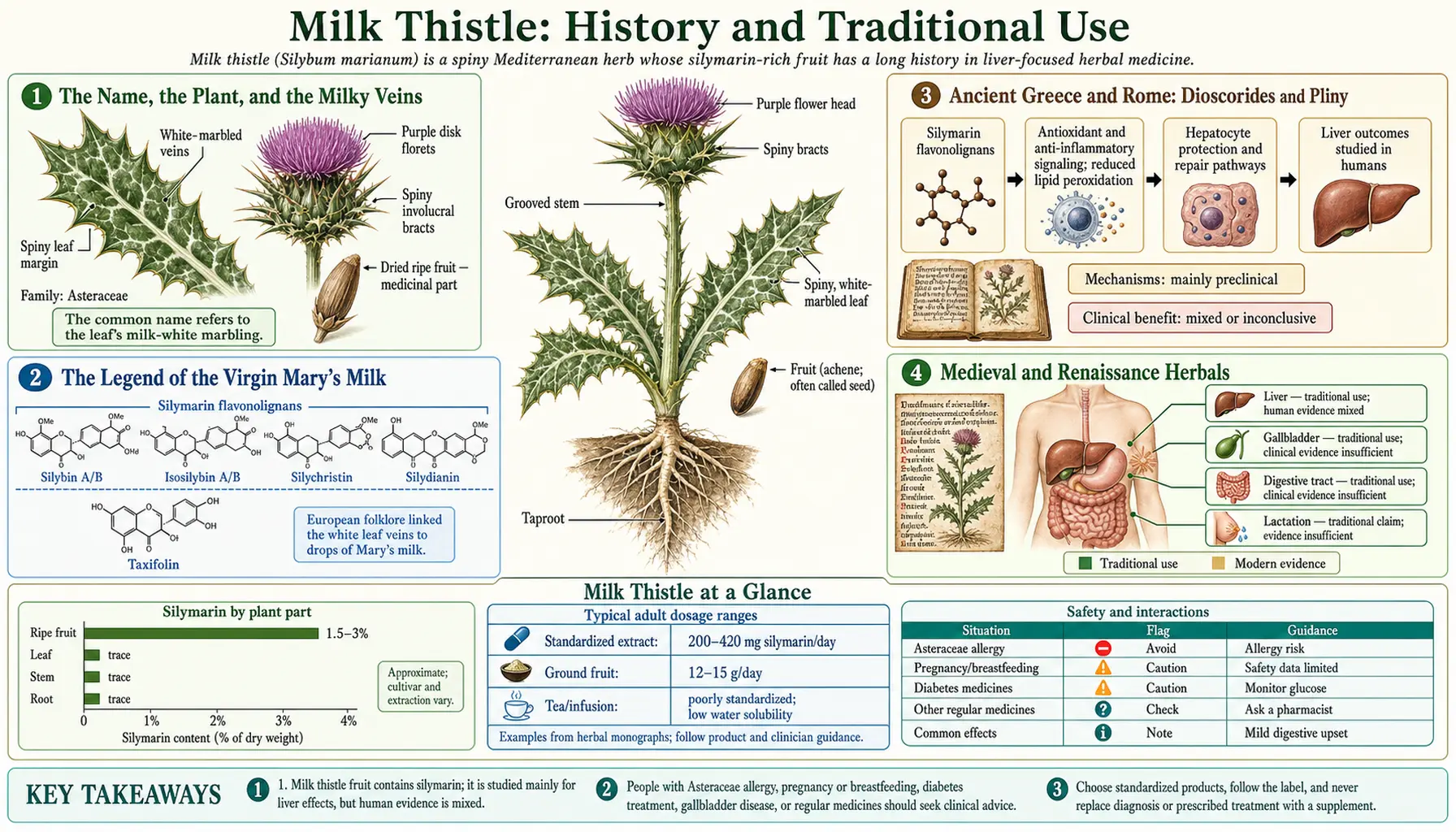
For more than two thousand years, the spiny purple-flowered plant we call milk thistle has been linked, again and again, to one organ above all others: the liver. Greek and Roman physicians wrote it down. Medieval and Renaissance herbalists copied it forward. A Christian legend gave it the name it still carries. And in the late twentieth century, German chemists finally put a molecule — silymarin — behind the old reputation. This page tells that documented story, marks tradition clearly as tradition, and is careful to separate what the historical record actually says from the folklore that grew up around it.
Table of Contents
- The Name, the Plant, and the Milky Veins
- The Legend of the Virgin Mary's Milk
- Ancient Greece and Rome: Dioscorides and Pliny
- Medieval and Renaissance Herbals
- Traditional Folk Uses Beyond the Liver
- 1968: Silymarin Is Isolated
- The Death Cap Mushroom and Modern Rescue Medicine
- From Tradition to Modern Research
- Research Papers and References
- Connections
- Featured Videos
The Name, the Plant, and the Milky Veins
Milk thistle is the common English name for Silybum marianum, a tall, spiny annual or biennial of the daisy family (Asteraceae, the same large family as ragweed, daisies, and artichokes). It is native to the Mediterranean basin and much of Europe, ranging eastward toward Central Asia, and has since naturalized widely across North and South America and Australia, where it often grows as a roadside and pasture weed. The plant is unmistakable: large, glossy, deeply lobed leaves edged with sharp spines, and, in its flowering year, a single thistle-like head of reddish-purple florets.
The genus name Silybum traces back to the Greek word silybon (also written sillybon), a term the first-century physician Dioscorides applied to certain edible thistles; Pliny the Elder used a related Latin form. The species name marianum — "of Mary" — comes from the Christian legend described in the next section. The plant's most memorable feature, and the source of its English name, is plainly visible on the leaves: a network of milky-white veins and marbling that stand out against the deep green. It is this white streaking, not any milky sap or medicinal "milk," that gives milk thistle its name and that the old legend set out to explain.
The Legend of the Virgin Mary's Milk
Milk thistle's alternate names — St. Mary's thistle, Our Lady's thistle, and blessed milk thistle — all descend from a single piece of Christian folklore. As the story is traditionally told, while the Virgin Mary was nursing the infant Jesus (in most versions during the flight into Egypt), a few drops of her milk fell onto the leaves of a nearby thistle and left the white veins that mark the plant to this day. This is a legend, not a historical event, and it is offered here purely as the documented origin of the plant's names; the white marbling is, of course, a natural feature of the leaf. The botanical epithet marianum and the whole cluster of "Mary" names preserve this story in the plant's formal and folk vocabulary alike.
Such legends are common for medicinal plants, and they often served as memory aids: a vivid tale attached to a striking visual feature helped ordinary people recognize and remember a useful herb long before printed field guides existed. In milk thistle's case the legend also reinforced its gentle, "blessed" reputation — a herb associated with nourishment and motherhood rather than danger — which fits its long folk use as a food and as a remedy thought safe enough for repeated, everyday use.
Ancient Greece and Rome: Dioscorides and Pliny
Milk thistle's documented medicinal record begins in the classical Mediterranean. The Greek physician Dioscorides, who lived in the first century CE (roughly 40–90 CE) and whose De Materia Medica became the foundational pharmacy text of the Western world for the next 1,500 years, is the oldest reliably reported source: he recommended the herb as a treatment for the bites of venomous snakes. His near-contemporary, the Roman naturalist Pliny the Elder (23–79 CE), recorded in his encyclopaedic Natural History that the juice of the plant mixed with honey was good for "carrying off bile" — an early association of the plant with the liver and gallbladder, the organs that produce and store bile. These two works are named here as historical primary sources rather than as modern citations, and the descriptions above follow how they are summarized by the U.S. National Cancer Institute's monograph on milk thistle.
It is worth being precise about what this earliest record does and does not show. The classical authors connected milk thistle to bile and to poisoning (snakebite), not to the modern, narrowly defined diseases of the liver that later writers would attach to it. The thread that runs forward in history is the broad idea of milk thistle as a plant that helps the body deal with bile and with toxins — an idea that, remarkably, anticipates the two areas where the herb is best known today: liver support and the treatment of certain poisonings. Some modern sources also credit the even earlier Greek botanist Theophrastus (fourth century BCE) with describing a thistle that may be this plant, but that identification is less securely documented, so it is mentioned here only as a possibility rather than as established fact.
Medieval and Renaissance Herbals
Through the Middle Ages and into the Renaissance, milk thistle passed from the classical authorities into European monastic gardens and the great printed herbals, and its reputation narrowed and sharpened toward the liver. In the medieval period it was commonly revered as an antidote for liver toxins and a remedy for "obstructions" of the liver and spleen — the period's language for sluggishness, swelling, and congestion of those organs. Physicians of the medieval Islamic world are also traditionally said to have used Silybum marianum for jaundice and biliary complaints, consistent with the same liver-and-bile theme.
The clearest surviving voices belong to the English herbalists of the sixteenth and seventeenth centuries. Nicholas Culpeper, in his enormously influential The English Physician (commonly known as Culpeper's Herbal, 1652), singled out milk thistle as effective for relieving obstructions of the liver and for related complaints of the spleen, and recommended it for jaundice; in keeping with the herbal medicine of his day he also valued it as a remedy for melancholy and for "bad" states of the blood, which were then understood to originate in the liver and spleen. Earlier writers in the European herbal tradition, including the great Renaissance herbalists, likewise listed the thistle for "dropsy" (fluid swelling) of the liver and for the spleen. These herbals are named here as historical texts; the indications they record — liver, bile, jaundice, spleen — map closely onto the conditions for which milk thistle is still studied.
Two practical points kept milk thistle in constant use through these centuries. First, it grew abundantly and cost nothing to gather, so it was available to rich and poor alike. Second, it was regarded as gentle — safe enough to take repeatedly — which suited it to the slow, chronic complaints of the liver and digestion for which the medicine of the day had little else to offer. That combination of abundance, gentleness, and a steady reputation for the liver carried the plant intact from the classical world to the threshold of modern science.
Traditional Folk Uses Beyond the Liver
Although the liver was always milk thistle's headline use, European folk medicine put nearly every part of the plant to work, and the historical record describes a much broader range of traditional applications. The herb was used for jaundice, gallstones and other gallbladder complaints, and general digestive upset; it was taken as a bitter tonic and, in some traditions, for kidney and spleen problems, rheumatic aches, and disorders of the heart. As with all historical folk practice, these uses describe what past cultures did, not modern medical recommendations.
Milk thistle was also a genuine food plant, which is part of why it was regarded as so safe. The spines were trimmed from the young leaves and the leaves eaten like spinach or in salads; the peeled stalks were boiled or eaten raw; the root was cooked as a vegetable; and the flower receptacle was prepared much like a globe artichoke, to which the plant is botanically related. The roasted seeds were even used at times as a coffee substitute. A particularly persistent folk use — reflected in the plant's very name — was as a galactagogue, an herb traditionally given to nursing mothers in the belief that it encouraged the flow of breast milk. This page records that folk use as tradition; it is not a clinical claim.
The breadth of these uses tells us something historically important: milk thistle was not a rare or specialist drug but a familiar, multipurpose plant woven into everyday rural life as food, tonic, and household remedy. That ordinary familiarity, more than any single dramatic cure, is what kept it in the materia medica for two thousand years and ready for the moment when chemists would finally ask what was inside it.
1968: Silymarin Is Isolated
The decisive scientific milestone in milk thistle's history came in 1968, when researchers at the University of Munich in West Germany isolated the plant's principal active complex from its seeds and named it silymarin. The work is attributed to Hildebert Wagner and colleagues, including L. Hörhammer and R. Münster, who characterized the chemistry of this new group of compounds from the fruit (seed) of Silybum marianum. This is a genuine, documented scientific milestone with named investigators, and it is reported as such by the U.S. National Cancer Institute's milk thistle monograph among other sources.
Silymarin turned out not to be a single substance but a mixture of closely related flavonolignans — chiefly silybin (also spelled silibinin, the most abundant and most active member), along with silychristin, silydianin, and isosilybin, together with the related flavonoid taxifolin. This was the moment milk thistle's ancient reputation acquired, in the words of modern reviewers, a "chemical address": for the first time the plant's effects could be tied to identifiable molecules that could be measured, standardized, and studied. Within a few years, a standardized silymarin extract was being manufactured and sold in Europe as a liver remedy, and silymarin became one of the most intensively researched plant extracts in all of medicine.
It is important to keep the historical perspective honest here. The 1968 isolation explained and validated a long folk reputation; it did not invent milk thistle's use, which is older than any laboratory by two millennia. Equally, the modern science is still unfolding — many silymarin studies are small, and reviewers continue to debate how much benefit it delivers and for which conditions. What 1968 changed was the kind of question that could be asked: from "what did the ancients say?" to "what does this molecule actually do?"
The Death Cap Mushroom and Modern Rescue Medicine
One strand of milk thistle's modern history reaches back, with eerie precision, to Dioscorides' use of the herb against poisoning. The death cap mushroom (Amanita phalloides) is responsible for the great majority of fatal mushroom poisonings worldwide; its amatoxins are taken up by liver cells and can destroy the liver within days. Beginning in Europe in the late twentieth century, physicians turned to an intravenous preparation of silibinin — the chief flavonolignan of milk thistle, in a water-soluble form marketed as Legalon SIL — as an antidote, because it helps block the toxin from being taken up and recirculated by liver cells.
Early clinical reports of silibinin in death cap poisoning appear in the European medical literature from the 1990s, and a body of observational experience built up over the following decades; reviewers describe intravenous silibinin as having become a treatment of choice in Europe for acute amatoxin poisoning. Here a careful, honest note is essential: the evidence for silibinin in Amanita poisoning comes largely from uncontrolled, observational studies compared against historical outcomes rather than from large randomized trials, so its precise life-saving benefit is genuinely debated even among experts. What is not in doubt is the historical irony — that the same plant the ancient world reached for against poison is, two thousand years later, given by drip in the emergency room for one of nature's deadliest poisons.
This use also draws the sharpest possible line for readers. Intravenous silibinin for mushroom poisoning is a hospital emergency treatment administered by physicians; it has nothing to do with taking milk thistle capsules or tea at home, and ordinary milk thistle supplements are not a treatment for poisoning of any kind. Anyone who suspects mushroom poisoning needs emergency medical care immediately.
From Tradition to Modern Research
The striking feature of milk thistle's history is how straight the line runs from the ancient record to the modern laboratory. Dioscorides linked the plant to poisoning and Pliny to bile; medieval and Renaissance herbalists, including Culpeper, narrowed it firmly onto the liver, spleen, and jaundice; and twentieth-century chemists isolated silymarin and found, in silybin and its sister flavonolignans, antioxidant and liver-protective activity that plausibly underlies that two-thousand-year reputation. Modern reviews of Silybum marianum explicitly frame the herb in exactly these "past, present, future" terms — old tradition, current evidence, and open questions.
None of this makes milk thistle a cure for liver disease, and this page does not claim that it is. The honest summary is that a herb used and trusted for two millennia has, in the modern era, been given a chemistry and a serious research program; some of that research is encouraging, much of it is still preliminary, and good medical care for any liver condition remains essential. The detailed mechanisms, the named compounds, and the clinical evidence — for liver protection, antioxidant and glutathione effects, hepatitis support, and skin health — are taken up in the companion Milk Thistle Benefits articles, while practical questions of forms, dosage, and safety are covered on the main Milk Thistle page.
That continuity — an abundant, gentle, well-loved plant named for a legend, used as food and medicine across two thousand years, and only recently explained — is what makes milk thistle's history worth knowing for anyone curious about how folk medicine becomes modern pharmacology.
Research Papers and References
The list below combines key peer-reviewed reviews of Silybum marianum and silymarin with curated PubMed topic-search links into the historical, ethnobotanical, and pharmacological literature. Historical primary texts (Dioscorides' De Materia Medica, Pliny's Natural History, and Culpeper's Herbal) are named in the article as historical sources rather than as modern citations. Author names, titles, and journals are given as plain text; only stable DOI, PMID, and institutional links are hyperlinked, and each opens in a new tab.
- Abenavoli L, Capasso R, Milic N, Capasso F. Milk thistle in liver diseases: past, present, future. Phytotherapy Research. 2010;24(10):1423-1432. — doi:10.1002/ptr.3207 · PMID 20564545
- Abenavoli L, Izzo AA, Milic N, Cicala C, Santini A, Capasso R. Milk thistle (Silybum marianum): a concise overview on its chemistry, pharmacological, and nutraceutical uses in liver diseases. Phytotherapy Research. 2018;32(11):2202-2213. — doi:10.1002/ptr.6171 · PMID 30080294
- Bijak M. Silybin, a major bioactive component of milk thistle (Silybum marianum L. Gaernt.) — chemistry, bioavailability, and metabolism. Molecules. 2017;22(11):1942. — doi:10.3390/molecules22111942 · PMID 29125572
- Mengs U, Pohl RT, Mitchell T. Legalon SIL: the antidote of choice in patients with acute hepatotoxicity from amatoxin poisoning. Current Pharmaceutical Biotechnology. 2012;13(10):1964-1970. — doi:10.2174/138920112802273353 · PMID 22352731
- Carducci R, Armellino MF, Volpe C, et al. [Silibinin and acute poisoning with Amanita phalloides]. Minerva Anestesiologica. 1996;62(5):187-193. — PMID 8937042
- National Cancer Institute (NCI). Milk Thistle (PDQ) — Health Professional Version (history, chemistry, and silymarin isolation). — cancer.gov: Milk Thistle (PDQ)
- Silybum marianum history and traditional use — PubMed: milk thistle history and traditional use
- Silymarin and silibinin in Amanita phalloides poisoning — PubMed: silibinin and Amanita phalloides poisoning
External Authoritative Resources
- NCCIH — Milk Thistle: Usefulness and Safety
- National Cancer Institute — Milk Thistle (PDQ)
- PubMed — All research on Silybum marianum
Connections
- All Herbs
- Milk Thistle
- Milk Thistle Benefits
- Dandelion
- Chanca Piedra
- Andrographis
- Turmeric
- Schisandra