Marjoram for Digestive Health
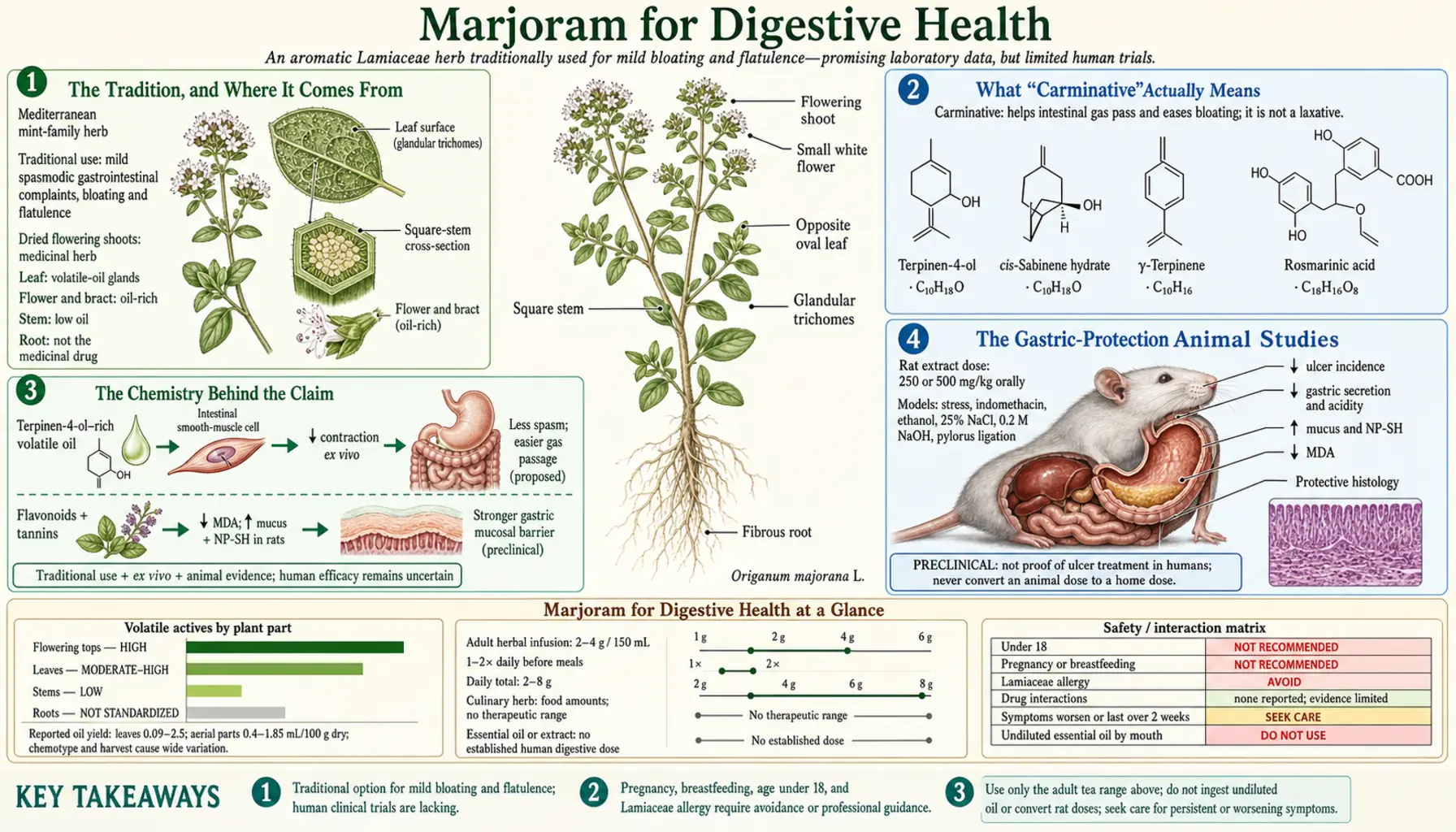
If you asked a Mediterranean grandmother what marjoram was for, she would probably not mention antioxidants. She would say it settles the stomach. Of all the things sweet marjoram (Origanum majorana) has been used for, easing a heavy, gassy, cramping gut is the oldest and the most consistent across cultures — from Greek and Roman kitchens through Levantine and North African households to the German and Polish traditions where a pinch of Majoran goes into fatty sausage and bean dishes for exactly this reason.
That is a serious tradition and it deserves a serious answer, so here is ours up front. The digestive use of marjoram is supported by centuries of practice, by a plausible and well-understood mechanism, and by a small body of animal work — but not by a single randomized trial in people. There is no study in which humans with bloating, indigestion or cramping were randomized to marjoram tea or a placebo. Anyone who tells you the science is settled here has not read it.
What we can do is explain the mechanism honestly, describe the animal evidence at the right size, compare marjoram fairly with the carminative herbs that do have trials behind them, and tell you how to use it so that if it is going to help you, it gets a fair chance. One botanical note first, because it decides which papers count: “wild marjoram” in older texts means oregano (Origanum vulgare), not marjoram. Every study named on this page has its species stated.
Table of Contents
- The Tradition, and Where It Comes From
- What “Carminative” Actually Means
- The Chemistry Behind the Claim
- The Gastric-Protection Animal Studies
- Bloating, Gas and Functional Dyspepsia
- Reflux: A Careful Exception
- Appetite, Bile and Fatty Meals
- Marjoram, Gut Bacteria and the Microbiome Question
- How It Compares with Better-Studied Carminatives
- How to Make and Use It
- Who Should Be Careful
- Key Research Papers
- Connections
The Tradition, and Where It Comes From
Evidence tier: traditional use only.
Marjoram's digestive reputation is not a modern wellness invention. It appears in the classical Mediterranean materia medica, persists through the medieval and early-modern European herbals, and is still visible in the food itself. Look at where marjoram traditionally goes in cooking and a pattern jumps out: fatty pork and sausage, lamb, goose, dried beans and lentils, cabbage, potato and heavy egg dishes. Those are precisely the foods that make people feel heavy, gassy and slow. The herb was not chosen at random for them.
Central and Eastern European cooking makes the case most clearly. German Leberwurst and Bratwurst, Polish żurek and pea soups, Hungarian bean dishes — marjoram is the signature herb of exactly the dishes that need help going down. Meanwhile in the Levant it goes into za'atar-adjacent blends and into digestive teas taken after a large meal. Two culinary traditions, separated by language and religion, arrived at the same use.
This kind of convergence is meaningful, but it is worth being clear about what it is evidence of. Long traditional use is good evidence of tolerability — a plant that made people ill would have been dropped — and reasonable evidence that people perceived a benefit. It is not evidence of a specific physiological effect, because our ancestors had no way to separate the herb from the warmth of the broth, the ritual of sitting down, the smaller portion or the expectation of relief. Those are exactly the confounders a randomized trial exists to remove, and marjoram has not had one.
What “Carminative” Actually Means
Evidence tier: mechanism, with human trial support for the herb class but not for marjoram.
“Carminative” is one of those herbal words that sounds vague and is actually specific. A carminative is a substance that reduces the discomfort of gas in the gut. It works in a couple of understood ways, and neither of them is magic.
First, relaxation of gut smooth muscle. Much of what you feel as bloating is not the volume of gas but the pressure of trapped gas against a spasming intestinal wall. Aromatic terpenes from the mint family diffuse into smooth muscle and interfere with calcium entry, which lets a spasm let go. When the wall relaxes, trapped gas moves on and the pain drops even if the total volume of gas has not changed. This is the mechanism that has been demonstrated most rigorously for peppermint oil, which is why enteric-coated peppermint has actual randomized trial support in irritable bowel syndrome. Marjoram's oil belongs to the same chemical family and is a reasonable candidate for the same effect, but the specific measurement has not been made for O. majorana in humans.
Second, reduced surface tension of foam. Gas in the gut is often not one big bubble but a froth trapped in mucus, and froth is hard to move. Aromatic oils reduce surface tension so small bubbles coalesce into larger ones that can actually be passed. This is the same principle behind simethicone, the over-the-counter anti-foaming agent.
Third, and most underrated, the warm liquid itself. A cup of hot water stimulates gastric motility and encourages the gastrocolic reflex. Any hot infusion does this, which is one honest reason marjoram tea may help someone even if marjoram contributes nothing beyond flavour. We would rather say that plainly than pretend the herb is doing all the work.
The Chemistry Behind the Claim
Evidence tier: preliminary (analytical chemistry, well established).
Marjoram brings two chemically distinct toolkits to the gut, and they behave differently.
The volatile oil
Sweet marjoram's essential oil is characteristically rich in terpinen-4-ol and cis-sabinene hydrate, with sabinene, γ-terpinene, α-terpinene, terpinolene, linalool and α-terpineol filling out the profile. Vera and Chane-Ming documented this pattern in Chemical composition of the essential oil of marjoram (Origanum majorana L.) from Reunion Island (Food Chemistry, 1999), and it has been confirmed many times since across growing regions.
This is the part that distinguishes marjoram from oregano at the level of gut effects. Oregano's oil is dominated by carvacrol and thymol, which are phenols: more aggressively antimicrobial, and considerably more irritating to mucous membranes. Marjoram's terpinen-4-ol is gentler on tissue. For a digestive infusion, gentler is the point — a strongly phenolic oil taken repeatedly can irritate the very lining you are trying to soothe. This is one of the few places where marjoram is arguably better suited than its famous cousin, rather than a weaker substitute for it.
The non-volatile phenolics
Boil the leaves and you also extract water-soluble phenolics that never make it into a distilled oil: rosmarinic acid above all, plus caffeic acid and flavonoids in the luteolin and apigenin families. Roby and colleagues measured this fraction directly in Evaluation of antioxidant activity, total phenols and phenolic compounds in thyme (Thymus vulgaris L.), sage (Salvia officinalis L.), and marjoram (Origanum majorana L.) extracts (Industrial Crops and Products, 2013), and marjoram held its own against two herbs with much louder reputations.
Rosmarinic acid matters here because it is anti-inflammatory in laboratory models and reaches the gut lining at meaningful concentration — unlike most polyphenols, whose poor systemic absorption is usually treated as a disappointment. For a gut target, poor absorption is an advantage: what is not absorbed stays where you want it. That is a mechanistic argument, not a demonstrated clinical effect, and we are labelling it as such.
The Gastric-Protection Animal Studies
Evidence tier: preliminary (animal).
The most substantive experimental support for marjoram's digestive reputation comes from rats, and it is worth describing properly because it is routinely overstated.
Al-Howiriny and colleagues published Protective Effect of Origanum majorana L. ‘Marjoram’ on Various Models of Gastric Mucosal Injury in Rats in The American Journal of Chinese Medicine (2009). The design is the standard gastroprotection screen: rats are given a marjoram preparation, then the stomach lining is deliberately injured by several different insults — the classic ones being ethanol, aspirin-type anti-inflammatory drugs, and stress or restraint — and the resulting damage is scored and compared with untreated animals. The authors reported that marjoram reduced the lesions across the models tested, and that markers associated with the stomach's own defences moved in a protective direction.
Why this is genuinely interesting: the study used several unrelated injury mechanisms, and an effect that survives that is less likely to be an artefact of one particular assay. It also matches the tradition rather than contradicting it, which is not always how these things go.
Why it does not license a clinical claim:
- Rats are not people, and gastroprotection screens are notorious for producing positives that never reproduce in humans. Dozens of plants pass this test.
- The dose is not a cup of tea. Animal gastroprotection studies typically use concentrated extracts at body-weight-scaled doses well above what a person would get from an infusion. Scaling those numbers into “cups per day” is an arithmetic exercise with no biological guarantee attached.
- Prevention is not treatment. The animals were pre-treated before injury. That models protection against a future insult, not healing of existing damage. It certainly does not mean marjoram treats an existing ulcer — a condition usually driven by Helicobacter pylori or by anti-inflammatory drugs and requiring real medical management.
So: a good reason to keep studying marjoram, and a fair reason to feel comfortable using it as a food. Not a reason to skip a gastroenterologist.
Bloating, Gas and Functional Dyspepsia
Evidence tier: traditional use only, for marjoram specifically.
Functional dyspepsia — upper abdominal fullness, early satiety, gnawing discomfort and bloating without a structural cause on investigation — is the condition marjoram tea is most often reached for, and it is a condition where the standard medical toolkit is genuinely limited. That combination is why herbal options get attention here rather than being dismissed.
What can be said fairly:
- Aromatic mint-family infusions have a strong traditional record in exactly this symptom cluster, and the mechanisms described above are plausible for it.
- Herbal combination products have real trial support in functional dyspepsia — the most-studied being multi-herb preparations built around peppermint, caraway, chamomile and bitter herbs. Marjoram is not a component of the well-studied ones.
- No trial has tested marjoram alone against placebo for bloating or dyspepsia. Not a negative trial — an absent one.
If you have persistent upper-abdominal symptoms, the important step is not choosing the right herb; it is getting the alarm features excluded. Unintentional weight loss, difficulty swallowing, vomiting, anaemia, black stools, or new symptoms after about age fifty-five all need proper evaluation, and a comforting tea is an actively bad reason to delay that. Once serious causes are ruled out and you are managing a functional condition, a marjoram infusion is a low-risk thing to try, with clear eyes about what is known.
Reflux: A Careful Exception
Evidence tier: mechanistic caution, extrapolated from a related herb.
This is the one place where a carminative can work against you, and popular herbal writing almost never mentions it.
The lower oesophageal sphincter is the ring of smooth muscle that keeps stomach contents where they belong. A compound that relaxes gut smooth muscle does not politely restrict itself to the intestine — it can relax that sphincter too. This is documented for peppermint, which is why peppermint is a recognised trigger in gastro-oesophageal reflux disease even though it helps lower-gut spasm. The same logic applies in principle to any aromatic terpene-rich infusion, marjoram included.
We want to be precise about the strength of this claim: it has not been measured for marjoram. No study has shown marjoram lowering sphincter pressure or worsening reflux. It is a mechanistic extrapolation from a chemically similar herb. But the asymmetry favours mentioning it — if you have reflux and marjoram tea makes your heartburn worse, that is a plausible reason rather than a mystery, and the fix is simply to stop. Culinary quantities in food are a different matter and are unlikely to be relevant.
Appetite, Bile and Fatty Meals
Evidence tier: traditional use, with partial mechanistic support.
A second strand of the tradition treats marjoram as an appetite and digestion stimulant rather than a soother — taken before a meal to get things moving. The rationale is the aromatic-bitter principle: aromatic and mildly bitter plants trigger receptors in the mouth and stomach that increase gastric secretion, bile flow and motility. Bitter receptors are now known to exist well beyond the tongue, throughout the gut, which has given this old idea a modern physiological footing.
Marjoram is only mildly bitter — nothing like gentian, wormwood or the bitter herbs used deliberately for this purpose — so if it works this way at all, it does so gently. That fits the culinary evidence: marjoram is used generously in fatty, protein-heavy dishes, where a nudge to bile flow would be exactly the useful intervention.
What has not been shown is any measurement of bile flow, gastric emptying or enzyme secretion after marjoram in humans. Treat this section as a plausible traditional rationale, and note that if you want a documented digestive bitter, other plants have far better claims.
Marjoram, Gut Bacteria and the Microbiome Question
Evidence tier: preliminary (in vitro), with an important caveat.
Marjoram's essential oil kills bacteria in a petri dish — that is thoroughly documented, starting with Deans and Svoboda's The antimicrobial properties of marjoram (Origanum majorana L.) volatile oil (Flavour and Fragrance Journal, 1990) and confirmed by Vági and colleagues in Essential oil composition and antimicrobial activity of Origanum majorana L. extracts obtained with ethyl alcohol and supercritical carbon dioxide (Food Research International, 2005). It is tempting to convert that into a digestive claim: marjoram tea as a gentle way to “rebalance” gut flora, or to address bacterial overgrowth.
Resist it. Two reasons, and both are decisive:
- The concentrations do not transfer. In vitro assays apply oil directly to a culture at concentrations orders of magnitude above anything a tea delivers to the intestine after dilution in gut contents. The gap is not a detail; it is the whole argument.
- Selectivity is unproven and the direction is unknown. Laboratory antimicrobials do not distinguish between organisms you want gone and organisms you depend on. A compound broad enough to inhibit a pathogen in a dish is broad enough to inhibit commensals. Nobody has characterised what marjoram does to a human gut community.
For SIBO specifically, herbal antimicrobial protocols do exist and have some trial support, but they are built around berberine-containing herbs and around oregano oil in enteric capsules at therapeutic doses — not around marjoram tea. If that is your question, the honest answer is that marjoram is not the herb with the evidence, and you should read about the ones that are.
How It Compares with Better-Studied Carminatives
Placing marjoram honestly among its peers is more useful than praising it in isolation.
- Peppermint — the strongest evidence of the group. Enteric-coated peppermint oil has repeatedly outperformed placebo for irritable bowel symptoms in randomized trials. Downside: it can aggravate reflux. If you want the best-evidenced carminative, this is it.
- Ginger — good randomized evidence for nausea, including in pregnancy, and reasonable data on gastric emptying. Different job from marjoram, better documented.
- Fennel — strong traditional record for gas and infant colic, with modest human data, often as part of a blend.
- Chamomile — appears in most of the well-studied multi-herb dyspepsia formulas, and doubles as a calming evening tea. The nearest thing to marjoram's role with better backing.
- Marjoram — the gentlest flavour of the group, a long culinary record, animal gastroprotection data, and no human trials. Its honest advantages are palatability, safety and the fact that it is already in your kitchen.
That last point is not a consolation prize. A tea you enjoy and will actually drink after dinner beats a better-evidenced capsule you abandon in a week.
How to Make and Use It
- The infusion. One rounded teaspoon of dried marjoram, or three or four fresh sprigs, per cup of just-boiled water. Cover the cup and steep five to ten minutes, then strain. Covering is not fussiness — the terpenes leave with the steam, and an uncovered cup gives you a weaker tea plus a nicely scented kitchen.
- Timing. For post-meal heaviness, drink it fifteen to thirty minutes after eating. For the appetite-and-bile rationale, ten minutes before.
- Frequency. One to three cups a day is well within traditional practice, and matches the twice-daily schedule used in the marjoram PCOS trial — the only human study to have established any tea regimen at all.
- In food. Add fresh marjoram in the last few minutes of cooking; add dried marjoram earlier, since it needs liquid and heat to release. Use it generously in beans, lentils, cabbage, potato, egg and fatty-meat dishes — the traditional pairings are traditional for a reason.
- Freshness. Dried marjoram older than a year has lost much of its volatile oil. If the jar does not smell strongly when you open it, it is a colouring agent, not an aromatic herb. Drying method matters too: Hossain and colleagues showed in Effect of drying method on the antioxidant capacity of six Lamiaceae herbs (Food Chemistry, 2010) that how a Lamiaceae herb is dried measurably changes what survives in it.
- Do not drink the essential oil. Concentrated marjoram essential oil is not a stronger tea. Ingesting essential oils can irritate or injure mucous membranes, and there is no established internal dose. The tea and the oil are different products with different risk profiles.
Who Should Be Careful
- Pregnancy. Culinary amounts of marjoram in food are considered fine. Avoid medicinal doses — strong or frequent teas, extracts, and the essential oil — because marjoram carries a traditional emmenagogue reputation, meaning historical use to bring on menstruation. That tradition has never been tested in either direction, which is precisely why the cautious default applies. Raise it with your obstetric provider before making marjoram tea a daily habit.
- Anticoagulant and antiplatelet therapy. There is a theoretical interaction. Aromatic Lamiaceae constituents can affect platelet function in laboratory conditions, and dried marjoram also carries vitamin K, which is directly relevant to warfarin dosing. No case series documents bleeding from marjoram. The practical advice is consistency: pick an intake and keep it steady rather than starting and stopping large amounts, and tell whoever manages your INR or anticoagulant.
- Reflux. See the section above. If heartburn worsens, stop — do not push through it.
- Active ulcer, H. pylori, or persistent alarm symptoms. These need diagnosis and treatment. The rat data are not a reason to self-manage.
- Mint-family allergy. Uncommon, but real. Stop at any rash, mouth itching or swelling.
- Children. Marjoram in food is fine. Herbal teas for infant colic should be discussed with a paediatrician, and essential oils should not be given to children internally at all.
Key Research Papers
Every citation below is a live PubMed search rather than a numeric identifier, with the title, journal and year given so you can confirm you have the right paper.
- Preliminary (animal) — Al-Howiriny T, et al. Protective Effect of Origanum majorana L. ‘Marjoram’ on Various Models of Gastric Mucosal Injury in Rats. The American Journal of Chinese Medicine, 2009. The central experimental support for the digestive tradition; multiple injury models, rats, pre-treatment design. Search PubMed
- Review — Bina F, Rahimi R. Sweet Marjoram: A Review of Ethnobotany, Phytochemistry, and Pharmacology. Journal of Evidence-Based Complementary & Alternative Medicine, 2017. The best single overview of what has and has not been studied in O. majorana. Search PubMed
- Preliminary (chemistry) — Vera RR, Chane-Ming J. Chemical composition of the essential oil of marjoram (Origanum majorana L.) from Reunion Island. Food Chemistry, 1999. Establishes the terpinen-4-ol and cis-sabinene-hydrate profile that separates marjoram from oregano. Search PubMed
- Preliminary (in vitro) — Roby MHH, et al. Evaluation of antioxidant activity, total phenols and phenolic compounds in thyme (Thymus vulgaris L.), sage (Salvia officinalis L.), and marjoram (Origanum majorana L.) extracts. Industrial Crops and Products, 2013. Quantifies the water-soluble phenolic fraction a tea actually delivers. Search PubMed
- Preliminary (in vitro) — Deans SG, Svoboda KP. The antimicrobial properties of marjoram (Origanum majorana L.) volatile oil. Flavour and Fragrance Journal, 1990. The benchmark antimicrobial screen — cited here for what it does not license about gut flora. Search PubMed
- Preliminary (in vitro) — Vági E, et al. Essential oil composition and antimicrobial activity of Origanum majorana L. extracts obtained with ethyl alcohol and supercritical carbon dioxide. Food Research International, 2005. Shows how preparation method changes both chemistry and activity. Search PubMed
- Preliminary (processing) — Hossain MB, et al. Effect of drying method on the antioxidant capacity of six Lamiaceae herbs. Food Chemistry, 2010. Why the state of your dried marjoram matters. Search PubMed
- Randomized clinical trial (marjoram, other endpoint) — Haj-Husein I, Tukan S, Alkazaleh F. The effect of marjoram (Origanum majorana) tea on the hormonal profile of women with polycystic ovary syndrome: a randomised controlled pilot study. Journal of Human Nutrition and Dietetics, 2016. Included here because it is the only human trial of marjoram tea, and therefore the only place a real-world tea regimen and tolerability were observed. Search PubMed
- Open topic search — marjoram and gastrointestinal smooth muscle: Search PubMed
- Open topic search — the class evidence marjoram is missing, for comparison: peppermint oil in IBS, randomized trials
- Open topic search — herbal combination products in functional dyspepsia: Search PubMed
Connections
- All Herbs
- Marjoram — the main page: botany, chemistry and culinary use.
- Marjoram Benefits Deep Dive — the hub for all four evidence reviews.
- Antimicrobial and Antioxidant Effects — why the petri-dish results do not become a gut protocol.
- Hormonal Balance and PCOS — the only randomized human trial of marjoram tea.
- Peppermint — the carminative with the best randomized evidence, and the reflux caveat.
- Peppermint Benefits — the IBS trial literature in detail.
- Fennel — traditional carminative seed for gas and bloating.
- Ginger — better-documented for nausea and gastric emptying.
- Chamomile — component of the well-studied multi-herb dyspepsia formulas.
- Chamomile Benefits — the parallel digestive-and-calming evidence review.
- Oregano — the carvacrol-rich cousin; more antimicrobial, more irritating.
- Thyme — another aromatic Lamiaceae herb used in heavy dishes.
- Licorice — a gastroprotective herb with its own real cautions.
- Functional Dyspepsia — the condition marjoram tea is most often used for.
- IBS — where carminative herbs are most studied.
- GERD — the reflux exception explained on this page.
- Gastritis — the human condition the rat gastroprotection models are meant to represent.
- SIBO — why marjoram is not the herb with the evidence here.
- Luteolin — flavone in marjoram's phenolic fraction.
Safety and disclaimer. This article is educational and is not medical advice. Marjoram is a culinary herb and traditional tea, not a treatment for any digestive disease, and the evidence discussed above is animal, laboratory and traditional rather than clinical. Avoid medicinal doses in pregnancy; be cautious and consistent if you take anticoagulants; never ingest marjoram essential oil. Persistent abdominal pain, difficulty swallowing, vomiting, unintentional weight loss, black stools or anaemia require prompt medical assessment — do not substitute a herbal tea for that.