Calendula

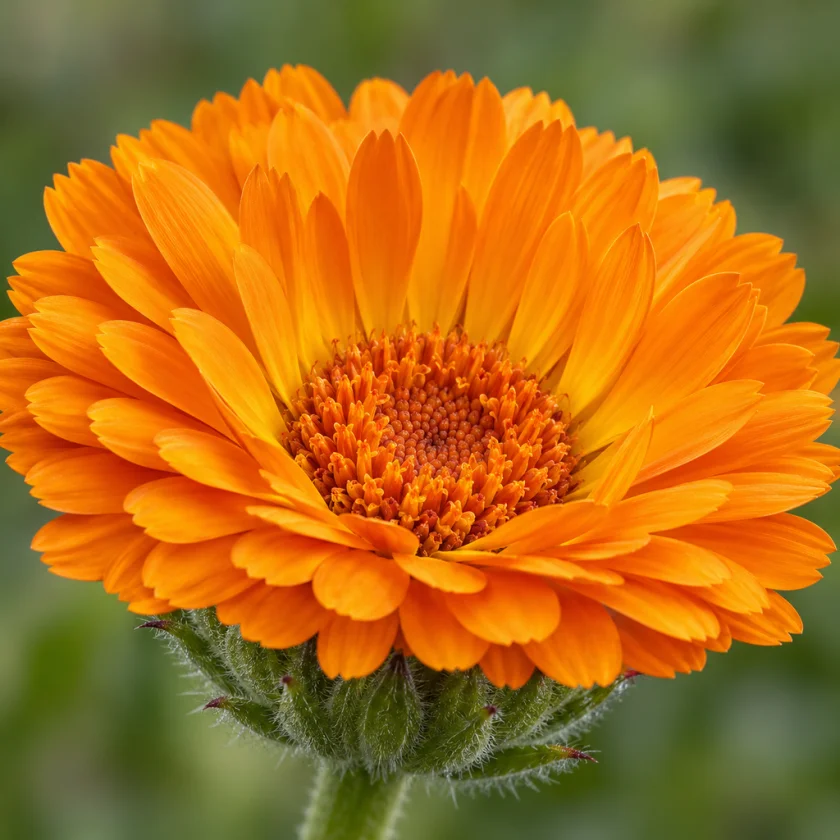
Calendula — the bright orange "pot marigold" — is among the most popular herbs for soothing the skin, and unlike many folk remedies it has some genuine clinical evidence behind it. That evidence is almost entirely topical (on the skin): creams and ointments for minor irritation and inflammation, with its best-known support for easing the skin reaction (radiation dermatitis) that can develop during cancer radiotherapy. This page explains what calendula is, where the science genuinely backs it up versus where use is merely traditional, how to use it, and its main safety caveat — an allergy risk for people sensitive to the daisy family. Throughout, the honest expectation is mild comfort, not a dramatic cure.
Table of Contents
What Calendula Is
Calendula (Calendula officinalis), also called pot marigold, is a bright orange-and-yellow garden flower in the daisy family. It is worth clearing up a common mix-up right away: this is not the same plant as the common bedding "marigolds" sold at most garden centers, which are usually Tagetes species. They look similar and share the name "marigold," but the herb used in skin remedies is specifically Calendula officinalis.
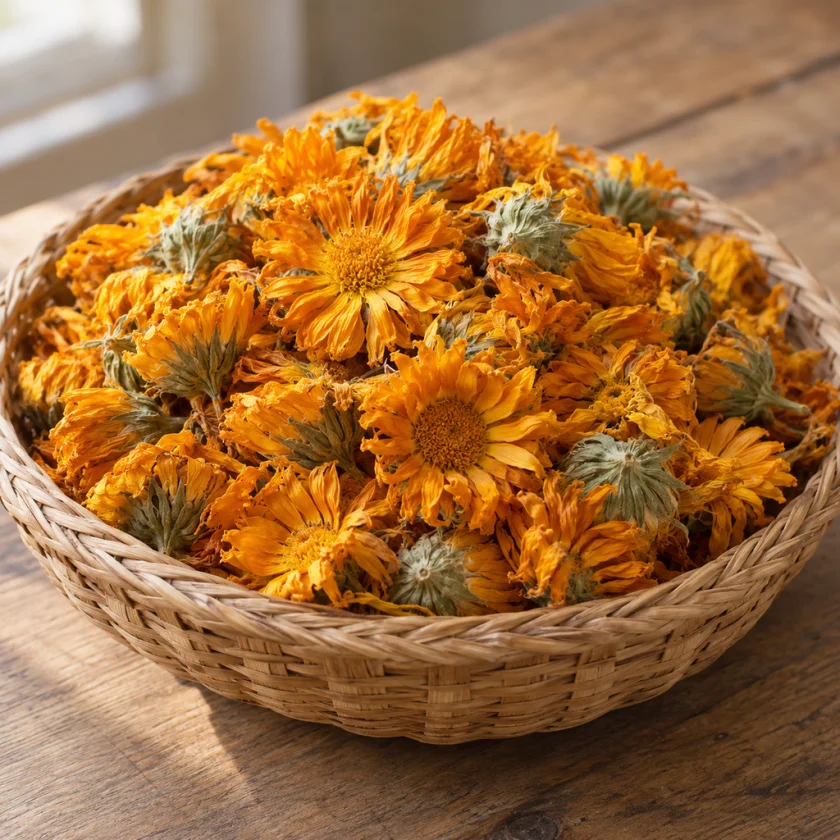
The medicinal part is the flower petals (and sometimes the whole flower head), dried and then made into creams, ointments, salves, infused oils, and teas. People have used calendula on the skin for centuries — in folk and traditional European medicine it was a go-to for minor wounds, scrapes, rashes, and inflamed skin.
The flowers contain several groups of plant compounds that are thought to explain its soothing reputation:
- Triterpenoids (such as faradiol esters) — generally considered the main anti-inflammatory and anti-swelling compounds in calendula.
- Flavonoids (plant antioxidants) — linked in lab studies to lower inflammatory signals and faster skin repair.
- Carotenoids — the orange and yellow pigments that give the petals their color.
It is honest to say up front that calendula is best understood as a gentle topical (on-the-skin) herb. That is where almost all of the useful evidence sits, and even there the evidence is modest.
Skin & Wound Healing — the Main Use
Skin is calendula's home turf. Topical calendula — applied as a cream, ointment, or salve — is traditionally used to calm minor wounds, scrapes, irritated or inflamed skin, and mild dermatitis. The idea is supported by laboratory and animal studies showing that calendula extracts can speed up the early phases of healing, encourage new tissue (granulation tissue) to form, and tamp down inflammation.
The single best-known piece of clinical evidence is for a very specific problem: radiation dermatitis, the red, sore, sometimes peeling skin reaction that many people develop during radiotherapy. In a well-known French randomized trial of 254 women receiving radiation after breast-cancer surgery, those who applied a calendula ointment to the treated area had noticeably less severe skin reactions than those using a standard cream (trolamine): about 41% developed a moderate-or-worse (grade 2+) reaction with calendula, compared with about 63% with the standard cream. The calendula group also reported less radiation-related pain and had fewer treatment interruptions.
That is a genuinely encouraging result — but it deserves honest context:
- It is essentially one notable trial. A 2019 systematic review found two randomized trials of calendula for radiation dermatitis: one, this French trial, showed improvement compared with trolamine, while the other found no improvement compared with an aqueous gel cream. The evidence is mixed and far from settled.
- Calendula was compared to another cream, not to doing nothing, so it is not proof of a dramatic effect — more a sign it may be at least as good as, and possibly better than, some standard options.
For everyday skin irritation, the evidence is thinner but still reasonable for a low-risk soother. A small randomized trial in infants found a calendula ointment helped diaper rash, with fewer rash sites than an aloe vera cream and no reported side effects. Reviews of calendula for general wound healing reach a consistent, sober conclusion: there are some promising findings consistent with its traditional use, but the trials are few and often low-quality, so calendula cannot yet be called a proven wound treatment.
Bottom line for skin: calendula is a low-risk topical used for minor skin irritation and inflammation, and it has real (if modest and not fully consistent) clinical support for easing radiation dermatitis. It is not a replacement for proper medical care of serious wounds, burns, or infections.
Other Traditional Uses
Beyond the skin, calendula has a few other traditional uses where the evidence is weaker and preliminary:
- Mouth and throat rinse. A calendula infusion has long been used as a gargle or mouthwash for sore, inflamed mouths and throats. The most interesting modern evidence is for oral mucositis — the painful mouth and throat inflammation caused by radiotherapy and chemotherapy. A small randomized study in head-and-neck cancer patients found that a 2% calendula mouthwash reduced the severity of radiation-induced mouth and throat inflammation compared with placebo. It is one small trial, so it is promising rather than proven.
- Minor cuts and insect bites. In folk practice, calendula salve is dabbed on small cuts, grazes, and bug bites to soothe the skin. This is traditional use; there is little formal clinical evidence specifically for bites, so it is a gentle skin comfort measure and nothing more.
For these uses, the honest framing is: traditional and preliminary. Calendula may help take the edge off minor inflammation, but the science is thin.
How to Use It
Calendula is, first and foremost, a topical herb — something you put on the skin or use as a mouth rinse, not generally something you take as a daily supplement.
- Creams, ointments, and salves. The most common form, applied as a thin layer to intact (unbroken) skin over a minor irritation, rash, or dry inflamed patch, typically a few times a day (the European Medicines Agency monograph gives 2 to 4 times daily). Commercial calendula creams vary in strength and ingredients, and each product label gives its own directions.
- Infused (macerated) oils. Calendula petals steeped in a carrier oil make a simple soothing oil for dry or irritated skin, and a base for homemade balms.
- Mouth rinse / gargle. For an inflamed mouth or throat, a cooled calendula infusion (petals steeped in hot water like a tea, then strained and cooled) is swished and spat out, or gargled; it is not meant to be swallowed in large amounts.
Practical points: people with sensitive skin often do a small patch test first (see Safety); it is kept away from the eyes; and radiotherapy units may have specific instructions about what goes on the treated skin and when.
Safety & Cautions
Used on the skin, calendula is generally considered very safe and well tolerated. Serious reactions are uncommon, and the trials above reported few or no side effects. Still, a few cautions are on record:
- Daisy-family (Asteraceae) allergy. This is the main concern. Calendula is in the same plant family as ragweed, chamomile, echinacea, daisies, and ornamental marigolds. People allergic to those plants can react to calendula with a skin rash (allergic contact dermatitis). The European Medicines Agency (EMA) monograph on calendula flower lists allergy to calendula or to other plants of the Asteraceae (Compositae) family as a contraindication, and notes that skin sensitization has been reported.
- Patch test for sensitive skin. People with sensitive skin often put a small amount on a small area (for example, the inner forearm) and wait 24–48 hours for redness, itching, or irritation before wider use.
- Pregnancy, breastfeeding and children. The EMA monograph, which covers skin preparations and mouth rinses, states that safety during pregnancy and breastfeeding has not been established and that, in the absence of sufficient data, use during pregnancy and breastfeeding is not recommended. It also lists skin use in children under 6 and mouth-and-throat use in children under 12 as not recommended, for lack of adequate data. Taken by mouth (concentrated extracts, tinctures, large amounts of tea), calendula has no established safety in pregnancy, and traditional practice treats it with caution.
- Serious wounds. Deep cuts, burns, wounds that won't heal, and signs of infection (spreading redness, pus, fever) are outside what calendula has been tested for; the EMA monograph treats signs of skin infection during use as a reason for medical care.
The Bottom Line
Calendula is a gentle, low-risk topical herb with a long traditional history for soothing the skin. Its strongest (though still modest, and not fully consistent) clinical evidence is for easing radiation dermatitis during breast-cancer treatment, with weaker supporting evidence for diaper rash, minor skin irritation, and — as a mouth rinse — radiation- and chemo-related mouth inflammation.
For ordinary use, it is a well-tolerated minor skin soother, apart from people allergic to the daisy family. What it is not is a proven cure or a substitute for proper medical care of serious wounds, burns, infections, or the skin and mouth side effects of cancer treatment — in those settings it has been studied as a complement to standard care, not a replacement. As with most herbs, the realistic expectation is mild comfort, not a dramatic effect.
Key Research Papers
The references below are real, peer-reviewed studies. Note the overall picture they paint: a few encouraging trials for specific skin and mouth problems, set against reviews that stress how limited and mixed the evidence still is.
- Pommier P, Gomez F, Sunyach MP, et al. Phase III randomized trial of Calendula officinalis compared with trolamine for the prevention of acute dermatitis during irradiation for breast cancer. Journal of Clinical Oncology. 2004;22(8):1447–1453. — The landmark trial: calendula ointment lowered the rate of moderate-or-worse radiation skin reactions (41% vs 63%) versus a standard cream. — doi:10.1200/JCO.2004.07.063
- Givol O, Kornhaber R, Visentin D, et al. A systematic review of Calendula officinalis extract for wound healing. Wound Repair and Regeneration. 2019;27(5):548–561. — A qualitative systematic review of 14 studies (7 animal experiments and 7 clinical trials); found some evidence for calendula in wound healing, consistent with its traditional use, and called for larger, well-designed randomized trials. Of its two radiation-dermatitis trials, one favoured calendula over trolamine and the other found no improvement over an aqueous gel cream. — doi:10.1111/wrr.12737
- Haruna F, Lipsett A, Marignol L. Topical Management of Acute Radiation Dermatitis in Breast Cancer Patients: A Systematic Review and Meta-Analysis. Anticancer Research. 2017;37(10):5343–5353. — A meta-analysis of 10 randomized trials (919 participants) of topical corticosteroid creams, which lowered the rate of moist peeling (wet desquamation) and the average radiation-dermatitis score; it did not assess calendula. — PubMed PMID: 28982842
- Babaee N, Moslemi D, Khalilpour M, et al. Antioxidant capacity of Calendula officinalis flowers extract and prevention of radiation-induced oropharyngeal mucositis in patients with head and neck cancers: a randomized controlled clinical study. DARU Journal of Pharmaceutical Sciences. 2013;21(1):18. — A small RCT in which a 2% calendula mouthwash reduced the severity of radiation-induced mouth and throat inflammation versus placebo. — doi:10.1186/2008-2231-21-18
- Panahi Y, Sharif MR, Sharif A, et al. A randomized comparative trial on the therapeutic efficacy of topical aloe vera and Calendula officinalis on diaper dermatitis in children. The Scientific World Journal. 2012;2012:810234. — A small trial finding calendula ointment improved diaper rash, with fewer rash sites than aloe vera and no reported side effects. — doi:10.1100/2012/810234
Connections
- All Herbs
- Calendula History
- Calendula Benefits
- Aloe Vera
- Tea Tree
- Manuka Honey
- Conditions on this site that reference this page: Athlete's Foot (Tinea Pedis) · Contact Dermatitis · Fungal Infections · Canker Sores (Aphthous Ulcers) · Gum Disease · Tonsillitis · Breast Cancer