Elderberry — Preparation and Safety
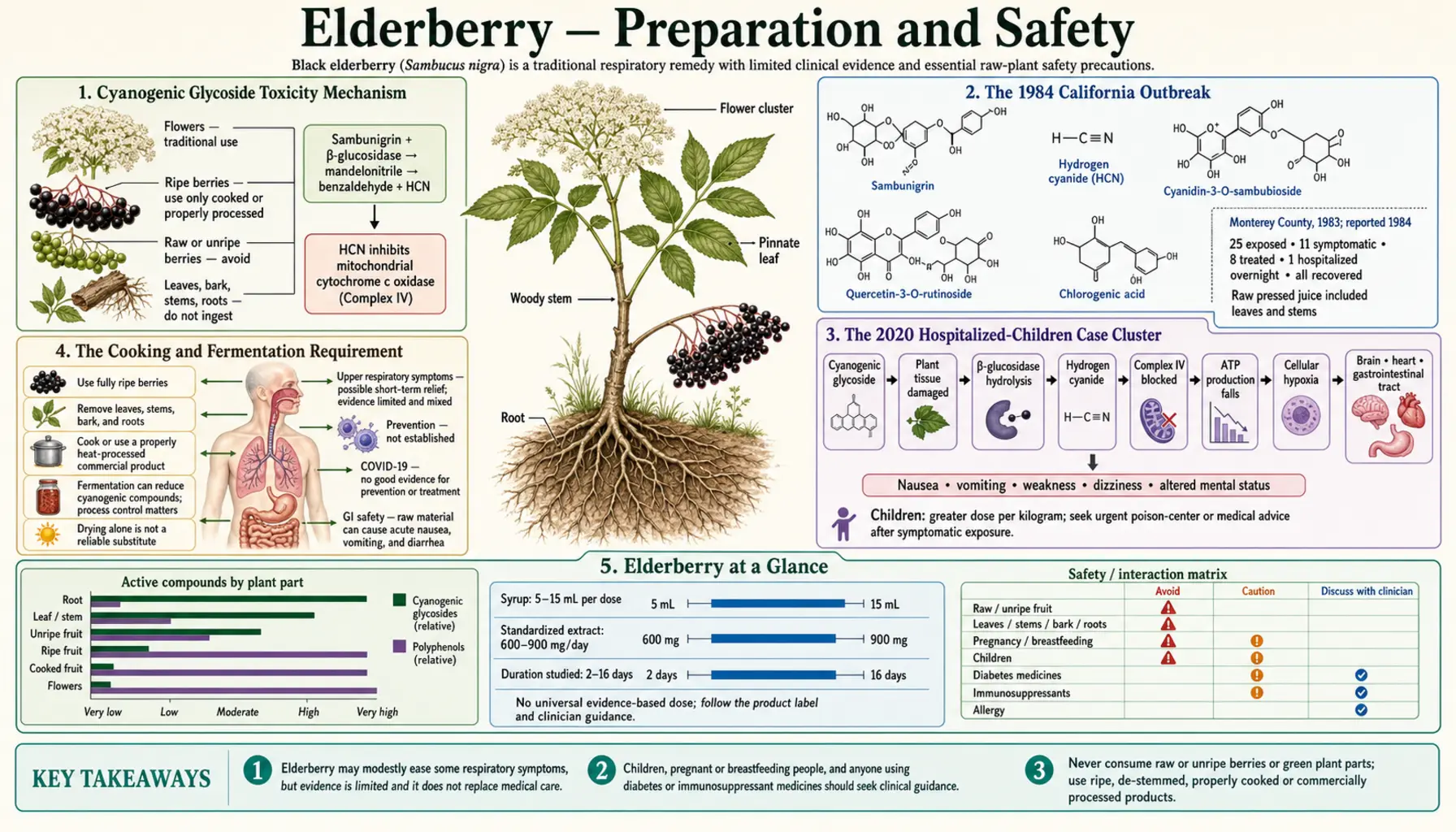
RAW ELDERBERRY TOXICITY WARNING: The leaves, stems, bark and roots of elder, and its unripe green berries, contain cyanogenic glycosides that can release hydrogen cyanide when the tissue is crushed; sambunigrin is the one most often named. In August 1983, a drink pressed from wild elderberries crushed together with their leaves and branches made 11 of 25 people at a gathering in Monterey County, California, ill, and eight of them were flown by helicopter to a hospital; the CDC reported the episode in 1984. The CDC report states that elderberries “may be safe to consume, particularly if cooked,” and that uncooked berries may produce nausea. In laboratory measurements, heating lowered the cyanogenic glycoside content of elderberry products by 44–96% depending on the product (Senica 2016).
Table of Contents
- Cyanogenic Glycoside Toxicity Mechanism
- The California Elderberry Juice Poisoning (CDC, 1984)
- Later Case Reports and Poison-Centre Data
- What Heat and Processing Do to the Glycosides
- Commercial Products — What Testing and Trials Show
- Home Preparation — What the Sources Report
- Species Differences — S. nigra vs S. canadensis vs S. racemosa
- Autoimmune and Cytokine-Storm Concerns
- Pregnancy, Children and Breastfeeding — What Data Exist
- Drug Interactions and Other Cautions
- Doses and Findings in the Clinical Trials
- Key Research Papers
- Connections
- Featured Videos
Cyanogenic Glycoside Toxicity Mechanism
Elder (Sambucus) tissues contain cyanogenic glycosides: sugar-bound compounds that release hydrogen cyanide (HCN) when they are split. In a Slovenian analysis of processed European elderberry products, sambunigrin was the prevalent cyanogenic glycoside in every product analysed (Senica 2016). The picture is not uniform across the genus: a 2024 method study of American elderberry detected only (R)-prunasin, and only in leaf samples, and did not detect sambunigrin (its isomer, also called (S)-prunasin) in the samples analysed, although sambunigrin has been reported in elderberry species before (Kasote 2024).
The chemistry follows the pattern common to cyanogenic plants. When tissue is crushed, chewed or juiced, a beta-glucosidase enzyme splits the glycoside, releasing mandelonitrile, which breaks down to benzaldehyde and hydrogen cyanide. Cyanide binds the iron in cytochrome c oxidase (complex IV of the mitochondrial electron transport chain), so cells can no longer use oxygen to make energy.
The symptoms recorded in the best-documented elderberry poisoning were nausea, vomiting, abdominal cramps and weakness, with dizziness and numbness in some people; the most severely affected person was stuporous (CDC 1984). For cyanide from any food, the European Food Safety Authority applies an acute reference dose of 20 µg per kg of body weight (EFSA 2019).
Measured amounts in the fruit itself are low, and they vary with plant part, ripeness and growing site:
- European elder (S. nigra), Slovenia: of the leaves, flowers and berries analysed, the berries contained the lowest levels of cyanogenic glycosides — 0.11 µg/g in berries from the foothills and 0.59 µg/g in berries from the hilltop (Senica 2017).
- American elder (S. nigra subsp. canadensis), Missouri: intact cyanogenic glycosides ranged from 0.12 to 6.38 µg/g in fruit tissues, 0.29–2.36 µg/mL in pressed juice and 0.12–2.38 µg/g in seeds; total cyanogenic potential was highest in the stems and green berries; no quantifiable trace was found in the commercial juice tested. The authors concluded the levels pose no threat to consumers of fresh and processed American elderberry products (Appenteng 2021).
- Other plant parts: the CDC report lists the fresh leaves, flowers, bark, young buds and roots as containing the glucoside, and calls the root “probably the most poisonous” (CDC 1984).
The low fruit levels and the 1983 poisoning are not in conflict: in that episode the berries were crushed together with their leaves and branches (CDC 1984).
The California Elderberry Juice Poisoning (CDC, 1984)
The best-documented elderberry poisoning in the US literature was reported in 1984 in the CDC's Morbidity and Mortality Weekly Report. On August 26, 1983, eight people with acute gastrointestinal and neurologic symptoms were flown by helicopter to a hospital in Monterey, California. The group of 25 had been served a drink made from wild elderberries of Sambucus mexicana, an elder native to the western United States. Bunches of berries had been crushed with their leaves and branches in a stainless-steel press, apple juice, water and sugar were added, and the drink was served the next day.
- 11 of 25 people began to have nausea and vomiting within 15 minutes of drinking it.
- The eight most ill reported nausea, vomiting, abdominal cramps and weakness; some also had dizziness and numbness.
- One man, who had drunk five glasses, was stuporous and was hospitalized overnight.
- Severity correlated with the amount of juice consumed; those who drank only tea remained well.
- All recovered quickly, including the man hospitalized overnight.
The editorial note states that the fresh leaves, flowers, bark, young buds and roots contain a bitter alkaloid and a glucoside that, under certain conditions, can produce hydrocyanic acid, and that the root is probably the most poisonous. The staff were told that “while elderberries may be safe to consume, particularly if cooked (uncooked berries may produce nausea), leaves and stems should not be crushed in when making juice.” The report does not name sambunigrin; that compound was identified in later chemical analyses.
Later Case Reports and Poison-Centre Data
Published reports of elderberry poisoning since 1984 are sparse. No published case series of children hospitalized after drinking raw elderberry juice was found in PubMed. The data that do exist:
- German poison-centre data, 2010–2019 — an analysis of fruit-plant inquiries to the Erfurt joint poison information center listed Sambucus species among the plants asked about most often. Across all fruit plants (not elder alone), 69.5% of inquiries concerned young children aged 1 to under 6 years, and outcomes were asymptomatic in 82%, mild in 14.7%, moderate in 3% and severe in 0.3%. The authors concluded that poisoning by fruit plants in Germany is rare (Wendt 2023).
- A case report of autoimmune hepatitis — a 2022 report describes a patient who developed autoimmune hepatitis while taking elderberry-containing supplements long term; the authors call the association “plausible” (Ramachandran 2022). A single case report cannot establish cause.
- Children and dose per kilogram — the EFSA acute reference dose for cyanide is set per kilogram of body weight (EFSA 2019), so the same amount of a cyanogenic food gives a small child a larger dose per kilogram than an adult.
What Heat and Processing Do to the Glycosides
The most direct measurements come from a 2016 Slovenian study that analysed processed elderberry products by HPLC-mass spectrometry (Senica 2016):
- Sambunigrin was the prevalent cyanogenic glycoside in all products analysed.
- Higher temperatures decreased the cyanogenic glycosides by 44% in elderberry juice, 80% in tea and 96% in elderberry liqueur and spread, compared with unprocessed berries.
- Heat also lowered the beneficial phenolics: from 958 mg/kg in unprocessed berries to 343 mg/kg in liqueur, 337 mg/kg in spread, 162 mg/kg in tea and 114 mg/kg in juice.
Heating lowered the glycoside content in every product measured, but by different amounts: least in juice (44%), most in liqueur and spread (96%). Other sources point the same way without giving figures: the CDC report says elderberries may be safe “particularly if cooked” (CDC 1984), and the LactMed database of the US National Institute of Child Health and Human Development states that cooked berries do not carry the cyanide risk of the bark, leaves and root (LactMed 2025).
The sources reviewed for this page give no validated cooking time or temperature, and no measurements for fermentation or drying alone.
Commercial Products — What Testing and Trials Show
- Laboratory testing — no quantifiable cyanogenic glycosides were found in the commercial American elderberry juice tested in a 2021 analysis (Appenteng 2021).
- Adverse events in trials — in the air-traveller trial, five participants reported adverse events (itchy throat and cold-like symptoms, fatigue, kidney pain), and a causal relationship with elderberry could not be established; the two with itchy throat were later found to be taking placebo (Tiralongo 2016). In the 2018–2019 emergency-room influenza trial, the most frequent adverse events overall were dry mouth (5.7%), constipation (4.6%), rash (4.6%) and bad taste (3.4%), with no significant difference between the elderberry and placebo groups (Macknin 2020).
- Systematic review — a 2021 systematic review of five randomized trials concluded that elderberry “may be a safe option” for viral respiratory illness, but that the evidence on both benefits and harms is uncertain (Wieland 2021).
- Allergy — elderberry preparations have rarely caused allergic reactions (LactMed 2025).
- Product variation — dietary supplements in the US do not need pre-market approval; differences are often found between labeled and actual ingredients, so clinical results for one product may not apply to another (LactMed 2025). Every trial on this page tested one specific proprietary extract.
Home Preparation — What the Sources Report
This section reports what the sources describe about home preparation; it is not a recipe.
- Plant parts — the 1983 poisoning followed a drink in which berries were crushed with their leaves and branches; the CDC staff advice quoted above was about leaves and stems crushed in when making juice (CDC 1984). Total cyanogenic potential was highest in stems and green berries in American elderberry (Appenteng 2021).
- Uncooked berries — the CDC report notes that uncooked berries may produce nausea (CDC 1984).
- Heating — heating lowered the glycoside content of elderberry products by 44–96%, depending on the product (Senica 2016); no source reviewed here gives a validated home cooking time or temperature.
- Honey-sweetened syrups and infants — many homemade elderberry syrups are sweetened with honey. The CDC states that honey can contain the bacteria that cause botulism and advises against feeding honey to a child younger than 1 year old.
Species Differences — S. nigra vs S. canadensis vs S. racemosa
- Sambucus nigra (European black elder) — native to Europe; the influenza and cold trials on this page used extracts of this species. Berries are black-purple when ripe.
- Sambucus canadensis (American black elder, now often classed as S. nigra subsp. canadensis) — native to eastern North America. Analyses of this subspecies found generally low cyanogenic glycoside levels, highest in stems and green berries (Appenteng 2021), and sambunigrin varies between populations (Buhrmester 2000).
- Sambucus mexicana — the western US elder whose juice, pressed with leaves and branches, caused the 1983 California poisoning (CDC 1984).
- Sambucus racemosa (red elder) — a separate species with red fruit, native to North America and Europe. None of the clinical trials studied it, and the sources on this page give no comparable safety measurements for it.
Elder has look-alike plants, some of them poisonous, so misidentification is a recognized risk in foraging.
Autoimmune and Cytokine-Storm Concerns
As discussed in the Immune Modulation deep-dive, a 2001 laboratory study incubated blood monocytes from 12 healthy donors with commercial elderberry preparations. Production of the inflammatory cytokines IL-1β, TNF-α, IL-6 and IL-8 rose 2–45-fold, most with the elderberry extract, compared with 3.6–10.7-fold for the bacterial activator LPS; TNF-α rose 44.9-fold (Barak 2001). This was a cell-culture result, not a measurement in people.
Two concerns have been raised from findings like this. Both are theoretical:
- Cytokine storm in COVID-19 — during the pandemic, concern was raised that elderberry might overstimulate the immune system and increase the risk of a “cytokine storm.” A 2021 systematic review found no studies linking elderberry to clinical inflammatory outcomes. Three studies measured cytokines ex vivo after people took elderberry and found some effect on inflammatory markers, which may decline with ongoing supplementation. The review concluded that there is no evidence that elderberry overstimulates the immune system, while calling the evidence on benefits and harms uncertain (Wieland 2021). A 2022 review likewise found not yet enough evidence for the cytokine-storm claim, and concluded that further research is required for COVID-19 patients because elderberry may provoke a cytokine storm if given as treatment (Asgary 2022).
- Autoimmune disease and immunosuppression — conditions such as rheumatoid arthritis, lupus, multiple sclerosis, inflammatory bowel disease and psoriasis involve these same cytokines, and some of their treatments block TNF-α or IL-6. No trial has tested elderberry in these conditions. The clinical evidence is one 2022 case report of autoimmune hepatitis in a long-term user, with a “plausible” association (Ramachandran 2022).
Decisions about supplements in autoimmune disease or during immunosuppressive treatment belong with the clinician managing that treatment.
Pregnancy, Children and Breastfeeding — What Data Exist
- Pregnancy — a 2014 review searched six databases to November 2013 and found no animal or human studies of elderberry safety in pregnancy. Only 77 people had received elderberry in the three efficacy trials then published. The authors concluded that, because evidence of both efficacy and safety was lacking, health care personnel “should not advice pregnant women to use echinacea or elderberry” against upper respiratory infection (Holst 2014). The 2016 air-traveller trial excluded women who were pregnant or wanting to become pregnant (Tiralongo 2016).
- Breastfeeding — no data exist on the excretion of elderberry components into breast milk, or on safety in nursing mothers or infants; LactMed states that no recommendations can be made on medicinal doses during breastfeeding. Elderberry has been used to increase milk supply in Türkiye, but no scientifically valid trials support that use (LactMed 2025).
- Children — two influenza trials enrolled children: the 1995 trial included ages 5 to 56 years (Wieland 2021), and the 2018–2019 emergency-room trial enrolled patients aged 5 and above, with no significant difference in adverse events between groups (Macknin 2020). No trial on this page enrolled children younger than 5.
- Infants under 1 year — for honey-sweetened syrups, the CDC states that honey can contain the bacteria that cause botulism and advises against giving honey to a child younger than 1 year old.
Drug Interactions and Other Cautions
- Immunosuppressants — the concern about combining elderberry with immunosuppressive drugs (such as cyclosporine, tacrolimus, corticosteroids or anti-TNF and anti-IL-6 biologics) is theoretical, based on the cell-culture cytokine findings above (Barak 2001). No clinical interaction studies were found in the sources reviewed for this page.
- Oseltamivir — in the 2018–2019 emergency-room trial, patients could also take oseltamivir; a post hoc analysis suggested outcomes with elderberry alone were 2 days worse than with placebo alone (Macknin 2020). Post hoc analyses are exploratory.
- Sugar content — elderberry syrups are sweetened with sugar or honey; the amount varies by product and is listed on the label. This matters for people counting carbohydrates, including people with diabetes.
- Allergy — elderberry preparations have rarely caused allergic reactions (LactMed 2025).
Doses and Findings in the Clinical Trials
The doses below are what the trials used, reported as findings, not as instructions. Each trial tested a single proprietary product, so results may not transfer to other products.
- Zakay-Rones 1995 (influenza B outbreak on an Israeli kibbutz, 1993; 27 participants aged 5–56) — 1 tablespoon of syrup twice daily for children and four times daily for adults (Wieland 2021). Symptoms, including fever, improved significantly within 2 days in 93.3% of the elderberry group, while 91.7% of the placebo group improved within 6 days; complete cure came within 2 to 3 days in nearly 90% of the elderberry group and within at least 6 days on placebo (Zakay-Rones 1995). Funding: sponsor not reported (Wieland 2021).
- Zakay-Rones 2004 (Norway, 1999–2000 influenza season; 60 patients aged 18–54 with symptoms for 48 hours or less) — 15 ml of syrup four times a day for 5 days. Symptoms were relieved on average 4 days earlier, and less rescue medication was used, than on placebo (Zakay-Rones 2004). Funding: sponsored by the manufacturer of the tested syrup (Wieland 2021).
- Tiralongo 2016 (312 economy-class air travellers from Australia) — capsules of 300 mg elderberry extract: 600 mg a day from 10 days before travel, then 900 mg a day while travelling and for 4–5 days after arrival. Cold episodes did not differ significantly (12 vs 17, p = 0.4), but the placebo group had more cold-episode days (117 vs 57, p = 0.02) and a higher average symptom score (583 vs 247, p = 0.05) (Tiralongo 2016). Funding: funded by the extract's manufacturer, which supplied the elderberry and placebo capsules and was partly involved in the study design.
- Macknin 2020 (trial run January 2018–April 2019 in three US emergency rooms; 87 patients aged 5 and above with PCR-confirmed influenza) — 15 ml twice a day (ages 5–12) or four times a day (over 12) for 5 days. Days until all symptoms were none or mild: 5.3 on elderberry vs 4.9 on placebo (p = 0.57); days to complete resolution: 8.6 vs 8.7 (p = 0.87). The authors found “no evidence that elderberry benefits the duration or severity of influenza” (Macknin 2020). Funding: a family foundation and the hospital system's own research funds; a manufacturer supplied the study product and placebo without financial support and could review the manuscript before publication.
- Hawkins 2019 meta-analysis — pooled randomized trials with a total of 180 participants and reported that elderberry substantially reduced upper respiratory symptoms, with a large mean effect size (Hawkins 2019). It was published before the Macknin trial and so does not include it. Funding: the research department of the authors' own wellness institute.
- Wieland 2021 systematic review (five randomized trials) — elderberry may not reduce the risk of developing a cold; it may reduce the duration and severity of colds and the duration of influenza, but the evidence is uncertain (Wieland 2021).
Key Research Papers
- Centers for Disease Control (CDC) (1984). Poisoning from elderberry juice — California. MMWR Morbidity and Mortality Weekly Report 33(13):173-174. — PubMed PMID: 6422238 (full text: CDC MMWR)
- Senica M, Stampar F, Veberic R, Mikulic-Petkovsek M (2016). Processed elderberry (Sambucus nigra L.) products: A beneficial or harmful food alternative? LWT — Food Science and Technology 72:182-188. — doi:10.1016/j.lwt.2016.04.056
- Appenteng MK, Krueger R, Johnson MC, Ingold H, Bell R, Thomas AL, Greenlief CM (2021). Cyanogenic glycoside analysis in American elderberry. Molecules 26(5):1384. — PubMed PMID: 33806603
- Senica M, Stampar F, Veberic R, Mikulic-Petkovsek M (2017). The higher the better? Differences in phenolics and cyanogenic glycosides in Sambucus nigra leaves, flowers and berries from different altitudes. Journal of the Science of Food and Agriculture 97(8):2623-2632. — PubMed PMID: 27734518
- Buhrmester RA, Ebinger JE, Seigler DS (2000). Sambunigrin and cyanogenic variability in populations of Sambucus canadensis L. (Caprifoliaceae). Biochemical Systematics and Ecology 28(7):689-695. — doi:10.1016/S0305-1978(99)00105-2
- Charlebois D, Byers PL, Finn CE, Thomas AL (2010). Elderberry: botany, horticulture, potential. Horticultural Reviews 37:213-280. — doi:10.1002/9780470543672.ch4
- Atkinson MD, Atkinson E (2002). Sambucus nigra L. Journal of Ecology 90(5):895-923. — doi:10.1046/j.1365-2745.2002.00698.x
- Mlynarczyk K, Walkowiak-Tomczak D, Lysiak GP (2018). Bioactive properties of Sambucus nigra L. as a functional ingredient for food and pharmaceutical industry. Journal of Functional Foods 40:377-390. — doi:10.1016/j.jff.2017.11.025
- EFSA Panel on Contaminants in the Food Chain (CONTAM); Schrenk D, et al. (2019). Evaluation of the health risks related to the presence of cyanogenic glycosides in foods other than raw apricot kernels. EFSA Journal 17(4):e05662. — PubMed PMID: 32626287
- Bolarinwa IF, Orfila C, Morgan MR (2014). Amygdalin content of seeds, kernels and food products commercially-available in the UK. Food Chemistry 152:133-9. — PubMed PMID: 24444917
- Vlachojannis JE, Cameron M, Chrubasik S (2010). A systematic review on the sambuci fructus effect and efficacy profiles. Phytotherapy Research 24(1):1-8. — PubMed PMID: 19548290
- Ulbricht C, Basch E, Cheung L, Goldberg H, Hammerness P, Isaac R, Khalsa KP, Romm A, Rychlik I, Varghese M, Weissner W, Windsor RC, Wortley J (2014). An evidence-based systematic review of elderberry and elderflower (Sambucus nigra) by the Natural Standard Research Collaboration. Journal of Dietary Supplements 11(1):80-120. — PubMed PMID: 24409980
- Zakay-Rones Z, Varsano N, Zlotnik M, Manor O, Regev L, Schlesinger M, Mumcuoglu M (1995). Inhibition of several strains of influenza virus in vitro and reduction of symptoms by an elderberry extract (Sambucus nigra L.) during an outbreak of influenza B Panama. Journal of Alternative and Complementary Medicine 1(4):361-369. — PubMed PMID: 9395631
- Zakay-Rones Z, Thom E, Wollan T, Wadstein J (2004). Randomized study of the efficacy and safety of oral elderberry extract in the treatment of influenza A and B virus infections. Journal of International Medical Research 32(2):132-140. — PubMed PMID: 15080016
- Tiralongo E, Wee SS, Lea RA (2016). Elderberry supplementation reduces cold duration and symptoms in air-travellers: a randomized, double-blind placebo-controlled clinical trial. Nutrients 8(4):182. — PubMed PMID: 27023596
- Macknin M, Wolski K, Negrey J, Mace S (2020). Elderberry extract outpatient influenza treatment for emergency room patients ages 5 and above: a randomized, double-blind, placebo-controlled trial. Journal of General Internal Medicine 35(11):3271-3277. — PubMed PMID: 32929634
- Hawkins J, Baker C, Cherry L, Dunne E (2019). Black elderberry (Sambucus nigra) supplementation effectively treats upper respiratory symptoms: a meta-analysis of randomized, controlled clinical trials. Complementary Therapies in Medicine 42:361-365. — PubMed PMID: 30670267
- Wieland LS, Piechotta V, Feinberg T, Ludeman E, Hutton B, Kanji S, Seely D, Garritty C (2021). Elderberry for prevention and treatment of viral respiratory illnesses: a systematic review. BMC Complementary Medicine and Therapies 21(1):112. — PubMed PMID: 33827515
- Asgary S, Pouramini A (2022). The pros and cons of using elderberry (Sambucus nigra) for prevention and treatment of COVID-19. Advanced Biomedical Research 11:96. — PubMed PMID: 36518861
- Barak V, Halperin T, Kalickman I (2001). The effect of Sambucol, a black elderberry-based, natural product, on the production of human cytokines: I. Inflammatory cytokines. European Cytokine Network 12(2):290-296. — PubMed PMID: 11399518
- Ramachandran A, Antala D, Pudasainee P, Panginikkod S, Gupta H (2022). A plausible association between the use of elderberry and autoimmune hepatitis. Cureus 14(4):e24250. — PubMed PMID: 35602846
- Holst L, Havnen GC, Nordeng H (2014). Echinacea and elderberry — should they be used against upper respiratory tract infections during pregnancy? Frontiers in Pharmacology 5:31. — PubMed PMID: 24624087
- Drugs and Lactation Database (LactMed) (2006–). Elderberry. Bethesda (MD): National Institute of Child Health and Human Development; entry revised April 15, 2025. — PubMed PMID: 30000895
- Kasote DM, Lei Z, Kranawetter CD, Conway-Anderson A, Sumner BW, Sumner LW (2024). A novel UHPLC-MS/MS based method for isomeric separation and quantitative determination of cyanogenic glycosides in American elderberry. Metabolites 14(7):360. — PubMed PMID: 39057683
- Wendt S, Prasa D, Lübbert C, Begemann K, Franke H (2023). Exposures to fruit plants in Germany from 2010-2019: analysis of the Erfurt joint poison information center database (article in German). Bundesgesundheitsblatt Gesundheitsforschung Gesundheitsschutz 66(12):1423-1433. — PubMed PMID: 37828294
PubMed Topic Searches
Connections
- All Herbs
- Elderberry Overview
- Elderberry Benefits Hub
- Elderberry for Cold and Flu
- Elderberry Immune Modulation
- Elderberry Antioxidant & Cardiovascular
- Toxins Overview
- Food Poisoning
- Lupus (SLE)
- Rheumatoid Arthritis
- Multiple Sclerosis
- Crohn's Disease
- Ulcerative Colitis
- Honey
- Echinacea
- Vitamin C
- Zinc
- Cold & Flu Treatments
- History