Elderberry — Benefits Deep Dive
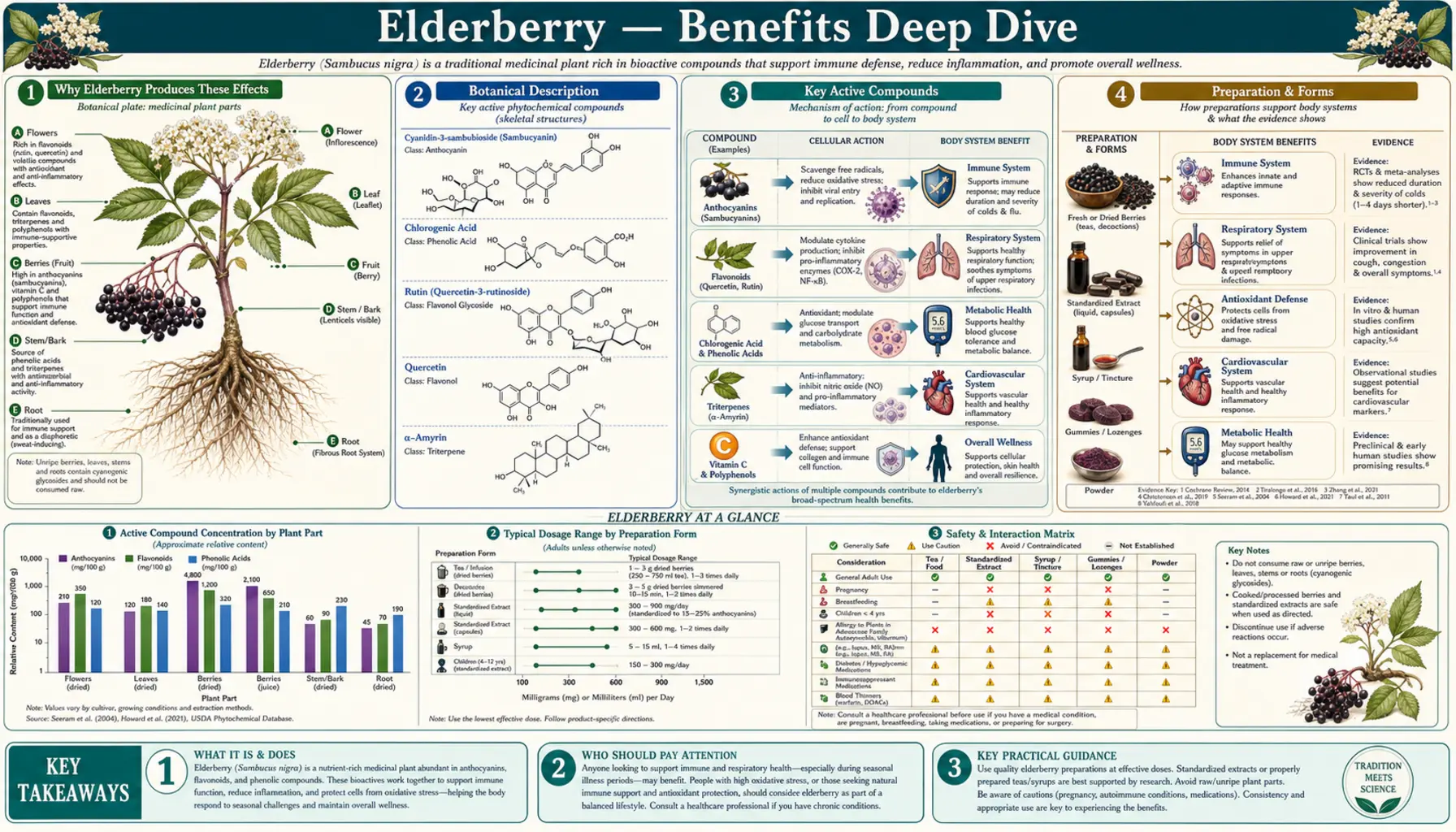
Elderberry (Sambucus nigra, European black elder) has been tested for colds and influenza in a small number of randomized trials. The first, published in 1995 and co-authored by the virologist Madeleine Mumcuoglu, tested a standardized elderberry syrup during an influenza B outbreak in Israel; a 2004 trial in Norway, sponsored by the syrup's manufacturer, reported symptom relief on average 4 days earlier than placebo. A 2016 air-traveller trial funded by an extract manufacturer found fewer cold-episode days but no significant difference in the number of colds, and a 2020 emergency-room trial found no benefit for the duration or severity of influenza. A 2021 systematic review rated the evidence on both benefits and harms as uncertain. The most abundant anthocyanins in the fruit are cyanidin-3-sambubioside and cyanidin-3-glucoside; in cell culture, flavonoids from an elderberry extract bound influenza virus particles and blocked infection. Raw elder leaves, stems, bark, roots and unripe berries contain cyanogenic glycosides (sambunigrin is the one most often named) that can release hydrogen cyanide. In 1983, juice pressed from elderberries crushed with their leaves and branches made 11 of 25 people in California ill; eight were flown to a hospital and one was admitted overnight (CDC, 1984). In laboratory measurements, heating lowered the glycosides by 44–96% depending on the product. The four deep-dive pages below cover the cold-and-flu trials, the immune-modulation research, the antioxidant and cardiovascular studies, and the preparation and safety findings.
Deep-Dive Articles
Cold & Flu
The two Zakay-Rones randomized trials of a standardized elderberry syrup for influenza (1995, an influenza B outbreak in Israel; 2004, Norway, 1999–2000 season, where symptoms were relieved on average 4 days earlier than on placebo). The Tiralongo 2016 air-traveller trial: fewer cold-episode days, but no significant difference in the number of colds. The Hawkins 2019 meta-analysis of 180 participants, and the Macknin 2020 emergency-room trial, which found no benefit.
Read the deep dive →Immune Modulation
What laboratory, animal and human studies show about elderberry and the immune system. The Barak 2001 cell-culture study, in which commercial elderberry preparations raised IL-1β, IL-6, IL-8 and TNF-α production by monocytes from healthy donors 2–45-fold. Complement-fixing and macrophage-stimulating pectins in laboratory assays, and why the clinical relevance is unknown.
Read the deep dive →Antioxidant & Cardiovascular
Cyanidin-3-sambubioside and cyanidin-3-glucoside are the most abundant anthocyanins in black elderberry. Two small randomized human studies: 12 weeks of elderberry anthocyanins did not change cardiovascular risk biomarkers in postmenopausal women, and a 2-week study found only a small, non-significant change in cholesterol.
Read the deep dive →Preparation & Safety
Raw elderberry toxicity warning. Cyanogenic glycosides (mainly sambunigrin) in leaves, stems, bark, roots and unripe berries can release hydrogen cyanide. The 1983 California juice poisoning reported by the CDC in 1984: 11 of 25 ill, 8 flown to hospital, 1 admitted overnight. Heating lowered the glycosides by 44–96% in a laboratory study; no validated home cooking time or temperature exists. Commercial products, and the theoretical autoimmune and cytokine-storm concerns.
Read the deep dive →Table of Contents
Why Elderberry Produces These Effects
How elderberry might produce the effects studied is not settled. The research points to three groups of findings, most of them from laboratory and animal work.
- Antiviral activity in cell culture — Elderberry extracts reduced hemagglutination and inhibited replication of several influenza A and B strains in cell culture (Zakay-Rones 1995), and a standardized liquid extract inhibited an H5N1-type influenza A isolate and an influenza B strain (Krawitz 2011). Flavonoids from an elderberry extract bound to H1N1 virus particles and blocked infection; the compounds identified were a methylated quercetin and a dihydromyricetin-related flavonoid, not the anthocyanins (Roschek 2009). Whether an oral dose reaches the airway at an active concentration is not known. The clinical trials are covered in the Zakay-Rones influenza trials and the Tiralongo air-travel trial, together with the Macknin 2020 trial that found no benefit.
- Immune effects — In a 2001 cell-culture study, commercial elderberry preparations raised production of the inflammatory cytokines IL-1β, IL-6, IL-8 and TNF-α by monocytes from healthy donors 2–45-fold (Barak 2001). Elderberry pectins fixed complement and stimulated macrophages in laboratory assays (Ho 2015). A 2021 systematic review found no studies linking elderberry to clinical inflammatory outcomes (Wieland 2021). See Immune Modulation for the full account.
- Antioxidant and vascular effects — Cyanidin-3-sambubioside and cyanidin-3-glucoside are the most abundant anthocyanins in the fruit (Mikulic-Petkovsek 2014). Elderberry preparations show antioxidant effects in vitro (Vlachojannis 2010), but in people, 12 weeks of 500 mg a day of elderberry anthocyanins did not change cardiovascular risk biomarkers (Curtis 2009), and a low-dose spray-dried juice produced only a small, non-significant change in cholesterol and no change in LDL resistance to oxidation (Murkovic 2004). See Antioxidant & Cardiovascular.
The safety issue that runs through all of this is that elder also contains cyanogenic glycosides, with sambunigrin the prevalent one in processed products (Senica 2016). The CDC report lists the fresh leaves, flowers, bark, young buds and roots as containing a glucoside that can produce hydrocyanic acid, and notes that uncooked berries may produce nausea. In the 1983 California episode, the people affected had nausea, vomiting, abdominal cramps and weakness, some with dizziness and numbness; the most severely affected man was stuporous and was hospitalized overnight, and all recovered (CDC 1984). Heating lowered the glycosides by 44% in juice, 80% in tea and 96% in liqueur and spread (Senica 2016); the sources reviewed give no validated home cooking time or temperature. No published case series of children hospitalized after drinking raw elderberry juice was found. Preparation and Safety sets out the CDC report, the heating measurements, and the theoretical autoimmune and cytokine-storm concerns.
Key Research Papers
- Zakay-Rones Z, Varsano N, Zlotnik M, Manor O, Regev L, Schlesinger M, Mumcuoglu M (1995). Inhibition of several strains of influenza virus in vitro and reduction of symptoms by an elderberry extract (Sambucus nigra L.) during an outbreak of influenza B Panama. Journal of Alternative and Complementary Medicine 1(4):361-9. — PubMed PMID: 9395631
- Zakay-Rones Z, Thom E, Wollan T, Wadstein J (2004). Randomized study of the efficacy and safety of oral elderberry extract in the treatment of influenza A and B virus infections. Journal of International Medical Research 32(2):132-40. — PubMed PMID: 15080016
- Tiralongo E, Wee SS, Lea RA (2016). Elderberry supplementation reduces cold duration and symptoms in air-travellers: a randomized, double-blind placebo-controlled clinical trial. Nutrients 8(4):182. — PubMed PMID: 27023596
- Hawkins J, Baker C, Cherry L, Dunne E (2019). Black elderberry (Sambucus nigra) supplementation effectively treats upper respiratory symptoms: A meta-analysis of randomized, controlled clinical trials. Complementary Therapies in Medicine 42:361-365. — PubMed PMID: 30670267
- Barak V, Halperin T, Kalickman I (2001). The effect of Sambucol, a black elderberry-based, natural product, on the production of human cytokines: I. Inflammatory cytokines. European Cytokine Network 12(2):290-6. — PubMed PMID: 11399518
- Macknin M, Wolski K, Negrey J, Mace S (2020). Elderberry extract outpatient influenza treatment for emergency room patients ages 5 and above: a randomized, double-blind, placebo-controlled trial. Journal of General Internal Medicine 35(11):3271-3277. — PubMed PMID: 32929634
- Wieland LS, Piechotta V, Feinberg T, Ludeman E, Hutton B, Kanji S, Seely D, Garritty C (2021). Elderberry for prevention and treatment of viral respiratory illnesses: a systematic review. BMC Complementary Medicine and Therapies 21(1):112. — PubMed PMID: 33827515
- Centers for Disease Control (CDC) (1984). Poisoning from elderberry juice — California. MMWR Morbidity and Mortality Weekly Report 33(13):173-174. — PubMed PMID: 6422238 (full text: CDC MMWR)
- Senica M, Stampar F, Veberic R, Mikulic-Petkovsek M (2016). Processed elderberry (Sambucus nigra L.) products: A beneficial or harmful food alternative? LWT — Food Science and Technology 72:182-188. — doi:10.1016/j.lwt.2016.04.056
- Krawitz C, Mraheil MA, Stein M, Imirzalioglu C, Domann E, Pleschka S, Hain T (2011). Inhibitory activity of a standardized elderberry liquid extract against clinically-relevant human respiratory bacterial pathogens and influenza A and B viruses. BMC Complementary and Alternative Medicine 11:16. — PubMed PMID: 21352539
- Roschek B Jr, Fink RC, McMichael MD, Li D, Alberte RS (2009). Elderberry flavonoids bind to and prevent H1N1 infection in vitro. Phytochemistry 70(10):1255-61. — PubMed PMID: 19682714
- Ho GT, Ahmed A, Zou YF, Aslaksen T, Wangensteen H, Barsett H (2015). Structure-activity relationship of immunomodulating pectins from elderberries. Carbohydrate Polymers 125:314-22. — PubMed PMID: 25857988
- Mikulic-Petkovsek M, Schmitzer V, Slatnar A, Todorovic B, Veberic R, Stampar F, Ivancic A (2014). Investigation of anthocyanin profile of four elderberry species and interspecific hybrids. Journal of Agricultural and Food Chemistry 62(24):5573-80. — PubMed PMID: 24830391
- Vlachojannis JE, Cameron M, Chrubasik S (2010). A systematic review on the sambuci fructus effect and efficacy profiles. Phytotherapy Research 24(1):1-8. — PubMed PMID: 19548290
- Curtis PJ, Kroon PA, Hollands WJ, Walls R, Jenkins G, Kay CD, Cassidy A (2009). Cardiovascular disease risk biomarkers and liver and kidney function are not altered in postmenopausal women after ingesting an elderberry extract rich in anthocyanins for 12 weeks. Journal of Nutrition 139(12):2266-71. — PubMed PMID: 19793846
- Murkovic M, Abuja PM, Bergmann AR, Zirngast A, Adam U, Winklhofer-Roob BM, Toplak H (2004). Effects of elderberry juice on fasting and postprandial serum lipids and low-density lipoprotein oxidation in healthy volunteers: a randomized, double-blind, placebo-controlled study. European Journal of Clinical Nutrition 58(2):244-9. — PubMed PMID: 14749743
PubMed Topic Searches
External Authoritative Resources
- NCCIH (NIH National Center for Complementary and Integrative Health) — Elderberry — US government overview of evidence and safety
- LactMed (NIH) — Elderberry — NIH database entry on elderberry and breastfeeding
- CDC MMWR — Poisoning from Elderberry Juice — California (1984) — the CDC report of the 1983 juice poisoning
- European Medicines Agency — Sambuci flos (Elder flower) monograph — formal EU herbal monograph
- PubMed — All Sambucus nigra research (live search)
Connections
- All Herbs
- Elderberry (Main Page)
- Elderberry for Cold and Flu
- Elderberry for Immune Modulation
- Elderberry Antioxidant and Cardiovascular
- Elderberry Preparation and Safety
- Echinacea
- Andrographis
- Garlic
- Quercetin
- Vitamin C
- Vitamin D3
- Zinc
- Influenza
- Cold & Flu Treatments
- Immune Boosting
- Oxidative Stress
- Sinusitis
- History